The bloody spur, p.17
The Bloody Spur,
p.17


“My lord, you make it sound like a war is coming.”
“No. A battle, maybe.”
She shuddered, nodded, and quickly pushed her way back inside.
York waited for Tulley and Doc Miller, to give them instructions. So far all he’d told them was just to meet him here.
After he’d given them their directions, Doc Miller said, “Seems like everywhere you go, Caleb, a physician ought to follow.”
“And yet,” York said, “I get no share in the fee.”
Soon the stage was set, with York himself part of it. He was seated across from Alver Hollis, with pop-eyed Lafe Trammel to the man’s right, one cheek covered by a bandage now, and porky Wilbur Landrum to the left. The Preacherman was in his usual black, his hat on, and his partners were in battered hats, arm-gartered work shirts, and bandanas no less filthy for the occasion. Each had his small stacks of one hundred dollars’ worth of chips before him—white bone chips edged blue (ten dollars), red (five dollars), orange (two dollars), and natural white (one dollar).
Also seated with York and the Preacherman flock were undertaker Perkins and Enterprise editor Penniman, everyone with their little towers of chips, whites tallest, blues shortest. Two Bicycle decks were in front of York, who had drawn first deal when house dealer Cole—in his trademark white, round-brimmed hat, gray suit, and ruffled shirt—came around and had each player draw for high card.
York exchanged smiles with all the men, even Hollis, although his idiot companions just scowled.
The next table over included Mayor Hardy, Newt Harris, and Raymond Parker, and three out-of-towners, two who were likely ranchers and another whose riverboat gambler apparel marked him as a professional. The table beyond that one included Clarence Mathers, Clem Davis, several area small ranchers, and more nonlocals.
The tables were spaced far enough apart that players at one table would have to damn near yell to be heard by the next. A good six feet had been allowed between the green-topped ones and tables occupied by the seated audience, who must have approached one hundred.
But down at the street end, almost to the front windows, one table had been slid between the front row of spectators and the wall. There sat Jonathan R. Tulley, who had finally bought a shirt—gray flannel—to wear over his BVD top, his scattergun nestled in his lap like a loyal dog. Next to the deputy sat Dr. Albert Miller, his Gladstone bag at his feet.
Well, Caleb York thought, with the deputy, doctor, undertaker, and newspaper editor all close at hand, every contingency should be covered.
Cole, friendly and handsome in his skinny-mustached way, strode to the front of the seated audience and raised his palms to quiet them.
“Ladies and gentlemen,” the house dealer said in a Southern drawl that might have been genuine, though York wouldn’t have bet more than a white chip on it, “welcome to the Victory. Ladies, we are particularly pleased to have you brighten up our lowly establishment, and perhaps in future we can find entertainment more suitable to your gentle sensibilities.”
The wives of Trinidad mostly smiled at that, and a few even blushed.
“I will be supervising tonight’s games,” Cole said, “to assure one and all that this is an honest, well-intended endeavor on the part of the Victory and these players. And now I’d like to introduce you to your hostess, Miss Rita Filley.”
Gesturing openhandedly, Cole made way for Rita, who took center stage to applause that was merely polite, since the husbands dared not clap too loudly and the women barely clapped at all.
“Welcome,” she said in a strong, clear voice. “We have separated our three tables in order to provide you good people a better opportunity to follow the action. Our players have been instructed to call out their bets and their requests for additional cards, as well as their hands when laying them down at the conclusion of betting.”
With considerable grace, Rita moved up and down the edge of the audience. Eyes male and female followed her.
“If you have difficulty hearing any of our competitors,” she continued, “please page Mr. Cole, the gentleman who just spoke to you, who will be monitoring the action. He will do his best to rectify the situation. We do ask you to watch quietly, as draw poker is a game requiring considerable concentration, and we are already subjecting our players to a circumstance that is unusual, to say the least.”
Now Rita again deposited herself at center stage.
“I must add,” she said, “that we have no way of knowing how long our tournament may last, and we understand that you may need to leave temporarily or for the evening, should we extend into the wee hours. As Mr. Cole mentioned, we are pleased to see with us this evening so many of our lovely Trinidad ladies, who are likely, as am I, to be rooting for a new schoolhouse . . . thanks to the participation of our Citizens Committee and our guest Raymond L. Parker of Denver.”
Those players, at Rita’s urging, stood and half bowed, and a solid round of applause echoed off the tin ceiling.
Then Rita said with her own half bow, “Thank you, gentlemen . . . and ladies.”
This time the applause for their hostess was perhaps more than polite, though still not ringing.
Cole called out, “Gentlemen . . . you may begin play!”
As York shuffled, he considered how key it would be for the Preacherman to win and keep winning, should his intended target be at one of the adjoining tables. As he dealt, he wondered who among these city fathers might be that target.
In the West, one never knew the history of a seemingly upstanding citizen. Only the background of editor Penniman, who had worked in the newspaper trade for some time, was known to York. But he could certainly have made a powerful enemy in that pursuit.
And who could say what sin lurked in the past of the undertaker here, a man so comfortable with death? Or whom the druggist, Davis, might have accidentally or even purposely poisoned? Had the barber or the hardware man stolen money or swindled a partner elsewhere to set up shop in New Mexico? That mercantile store would take real money to get going.
Who is the target?
The first hand was won by Hollis—three jacks taking it over York’s pair of aces, the others having dropped out. With an ante of a dollar chip, a first round two-dollar bet, and York meeting the Preacherman’s five-dollar bet, that was twenty-eight dollars sliding down to Hollis at his end of the table, with York eight dollars the poorer.
This could go fast, he thought.
But things evened out as each player took his turn as dealer. York noted that when Hollis first dealt—and the Preacherman had a riverboat gambler’s touch that Yancy Cole might have envied—lanky, bandaged Trammel pulled in a pot with the best hand of the night so far: full house, queens over tens.
Both Trammel and Landrum had to be reminded when they displayed their hands to announce their cards to the crowd, but by the time the cards came around to York again, they’d fallen in line. York’s deal this time earned him a small victory—a pair of kings besting the undertaker’s eights—and by the start of the second hour, he was up fifteen dollars. Trammel was keeping alive, largely based on that big pot he’d landed, though Landrum’s stacks had dwindled considerably.
Down half maybe?
Then it was the Preacherman’s deal and, lo and behold, Landrum pulled in his own healthy pot, with a straight to the king, which knocked out York’s three queens and decent hands that had kept both Perkins and Penniman in for several raises. Their stacks were withering. Only Trammel had been smart enough to get out.
Trammel smart enough?
That was the moment when York realized how Hollis was operating. Whenever the deal was his, the Preacherman was feeding big pots to Trammel and Landrum to keep them in the game. Hollis was sharp enough a player not to have to cheat for his own benefit, at least not at this point.
But the way the tournament was set up, only two players from this table would move on to the next one. So why keep them both in? Why didn’t the Preacherman select one of his cronies—the better gun between them, most likely—to move on to the next table with him?
Something at the back of York’s neck was tingling.
The deck was his now. He shuffled four times, gave the cards to Penniman for a cut, then began to deal. When he looked at his cards, they almost smiled back at him—an ace-high flush. A lovely hand. Hollis opened for two dollars. Everybody stayed in, and York raised it another orange chip.
Again, everybody stayed.
Nobody liked it when York said he was pat, but nonetheless, everybody stayed in for the second round of betting. That could make uneasy even a player with a hand as good as York’s. He decided to see where the power was and raised Penniman, who had bet two more dollars, a red-edged chip. Five whole dollars.
At that, everybody dropped out but the Preacherman, who saw the five and raised it ten—the first raise of a blue-edged chip at this table. York saw the bet and raised it another blue chip—the final bet allowed. All eyes at the table traveled between the two men, and the audience near their table was paying rapt attention, as well.
Hollis saw York’s ten dollars and raised it another blue chip.
And York knew. Suddenly he knew. Knew exactly who the Preacherman had come to town to kill . . .
Caleb York.
Casually, he dropped his right hand from the table as he flipped with his left another blue chip into the pot, seeing Hollis’s bet.
“Three kings,” Hollis said, showing them.
York turned over the ace-high flush.
And just as he knew would happen, the Preacherman snarled, “You’re a goddamned cheater, York! You been dealing off the bottom, and my friends and me saw it!”
The Preacherman’s right hand slipped from view.
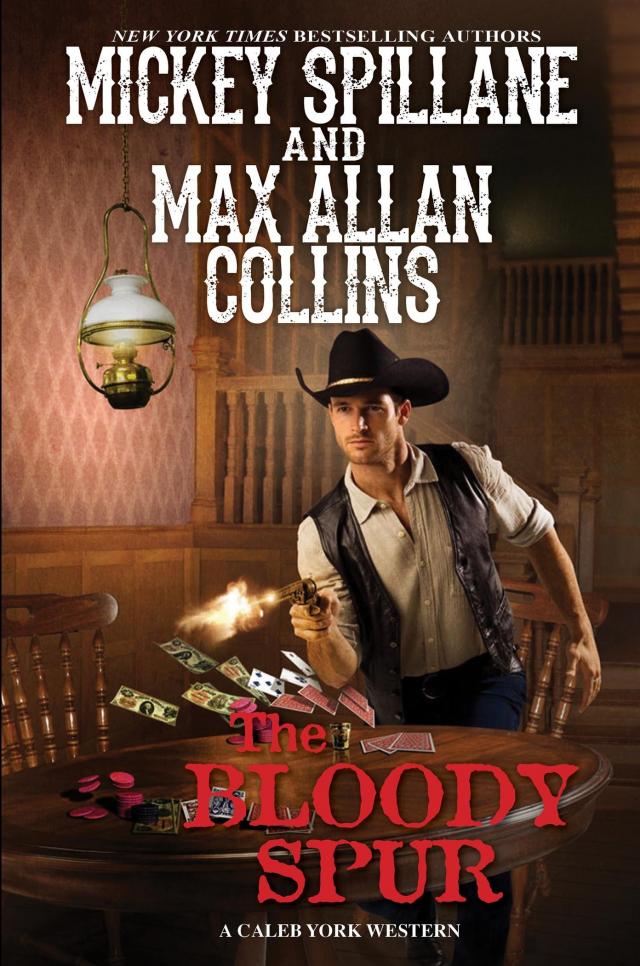
With his left, York upended the table, putting it between him and Hollis, and chips and cards flew everywhere, and the players to his right and left scattered almost as quickly as the .44 in Caleb York’s fist punched three holes through the table in the Preacherman’s general direction.
The thunder of it, the splintering wood, the smoke from the gun, the shrieks of women, the yells from men were everywhere as York, ready to shoot again, kicked his chair away and stepped to his left.
Hollis crawled out from behind and under the upended table, Colt .45 in hand, and rolled onto his side, tried to bring the gun up, hand quavering, then passed out.
The Preacherman’s stunned gunny Trammel backed away, eyes bulging, and bumped into the staircase, going for his own .45 as an afterthought. York sent a shot through the goggle-eyed scarecrow’s right shoulder, rocking him, turning his gun hand a limp thing that could barely hold on to its fingers let alone a weapon, which careened away on the floor somewhere. Then Trammel lost his balance and sat down hard on a stair step and slid down to the next one and sat hard again.
Somewhere an explosion happened, and York glanced to his right to see that the pig-faced Landrum, .45 in hand, had taken a blast from Tulley’s scattergun in the back and was weaving on two pudgy legs that did not have a chance in hell of holding him up. In the next instant the pudgy saddle tramp flopped facedown onto the back of the table, cracking it, the bloody, jagged, gaping hole in his back revealing his spine had indeed been severed.
York had barely heard the screams of the men and women who had been so nearby and were now down on the floor, knocking chairs aside, scrambling away like the frightened animals they’d become. And he did not see Rita Filley watching with big eyes and a hand over her mouth. Nor did he see Hub Wainwright and Yancy Cole coming up with their weapons in hand, ready to back him, if he needed it.
He didn’t.
York went over to the Preacherman, who was on his back now, hat askew, his breathing heavy and bubbling, mouth frothing scarlet, two red holes in his black-vested chest and another in his belly, and plucked the .45 from the dying man’s fingers.
Turned out the ivory handles did have angels carved on them.
York stuffed the gun in his waistband just as Hollis’s eyes fluttered open. Then the killer’s face contorted into something ugly with pain and hate, though it included a terrible grin. A slight bob of the head bid York to lean closer, which he did.
“See you . . . see you in hell,” the Preacherman whispered.
“I don’t remember that one,” York said. “What’s that? Proverbs? Psalms?”
Then the Preacherman’s grin was gone, and so was he.
To his final reward.
CHAPTER FOURTEEN
At just after eight o’clock the next morning, Caleb York entered his jailhouse office to the unmistakable aroma of his deputy’s coffee. Always strong enough to curl the bark off a tree, the stuff had taken some getting used to, but York had come to depend on it to get his day going, after coming straight over from the hotel without taking breakfast yet to check with Tulley and see if anything had come up overnight.
After the shooting at the Victory last night, he expected news this morning.
He got it.
Tulley, a York-designated tin cup of Arbuckles’ in hand, rushed over from his table to set the coffee down and lean in like a friendly madman. The nice shirt of the night before was gone, and the skinny, bowlegged deputy was back to a badge-pinned BVD top and suspenders.
“That feller you shot last night? One ye didn’t kill?”
“I vaguely recall,” York said after braving a sip.
The white-bearded coot thrust out a finger, pointing toward the lockup. “He’s back in the cell next to mine.”
Tulley was not a prisoner—exactly—but did regularly camp out on the cot in a cell, keeping the office manned through the night.
York sipped again. Few things made him wince in pain, but this bitter brew did just that.
“Trammel,” he said.
“Yep. Lafe Trammel. The doc brought him over round midnight, all bandaged up and loopy on laudanum. Trammel, I mean, not the doc. I deposited him in that cell. Slept good. Didn’t bother me none.”
If Tulley’s own lumber-mill-in-action snoring hadn’t woken their guest, then Doc Miller must have administered a pretty good slug of the morphine/alcohol mix that was laudanum.
Tulley pressed a hand on the desk and leaned forward, keeping his voice hushed. “But our guest woke up this mornin’, when the Mexie’s roosters ’cross the way started in to crowin’. He was blubberin’, Sheriff—blubberin’ like a baby.”
“Do tell.”
Tulley jerked a thumb toward the cells. “He’s scared, Sheriff. From them spooky eyes down to his dirty toes. Now, when I checked on him bit ago and give him a walk out to the privy, he got cocky again. All tough talk. ’Bout how he’d make you pay for gunnin’ down his Preacherman pal.”
Another bracing sip. “So what do you make of it, Tulley?”
“Jest braggadocio. The no-good’s scared of what’s goin’ to happen to him. Scared of what you might do to him.”
“Good to know, Tulley. Good to know.”
Tulley nodded, grinning, self-satisfied, then headed back to his table and his own tin cup of eye-opener. When he’d settled in his chair, something came to him, and he called out, “Oh! That envelope there—Ralph Parsons from the telegraph office dropped that by first thing!”
York, who hadn’t noticed it atop a pile of circulars, plucked off the little yellow envelope and had a look inside. As he read, he smiled slowly to himself, then folded and tucked the telegram into his breast pocket. He finished his coffee, then headed back to the cell where Lafe Trammel sat slumped on the edge of his cot, which was chained to the wall.
The lanky gunhand had his right arm in a sling, and his hat was beside him on the blanket, but otherwise he looked the same—bulging eyed and scruffy, though his filthy shirt and bandana and trousers bore some reddish-brown bloodstains. The doc had given him a fresh bandage, a little smaller, for his cheek.
“What the hell charge you holdin’ me for, York?” the prisoner blustered, getting to his feet and coming over to the bars. “After you shot my partner, I was jest meanin’ to protect myself.”
York found a chair and dragged it over. Sat. “You know, Lafe, you have a point. It’s within my power to take you at your word and send you on your way. If I did, you’d have no reason to hang around Trinidad, would you now?”
Had those eyes grown any wider, they’d have fallen out of Trammel’s head and gone rolling around on the floor.
“You got nothin’ in this town I give a good goddamn about! You spring Mrs. Trammel’s baby boy, and the ass end of my horse is the last you’ll see of me!”
York nodded slowly, as if considering the offer. “On the other hand, you’ve been traveling in the company of Alver Hollis and that fellow Landrum, may they both rest in peace or not . . . and of course, Hollis was a known hired gun.”
“Never proved. Never proved.”
“If I were to tell the circuit judge that you drew down on me in a gunfight you and the Preacherman and Landrum started, before witnesses . . . well, the only question is whether you’d get a rope or a prison cell.”
The pop eyes popped. “A rope! I didn’t kill nobody!”
York made a fatalistic click in one cheek. “You drew down on a lawman. We hang you for that in this territory.” York didn’t know if that was true, but he made it sound so.
Trammel hung onto the bars of his cell as if they were all that was holding him up. “Turn me loose, Sheriff. Turn me loose, and you won’t see hide nor hair of me again.”
York was shaking his head glumly. “I can’t have the good folks of Trinidad thinking a man can pull on me and I just let him get away with it.”
Trammel shook the bars, and they rattled some. “I’m the one got shot! I didn’t get away with nothin’!”
“You are the one who got shot,” York granted, pointing a forefinger at the prisoner. “You might have been killed.”
“I might have been!”
“But you weren’t. I didn’t kill you, like I did the Preacherman. Like my deputy did Landrum. What do you make of that, Lafe?”
The goggly eyes drifted. “You . . . you missed?”
York grinned at him. “Really? You know my reputation. Do you really think Caleb York would miss at such close range?”