The bloody spur, p.12
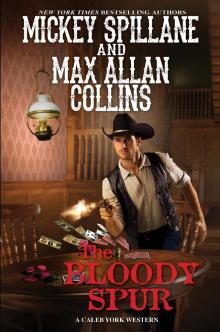
The Bloody Spur,
p.12


Almost irritated again, she asked, “But you are?”
He shook his head once, firmly. “No. Nobody could replace your daddy. But I could be right there beside you, with some helpful words and a strong arm . . . and besides which, these fools that can’t accept a woman like yourself runnin’ things? My presence might smooth things out a bit for ’em.”
She gave him an unblinking gaze. “I intend to run this ranch myself, Uncle Burt.”
“And if you want me to be a part of things, you still would be. I’d be your ramrod here at the ranch, and I don’t mean just on cattle drives. Anyway, I’m only offerin’ this as somethin’ you might consider. You don’t see me as part of the Bar-O, I’ll be more than happy with that little spread you and your daddy picked out for me.”
Of course, Burt O’Malley was the O in Bar-O. . . .
“It’s kind of you, Uncle Burt. But let me think on it some.”
“Naturally.”
She sighed. “Papa dying means I can do what I want where that railroad right of passage goes.”
“That’s so.”
“But that troubles me most of all.”
“Why?”
She mulled it a few moments. Was it all right to talk of this before it became public? Well, it would be out there soon enough....
“Papa was murdered,” she said.
O’Malley lurched forward from where he’d been leaning beside her on the wooden stall frame. Turned to look directly at her. “So he wasn’t thrown.”
“He wasn’t thrown. We just saw something that we were supposed to take that way.”
She shared with O’Malley what she’d overheard when Caleb and Doc Miller, doing their detective work, had been talking over her father’s body.
“Murdered,” O’Malley said, tasting the word and not at all liking the flavor. “Why in hell? Because . . . because of his stand on the spur, you think?”
She sighed. “Must be. No one else had any grudge against him. But if he was killed to clear the path for that branchline, I can’t in good conscience go along with the Santa Fe’s efforts. Doesn’t matter that he and I were on opposite sides of the thing—I have to honor his wishes.”
Nodding slowly, O’Malley asked, “Did you tell anybody that you and your papa were on opposite sides of the spur?”
“No.”
He shrugged. “Then how can you think he was killed to put you in charge of the decision? That’s what you’re sayin’, isn’t it?”
“I guess maybe it is.”
“Could be whoever killed your daddy had some other motive entirely.”
“Possible. Possible.” She drew in a breath deep, let it out slow. “Which means I shouldn’t jump to a decision. I should wait.”
“Wait for what?”
“Well, for one thing, wait for Caleb York to bring in whoever killed my father.”
* * *
Late morning, Caleb York found Trinidad’s modest barrio its usual mix of languid and lively, the dusty path between facing adobes filled with yapping dogs, clucking chickens, and squalling children. The smell of beans frying came through windows where las madres could be glimpsed, their men off doing servile work in town or perhaps tending a small patch of land behind their humble homes.
At the end of this tumbledown lane, the two-story Cantina de Toro Rojo was looking less grand by day, minus music and glowing windows and señoritas for sale, just a bigger adobe version of its neighbors. No horses were tied up out front; no one was coming in or out. The place might have been deserted.
York went through the arched doorless door and found the place empty but for the proprietor, Cesar, who was cleaning blood off the wall in the aftermath of last night’s gunfight, fading the bullfight mural further.
The sweaty, hooded-eyed fat man—halfhearted strands of black hair atop his round head, scraggly bandito mustache, and untucked cream-colored shirt with matching trousers—put down his bucket and tossed a sodden rag into it with a plop.
“You always welcome here, Sheriff,” Cesar said in a weary monotone at odds with his words, “but you know we don’t open till sundown.”
What Cesar said was not strictly true—men from the barrio might wander in here during daylight for a tequila or a beer. But the Red Bull was not the kind of place white men frequented before dark, at least not in Trinidad.
“Just looking for a word, Cesar.”
York crunched across the straw-covered floor and took a seat near the owner and his bucket.
“Those three gringos last night,” York said lazily, arms folded, leaning back, “the little group includin’ the one that messed up your wall . . . what became of them?”
Cesar thought about that. It was clear several answers to that question floated in the fat man’s head, perhaps even an honest one, but he seemed to be having trouble selecting one, like a child given permission to pick out a single piece of candy at Harris Mercantile.
To be helpful, York said, “I checked with the hotel. They aren’t staying there.”
Cesar trundled over and stood before the sheriff. Jerked a thumb skyward. “They upstairs. Three doors on the right side. Each got a girl. Even that Preacherman.”
“I don’t think he’s a real preacher, Cesar. Hear anything out of them this morning yet?”
“No, señor.”
“Where are their horses? The livery?”
Cesar shook his head. “Hitched out back.”
“Any of ’em go out for a ride this morning that you know of?”
“No, señor.”
“Pretty sure of that?”
A shoulder went up and down. “I only here since an hour ago, maybe. Maybe they go and get back before I get here. Who can say?”
Cesar did not live on the premises. He and his wife resided in a former hacienda outside town. Some of his girls lived out there, too—not daughters, his . . . girls.
York said, “You don’t generally let customers spend the night, do you, Cesar?”
An eloquent shrug. “If they got the dinero, sure they can.”
“The Preacherman’s party . . . They had the dinero?”
Cesar nodded. “They each got a room up there.” Then he frowned and shook a scolding finger. “Killing them one at a time, señor, that could take doing.”
“Who said anything about killing them?”
Cesar shrugged again, more matter-of-fact this time. “You go up to arrest them, there be killing, all right.”
“Who says I want to arrest them?”
Cesar frowned curiously. “You just asking about them? Really just asking?”
“Really just asking. They’re what people in my line of work call suspicious characters.”
The proprietor’s eyes widened. “They that, all right. If you go killing or arresting them, Sheriff, do me a favor? Do it in daylight. Killing at night? Bad for business.”
“See what I can do,” York said with a chuckle. He arose, tipped his hat, and left Cesar to his work.
Outside, the sun was making its climb, but the late morning remained brisk. York took a left as he exited the cantina and walked around the side of the building, past the exposed wooden staircase up to where soiled doves entertained their patrons. In back, where there was nothing much but a privy and scrubby land that extended into a desert distance, he found three quarter horses hitched up at the leather-glazed hitch rail, two grays and a buckskin.
None of the horses appeared to have been ridden hard of late. No smell of sweat from their coats or any sign of foam, wet or dry. No saddles. Those were probably upstairs with their owners and their hostesses. He supposed one or more of these animals might have been cooled down and brushed after a morning ride. Certainly, none of them seemed tired out.
A sudden hand settled hard on his shoulder, turned him around, away from the horse, and shoved him. After losing his balance, hitting the ground hard, York found himself looking up at Lafe Trammel, the Preacherman’s tall, skinny sidekick, who had killed a black cowboy the night before, just inside those adobe walls.
“Let’s finish what we started over at the Victory, Sheriff,” the lanky Trammel said, fists balled, shoulders hunched, his grin made even more terrible courtesy of the wide space where his two front teeth presumably once had been.
The looming saddle tramp was in his BVD tops and trousers and bare feet, no weapon at his hip. This put York in a perfect position to kick the idiot in the balls, which was what he did, the hard toe of his boot sinking deep. A howl went up that rivaled any wolf and any moon.
Back on his feet, York appraised his opponent, who was doubled over, even more bowlegged than usual, clutching himself, mouth open, eyes bulging like balloons about to burst.
“Ain’t . . . ain’t fair,” Trammel sputtered.
“Neither is this,” York said and whipped out his Colt. 44 and slapped Trammel across the right cheek with a downward motion, tearing the flesh and leaving a long jagged streak of glistening red behind. The blow dropped the man, who was down on his side on the dusty earth, blubbering like a baby.
Kneeling, York wiped the blood off the barrel of his. 44 on Trammel’s BVD sleeve and slipped it back into its holster. He was barely to his feet when he realized company was coming.
Moving from around the building came the Preacherman, already in his flapping black coat and hat, accompanied by the pudgy Landrum, who, like the fallen Trammel, was in BVD top and trousers and bare feet, no weapon on his hip.
But Alver Hollis, the Preacherman, surely wore one—a Colt Single Action Army .45, nickel plated, ivory gripped. Legend had it an angel was carved out of either side of those grips, but York hadn’t got a close enough look yet to check that out.
Right now the Preacherman’s hand hovered over the low-slung handle as he approached as inexorably as a mountain storm.
Perhaps five feet separated York and Hollis—the buck-toothed, piggy sidekick was hanging back another five or more.
The Preacherman, in his deep, mellow voice, asked, “What have you done to my friend, Sheriff?”
He met the man’s eyes. “He wanted a fair fight. He came to the wrong place.”
Trammel, off to York’s right now, was still down in the dust, whimpering, a pile of limbs tossed here and there.
The Preacherman said, “ ‘An angry person starts fights; a hot-tempered person commits all kinds of sin.’ Proverbs twenty-nine, twenty-two.”
“I know the one about turning the other cheek, and if your friend gets up, encourage him to do so and see what happens. You fellas sleep in?”
Pausing briefly to process that, Hollis said, “We did. We made a rather late, raucous night of it.”
York grinned. “Well, gunning a man down, like your friend here did, that’ll take it out of you. So . . . you weren’t out riding this morning?”
The Preacherman’s hard eyes narrowed. “No. Is there a reason why you’re asking? Is that why you’re poking around our horses?”
“A man was murdered out on the Bar-O range.”
“How tragic. ‘No murderer has eternal life abiding in him. John three, fifteen.’ ”
York turned his grin sideways. “Well, I guess you’d know. This particular murder? Wasn’t really your style.”
“That so?”
“This was a faked accident. A man supposedly throwed off his horse. You like to take care of your victims in public. Like them to go for their guns first, with plenty of eyes on ’em.”
“I have no victims, Sheriff.” The shoulders beneath the black suit coat lifted and lowered. “I live in a dangerous world, however, as do you. And at times I must defend myself.”
York nodded. “You see, that’s why I know you won’t draw on me right now. No one to see it but your two gutter ride-alongs. And their kind of testimony might not stand up when the circuit judge comes around.”
The Preacherman’s smile seemed beneficent. “Why would I want to shoot you, Sheriff? My friend Trammel here . . . Get up! Get on your feet . . . ! He picked a fight, and he lost. ‘For each will have to bear his own load.’ Galatians six-five.”
“You didn’t ask who was killed.”
“I don’t know many folks around these parts. But do pass along my sympathies to the family of the departed. Afraid I don’t read over the dead no more. They’ll need someone local.”
With a nod, the Preacherman gathered his flock, and they departed, no doubt back to the loft where the ladies of the choir awaited them.
CHAPTER TEN
At 8:00 p.m. on a weeknight, the hotel restaurant was sparsely populated, more waiters than diners—a married couple here, a pair of traveling salesmen there. Folks around town tended to take supper earlier than this, but Caleb York figured the gent who’d invited him here was well aware of that fact.
Grover Prescott, in a tan frock coat with a tan-and-black vest and a tiny black bow tie, was seated alone at a table for four in the far corner of the dining room. The hanging kerosene lamps were turned to a muted glow, lending the dark wood, carved chairs, and linen tablecloths of the chamber an elegance not otherwise found in Trinidad, New Mexico.
Prescott stood and gave the approaching York the kind of smile reserved for close friends, thrusting his hand out for the sheriff to shake, which he did. The railroad man’s grip was a tad too tight, showing off some. He was almost as tall as York, a sturdy-looking individual, not quite fat.
York sat, and so did Prescott, who started right in.
“I’m very pleased you agreed to break bread with me, Sheriff,” Prescott said. “I was afraid I’d got off on the wrong foot with you at that Citizens Committee meeting the other day.”
“Not at all,” York said. “I have nothing against a free meal courtesy of the Santa Fe.”
“My understanding is that I misjudged you. That you’ve agreed to cooperate with the town fathers’ efforts to make this branchline a reality.”
York said, “Let’s just say I have an open mind.”
Prescott raised a forefinger. “And a realistic one. You’re too seasoned a westerner not to know that the future is coming. A man can stand by and wait for the future to come find him, and roll over him, or he can embrace it with open arms and be part of a new day.”
Just as at the meeting, everything this slicker said had a practiced sound.
A waiter in black livery arrived to take orders. Prescott read from the menu like a singer from sheet music.
“Let’s start with the chicken consommé, followed by the baked salmon à la Chambord. Then filet of veal à la Périgord, with asparagus, new potatoes, and artichokes. For dessert, blancmange.... Shall I make that two orders of those selections, Sheriff York?”
“No.” His eyes found the waiter’s. “Just bring me a beefsteak, rare, thick. Fried potatoes. Coffee. Black.”
York’s host raised a hand. “Coffee later, perhaps if I can convince you to join me in dessert. For now, waiter, bring us a bottle of your best champagne.”
York went along with that. After all, he was the man’s guest. A bottle arrived, was opened; glasses were filled.
While they waited for the food, Prescott continued with what was clearly a presentation.
“I understand the Citizens Committee has discussed increasing your pay and providing you with suitable lodgings for a man of your stature.”
Somehow York didn’t figure Prescott was referring to his six feet one.
“They have,” York said. “Contingent on the spur coming through.”
Prescott reacted a little to the word contingent. Perhaps he’d figured Caleb York would have the vocabulary of a mountain man.
“You may be in a position,” Prescott said with a sly smile, “to help make that happen.”
York didn’t follow up on that—the chicken consommé arrived before he could. Just to have something to do, the sheriff told the waiter to bring him a cup, too.
When the soup was done and the next course had yet to appear, Prescott said, “You may wonder what I mean when I say you could be helpful in making this branchline a reality.”
“I don’t wonder, really,” York said. “You have heard that Willa Cullen and I are friendly, and have been told that I might be able to sway her toward selling you people the right of passage.”
Prescott, a trifle surprised, merely nodded.
“But surely you’ve also heard,” York said, “that Miss Cullen is already inclined to do business with the Santa Fe. Several members of the Citizens Committee seem well aware that Willa did not support her late daddy in his typically stubborn position.”
His expression suddenly grave, Prescott leaned forward. “Let me say, Sheriff, how terrible the Santa Fe finds the loss of George Cullen, one of the true pioneers of this region.”
“On the other hand,” York said, “his death seems to clear the path for the railroad and its branchline. One might even call it fortuitous.”
Prescott’s small plate of baked salmon à la Chambord came. He began to eat, as if that were preferable to actually confirming what York had said.
York continued. “Problem is, with Old Man Cullen murdered? Miss Cullen may not take kindly to any who might have had a hand in it.”
A forkful of salmon froze between plate and mouth. “Sir, what are you implying?”
York shrugged and leaned back in his hard, fancy chair. “Not implying a damn thing. Just that those with the best motive for the removal of George Cullen are sitting on the Citizens Committee. Well, most of them, anyway.”
Prescott swallowed his bite without taking time to taste it and said, “And now what are you implying, Sheriff York?”
“Again, no implication—just fact. You are a suspect in this crime as much as any of our esteemed town fathers. By the way, where were you this morning, between sunup and, say, ten a.m.?”
Prescott pushed away the half-eaten plate of salmon. “I took breakfast here at the hotel around eight. I’m sure you’d have no trouble finding witnesses. At nine I met with Trinidad’s new bank president, Harold Turner, to discuss the branchline and how it might benefit his business.”
Turner was new in town and had not yet been added to the Citizens Committee, although that seemed inevitable.