The bloody spur, p.16
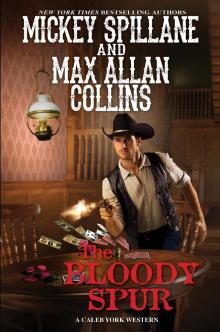
The Bloody Spur,
p.16


“How so?”
York leaned forward. “Well, for one thing, maybe Prescott and the Santa Fe were willing to back him. And he’s also got himself very much on Willa’s good side now. There had been talk of him buying one of the smaller spreads that the Bar-O recently swallowed up. But O’Malley told her he’d much prefer to buy into the Bar-O itself.”
“Do you think he could manipulate her into that?”
“Not with me around.” York’s own quick remark made something stir in the back of his brain. Then he said, “You said we had business. What business is that?”
“We finished here?”
“Sure.”
Parker rose, tossed a half eagle on the table to cover generously the breakfasts and a tip, and they headed out onto the boardwalk.
As if Parker were the one who lived here, York followed him down and across the street. At first York thought they were headed to the newspaper, but the destination turned out to be next door to the Enterprise—the law office of Arlen Curtis.
York followed Parker into the big square single room. No secretary awaited, and only a few chairs at right and left served as a reception area. Much of the central space was taken up by a massive, heavy oaken table, which Curtis—a broad-shouldered, dark-bearded fellow in black who resembled General Grant—used for a desk.
The tabletop’s clutter included stacks of papers, a few thick legal tomes, ink bottles, pens in a drinking glass, and a lion’s-head press for applying seals. The walls were papered an undecorative faint yellow, and the back one bore several roll-down maps and a pigeonhole rack of papers and office supplies, with more legal books stacked on top. Below the rack a fat safe squatted like an eavesdropper.
Curtis stood, and a smile peeked out of the thicket of dark beard. “Right on time, gentlemen,” he said.
York blinked. Right on time?
Two client chairs were waiting. Both Parker and York shook hands with Curtis; then everyone took their seats. The lawyer flipped through several pages of a legal document, found what he was looking for, then looked up pleasantly at his visitors.
“With your permission,” the lawyer said, “I believe we can do without certain formalities.”
“We can?” York asked.
Curtis nodded. “There is only one bequest, Sheriff York, and it concerns you.”
“Bequest? What is this? The reading of a will?”
Curtis flicked another smile. “Well, of course. Hasn’t Mr. Parker made that clear?”
“He has not,” York said, giving the businessman a sharp sideways look.
“Mr. Curtis,” Parker said, sitting forward, “the sheriff and I had to discuss a few things first, which we have done. I didn’t think the purpose of this meeting needed to be one of them. We were in a public place, after all.”
York, frowning, said, “We were talking murder over breakfast, and that didn’t seem to be a concern! What the hell is going on here?”
Thick black eyebrows rose as the lawyer fixed his gaze on the sheriff. “Why, the reading of George Oliver Cullen’s last will and testament, of course. Mr. Parker here is the executor, and you, Mr. York, are the sole beneficiary.”
York sat forward on his hard chair. “Well, that’s absurd. Why would I be the beneficiary of anything? Why isn’t Cullen’s daughter, Willa, here? Surely, she inherits everything!”
Curtis raised a calming hand. “Sheriff York, if you will think back . . . during the difficulties with your late predecessor, Sheriff Harry Gauge, Mr. Cullen transferred all his holdings to his daughter. She does not need to inherit the Bar-O and all its assets, because she already owns them.”
York squinted at the lawyer. “Oh-kay . . . Then why . . . ?”
The lawyer flipped a page of the legal document. “There is a parcel of land, actually several adjacent parcels, that Mr. Cullen has left to you. This property is separate from the Bar-O and its holdings.”
Still squinting, as if hoping to bring the lawyer into focus, York said numbly, “He left me some land.”
“Yes. If you will forgive my speaking out of school, the late Mr. Cullen indicated that he held you in high regard, sir, and that he had hopes that you and his daughter would, well . . . I believe you know what those hopes were. Mr. Cullen wanted to encourage you to maintain residence in this part of the world. And this bequest was his way of trying to accomplish that.”
York leaned back. “What land are we talking about?”
“Half an acre at the east end of town. To the rear of the livery stable.”
“What on earth would I do with that?”
Curtis shrugged. “That would be up to you. But if Trinidad expands, as it seems likely to, with the railroad’s interest in this town? That property could become quite valuable.”
York was shaking his head, as if trying to clear it of cobwebs. “That makes no sense! George Cullen was foursquare against the Santa Fe in this.”
The lawyer shrugged, tossing the document on the table. “This bequest was arranged well before the issue of the railroad spur arose. He felt Trinidad was bound to expand as long as the Bar-O continued to flourish. After all, George Cullen was responsible for this town’s very existence.”
York’s head bobbed back, like he was ducking a blow. “How do you figure that, Counselor?”
Curtis leaned forward, gesturing with an open palm. “The land on which this very town was built was once part of the Bar-O’s holdings. Ask Mr. Parker here. He can confirm as much.”
Bewildered, York glanced at the businessman, who nodded.
Parker said calmly, “The Bar-O land was purchased many years ago from the holder of a Spanish land grant, for virtual pennies. That included the flat stretch on which Trinidad now stands. I was in charge of the effort to build structures here and invite merchants in, selling to them at a loss. We wanted a town nearby. Going twenty-five or thirty miles for supplies was just too much trouble.”
York let out a humorless laugh from deep in his belly. “No wonder the old man was bitter,” he said, “when the Citizens Committee wouldn’t respect his wishes where the Santa Fe was concerned. He’d practically made a gift of the town to them.”
Parker nodded. “But George was wrongheaded in this, nonetheless. Trinidad will wind up just another ghost town if Ellis or Roswell gets the Santa Fe spur.”
York could not argue with that.
Half an hour was spent on paperwork, including the transfer of the deed to the east-of-town property. Hands were again shaken all around, and soon York and Parker were back out on the boardwalk.
Parker paused to light up a cigarette. “Any notions for what you might do with your newfound holdings?”
“None. As far as I’m concerned, it’s an annoyance. The old boy might have asked me if I was interested in being a damn land owner.”
Waving out his match, Parker said, “Most people wouldn’t object to such a burden. But I may have a notion for you. I’ll be in town till tomorrow. We’ll talk again.”
And Parker headed across the street, skirting a buckboard, leaving York behind.
The sheriff, hands on his hips, was feeling flummoxed. But then something that had been said at the café made its way from the back of his brain to the front, and he hustled across the street himself.
York pushed through the door into the telegraph office, where skinny, bespectacled Ralph Parsons was behind the counter.
“Sheriff,” the operator said.
“Mr. Parsons,” the sheriff said.
He filled out a blank form, taking his time, then handed it to the operator.
“Get that right out,” York said.
“Will do, Sheriff. Quite a few words.”
“I’ll pay you for them.”
“The Kansas State Penitentiary! My. This sounds serious.”
“It is, Ralph. Would you like to know how serious?”
“If you think it’s best, Sheriff.”
York leaned across the counter and summoned his nastiest smile. “Should you reveal the contents to anyone, I might have to beat you to within an inch of your life.”
“But . . . you’re the sheriff!”
“That’s right. And that puts you in a difficult spot, Ralph. Because that leaves only Deputy Tulley to arrest me, and I’d fire him first.”
That apparently sank in quickly, because the operator’s fingers were flying even before York had stepped outside.
CHAPTER THIRTEEN
Friday, just before eight o’clock, the Victory was jumping, which was not unusual, and yet the place didn’t seem itself.
As Caleb York pushed through the batwing doors into the imposing saloon with its fancy high tin ceiling and kerosene chandeliers, he found merchants, clerks, menial workers, and cowboys shoulder to shoulder at the long well-polished carved oaken bar at left, attended by a double-size staff of bow-tied, white-shirt-wearing bartenders. At the rear the small dance floor was packed with dance-hall girls and their customers jigging to a lively tune from the barrelhouse piano player. In the central casino area, stations for dice, faro, red dog, and twenty-one were doing business as usual, but roulette, chuck-a-luck, and wheel of fortune were shut down.
At York’s immediate right, tables and chairs normally arranged for the pleasure of drinking men were positioned in clusters to face three round green-felt-topped tables, set well enough apart that the seated spectators might have been viewing three separate theatrical stages lined along the far wall, each with plenty of breathing room.
Those spectator tables and chairs were filled not only with menfolk of Trinidad, but in many cases by their distaff counterparts, as well, gentle creatures not often seen . . . almost never seen . . . on these premises, which were, after all, an exclusive male preserve.
Exclusive, of course, but for owner Rita Filley and her dance-hall girls, whose satin and lace and low bodices were in direct contrast to the calico and gingham and high collars of these rare Victory visitors, women whose lack of Sunday-best apparel said something of their attitudes, although the daily wear they sported was clean and crisp and, one might say, wholesome.
As he wandered in, York couldn’t help but grin, pushing his hat back on his head, though the smile didn’t last long, as he spotted Alver Hollis and his two cronies huddled over by the staircase to Rita’s quarters, near one of the trio of green-felt tables. Spotted around the crowd, as well, were various of the city fathers whom York had not long ago interrogated concerning a murder.
Rita herself, in dark blue satin and black lace but sporting less daring a bodice than usual, was threading through the crowd, speaking to the cowboy and town regulars and then winding through the spectator tables to welcome the women gracing her establishment, and their husbands, too, of course. From the ladies, Rita harvested an array of stiff, polite nods before she spotted York standing near, though not at, the bar.
She came over fluidly and stood with her arms folded across the generous shelf of mostly clad bosom and smiled. “Ready for the big game?”
York nodded. “A private word?”
“Of course.”
He held one of the batwing doors open for her, and she slipped out. He followed. The night was as crisp as the calico and gingham dresses of the Trinidad wives in attendance, and almost as cold.
“I want to thank you,” he said as they stood to one side of the entry, “for providing me with that list of names.”
As promised, she had sent over a complete listing of the eighteen players in the draw-poker tournament. With six seats available at each table, that had been the limit.
“Ten locals,” York said, “including myself and damn near all the town fathers—mayor, druggist, hardware and mercantile store owners, newspaper editor, even the undertaker.”
Shrugging, she asked, “Does that surprise you? Who else in Trinidad could afford the hundred-dollar buy in? And each one has promised, if the winner, to donate the two thousand dollars at stake for the building of a schoolhouse. That’s why you have so many wives gracing my tawdry establishment on this fine night.”
“Makes sense. And I see Raymond Parker is on the list, as well.”
She nodded. “Not a local, but local ties. He’s made the same schoolhouse pledge.”
“Which, I would imagine, can’t be said of the Preacherman and his two choirboys.”
A wry smile appeared on the lush red-rouged lips. “No. And the same is true of the remaining seven. We have several professional gamblers, a couple of small ranchers from around Las Vegas, a saloon owner from Ellis, and, well, you get the idea.”
“But do you?”
She frowned in confusion. “You’re going to have to spell it out, Sheriff. I’m not following you.”
He nodded toward the saloon. “You know how the Preacherman operates. He’s a hired gun, but he always gets away with it because he stages his kills as fair fights . . . fair fights grown out of disagreements, such as if somebody’s been cheating at cards. I know of three men he gunned down in just that manner.”
Still frowning, she shook her head. “The mayor and the others . . . they won’t be armed. You ever remember seeing any of them with a gun on his hip?”
“No. But that won’t matter.”
The dark eyes flashed. “But of course it will!”
“No. I’ll be armed, and so will the Preacherman and his little gang, and some of the other players. Not the city fathers.”
Incredulity colored a smile. “If one of them is his intended victim, what would Alver Hollis do? Gun them down in cold blood?”
“That’s exactly what he’ll do. In at least two previous instances, Hollis was first to his fallen adversary, to bend over and check for vitals . . . and to point out a derringer in the freshly dead man’s vest or coat pocket.”
“Which he claimed the man had reached for.”
He nodded once.
The big brown eyes tightened. “Meaning it was anything but a fair fight. That his opponent . . . his victim . . . was unarmed.”
“And Hollis planted the little gun on each of them, yes.” York’s shrug was slow. “Now, it’s not always been that way. Preacherman’s very fast, they say, and real good at goading a man into going for his gun.”
The blood had drained from her face. “You think he’s going to kill somebody tonight—here at the Victory.”
Another nod. “I think he plans to. That’s why I had you seat me at his table. I want to be right on top of things.”
“Understood.” She sighed deeply, shuddering and not entirely because of the chill. “Now I’m regretting not using Cole and a couple of his professional pals.”
House dealer Yancy Cole would not be dealing and would instead be a kind of roving referee—this would be strictly a player-dealt game, the entrants at each table passing the deck after their deal. That decision had unwittingly paved the way for one player to accuse another of cheating while dealing.
Also, when the players at a table were reduced to two, as the others lost and departed, those top two players would move into seats made available by losers at the other two tables. Eventually, there would be one table, and one winner. And the process might last a very long time, probably longer than the visiting ladies could endure, even at the prospect of a schoolhouse.
“You’re right in thinking,” York told her, “that one of the players here tonight is the Preacherman’s target.”
The pretty eyes were hidden in slits now. “And not any of the out-of-towners.”
“Probably not. Likely one of our city fathers. Possibly Raymond Parker, particularly if the George Cullen murder was the work of the Preacherman, too.”
“I don’t follow.”
He grunted something deep in his belly that wasn’t exactly a laugh. “Cullen’s murder guaranteed his partner and oldest friend, Raymond Parker, would come to town for the services. But I’m not sure how anyone could make the leap that Parker would stay for the poker tourney, as well. Perhaps our friend from Denver was somehow manipulated into participating.”
She shook her head. “I have no way of knowing. He simply came into the Victory the evening of the Cullen burial and asked to be added to the list. I had a seat left, and I gave it to him.”
York looked toward the saloon, from which raucous music could barely be heard under the conversation and laughter.
“Well,” he said, “Hollis is here to kill somebody. So I’ll do my best to stay in the game and follow him to the table where his potential victim is seated.”
“You play well, Caleb, but there’s no guarantee of that.”
“No, there isn’t,” he admitted.
She shivered, hugged her arms to herself. “This is terrible. Some innocent bystander could be shot!”
He rested a gentle hand on her bare shoulder; it was warm, even if she wasn’t.
“Probably not,” he said reassuringly, squeezing her shoulder, then removing his hand. “The Preacherman’s a professional. But that’s a valid concern. And he’s backed up by those other two reprobates, so it is possible bullets could fly.”
“Oh, my God.” It was almost a prayer.
Nodding toward the Victory, he said, “There are still a few audience tables open in there, despite the crowd. Grab one for me, would you, before somebody at the bar comes over and fills it? And move it into the front row?”
“Of course. Why?”
“I’m going to position Tulley with a shotgun on his lap in full view of the players. Encouraging caution on their part. And I’ll have Doc Miller seated, with his medical bag under the table. We’ll be ready for anything.... Here they come now.”
Footsteps on the boardwalk announced the bandy-legged deputy and Doc Miller, his suit looking pressed for once, chugging toward them. Tulley’s scattergun was cradled, and the doctor’s bag was in hand.
A hand on York’s sleeve, Rita asked, “Anything else I can do?”
“Tell Yancy Cole what’s going on. He isn’t wearing a sidearm. Have him sling one on. Were you planning on table service?”
“Yes. I was going to use one of my girls. . . .” She grinned impishly. “Just to sort of rattle the holier-than-thou ladies.”
“Use Hub Wainwright instead. And tell him to have a gun stuck in his belt under his apron.”