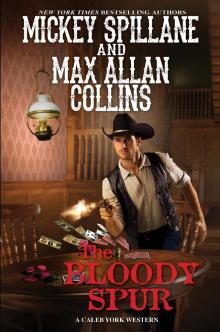
The bloody spur, p.14
The Bloody Spur,
p.14


“I’ll be here,” she said.
CHAPTER ELEVEN
Half a mile out of town, the rough-hewn sign by the roadside said TRINIDAD CEMETERY, but locals called it Boot Hill, inaccurate though that might be for such a flat, scrubby patch of dusty earth overseen by a single stubborn mesquite tree and disrupted by frequent wooden crosses and occasional tombstones. In the distance, the steep cliffs of buttes, with grooves carved vertically by erosion, made long, sorrowful faces as citizens from the nearby town and its environs made their way in buggies and on horseback.
The cemetery’s residents lay close enough together to make graveside services awkward: when a sizable crowd like this morning’s was in attendance, mourners had no choice but to gather in lanes between the previously buried. The morning was cold but still, no wind stirring at all, as if the earth were as dead as the man this group of several hundred in Sunday best was seeing off.
Caleb York had attended several such services at Boot Hill, but never one so well attended by such a variety of citizens. All the Citizens Committee members, standing together, with wives and families—but for the widowers and bachelors—were along one side of the grave. Other respectable townsfolk had assembled to the rear on that same side, while opposite were cowhands from the Bar-O—Whit Murphy right in front—and other spreads, including rival ranchers; they too were in attire reserved for church, weddings and, of course, funerals. Hats were respectfully in hand.
Toward the back, in apparel considerably less gaudy than their working clothes, were Rita Filley, her girls, and the bartending staff. Now and then the young women would receive sharp, reproving glances from wives, while the husbands wouldn’t look in that direction at all. The contingent from the Victory paid no heed to either slight.
At the foot of the grave, in which was Undertaker Perkins’s finest mahogany, brass-fitted casket, stood Willa Cullen, between Burt O’Malley and a tall, distinguished-looking gentleman in his fifties, whom York did not know. The well-barbered, white-haired, white-mustached stranger looked like money in his double-breasted, gray, trimmed-black newmarket coat, double-breasted lighter gray waistcoat, and darker gray trousers, white top hat in hand.
Furthermore, the gent had his arm through Willa’s, who was in a long-sleeved silk mourning dress under a matching black parasol. A relative, perhaps? York couldn’t recall her mentioning anyone who might fit the bill.
Reading words over the deceased, lanky, mutton-chopped Reverend Caldwell from Missionary Baptist was standing just to one side of the temporary wooden marker, which would be replaced by a tombstone, expected within the month from Denver by way of Las Vegas. Toward the rear, under the mesquite, like a vulture and a couple of crows who’d fallen from it, lurked the undertaker in his black stovepipe hat with two Mexican grave diggers with shovels ready to fill in the hole when respects had been paid.
“Blessed are those who mourn,” the reverend was saying, reading from the Good Book, “for they will be comforted.”
The Scripture reading served only to remind York of one person not in attendance: the Preacherman. But then, Alver Hollis had never met George Cullen . . . had he?
Moving through the crowd as inconspicuously as possible, York made his way to Willa. He came up behind the girl and slipped between her and O’Malley, giving the man a nod. She glanced up at York and smiled just a little. He would have liked to hold her hand, but she was clutching that parasol, and, anyway, things hadn’t entirely warmed up between them.
So he settled on just touching her shoulder briefly and giving it a gentle squeeze.
He recalled what Whit Murphy had said last evening at the Victory—she was not crying and showed no signs of having been. No redness, no watery setting for the dark blue eyes. Just a lovely, stoic expression.
Glancing around at the attendees, his gaze drifting across the assembled Citizens Committee, York couldn’t help but think how hypocritical some of them were, mourning—or pretending to—the death of the man who had stood in the way of their potential prosperity. As his eyes took their grim inventory, he noticed how glum Rita’s expression was, her own eyes taking inventory, as well, noting his presence at Willa’s side.
When the service was over, and Willa had tossed in a black-lace-gloved handful of dirt, she turned slowly to look around at the crowd and announce strongly, “We’ll be serving lunch at the Bar-O. I hope you all will be able to join us and share happy memories of my father.”
This was no surprise—an after-funeral meal from the grieving family was quite common, particularly among those better off. So was good-natured gossip and yarn spinning about the departed.
As the crowd dispersed, Willa turned to York and gestured to the distinguished figure at her side.
“Caleb York,” she said, “Raymond L. Parker.”
Thinking, I should have known, York held out a hand and received a firm, warm handshake in return. This was the third partner in the original Bar-O, the one who had sold out to make his fortune elsewhere some years ago.
And make it Parker had, with hotels and banking interests in both Denver and Kansas City.
“Mr. Parker,” York said, “despite the circumstances, it’s good to finally meet you.”
The white-mustached face gave the sheriff as wide a smile as the occasion dared.
Parker said, “George spoke most highly of you, son. And, of course, your storied reputation precedes you.”
“The former honors me,” York said, “but you’d be wise to ignore the latter.”
They began to walk for the waiting buggy, O’Malley taking Willa’s arm, while York and Parker followed, chatting.
York said, “I’m surprised you were able to get here so quickly, sir.”
“Train, stagecoach, and finally a Morgan horse I bought out at the Brentwood Junction crossroads. Cost a pretty penny. But I’d have made the journey on foot, if needs must.”
“Staying at the Bar-O?”
“Uh, no. In town. At the hotel.”
“That’s where I room. Perhaps we can dine in the restaurant there this evening.”
Something tightened around Parker’s eyes, which York couldn’t read. “I’d like that, son, but not this evening. Afraid I have business to attend to. Breakfast tomorrow, perhaps? The café?”
“Certainly.”
Business? What business?
Soon the buggy—O’Malley at the reins and Willa between him and Parker—swung out to the right, in the direction of the Bar-O, falling in with the other buggies, buckboards, and horseback riders on their way to the luncheon.
York was about to mount his black-maned, dappled gray gelding when he realized Rita was at his side.
She was in a black dress trimmed with white, what sometimes was called half mourning, referring to a stage of grief as shown by a widow. Like Willa, Rita had a parasol, though hers was white. Still, seeing the two women dressed so similarly gave York a sudden realization of how much alike they were physically, and how young they both were. The major difference, of course, was Willa’s Nordic coloring and Rita’s half-Latin heritage.
Parasol resting on her shoulder, she aimed her big brown eyes up at him and asked, “So was he here, do you think?”
“Who?”
“The one who killed him.”
York drew in a breath, let it out slow. “Probably.”
“A face in this crowd give anything away?”
Just you, he thought, when you saw me standing beside Willa.
“No,” he said. “Guilt is good at pretending to be sorrow.”
An eyebrow went up. “Someone wasn’t here this morning. Of course, he’s not a citizen.”
“The Preacherman, you mean? And his toadies?”
She nodded. “Have you really ruled him out?”
“Not entirely. There’s a reason why his usual method wouldn’t have worked in this case.”
“What’s that?”
“You can’t goad a blind man into pulling on you.”
She laughed a little. “I suppose you’re right. Old Man Cullen didn’t wear a gun on his hip, but he often had a rifle in hand. That might have been enough to give the Preacherman his out.”
York shook his head. “Not likely. Not with me as sheriff. I’d have gone after him and brought him back slung over a saddle.”
“You mean, you’d just kill him?”
He grinned at her. “I didn’t say that. Probably I’d just have . . . goaded him into going for it.”
She smiled back at him, something impish in it. “You’re very bad for a good man, Caleb York.”
“Or good for a bad man,” he said with a shrug. “You have to fight evil with evil’s means.... Listen, I’m glad you stopped me. I wanted to talk to you. And I figure you won’t be at the luncheon.”
She paused, possibly trying to decide whether or not to take offense. Then the impish smile returned, but with something sad in it now.
“You’re right, Caleb,” she said. “My girls and I and Hub and the rest of the staff, we need to get back and open up the Victory. Otherwise, I’m sure we’d be welcome at the Bar-O.”
Her sarcasm chastised him.
He said, “I might’ve mispoken. Miss Cullen is a pretty open-minded gal.”
Rita’s smirk was almost a kiss. “Not where I’m concerned, I’m afraid. I think she sees me as the competition. Isn’t that silly? Isn’t that just utter foolishness?”
He didn’t know what to say to that, so he said, “Look, uh, about that poker tourney of yours tomorrow night.”
Her eyebrows went up. “What about it? You’re signed on. You have a seat at one of the tables.”
“That’s what I wanted to talk to you about. How many tables will there be?”
She frowned, wondering what this was about. “Just three.”
“Can you make sure I’m seated at the same table as Alver Hollis? And put his two cronies there, too.”
Half a smile joined her frown. “You want to share a table with the Preacherman? Why? Do you need to get some religion?”
“The words that real preacher spoke over George Cullen’s grave are all the religious teaching I need. I just want to make sure, when that tourney starts, that I’m sitting with Hollis and company. Can you handle that?”
She nodded, but her eyes were narrow. “You’re not going to spoil my big event, are you?”
“Not unless the Preacherman already has that in mind. He’s said specifically he’s in town for the big game and will leave shortly thereafter. And I’m convinced he’s in town to kill somebody.”
She was nodding. “So if he hasn’t earned his gunman’s pay by the time the game starts, then . . .”
“Someone in that game is set to die.”
All but a few of the mourners had made their exit, a handful taking the opportunity to have some time at this or that grave of a family member or friend. Undertaker Perkins and his Mexican boys were waiting impatiently beneath the mesquite for the cemetery to clear.
York was up on his gelding, but Rita was still alongside, a hand on the animal’s rump, her pretty, wide-eyed face tilted toward the sheriff.
“I can give you the list of players,” she said. “That might give you an idea of who the Preacherman intends to send to their reward.”
“I was hoping I might ask for that,” he said, damn near grinning. “That could be a big help.”
“I’ll make a copy.”
He reined up the animal. “I’ll send Tulley down to pick it up. Much obliged to you, ma’am.”
Her smile showed small, perfect teeth. “Call me ‘ma’am’ again and I’ll slap that horse on the rump and send you for a good damn ride.”
He chuckled and headed out, the gelding going nice and easy.
* * *
At the Bar-O, just inside and under the log arch bearing the ranch’s brand, a dozen picnic tables borrowed from the church had been set up in the front yard, the main ranch house looking on in the background.
Also looming was the cookhouse, with its hand pump and tin basin–lined bench under an awning-shaded porch; smoke twirled out of the cookhouse chimney like a lazy lariat.
But there was nothing lazy about what went on within the log building, where Harmon, the plump, white-bearded Bar-O cook—who’d been at it since sunup—and several helpers were turning out fried chicken, dumplings, potato salad, and apple pie. Coffee and milk were flowing, too. The seated guests were served by Bar-O cowhands still in their Sunday-style finery, and the air was filled with stories about George Cullen, some amusing, some hair raising, but clearly the residue of a life lived large.
York sat with O’Malley beside him and Parker across the way. Willa had disappeared somewhere, but a seat next to the guest from Denver was reserved for her. The bachelor mayor was just down from them, regaling newspaperman Penniman—his wife and two children nearby—with examples of how generous the late Bar-O owner had been with the town of Trinidad, such as when he had donated the money needed to build Missionary Baptist Church. Doc Miller was down there eating chicken and keeping to himself, ignoring the foofaraw.
Perhaps it was just the mayor dominating the talk that made it so, but York found it interesting and a little unsettling that he hadn’t heard O’Malley and Parker exchange as much as a word. These two old friends, reunited after so many years, seemed to have nothing to say to each other.
Was there something significant about Parker staying at the hotel and not here at the ranch? Where O’Malley was already bunking down?
Suddenly heads were turning, and York swung in that direction himself. There, on the ranch-house porch, stood Willa Cullen, in her familiar red-and-black plaid shirt and denim pants, all that yellow hair braided up, the mourning attire already tucked away.
With all those eyes on her, she merely smiled, chin up a little, and called out, “I’m so pleased you could join us here at the Bar-O! This is exactly the kind of celebration my father would’ve relished!”
Then she came over to the head picnic table and took her seat next to Raymond Parker, who was looking at her with quiet amusement. York was doing the same.
“What?” she asked, glancing up at them from the big dish of potato salad, a heaping spoonful of which she was transferring to her plate.
“People will talk,” York said, mischief in his voice.
Her chin came up even more. “Let them. They need to know that the Bar-O is up and running, and doing just fine.”
“And,” Parker said, “you want them to know who’s in charge.”
Actually, York thought, who’s still in charge.
“If they take me for some helpless young thing,” she said, “I’ll spend all my time fighting off those who want to ride roughshod over me.”
“Heaven help them,” York said.
She blushed but was smiling.
O’Malley wasn’t smiling. If anything, he seemed on the doleful side.
By mid-afternoon, most everybody had collected their rides and gone back off to town. The sporadic caravan of buggies, buckboards, and horses raised a small dust storm down the dirt road.
Parker and Willa were still at their table, talking. O’Malley had moved to the porch, where he sat on a rough-hewn chair probably hammered together by their late host, and puffed away on a cigar.
Another such chair was next to the man, and York took it.
“Mind if I interrupt the festivities,” York said, “to ask a few lawman type of questions?”
“I’d say the festivities are pretty well worn down already,” the big man said, with that easy half smile of his. “And if you have a job to do, by all means do it.”
York nodded around them. “Right here on this porch, night before things went tragic, you were seen arguin’ with the old man. Word is it got right heated.”
“Is that what the word is?”
“It is.”
The dark blue eyes fixed on York unblinkingly. “Who told you that? I don’t remember anybody bein’ around.”
“So you don’t deny the two of you argued?”
The intense eyes stayed right on York. “Answer my question first, Sheriff. Who told you I got into it with ol’ George?”
“Just one of the cowpokes who made a run out to the privy and happened to hear.”
“What did they happen to hear?”
“Not much. Didn’t want to intrude but couldn’t help noticin’, what with voices raised and all. What might they have heard if they hadn’t been so mindful of their manners?”
The dark blue eyes turned away, looked out into the afternoon, where the cleanup of the luncheon was under way. “I wanted to buy back in.”
“Earlier he offered you one of the smaller spreads, to be your own. For the money he’d put aside for you.”
O’Malley was nodding. “And that was generous. And I am still considerin’ that. But I felt . . . and this is what made the old boy get touchy . . . that he shouldn’t leave the Bar-O in the hands of some little snip of a gal.”
“I’d imagine he said Willa wasn’t just ‘some little snip.’ That she was his blood and that he’d raised her to it, and that she was damn near born in a saddle. Words to that effect.”
“Words to that effect.”
York slapped his thigh. “So. Who shoved who?”
O’Malley sat forward in his chair. “Nobody shoved nobody. Maybe a finger got stuck in a chest here and there. I don’t fight with old blind men, particular old blind men that I love. You got that, Caleb York? I loved that old man.”
O’Malley’s finger was raised at York’s chest level, as if about to thump again. The big man realized as much and withdrew it.
O’Malley swallowed thickly, then said, “All I want to do, Sheriff, is help in this investigation of yours. Tell me, please, is there anything I can do?”
York shrugged. “Just stay on here at the ranch and keep an eye on Willa.”
“I can do that.”
“But can you not pressure her in any way—for or against—concerning how she should go where this spur is concerned? And if you see anybody doing that, again whichever side, advise ’em politely to back off.”
“How politely?”
York grinned. “Stoppin’ short of getting yourself sent back to the hoosegow.”