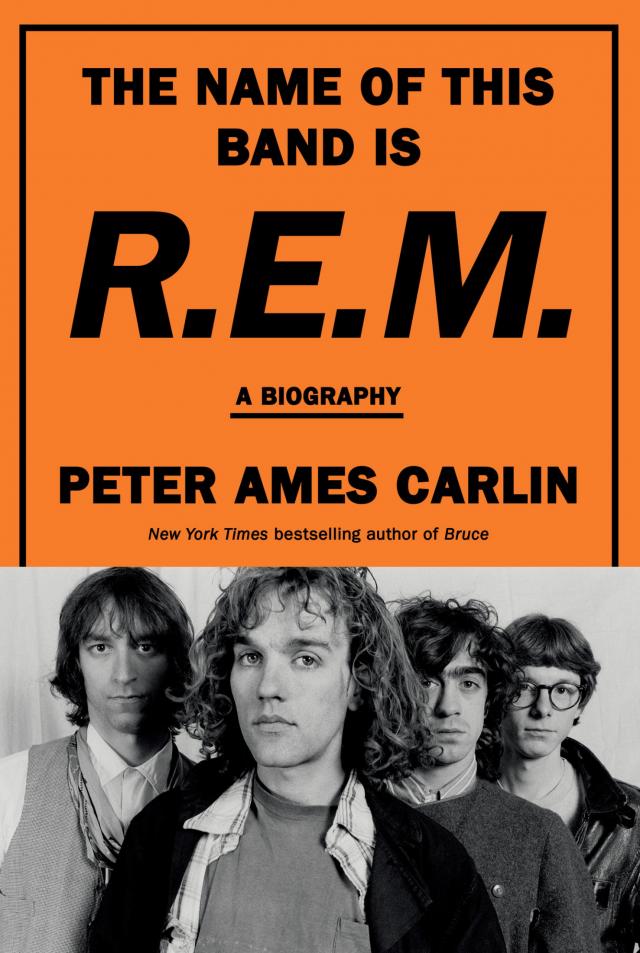
The name of this band is.., p.17
The Name of This Band Is R.E.M.,
p.17


* * *
—
But Tom Smith was far more enraged at R.E.M., and particularly at Michael, his fellow art student and supposed friend to Carol Levy. Michael had been an honorary member of Boat Of and performed with them on several occasions. But the release of Murmur, and R.E.M.’s ceaseless pursuit of even greater success, drove Smith berserk. He printed up a T-shirt, maybe more than one, and sported it around town. The thing seethed with Smith’s rage. A Collective Fist, it snarled, Up M. Stipe’s Ass.
* * *
—
Jimmy Ellison, Vanessa Briscoe’s ex-husband and once the bassist with the Side Effects, now playing with Group 3, wasn’t feeling right. He went to the doctor, got checked out. They performed more tests, the doctors pointed to a shadow on his MRI. The diagnosis was bleak: a brain tumor. Secret stigma, reaping wheel, don’t get caught. The headlights spinning, the machine out of control, spinning in his direction. A few months later Ellison was dead.
* * *
—
This is how it happens. At the end of the year the amassed critics for Rolling Stone reconsidered Steve Pond’s four-star review of Murmur and cranked the volume even higher. Measuring the merits of all the albums released in 1983, which included pop culture epics no less monumental than Michael Jackson’s gajillion-selling Thriller and U2’s acclaimed War and the Police’s multi-platinum apotheosis Synchronicity, they bestowed their Album of the Year title to…Murmur. R.E.M. also took honors for Best New Artist and, again beating out U2 and the Police, Band of the Year.
Secret stigma, reaping wheel.
Part III
This One Goes Out
20
Here We Are
The songs are all in motion. Whirling guitar notes, restless drums, the bass untethered, bouncing all over the scale. The lead vocal here, the supporting vocal there, a third voice somewhere in between, all singing different words, in their own rhythm, telling their own stories but still somehow in perfect, unexpected harmony.
Another Greenville, another Magic Mart…
Highways, rivers, climbing and falling, drifting and churning, currents flowing, the world swept up in a flood tide. It’s all velocity, distance, and isolation.
These rivers of suggestion are driving me away…
The fall of 1983 came at them at top speed. After the Letterman show, in early October, it never stopped. More shows in the Northeast, then on to California, then England, the Netherlands, and France. They got a week off, then back into the van to Charlotte to spend nine days recording songs for their next full-length album with Mitch Easter and Don Dixon. A couple of weeks off for the holidays, then back to Charlotte in January 1984 for another ten days in the studio.
Vacation in Athens is calling me…Heaven is yours where I live.
They got a few weeks in Athens to sleep and reconnect with friends, family, and whatever romantic partners they might still have, though it also featured a lot of musical side projects and guest appearances on other people’s shows. In early March they played a couple of hometown club dates at the Mad Hatter, then hit a few college-centric one-offs, a spring break appearance at the bandshell in Daytona Beach, Florida, then a couple of gigs with the Minneapolis punk trio Hüsker Dü in Boston. Back in Athens a few days later, they spent a day with UGA art professor/painter/filmmaker Jim Herbert shooting video to accompany some of the new songs. With the new album set to be released around the world in early April, they flew to London for two days of interviews and then a month of shows in Europe and the UK.
It’s what I want, hurry and buy…
* * *
—
Writer Anthony DeCurtis was working on a PhD in literature at Emory University when he got his first assignment from Rolling Stone in 1980, reporting on a homecoming (of sorts) concert the B-52’s gave in Atlanta. The magazine assigned a piece about Pylon next, then sent him back to Athens a few months after that to report on the town’s music scene. Michael Lachowski served as his guide for that 1981 trip, showing him the clubs and directing him to the most interesting artists in town. Lachowski also took him to see R.E.M. And though the Pylon bassist made his skepticism about the band clear, calling them a pop band, the writer was floored by what he saw at Tyrone’s O.C.
He became friendly with the band members, and when they went to North Carolina to work on their second album in early 1984, Peter invited DeCurtis to come and hang out. What he saw, DeCurtis says, was like a dream about what recording sessions should be. The new songs were as eccentric as the ones on Chronic Town and Murmur, only catchier and more propulsive than before. The sound in the studio was punchier too, from the crisp tone of Peter’s guitar to the slap of the drums and the pulse of the bass tones. And if Michael’s lyrics were still elliptical, his singing was more pronounced. “It was like the kids had taken over the candy store,” DeCurtis says. “They were doing exactly what they wanted to do with Mitch and Don, and it was so exciting, so inspiring. And it was like Fuck, this is how it should always be! Smart people doing exactly what they want!”[1]
They’d had to be strategic to steer clear of the creative input from I.R.S.’s executives, making certain Jay Boberg didn’t visit the studio until the record was all but finished, then counting on Jefferson Holt and their producers to insulate the band from Boberg’s urging to give the company at least one song that sounded like a hit. Ultimately they could do whatever they wanted. And what they wanted to do was make an album full of crunchy, melodic songs, many of which were designed to subvert every expectation a casual listener might have for their, or anyone’s, modern rock songs.
“Harborcoat,” the opening track, was titled after an imaginary garment or, more likely, a made-up term for protection. Who’s being protected, and why, can only be inferred from a chain of references to statues of Vladimir Lenin, banned books, and feigned belief. That all of this comes in a hummable melody strung across an upbeat, danceable instrumental track makes it all the more difficult to parse. The verses of “7 Chinese Brothers” play out across a tuneful if pensive guitar figure, before blossoming into a ringing chorus that should herald something a lot more glorious, were the lyric not a cryptic description of romantic perfidy crowned by a reference to a Chinese children’s parable about greed. “So. Central Rain (I’m Sorry),” the urgent, fretful song that was still nameless when they debuted it on Late Night with David Letterman, is far more straightforward, a tale of broken communication from a distant lover who finds himself plagued by foul weather and a guilty conscience.
Two of the songs dated back to the band’s earliest days. “Pretty Persuasion” is a group composition from late 1980, a blazer that opens with an electrifying twelve-string guitar riff, hanging two vocal lines (Michael’s melody and a higher harmony by Mike) across another romantic triangle with a bisexual twist: He’s got pretty persuasion / She’s got pretty persuasion. The other oldie, “(Don’t Go Back to) Rockville,” was the solo Mike Mills composition that went all the way back to June 1980. The Athens-set triptych concludes with “Camera,” which memorializes Carol Levy in spare instrumentation, a mournful, hanging melody, and disconnected memories of friendship and grief.
Apart from the plainspoken narrative Mike wrote for “Rockville,” the most direct songs on the album describe the surreality of the band’s real life as working musicians. “Letter Never Sent” and “Little America” are hard-rocking dispatches from the road, while “Second Guessing” takes a not terribly veiled swipe at record company executives and other critics who feel obliged to comment, critique, or otherwise revise the band’s work, ending with a full-throated chorus of Here we are, here we are, a celebration with a defiant subtext: take us or leave us.
* * *
—
They agreed to make a traditional music performance video for “So. Central Rain (I’m Sorry),” with a couple of significant differences: the instrumentalists would mime their parts while standing behind translucent scrims so they would register as shadows, and Michael, who drew a hard line around pretending to sing on television, would record a new vocal as the cameras rolled. They shot it in Reflection Sound Studios during the week of recording in January, with director Howard Libov keeping Michael in tight focus as he sang, eyes shut, his chestnut curls haloed from the backlit scrims. The lighting gave him an angelic look while simultaneously hiding and revealing his bandmates, a visual representation of how R.E.M. was both pursuing and dodging its growing success.
The governing duality in the band is also symbolized on the cover of Reckoning, as they titled their second album, by a two-headed snake. The viper, sketched by Michael and then colored and enhanced by Howard Finster, twists through a dark field filled with the artist’s childlike drawings of faces, houses, and fantastical animals. Homespun and strange, the cover illustration ran counter to the glossy images on nearly every other new album on the shelves. The band found a variety of other ways to subvert expectations, starting with the spine of the LP, which repurposed the old-fashioned File Under indicator (meant for record store clerks who might not know if an album was pop, folk, jazz, or whatever) into File Under Water, a reference to the number of songs with lyrics mentioning rivers, oceans, and so on. The album’s label dispensed with “side one” and “side two” labels, substituting a prankish Left Side/Right Side designation.
The going got even stranger on Jim Herbert’s music video. With no interest in making anything like a traditional MTV clip, Herbert took the band to a sculpture garden built by the Georgia artist Bill Miller and filmed the musicians wandering around the assortment of wind-powered whirligigs. Captured in the fading light of a March afternoon, the band’s images freeze, jump forward, double back, and come in and out of focus through a visual process that allowed Herbert to isolate and manipulate individual frames of film. None of the action was edited to correspond to the music, and because Herbert was accustomed to making films of about twenty minutes, the video covered all the songs on the new album’s opening side. It was titled according to its puckish label designation, Left of Reckoning. And though the film was financed by I.R.S. and packaged as an R.E.M. music video, it’s actually a Jim Herbert art project in which the musicians happen to appear. At a moment when mainstream music videos had the gloss and bounce of big-budget Hollywood movies, it was, to put it lightly, a striking departure.
* * *
—
All of it, the catchy, bright-spirited songs paired with dark, oblique lyrics; the see me/don’t look at me videos; the subversion of the mainstream pop album’s customary look, feel, and most prosaic details (file under…water?) expressed something essential about R.E.M., the performative ambivalence that was crucial to their project, and to their connection to their core followers. It was the same thing Michael had been saying in public since he made himself the focus of the TV news camera at the Rocky Horror show in St. Louis in 1978. A declaration of deviation. A public abandonment of normative principles. Dress up in full, extravagant drag, gaze right into the lens, and shrug it off. We’re all quite normal, really.
Here we are, and this is fine. This is more than fine. And if you can hear this and see this, and you understand what we’re saying, you’re one of us.
It was like a bat signal coming through the clouds. If you don’t belong, you belong here. Even as the band ascended, they knew where they could find their people. When they came to town, the members of R.E.M. still beelined to the campuses, still booked interviews on the college radio stations, still spun their favorite records on the air and then hung around afterward to talk to the staff and anyone else who showed up. About bands, about books, about the best place to get hummus and organic juice near campus, or where they’d find some pitchers of beer and a jukebox loaded with cool records. And if you were with them now, you could be with them later, too. Everyone they met could get on the list for the show and knew where the party would be when it was over. For the fans who couldn’t get to the show, the invitation had already been etched in the vinyl. In the songs that didn’t work like any other songs you’d heard. In the records that came packaged in weird Howard Finster paintings. In the music videos that said music videos are dumb, and fuck music videos.
* * *
—
Released on April 9, 1984, Reckoning climbed to number twenty-seven on the Billboard album chart and sold at a steady clip for the next few months. More significantly, it shot to the top of the CMJ campus airplay charts and dominated the college airwaves for the rest of the year. So while commercial radio and MTV clattered, whirred, and flashed with Michael Jackson, Bruce Springsteen, Prince, Madonna, Dire Straits, and all the other megastars of the supersize mid-1980s, on the left side of the dial, where the low-power stations spoke a spikier, deeper language, the air buzzed R.E.M., R.E.M., R.E.M.
And R.E.M. buzzed back at them. When they were presented with CMJ’s Album of the Year award at the New Music Awards in 1983, they missed the ceremony but sent a video of the four of them singing the theme to the Monkees’ TV show, with new lyrics to mark the occasion. Peter strums an acoustic guitar to start it, Mike and Bill look into the lens from behind him, and Michael sits to his left, a hand held over his face until Peter counts four and they all start to sing in unison: Hey hey, we’re acceptin’ the award you’re givin’ today / Thank you, everybody there at CMJ. Hey, hey! When they won the same award and also Group of the Year in 1984, they sent another video acceptance, only this time it was an elaborately staged silent movie costarring Jefferson Holt, attorney Bertis Downs, and staffers Liz Hammond and Sandra-Lee Phipps, who receive the news at R.E.M.’s office, respond ecstatically via old-fashioned dialogue cards reading Oh My God!, Shazzam!, and so on. Let’s Go Tell The Combo! they cry, then ride bikes across Athens to the band’s rehearsal space, a garage in which the four musicians stand around a microphone like a barbershop quartet, snapping their fingers and singing what the next title card transcribes as Shoop Doo Doo Wah Ooby-Dooby. When the office team delivers the news, each band member mugs his shock and delight, the entire gang stages an ecstatic dance, and the scene fades as awkwardly and cheerfully as any no-budget dormitory gag film would. Just a bunch of college kids having fun while the rest of the world wasn’t looking. Yet.
21
My Soul Doth Magnify the Lord
Nine songs in, Reckoning takes a sharp right turn. The rhythm slows to midtempo and the electric guitar is subbed out for an acoustic strum as a honky-tonk-style piano rolls to center stage. When the words come, Michael sketches the scene with a distinct, and distinctly sad, southern accent. A friend in the bus station, packed up and leaving for some other, less agreeable town. She’s not leaving the singer in the heat of quarrel or for any reason beyond the calendar and circumstance: work, family, something that feels unavoidable to her, if not him. All he knows is that she’s leaving, he’s going to be lonely, and as far as he’s concerned she’s making a terrible mistake. The one-line chorus, which repeats over a simple three-chord pattern, boils all of his feelings down to a simple declarative statement: Don’t go back to Rockville.
“(Don’t Go Back to) Rockville” is an outlier on Reckoning, and not just because it dates back to the spring of 1980, just a few weeks after the party at the church. It’s also a solo composition, written entirely by Mike Mills. He wrote it at the end of the spring term, but it took four months for the song to make it into the band’s set list, and nearly four years for them to put it on an album. The song, like its author, took a little time to grow on people.
* * *
—
Bill Berry hated Mike Mills at first sight. This became one of their favorite stories: how they had been ninth graders in junior high in Macon when they first saw each other, looking from opposite ends of a yawning cultural divide, because Bill, as he recalled later, was an aspiring troublemaker. Fourteen and sarcastic and seething with teenage contempt for school and teachers and all the shit they tell you, man. Bill and his thuggish little buddies wore jeans and T-shirts and slumped in the back row of class, muttering.
Mike Mills, on the other hand, was perched in the front, upright in his seat and dressed smartly in a button-up shirt and pressed trousers. He kept his sandy brown hair combed, even when it flowed over his collar, as per the style of the mid-1970s. He paid attention to his teachers and was unfailingly polite. Yes sir, no ma’am, in that reedy voice of his, the slightest hint of a drawl pulling at his vowels. He was thin as a beanpole and fair-skinned and looked to be about twelve, his cheeks smooth and untroubled by acne. Everything came easily to him, it seemed. Mike made the school honor society during his first year at Northeast High School and was named an alternate in the statewide Governor’s Honors Program held each summer at Wesleyan College. It was just the start of the academic awards that came his way, and Bill, who figured it was smarter not to give a shit about school, could only watch and scoff. Mike might have pretended he didn’t notice, but he didn’t like Bill either. “I thought he was an asshole.”[1]