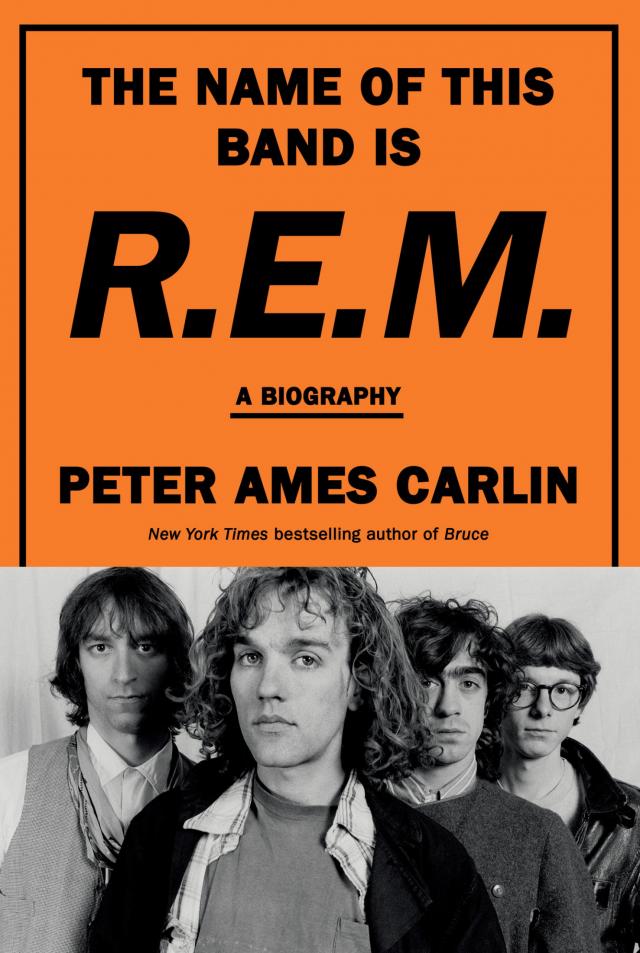
The name of this band is.., p.9
The Name of This Band Is R.E.M.,
p.9


Young Peter spent so much time pawing at his father’s hi-fi, his parents bought him his own record player, an inexpensive close-and-play model that spun the 45 rpm singles that were the core of the pop music industry at the time. His first purchase, Peter said to Milano, was the Beatles’ “A Hard Day’s Night,” in its original picture sleeve. Whenever he had a little pocket money, the first place Peter wanted to go was the neighborhood record store. He developed a schoolboy crush on a woman who worked there, a siren in go-go-boots who steered him away from hit singles by Tom Jones and the Seekers and toward the grittier, cooler likes of the Animals and the Rolling Stones. The pull to music and the early stirrings of romantic longing set the grade schooler’s head spinning. “It was very influential to me that you tied those two things together—that kind of inchoate sexual urge and buying records,” he told Milano. “And I was already obsessed.”[3]
* * *
—
As pop music evolved in the mid- and late 1960s, Peter’s tastes changed too. The Bucks followed the elder Peter’s career to a Simmons factory in Munster, Indiana, where the nighttime skies glowed orange from the steel factories just over the horizon in Gary. The family moved back to California in late 1968, settling in Montrose, a suburb near Glendale, north of Los Angeles. Living in the staid, upper-middle-class suburbs gave the young adolescent an appetite for music that was smarter, and often weirder, than what could be found on the Top 40 stations he’d tuned in to as a boy. When he found a cool record store in Glendale that was staffed entirely by freaky guys with long hair and beards, Peter started hanging out, eavesdropping on their conversations while he flipped through the bins. Determined to spend as much time there as possible, he screwed up his courage and approached the hippie standing behind the register. “I’d do anything to work here,”[4] he declared. The guy thought about it for a bit and offered a deal: They couldn’t pay him, but if Peter wanted to sweep the floors a couple of days a week, they’d give him a discount on anything he wanted to buy. Peter jumped at the chance.
He was thirteen years old. The months he spent at the shop were a revelation, a conduit into a realm of adulthood that was as beguiling as it was mysterious. Music, culture, politics, drugs, sex, history, freedom—all of it was in the record bins. Most of it went over his head; he was only starting to piece it together, sifting for clues on the album covers, listening for the messages encoded in the songs. The longhairs behind the counter nudged him in the right direction. You should check out this band, this new record…This is older, but you can’t understand the new stuff until you hear it…This looks good, but isn’t. That one there, get that. Peter pushed his broom, stayed out of the way, and watched it all go down. The other workers treated him like an adult, even if they made him leave the room when they wanted to smoke a joint. “And I’m like, ‘Wow, man! I heard about that! Can I smoke some pot, too?’ ”[5]
He got hip. When the new thing came, Peter had already read about it, heard it, had bought it, and knew it front to back before it had a chance to become the big new thing. He bought James Taylor’s Sweet Baby James the day it came out in February 1970, seven months before “Fire and Rain” hit the radio. He picked up Black Sabbath’s debut album on its release day too. What he didn’t hear from the hippies he could glean in the magazines and underground newspapers they kept on their racks. Rolling Stone, Crawdaddy, Cheetah, the Los Angeles Free Press. A language, a philosophy, a world, all of it woven into music.
The Bucks upped sticks again in 1971, heading this time to Martin’s Landing, Georgia, a small community within Roswell, Georgia, a suburb of Atlanta. A suburb inside another suburb. This time the crucial record store was farther away, more than ten miles, but Peter made friends with the guy there. He remembered him as a kind of hippie-music Paul Bunyan, close to three hundred pounds, hair to his waist, beard to his chest, perpetually stoned and eager to share. When something caught his ear he’d call the Bucks’ house and urge his young friend to get over there, now. “He’d call me up and say something like [in a conspiratorial whisper], ‘Hey, that new Stones album, Exile on Main Street, it’s coming out tonight,’ ” Peter recalled to Milano, and he’d be out of the house, down to the highway to thumb a ride and risk the abuse a kid with shoulder-length hair could get from a shitkicker driving through the Georgia ’burbs in the dregs of the hippie years, 1972. But Exile, man! He nabbed his copy, took a gander at the literal freaks gawping back among the blurry shots of Mick, Keith, and the others on the cover, and held it tight to his chest as he headed back to his record player at home.
New records, new languages, new worlds. John Coltrane, A Love Supreme. Van Dyke Parks, Song Cycle. Skip Spence, Oar. He held on to the old ones, too: the Beatles, the Monkees, the Beach Boys. It all fit together. Heard in the right moment, in the right mood, it was perfect. Peter would spin his records constantly, listening again and again while he pored over the lyrics, the liner notes and credits, absorbing all the names: the musicians, the producers, the arrangers, the engineers, the second engineers and art directors, the managers and road managers. The recording studios and mixing studios, the names and locations of the theaters where live shows went down. He could imagine being there. He could imagine making the music…wielding the guitar. It was always a guitar in his imagination. Always the guitar.
* * *
—
His younger brother, Ken, was the first to pick one up. He got a nylon-string guitar and started classical guitar lessons, mastering the theory and technique in the formal way required of serious musicians. Pete had no interest in conventional instruction; he didn’t want to listen to someone else telling him how to learn, let alone what to play. If he couldn’t play the music he wanted to hear—rock ’n’ roll—he wanted nothing to do with it. So right around the time he got to high school, Pete got a steel-string guitar, picked up a few songbooks and instructional books with the basic chords and fingering, and set to figuring it out on his own. It was painstaking work, slow, with plenty of flubbed notes, but it came. Chords, melodies, songs. Sometimes he’d get Ken to play with him, and the brothers would gamely try to make some music together. When he got to talking to Joe Craven about music, they discovered how much they had in common. A passion for music, but also a way of thinking. “He was a soft-spoken, quiet guy, but I could look at him and tell his brain was racing,” Craven says. “He was thinking about lots of things. I think he and I in our own ways were both experimenting, liberating ourselves from the tyranny of common sense.”[6]
For all his good cheer and good grades, his student-body-president, lead-in-the-school-play, editor-of-the-yearbook ways, Craven was a breed apart from the other suburban achievers. There was sand on his tongue, a dissonant buzz that led him to the same outsider music Pete loved. Stuff from Frank Zappa and Captain Beefheart that blended form and chaos in ways that could make even the freakiest hippie back away. It was the incongruities that appealed to them. “Pete loved being paradoxical, mixing and matching things mentally and in appearance. I think he enjoyed experimenting with things that were contradictory. Seemingly contradictory emotions and ideas.”[7]
* * *
—
The afternoon music sessions in the basement of Peter’s two-story colonial were free-form. Both boys were new to their instruments, both still learning the fundamental chords and progressions. Neither had played long enough to develop relative pitch, the visceral comprehension that allows you to figure out a song as you listen to it, playing by ear, so they made up their own songs as they went. “We’d try to find a groove and play on it,” Craven says. “A lot of it was instrumental. We played around with singing a little, but most of it was pretty experimental.” Peter focused on the rhythm part, strumming chords while Craven plucked out a melody. Sometimes Ken would play with them, adding another guitar into the mix.
Eventually Pete got an electric guitar, then more instruments found their way into the Bucks’ basement: a bass, amplifiers, a set of drums. A schoolmate named Bobby Jenkins brought over a Farfisa organ and added some keyboard parts. Some days the boys would play a kind of musical chairs, starting on one instrument, riffing for a while, then trading off and starting again. Sometimes they’d find a compelling new groove, sometimes it would collapse into a formless racket. “We did a lot of laughing,” Craven recalls. “Pete had a great laugh. He’d laugh at everything, including himself.”[8]
Eventually they mastered enough real songs to take their guitars to a party or two and play for their friends. That was fun, Craven recalls. Once they even played a few songs at a school assembly. What they played there, what the assembly was about, and how it went no longer feature in his memory, for reasons Craven isn’t sure he understands. Maybe because it was, in Pete’s words, a mess. If so, the problem would have been some combination of nerves and inexperience. They didn’t smoke weed or do any of those other hippie-era drugs, but alcohol, on the other hand, was easily found and widely enjoyed by the teenage set in and around Dunwoody, Georgia. Kids would get a case of beer or raid their parents’ liquor cabinet on a Saturday night and head down to the banks of the Chattahoochee River to get blasted. Or there’d be liquor-soaked parties, drunken racing through the neighborhood streets, endless opportunities to create your own catastrophe. Craven’s parents were divorced, and he envied the domestic stability he saw in the Buck family’s home. Pete didn’t have a lot to say to his dad, but he was a teenage boy, it was the early 1970s—what else was new? Two parents, two kids, quiet evenings at home.
The silence told its own stories. And despite what appeared to be happy and prosperous childhoods, both of the Buck parents had long since learned that some stories were best left untold.
* * *
—
The elder Peter Buck was born in Los Angeles in 1923 to George and Eunice Buck. George was a salesman who died of pneumonia in 1927. This seems to have had a devastating impact on Eunice. She stayed in L.A., but Peter and his elder sister, Marguerite, were sent to a foster family in rural Canada, where they were put to work in the fields. It was a raw and difficult life until, blessedly, Eunice called them back. She’d fallen in love with and married a new husband, a kind and prosperous butcher named Stephen Picelich, who lived in Eagle Rock, a leafy suburb near Pasadena.[9]
Back in the sunshine, Marguerite and Peter prospered. Both were popular and successful at school and in Eagle Rock’s youth societies. Peter was a star tackle on the Eagle Rock High School football team and made the All-Valley squad during the fall of 1941. He spent three years with the U.S. Marines during World War II and saw gruesome action on the island of Bougainville. “We made the initial landings and fought the Japs up there,” he wrote to his parents in late 1943. “We were hit out there one night when we were about four miles in front of our lines…we pulled out in a hurry leaving about ten dead Japs. Earlier when we got hit was the ‘scaredest’ I’ve ever been!” The letter goes on. Hip-deep mud, nonstop rain, incoming mortar fire, outgoing machine gun fire, dense enough to leave the hill knee-deep in dead Japanese soldiers.[10] Later, Peter was injured in a hand grenade attack.[11] He came home after the war and studied journalism at the University of California, Berkeley, on the G.I. Bill and pursued graduate work at the University of Florence, in Italy. He married a hometown girl, Violet Lorenson, a UCLA grad pursuing a master’s degree in history, in 1953.[12]
Violet’s family came with their own extraordinary story. Her father, Harry Lorenson, was a high-ranking captain with the Los Angeles Police Department who was very close to Mayor Fletcher Bowron, whose administration had what you might call a working relationship with the city’s reigning mobster, Mickey Cohen. According to Cohen’s memoir, Mickey Cohen: In My Own Words, the mob boss was called to a meeting with Lorenson, who passed on the mayor’s request that he exact some street justice on an electronics shop owner who had not only filed scores of nuisance suits against the city but also managed to claim ownership of a customer’s home because she had an unpaid repair bill of $8.90. As Cohen wrote in his memoir, “In fact, what Lorenson said is, ‘The Mayor wants this guy banged up so bad that he’s sent to a hospital. But that’s all!’ ”[13]
The mayor arranged to clear the shop owner’s neighborhood of police for an hour the next Saturday. The crooked shop owner was busted up, and all would have gone according to plan if not for a pair of rookie cops who hadn’t gotten the memo about turning a blind eye to the assault. Cohen’s boys were arrested, Lorenson helped spring them before charges could be filed, and when the newspapers got wind of the scheme it all blew up.[14]
Lorenson and two other police officers were suspended from the force and then indicted on criminal charges, launching a scandal that played out in the front pages of all the Los Angeles newspapers for more than a year. But the prosecutors’ case was shaky and Lorenson was eventually cleared of the charges and reinstated to the force. Nevertheless, he retired soon after, and eventually had to sue the city to receive the year of back pay he’d lost when he was suspended.[15]
* * *
—
Peter and Violet’s wedding rated a long feature in the March 5, 1953, edition of the Eagle Rock Sentinel, which noted that the happy couple, following a brief honeymoon in Mexico, would move to Las Vegas, where Peter was working as an investigator for the federal government.[16] Their son Peter was born in L.A. in 1956, and the family moved north to the Bay Area, where the elder Peter started his career with the Simmons Mattress Company. Younger son Ken was born in 1958, and the family stayed put until 1965, when Simmons moved Peter to oversee a factory in Munster, Indiana. The family returned to California in 1968 then, when Peter was promoted to the company’s Atlanta headquarters in 1971, moved to Georgia and into a comfortable two-story house in Martin’s Landing, near the suburb of Roswell.
The elder Peter Buck stayed at Simmons for the rest of his career, which ended with his death, at sixty-two, in 1986. In marked contrast with the exploits he packed into the first twenty-five years of his life, the elder Buck’s passing occasioned no published obituaries anywhere. His son has rarely spoken of his father in public, barely acknowledging either his parents or his relationship with them in any of the hundreds of interviews he has given in the past forty-plus years. None of his bandmates or friends who have discussed their relationship with Peter the musician ever mentioned his family, except in the most abstract way: that his parents, who both had graduate degrees, expected both of their sons to get college degrees, at the very least. Peter, for all his obvious intelligence and endless appetite for books and information of every sort, had no interest in doing that.
Father and son had never had much to talk about. The younger Peter Buck’s rejection of education and his disinterest in continuing the family’s journey from the working class to the educated white-collar sector aggravated his father no end. The boy’s consuming interest in music struck his father as frivolous. Peter’s dedication to his guitar and the discipline with which he pursued it didn’t change the old man’s mind. Neither did the fame, the critical acclaim, or even the financial rewards when they started to accrue. He tried to swallow his disappointment but never really could. Talking to a reporter in 1987, Peter recalled one thing his father had recently told him. “We weren’t really close in a lot of ways, but the last thing he said to me before he died was, ‘Make sure you make a million because there’s nothing else on earth that you are able to do.’ He was trying to kind of say ‘stick with it,’ but he was saying it in the nastiest possible way.”[17]
11
Hey, He Really Knows His Shit!
It was his clothes that Ken Fechtner noticed first. A junior at Emory University, the pre-med student had seen a couple of waves of incoming freshmen at the school. One of the few major colleges in the Southeast to not have a varsity sports program, Emory appealed to the region’s more serious high schoolers. The ones who could already anticipate the postgrad programs that lay beyond their undergraduate years, and the careers that would follow after that. Sure, the place had its share of longhairs and party animals; it was still a college, still full of adolescents freshly liberated from home, parents and all the rules that had held them in place throughout their lives. But none of those eager young subversives had seemed remotely original to Fechtner, until he came across Peter Buck, lurking on the fringe of a dorm party.
The tall, dark-haired boy was positively electric in a pink ruffled tux shirt, a paisley smoking jacket, and red Converse high-tops. In a time and place where thrift-store shopping was not the rage, the guy looked like some kind of color-blind hobo. Fechtner walked up and introduced himself, and once they got to talking, the two students discovered an array of common enthusiasms. Raised near New York City in New Jersey, Fechtner knew all about the shadowy downtown bands like the New York Dolls and the Velvet Underground. Both were into Johnny Burnette and ’50s rockabilly and were also unabashed fans of the ultra-bubblegum Scottish pop stars the Bay City Rollers and the critically beloved, if little-known, power-pop band Big Star. Fechtner didn’t get as much of a charge from the Grateful Dead as Peter did, but he chalked that up to his new friend’s fixation on the guitar.