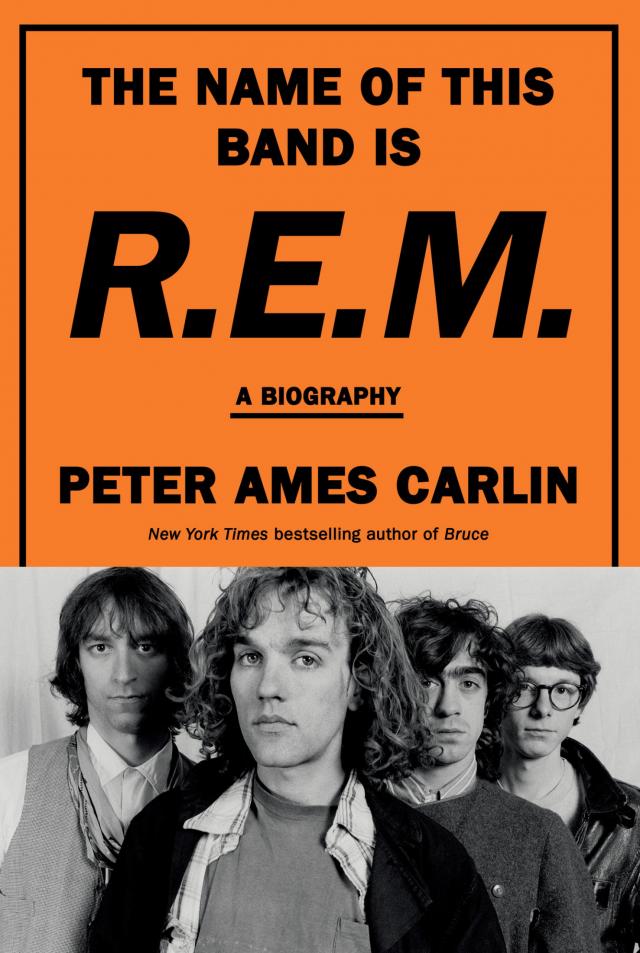
The name of this band is.., p.27
The Name of This Band Is R.E.M.,
p.27


After nearly a decade of serving in a working rock band, the members of R.E.M. had developed rituals and habits to ease their way through the days, weeks, and months of work. At first they had fueled their travels with amphetamines and heroic quantities of beer. They relied on the generosity of bartenders and fans to keep them lubricated and, particularly in the early days, fed with something more than subsistence rations. But success had given them more and better options. Like all entertainers working the bigger halls, they could require concert promoters to supply enough food and beverages to keep the band and their crew satisfied before, during, and after their labors.
The rider on their standard performance contract listed their needs in detail. Along with the assorted cereals, bagels, cream cheese, eggs, bacon, and sausage that greeted the crew in the morning and the pots of fresh coffee, sodas, juices, tea, and spring water that would quench their thirst during the days; the sandwich makings, cold vegetables, and cookies for lunch, and the hot and cold meat-based and vegetarian meals they’d need to serve twenty-five people; and the various waters, sodas, sliced lemons, cough drops, fruit baskets (no grapes!), gourmet cheeses, and other snacks the band members wanted in their dressing rooms, they also required several cases of beer, eight bottles of high-quality wine (to be selected by the production manager), and two liters of Absolut vodka. Often the promoter would add other treats as gifts, champagne or other kinds of liquor, or, on occasion, other, more powdery substances that could make a night feel extra fun and special.
Cocaine and other drugs laced the music industry in the 1980s, and though nobody in R.E.M. was a serious drug abuser, most of them weren’t opposed to a convivial snort, particularly as the months passed and the road twisted into the distance. Vodka drinks, gin and tonics, and glasses of red wine rivaled beer in the dressing rooms, and though they all had their share, Bill more than kept up his end. The drummer’s love for performing and his excitement about the band’s mounting success had been worn down by a growing distaste for travel and the interviews, photo sessions, and meet-and-greets with promoters and local media figures that consumed so much of their time on the road. Long an enthusiastic drinker, Bill knew how much ease he could pour out of the bottles on the liquor table, but as the inside jokes on David Russell’s daily tour bulletins made clear, the alcoholic tide left chaos in its wake. The drummer had a habit of losing his tour credentials and leaving other personal items in his dressing room. And in one of the bulletin’s recurring gags, describing the various members as animals in a bestiary, Bill is designated by the Latin Drummerus hungoverus and noted for “frequenting back lounges and after-hours watering holes til sunrise.”
* * *
—
The Green tour made one last swing through the Southwest in the fall before returning to the Southeast for two final weeks of shows, often visiting the university towns of North Carolina, Tennessee, Virginia, and Georgia they had first played during the earliest forays in 1980 and 1981. The tour made its final bow in Bill and Mike’s hometown of Macon on November 11, performing a not quite sold-out show at the city’s Coliseum sports arena. It was a particularly sweet night for the Macon boys, who had grown up seeing their heroes playing in the same venue. R.E.M.’s rhythm section stopped by the mayor’s office before the show, where they were presented with a ceremonial key to the city. The band played one last show at the Fox Theatre, in Atlanta, a fundraiser for a local environmental group, then packed up their gear and went their separate ways, with a long decade behind them and no particular plans for the 1990s.
32
The Fever
Home in Athens during a short break between tour legs earlier that year, at the start of May 1989, Bill Berry went to his garden to unwind. He and his wife, Mari, were renovating a vintage house they’d bought in the city’s historic Cobbham district, and the place came with grounds that had become overgrown. Always happy to do physical work outside, Bill spent an afternoon cutting back a wisteria bush. It was sweaty work, whacking away at the voluminous growth and then wrestling the cut tendrils into mounds that could be collected and taken away. The drummer was worn out at the end of the day, but the soft spring air and the tang of fresh greenery had restored him, and when he left for Europe a few days later his eyes were noticeably brighter than they’d been when he arrived. This would change.
Picking up their work again in Germany, on May 8 the band performed “Stand” on a TV show, then went to Düsseldorf to start the next stretch of concerts. The ease Bill had found in his garden dissolved into a headache somewhere in Düsseldorf, and his whole body hurt by the start of the May 9 show. But he powered through, then went to his room to try to sleep off whatever was ailing him. It didn’t work. By the time Jefferson Holt went to check on him in the morning, the drummer’s fever had spiked above 103 and he was seeing things that weren’t actually in the room. Holt summoned a doctor, who promptly had Bill transported to a hospital. The next night’s show in Munich was canceled, and when the drummer’s fever continued to burn, the next two shows fell off the schedule too.
Nothing worked. It started to get scary, particularly when Bill broke out in a rash that covered his chest and face in red spots. The German doctors were mystified, but when Michael called home to fret to his parents, his dad figured it out immediately. A high fever and a blotchy rash? That sounded like Rocky Mountain spotted fever, an infection carried by ticks, which, while common in the United States and the wisteria bushes of Athens, Georgia, were unheard of in Europe. This explained the doctors’ confusion. The band flew a specialist to Germany, and when Lieutenant Colonel Stipe’s diagnosis proved correct, the doctors pumped the drummer full of doxycycline. The antibiotics knocked his fever back in a matter of hours, and though he was still visibly spotted a week later, Bill was determined to get back onstage in time for the Pinkpop Festival in the Netherlands on May 15.
“That was so important to him, because he hated to disappoint people,” then-wife Mari says.[1] It was what kept Bill on the road, at the interview sessions, and in front of the cameras, even when he would rather have been anywhere else. “When they went onstage and played, he loved it,” Bill’s brother Don says. “But that’s only a small percentage of the time. You have all this other stuff to do, and as you become more famous you have less control over your life. You’re living by a schedule and timetable and soundchecks and being on the bus at the right time. I think that was what got him to thinking about giving it up.”[2]
But how could he give up the only job he’d ever wanted to do?
* * *
—
Born in Duluth, Minnesota, on July 31, 1958, William Thomas Berry was the fifth and last child born to Donald Berry, an accountant for the Lippmann Engineering Works, and Jane, who ran the household and cared for the three sons and two daughters they’d started having soon after Donald returned from his World War II service. The four eldest, James, Jane, Don, and Katheryn, came between 1947 and 1952, Bill making his belated arrival six years later. Donald was promoted to plant manager in 1960 and the family moved to Wauwatosa, a suburb of Milwaukee. In 1967 a career shift sent the Berrys to Sandusky, Ohio, where they stayed until another transfer moved Donald and his family to Macon, Georgia, in 1972. The older kids had moved away by then, leaving their youngest sibling to spend his adolescence as an only child. He was fourteen years old, but the older kids’ interests, and record collections, had made a mark on him.
Both parents had tilted toward music, if only for fun. Donald liked to entertain the kids by singing silly songs he’d learned in the Army, and Jane played piano, although her repertoire was limited to a few pieces she’d learned while taking lessons as a girl. The older kids took up instruments in school, but none pursued them with the drive Bill showed for the drums when he first picked up the sticks as a fourth grader in 1967. He’d also developed a serious enthusiasm for the pop music he heard coming from his older siblings’ radios and the family stereo. The Beatles were everyone’s favorites, and Don came home with albums by late ’60s heroes ranging from Jimi Hendrix to Jefferson Airplane, the Rolling Stones, the MC5, and Frank Zappa. Bill loved the Beatles the most, and when he found a ukulele around the house, he fiddled with it until he could approximate the chords in the songs and play along.
* * *
—
It all began with an announcement from the principal of his grade school: any student who wanted to join the school band should come to the lunchroom right now. Bill was in fourth grade, maybe ten years old. He’d never thought about taking up a band instrument, but if it was going to get him out of class, he was definitely interested. With a roomful of instruments in front of him, Bill reached for the first one that caught his eye.
“I thought, I’ve got to play something, why not the drums?” he recalled.[3] He learned the rudiments of rhythm at school, then got his parents to rent him a kit so he could play rock ’n’ roll. The more he learned, the more he wanted to know, and he’d spend hours in the garage, pounding away. Music got under his skin. A catchy melody would stick in his mind and follow him around all day. He developed a deep connection to the Stax artists coming out of Memphis, and all the great rhythm-and-blues songs of the era. Anything with a good rhythm could get him going.
Relocated to Macon at the start of ninth grade, Bill felt drawn to the outsiders, the tough-talking guys who sat in the back row of class and snuck out to the parking lot to smoke cigarettes at lunch. He’d ride around with them on the weekends, guzzling beer and passing joints in the back of someone’s car. Later he liked to talk about himself as one of the bad kids, sarcastic, two-fisted, and always ready for trouble. His heavy brows and hooded eyes helped give him a sinister appearance, and Bill could turn his glare on another kid who aroused his ire, like that geeky Mike Mills. But it was almost entirely an act. “He smoked weed with the rest of us, but Bill was never a bad kind of guy,” Gevin Lindsay says. “He was friendly and nice.”[4]
He enjoyed a warm relationship with his dad, playing golf with him at the country club and spending long afternoons together in a fishing boat, poles in hand, lines trailing across the surface of a lake. And if Bill’s grades left something to be desired, he was obviously smart and had a good work ethic, mowing lawns so he could buy more and better drums and then, when he was old enough to drive, a beat-up old Volkswagen Bug. The thing had a broken starter, and he had to park it on hills so he could get a rolling start and pop the clutch, but he could fit his drums inside. Once he started jamming with other guys, it was good to be able to get around.
Soon music, and playing in a band, became the primary driver of Bill’s life. The jam session in the Mills family basement that cemented his new friendship with Mike; the connection to David Wilson and Alan Ingley, the other two members of Shadowfax; the hours of rehearsals, of listening to records, the talking about what they heard and what they wanted to play. His parents could only shake their heads. “Oh we had fits, you know, about the noise and the kids that were coming around,” Bill’s mother, Jane, told the Macon Telegraph and News in 1984. “We just thought it was a passing thing, and he’d go on to something else after a while. But it was the only thing that held his interest.”[5]
And not just as a boyish fantasy. Macon’s music scene was incredibly rich and, thanks to the locally based Capricorn Records label and its star act the Allman Brothers Band, a lot of the action was taking place just around the corner. They’d met and hung out with some of their crowd and could talk to them about how a professional band went about its business. It was exciting and spoke to both sides of Bill’s character: the music-besotted kid who wanted to rock out all night long and the practical kid who sometimes begged off rehearsals so he could tend to his lawn mowing clients.
When he decided to take time off after high school, Bill hustled his way into his job at the offices of Paragon Booking and came away a few months later with a working knowledge of the concert industry. When he first got to the University of Georgia, he figured he’d pursue his interest by going to law school and learning entertainment law. But when the band, against all odds, started to gain momentum, he not only quit school but also insisted that the two other students in R.E.M. do the same. Mike didn’t hesitate, but Michael, who truly enjoyed his art studies, had to think about it a little longer. Bill made it clear that the band’s future depended on what he decided: if the singer couldn’t commit himself entirely to the band, Bill wasn’t going to stick around. “Once Bill gets an idea in his head, he’s going to go for it. He’s not going to waste his time,” Mari says. “He’s like, ‘This is what I want, and this is what we need to do.’ He’s very determined.”[6]
* * *
—
In the weeks after the 1989 tour ended, Bill felt shattered. His summertime bout with Rocky Mountain fever had been terrifying; the days of feverish hallucinations cast a shadow across his memory like a near-death experience. He’d hated being responsible for the canceled shows and had left the hospital for the Netherlands against his doctors’ strong recommendation, risking his recovery by coming back as quickly as he did. Then the underwhelming crowds they’d drawn in the autumn made him wonder what the point of it all had been.
The drinking he’d done had made it even more toxic. The beers and pills in the early years had been one thing, but now there were those bottles of Absolut greeting them everywhere they went. And everywhere they went, he’d been eager to crack them open, to pour himself one drink to get going, another to keep it moving, to top that one off when it ran low, and to pour another to come down from the show at the end of the evening. Drummerus hungoverus was funny when they were all a gang on the road, but when he was home it was a misery.
What was he doing with his life? After nearly a decade with R.E.M., almost all of it spent away from home, either bouncing from town to town on one of their endless tours or off in a recording studio spending ten to sixteen hours a day trying to make music that felt at least a little bit original, he’d washed up at home with a wife he loved but hadn’t really gotten a chance to know.
The start of the new year, and the new decade it brought in with it, gave Bill a sense of resolve. He stopped drinking. Maybe not forever, he thought, but certainly for the foreseeable future. Almost immediately he felt unburdened. “Things started coming into focus,” he said. “I’d been married since 1986 but it wasn’t really a marriage until I got off the road and realized that I have other attributes apart from being a reasonably OK drummer with a very good group. I started respecting myself more and things just took care of themselves.”[7]
Another thing he could take care of was how he and R.E.M. were going to spend their time in the next year or two. As far as he was concerned, they’d done quite enough touring. They were done, he said, “beating our heads against the wall.”[8] Instead, they needed to focus on the artistry that mattered the most: writing songs and making records. They’d just have to find a new way to promote them. And if taking a break from touring meant settling for smaller sales, that was fine.
33
A Breath, This Song
As 1990 dawned, the four members of R.E.M. had achieved something like rock ’n’ roll grace. Almost exactly ten years after they had first gathered to play some rock ’n’ roll songs at St. Mary’s Church, they were, by every definition, rock stars. Green had sold more than two million copies, more than twice what Document had sold. Their music played on radio stations all over the world. Their videos could be seen on MTV, now available all across the globe, multiple times a day. They weren’t the biggest stars in the music galaxy; “Pop Song 89,” released as the follow-up to the smash “Stand” single, had stalled at number eighty-nine (numerical irony noted) on Billboard’s singles chart, while “Get Up,” released a few months later, didn’t even sell enough copies to chart. But it didn’t matter. Even with the underwhelming audiences during the final swing through the United States, their year of touring arenas had been enormously successful, clearing millions of dollars in profits. Now all four of them could go anywhere, do anything, and spend their time working on, or not working on, anything that captured their interest. What they did, less than a week into the new decade, was get together to write new songs.
They had set up their instruments, amplifiers, and other gear in a comfortable rehearsal space on the second floor of a building on Clayton Street in downtown Athens. It was a perfect clubhouse for four young men who liked nothing more than listening to, thinking about, writing, and playing music. It had always been one of their greatest strengths as a unit, that they’d always been industrious, always felt most comfortable hewing to a consistent regimen. So once they got going on January 6, 1990, they fell into something like a traditional work schedule: getting together five days a week in Clayton Street, taking turns playing the riffs and chord progressions they’d come up with, working together to weave them into verses and choruses until they started to feel like songs. When they had a handful of new tunes, they’d head to John Keane’s recording studio to turn the latest constructions into demos. It was easygoing and fun, with no set schedule and no deadline, no need to worry about their income or what the folks at the record company thought. It was, in short, a dream. If you could have gone back to January 1980 and asked young Bill, Peter, Mike, and Michael what they’d like to be doing with their days in ten years…well, here it was.
* * *
—
This utopian breeze didn’t just blow through the windows of R.E.M.’s workroom. All around the world, an unexpected series of developments had given the first days of the 1990s a more hopeful outlook than any time since the early 1960s, when the newly inaugurated president, John F. Kennedy, called his moment the New Frontier. The optimism was, as usual, fleeting. In the spring of 1989, an extended student protest in China’s Tiananmen Square spurred a vast pro-democracy movement that was ultimately put down by the communist government, but not before it inspired similar action from oppressed people all around the world, and some of these rebellions proved far more successful.