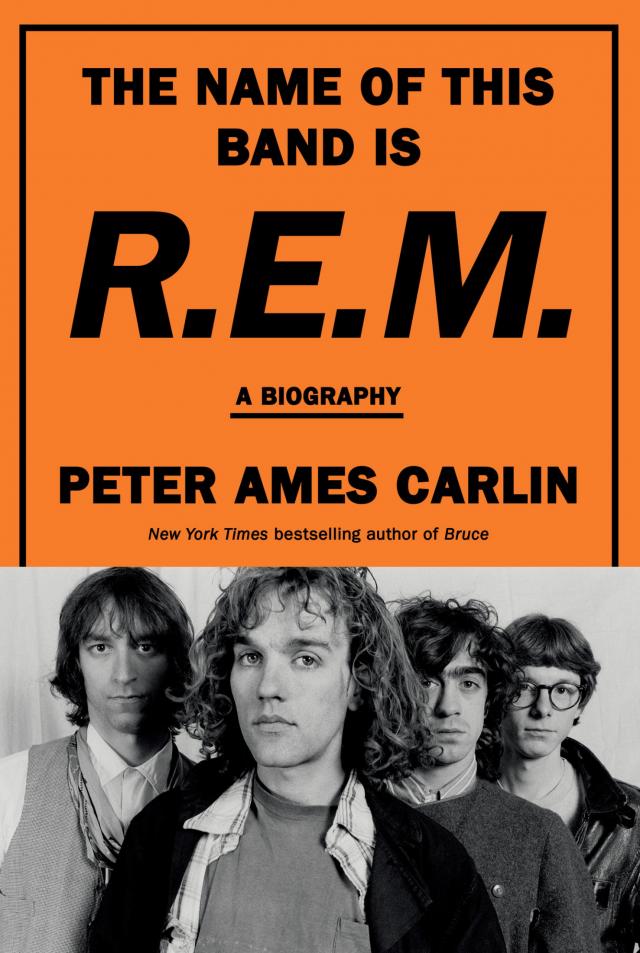
The name of this band is.., p.37
The Name of This Band Is R.E.M.,
p.37


* * *
—
A woman at R.E.M.’s office in Athens said Jefferson Holt, her boss, had propositioned her. She didn’t make an official complaint with the state’s equal opportunity office or file a lawsuit, but she did complain to the band members, who declared themselves shocked and launched a monthslong investigation. Holt denied the charge, heatedly and repeatedly, but apparently there had been a relationship between the two. When the investigation was completed, his association with R.E.M. ended. In mid-June, Holt and the band announced a separation agreement that involved quite a bit of money and extremely strict restrictions on any of them ever uttering a word about what had happened between the band and its former manager.
What’s more, the parties were also forbidden from saying anything critical about the other in public, or else they’d face hefty civil penalties. But someone leaked something to the Los Angeles Times in June, resulting in a story headlined, “R.E.M.’s Former Manager Denies Allegations of Sex Harassment.” Hmm. Who could have done the leaking? And why? Asked for a comment, the band released this statement: “The reasons for this decision and terms of the termination are private and confidential, and no further discussion of these matters will be made by any of the parties.” Holt said this: “I’ve become more interested in other things in life and wanted to spend more time pursuing those interests. I’m happier than I have been in a long time.”[8]
It was not an amicable parting. From that point forward, no member of R.E.M. has uttered Holt’s name in public, even when describing long-ago events in which he played a significant, even crucial, role. Recounting their past, they merely pretend the manager they treated, and listed on their albums, as a fifth band member never existed. When they dusted off “Little America” in live shows a decade after Holt’s departure, Michael changed the concluding line, Jefferson, I think we’re lost to Washington, I think we’re lost. Revisionist history. A quarter-century after the rupture, the anger is still palpable. When his name comes up in conversation with anyone from R.E.M., their faces grow steely and their eyes narrow. Holt refers to them only as “the band that cannot be named,” this in part because of the limitations imposed on all of them in the financial agreement.
The same limitations make it impossible to know for certain if sexual harassment, or even just sexualizing what was supposed to be a work environment, was entirely to blame for the rupture between R.E.M. and their manager. Assuming it played a significant role in what was a jarring disruption to the band’s operations, it would stand as the most progressive act, creative or otherwise, R.E.M. ever made. In an era in which men, and not just the ones in the decadent, male-dominated world of rock ’n’ roll, commonly treated the workplace as a sexual game farm in which employees served as quarry, such antics were tolerated, even encouraged. But the members of R.E.M., no matter their own indulgences, apparently drew a hard line around their office and the women who worked there.
42
…And Where It Got Us
While the band was putting the final touches on New Adventures in Hi-Fi, the delightful name they gave their new album, Bertis Downs prepared to negotiate a new contract with the executive team at Warner Bros. Records. All the chips were on R.E.M.’s side of the table, and not just because the band had sold so many more records than anyone had ever expected when they signed their first contract, in 1988. Due to a shift in management at the record company’s corporate parent, Time Warner, Warner Bros.’s longtime chairman Mo Ostin and company president Lenny Waronker had both resigned in 1994, ending decades of stability at the record company. A series of ill-advised decisions at the corporate headquarters in New York kept the record company in chaos for nearly two years and threw its future in doubt. When Warner Bros.’ reins were finally handed to Russ Thyret, a roundly admired holdover from the Ostin-Waronker days, his team identified R.E.M. as the most prominent link to the company’s golden era. Keeping the band at the label became the company’s top priority.
Downs, working under the catchall title of adviser and thus no longer serving as the band’s attorney, hired an outside counsel to help work through the terms. They spoke to representatives of other companies too, including Mo Ostin and Lenny Waronker, who were now running DreamWorks Records, the musical arm of the entertainment complex cofounded by Steven Spielberg, David Geffen, and Jeffrey Katzenberg. Whether those were serious negotiations or merely ploys to turn up the heat on their current label is unclear.
The talks with Warner Bros. shifted into higher gear in mid-August. The principals set up in a hotel in Orange County, not far from where the annual sales convention of Warner-Elektra-Atlantic, the umbrella organization for Time Warner’s many record companies, was taking place. The convention loomed over the Warner team and created a deadline. “Our goal was to reach an agreement and come back and tell the assembled sales reps at WEA that we had just re-signed them,” says David Altschul, then the head of business affairs for Warner Bros. Records.[1] After two years of turmoil, the executives were desperate to bring some good news to their sales force, evidence that the company’s future could still be as bright as its past. As the clock ticked, the numbers got larger. When they reached toward the astronomical, the mood at the R.E.M. end of the negotiating table brightened. Then the skies opened and the sun broke through.
In the midst of the convention’s Saturday afternoon session, a special announcement was made. The members of R.E.M. had a message for everyone. Bertis Downs strolled onstage holding a piece of paper and began to read. They had all done so much good work together in the past few years, he recited. Let’s keep it going! R.E.M. was staying with Warner Bros. The WEA salespeople jumped to their feet and cheered. Some were said to have wept for joy. The reactions of the members of R.E.M. went unrecorded, but a few tears might not have been surprising. The deal they had reached was the biggest in the history of the recording industry, worth an estimated $80 million. That top-line number might have been aspirational—a calculation based on potential royalties assuming the next few records netted the astronomical sales numbers the band had achieved on their previous five records. But the guaranteed payments for each album would still be immense, and the potential for sales in the multimillions still seemed overwhelming. No matter what happened, R.E.M., whose members had been floating in a flood tide of record royalties, publishing royalties, and tour proceeds for close to a decade already, would earn, by the most conservative estimates, a shit-ton of money.
* * *
—
The blowback started before the new record came out, before the details of the rather astonishing new contract they signed with Warner Bros. Records had been finalized. But after sixteen years together, throughout which they had cultivated a nearly unblemished reputation as the hippest, most artistically pure, and yet refreshingly nice guys in rock ’n’ roll, perhaps a reckoning was overdue.
* * *
—
The Los Angeles Times published its anonymous leak-sourced story about the reasons for Holt’s departure in late June, just as the British music magazine Mojo was gearing up to publish a cover story on the band. Though Mojo had been around for only a few years, the size of the magazine’s readership—and its reputation for publishing thoughtful stories about art-forward acts—should have made the band happy to speak to its reporter. But the entire R.E.M. organization was being jolted by the Holt investigation just when the Mojo writer, Barney Hoskyns, came looking for interviews. When they sent him away, Hoskyns turned to other sources for information. His story, published on the magazine’s cover with the headline “R.E.M.: The Final Act?,” relied on anonymous quotes and a generous amount of speculation to posit, among other things, that the band might well break up soon.
It wasn’t an entirely far-fetched proposition. As Hoskyns detailed, the rigors of the Monster tour had sent three-quarters of the band to the hospital. The four members had scattered across the country, only a few years after Mike said their proximity was crucial and that any one of them moving away from Athens would be “destructive.” And then there was Holt’s departure, which at least some of the nameless insiders considered terribly unfair, given that the band was about to enter into what would almost certainly be an enormous new recording contract. And hadn’t they said they would play one final concert on December 31, 1999, and break up just as the second hand swept the world into the twenty-first century? Yes, they had. Jokingly, but still. Only three years earlier, Mike had more or less confirmed that they were contemplating packing it in: “R.E.M. can’t last forever…You get too old for that kind of thing.”[2] Still, Hoskyns included a generous number of quotes from his insiders about how strong the new album was, along with his own assertion that the musicians “remain resolutely idealistic after all these years—still rooted in a punk-rock aesthetic that would forbid them turning into undignified breadheads.”
What Hoskyns and his Mojo editors didn’t know, or didn’t care about, was how the article would be received by the band and its record company. Not very well, as it turned out. When Mojo editor Mat Snow heard from Warner publicist Barbara Charone, she was, in his words, “incandescent.”[3] Confronting Snow with the full rage of Warner Bros. Records, she pulled all of the company’s advertisements from the magazine and promised that no member of R.E.M. would ever again utter a word to a reporter from Mojo. Snow was mostly unperturbed by the threats. Mojo had not only a sizable readership, but one whose core of educated, prosperous thirty-to-forty-five-year-olds amounted to ground zero of the record company’s target demographic. Warner Bros. couldn’t spurn them for long without hurting the prospects of their other artists. But as Snow told the American music writer Jim DeRogatis, it was a sobering glimpse into a band that had become so big and powerful, it had come to “see press merely as an aspect of promotion as opposed to what you might call journalism.”[4]
* * *
—
Meanwhile, DeRogatis, a Chicago-based writer, was working on his own story for Request, a music magazine published by the Musicland record store chain. He was in the thick of it that summer when news broke that R.E.M. was about to become the highest-paid recording act in the history of the music business. To DeRogatis, who had followed the band’s career since they were skinny outsiders traveling in a beat-up van, this was jarring news indeed.
Ushered into R.E.M.’s company to write a feature pegged to the new album, DeRogatis joined a small clutch of reporters allowed to observe the band as they filmed the video for “Bittersweet Me,” slated to be the second single on New Adventures in Hi-Fi. To start, he noted how predictable R.E.M.’s media routine had become. In earlier times they had invited writers to visit them in Athens, often taking them into their homes and to their favorite restaurants, to holiday parties, and more. But since ascending to major-label stardom, they had ritualized their media availabilities, allowing a small number of writers measured portions of access that would include scene-setting doses of “color” (e.g., watching them shoot a video), then one or more interviews during which one or more band members described their new record as the band’s best ever. Allowed access only to Mike and Peter, both of whom were greeting reporters in one of those RV-like portable dressing rooms you see near movie sets, DeRogatis had plenty of questions for both of them. And he heard and reported far more than what they said, or intended to say.
The story, published in the fall issue of Request, was withering: a catalog of apostasies rendered against the church of alternative music and culture. It started on the set of the video, where DeRogatis noted that Michael was lip-synching his vocal (“something he vowed he’d never do”), then observed Mike having a hissy fit over having to share his trailer with Peter (they had separate rooms within the vehicle, but still). When the bassist submitted to an interview, he was extremely peevish, particularly when asked about the insiders who’d provided the blind quotes in the just-published Mojo story. (His directive to the band’s loose-lipped intimates: “Mind your own fucking business.”) From there DeRogatis described the astronomical terms of their latest major-label deal, then ripped the band for charging an average of $40 to $50 for tickets to concerts on the Monster tour, twice what younger alternative acts such as Pearl Jam and Green Day had charged their fans. And speaking of concerts, what ever happened to Peter’s promise, back in the 1980s, that R.E.M. would never play halls with more than five thousand seats? “The band now regularly breaks promises it made early in its career,” DeRogatis wrote.
Ouch.
Writing as an outsider with more contempt for than knowledge of the music industry, DeRogatis strayed toward the absurd, as when he asserted that the size of their new record contract would make the band hostage to their company’s demands for market-friendly product. R.E.M. had never signed a contract that didn’t grant them complete control over their music, and at this point they wielded more power than ever before. But he was right about his central point: they had come quite a distance from the anti-commercial indie band they had once proclaimed themselves as being.
But was that really such a bad thing?
* * *
—
The members of R.E.M. had always been smart about their decisions. Their instincts had also been good, both in the loftiness of their artistic ambitions and their commitment to the hardscrabble labor necessary to build an audience. And their music, like all great rock ’n’ roll, was about something larger and grander than songs, albums, and shows. It was about being an outsider, about working against the grain of mainstream society, about being by, for, and often about the artists, the freaks, and the weirdos in the room. The secret to their success was their ability to locate the sweet spot where the band could be, in Peter’s words, “the acceptable edge of the unacceptable stuff.”[5]
Rather than soft-pedal their eccentricities, they made them a selling point. Which was daring on one level, and extremely conventional on another. For the simple reason that rock ’n’ roll has always been about rebellion. It happens over and over again, each new wave of artists subverting whatever came before them. Elvis undid Sinatra; the Beatles supplanted Elvis; the Sex Pistols rode over the horizon to gun down the increasingly fat and happy hippie generation. What they all had in common, and what R.E.M. offered in their time, was an alternative to the assumptions and prejudices, the sheer terribleness, of the dominant culture. But what happens when the rebels get to be so successful they become the dominant culture? That’s the inevitable reward for successful revolutionaries, and also when rock ’n’ roll gets complicated.
Indeed, the vastness of R.E.M.’s success in the mid-1990s was breathtaking. In the United States alone, Monster shipped platinum on the day of its release, cleared double platinum a few weeks later, then triple platinum, then went quadruple platinum in early August 1995. The album sold millions of additional copies around the world, making it the fifth-straight R.E.M. album to sell in the multimillions and the third in a row with worldwide sales in the eight figures. The global Monster tour, which included 113 shows (a slightly reduced number due to the members’ various illnesses), drew nearly three million attendees around the world, grossing an estimated $95 million in ticket sales alone. Adjusted for inflation, that’s close to $200 million in 2023 dollars, and it doesn’t include what they earned on sales of T-shirts, concert programs, and all the other associated merchandise. Then came the $80 million deal with Warner Bros. Records.
How did this happen? So many of the artistic goals and policies R.E.M. had set for themselves during their first decade, the buried vocals and unparsable lyrics on the early records, the rejected offers to tour with U2 and Squeeze, the refusal to lip-synch or to put in anything more than brief cameo appearances in their own video clips, might have slowed their commercial progress. But it had also been a crucial part of establishing their bona fides as cultural renegades. And yet, bringing about cultural revolution wasn’t all they were after. As much as they’d set out to subvert the mainstream expectations of pop music, they also wanted their music to be heard. They worked hard to be a good band, and when that work began to pay off, they worked even harder and got even better. Better performers, better songwriters, better record makers, all of which helped them build an even bigger audience. Still, becoming a big deal didn’t change their core values or their conception of themselves as people. When they looked in the mirror, they recognized the artists, freaks, and weirdos they’d always been. And what could be artier, freakier, and weirder than injecting their outsider ideas into the heart of the mainstream? Pylon was not the only Athens band that imagined its career as a kind of portable art installation. The difference was that each member of R.E.M. came into their band already dreaming rock-star dreams.
“You pick up an electric guitar when you’re a kid, you want to be like your heroes,” said Wayne Kramer, who cofounded the revolutionary proto-punk band the MC5 in 1963. Kramer was addressing a question about Bruce Springsteen, but he could have been talking about R.E.M. or Nirvana or dozens of other artists who have publicly agonized over the cost of fame. “You don’t say, ‘Well, I only want to be this big, not that big, because it’s more manageable, and I’m a humble guy.’ ” The MC5 might have been radical leftists, Kramer continued, but they really and truly wanted it all. If they failed to achieve it, it wasn’t because they were conscientious objectors. They simply failed to get across. “I never wanted to be just kinda big,” he concluded. “That’s ridiculous.”[6]