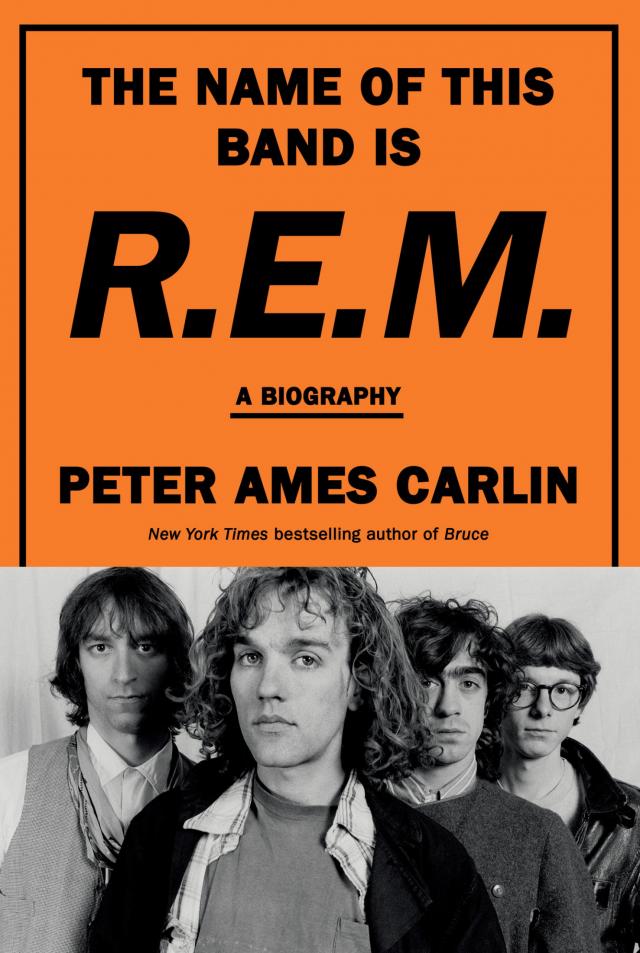
The name of this band is.., p.41
The Name of This Band Is R.E.M.,
p.41


At first R.E.M. was like an open secret. This band of college-aged guys from a college town, writing and performing rock ’n’ roll songs full of big ideas and complicated language. That so much of it seemed to take place among various shades of outsiders (seemed to because the lyrics stirred up so many more questions than they provided answers) clarified the signal’s amperage. If you were in a position to tune it in and liked what you heard enough to follow the signal, it was like realizing that the thing that once made you unacceptable now gave you entrée into an exclusive club. Another version of the painted, prancing gang Michael joined when he started going to those Rocky Horror Picture Show screenings in 1978. The dressing up and dancing were part of a secret language that had a double edge—it seemed to be speaking about satirical movie musicals but was actually about a way of thinking and being. About living outside the lines that society had drawn to govern your life. “This is an excellent movie. It really is,” Michael had told that TV reporter, speaking in the first language. “And we’re all quite normal, really,” he continued, in the second. All of Michael’s freaky young friends applauded him that night, and that sound must have gotten under his skin.
The fast, lean sound and scattered imagery of “Radio Free Europe” served as an invitation. The songs on the Chronic Town EP and Murmur, in all their offbeat tunefulness and lyrical inscrutability, described the pleasures and risks of living outside the lines, while the songs on Reckoning and Fables of the Reconstruction explained why it was necessary. And when they toured, which was nearly all the time during the first half of the 1980s, the members of R.E.M. found their people, looked into their eyes, and let them know they’d been seen, and understood. And if you knew where to listen, and what you were listening for, you could be a part of that. That’s the sound of Murmur, and if that was your R.E.M. album back when it was the only R.E.M. album, nothing could ever be more powerful.
* * *
—
Lifes Rich Pageant, Document. The bottom end got punchier, the loose ends tucked and buttoned. The lyrics were still cockeyed, but tighter and brought into focus. “Fall on Me” slipped onto commercial radio, and then “The One I Love” broke big and “It’s the End of the World as We Know It (and I Feel Fine)” nearly did the same and it was a new thing. Rock ’n’ roll shot through with artistry; pop music invested with a kind of righteousness. We are hope despite the times and Let’s begin again were bracing stuff in the late 1980s, even given the singer’s auto-skepticism, and a whole new crowd came in.
This is the point in R.E.M.’s career where the Murmurers start to get twitchy, as if this hadn’t been the plan all along. Because even if they’d started as the house band for outsiders, they were never going to be content speaking only to their own people. Hadn’t they made that clear when they set out on the road in 1980, taking every show they could possibly book? Anything, anywhere. Rock clubs, of course, but also restaurants, frat parties, roadhouses, gay bars. In New York, New Orleans, Outer New Bunghole, anywhere that had power, lights, and a stage or even just an open piece of floor where they could set up and plug in. They wouldn’t play any songs they didn’t want to play; it wasn’t about making themselves more normal in order to appeal to the normies. On the contrary, it was a matter of projecting their weird vision in such a powerful way that they couldn’t be ignored. To be, in Peter’s words, the acceptable face of the unacceptable stuff. Which is to say: still unacceptable at heart. Even when they hit the top ten. Especially when they hit the top ten.
Then came Green and Out of Time and the hordes came flooding in. And no wonder: R.E.M. was everywhere. Hit song after hit song after hit song, smash videos, tens of millions of records sold, the band’s name on the lips of presidential candidates, tossed around on television as a cultural signifier, shorthand for hip, smart, socially engaged, of the moment. Here the Murmurers wailed with fury. R.E.M. had become so smooth, so mellifluous, so shiny and happy. It was easy for an incredulous Murmurer to miss the weirdness hiding in plain sight. How the beasts jumping the barriers in “Belong” were off to join the fun at the utopian house party of “Shiny Happy People.” How the shame and desperation in the lyrics of “Losing My Religion” harmonized with the queer imagery in the song’s video. And how this rock band that had started out playing unacceptable music by, for, and about the outsiders had not just dragged the unacceptable into view, and not just put it on a pedestal for the entire world to see, but also made the world love it. Made it super fucking famous, in Michael’s words. At which point they could, and would, do anything they wanted to do. And get paid $80 million in corporate money to do it.
The freedom held when the media sharks sniffed something about Michael’s private life and began implying that he might have AIDS. At which point he felt free to correct them: he was perfectly healthy. And though it was nobody’s business, he was also perfectly queer. Happy to have sex with women and maybe even happier to do it with men. At one time, that kind of admission could be a death knell for a pop star’s career. But not for R.E.M. Because they had helped the beasts jump the barricades, and now the old rules no longer applied. And what happened next was Monster, was the Monster tour, was R.E.M. at its absolute zenith. Michael could do anything, and none of it was wrong. When he got to his dressing room in Chicago and discovered a gift basket from the venue that included a jersey from the Blackhawks hockey team, he fashioned it into a skirt and wore it onstage.[2] Was it the first time he ever wore a dress onstage? It certainly wasn’t the last.
* * *
—
If there was an audience segment R.E.M. could still add to their litany by the mid-1990s, it was the gay men and women who had sensed what Michael’s orientation was during the 1980s and either resented his not being public about it or hadn’t noticed or cared. Now it was hard to not admire that a pop star of such magnitude could be so out, proud, and often bracingly outlandish. “Michael had an impact on mainstreaming queer culture, I think,” says Victor Krummenacher, the bassist for Camper Van Beethoven, who had been among the first out alternative/indie musicians. Krummenacher had no problem with Michael choosing to keep his sex life to himself. The post-punk/alternative rock scene of the 1980s was, like so much of rock ’n’ roll, overwhelmingly male, white, and straight, and fame is difficult to navigate under any circumstances. But Krummenacher had plenty of friends who felt differently. Michael changed a lot of minds when he did come out, and the impact, the bassist says, can still be felt. “What’s interesting now is how gender ambiguous younger people are,” he says. “Everything is more gender fluid…and I think Michael is definitely part of that.”[3]
* * *
—
You didn’t have to be an old-line R.E.M. fan, or even all that invested in the politics of indie-vs.-mainstream culture, to think that Around the Sun, the album R.E.M. released in 2004, was more than a little too sleek for anyone’s good. If only because that’s what the band members thought. And actually said about it, starting not long after the record’s release that October. They’d started work in Athens in January 2004 with a relatively big array of new tracks to work on, plus more than enough shared outrage for President George W. Bush, who had leveraged post-9/11 fear into a full agenda of neoconservative policies that included the invasion of Iraq, to fuel quite a few songs full of jagged political commentary.
The demos they produced were by all accounts bristling with restless energy: guitars, bass, and drums at the center of the mix. Then the band relocated to a recording studio in the Bahamas. Two months of island breezes and tropical sunshine might have been good for the soul, but it also inspired musical torpor. Whatever spiky guitar lines might have existed on the original tracks were either subsumed or replaced by smoother keyboard sounds. Tart sonic missives were rolled in sugar and drizzled in chocolate. Still, some of the songs get their hooks under the skin. The opening track and lead single, “Leaving New York,” expertly weaves its dark verses with ringing, tuneful choruses. “Electron Blue” and particularly “The Ascent of Man” pair engaging lyrics with melodies that climb into your pockets and ride around with you all day. But too many of the songs substitute professionalism for inspiration, and lushness for passion. By the time they get to the title track, which pop historians will note is the first time an R.E.M. album has ever had a title track, the calls to action (Hold on, world, ’cause you don’t know what’s coming) are overwhelmed by summery metaphors that sound suspiciously like something dreamed up by a man lounging at poolside (I want the sun to shine on me…Let my dreams set me free).
Critics around the world were less than impressed. Entertainment Weekly put it like this: “As arena folk goes, R.E.M. remain cooler than, say, the Wallflowers. Just barely.”[4] Which is perhaps another way of saying that Around the Sun proved that R.E.M. had joined sex and pizza in the category of Things That, Even When They’re Pretty Bad, Are Still Pretty Good. “Leaving New York” hit top tens all across Europe, rising as high as number four on the continental chart. The album topped sales lists all across Europe, though it peaked at only number thirteen in the United States—the first R.E.M. album not to reach the top ten since Green, though that record continued selling long enough to go platinum twice, while the new album’s visit to the bestseller charts, in every country, was brief. Around the Sun moved a million copies overseas,[*] and a paltry 213,000 during its first year in the United States. If there’s one thing R.E.M. fans of every vintage and stripe, and the musicians themselves, can agree on, it’s that the lowest point in the band’s entire creative history is right here.
* * *
—
The week Around the Sun was released, in October 2004, R.E.M. was performing as part of an all-star lineup in the Vote for Change tour. Various acts participated in the forty concerts around the nation, with R.E.M. joining in a six-show whirlwind through five electoral swing states and then, ultimately, at the MCI Center arena, in Washington, D.C. Sharing the bill at most shows with Bruce Springsteen and the E Street Band, John Fogerty, and the neo-folk-rock phenom Bright Eyes, they performed abbreviated sets that began with “The One I Love” and leaned heavily on their most popular material, with just one or two of the new songs tossed in.
The tour, which was intended to raise money and awareness for the political opponents of President George W. Bush, who was running for reelection against the Democratic U.S. senator John Kerry, had a communal vibe that lent itself to cross-act duets. Springsteen played guitar and sang on R.E.M.’s “Man on the Moon” each night, while Michael joined the New Jersey musician on “Because the Night,” which he’d cowritten with Patti Smith. Peter and Mike joined the E Street Band for “Born to Run.” It looked like a lot of fun. But, as they told every reporter they talked to, they were there to speak truth to power and make a political impact. “The country is going so wrong, we’ll do whatever we can to change it,” Mike said.[5]
Michael spent so many years distancing himself from the history and traditions of rock ’n’ roll that it was astounding to see how excited he was to meet Bruce Springsteen. In the documentary National Anthem: Inside the Vote for Change Concert Tour, produced for the Sundance Channel, he’s fairly aglow as he makes his way to the venue where the bands will first come together. “To be playing on the same stage as Mr. Springsteen, who is someone I’ve followed as a fan since I was a teenager, is…a little daunting,” Michael tells the camera. “I’m nervous,” he adds with a laugh. Overhearing Peter working out the guitar part for “Born to Run,” the singer goes in to get a closer listen and starts singing along, all the words in place, the intonation just exactly right. Standing on the stage an arm’s length from Springsteen during a run-through of “Because the Night,” Michael gets so caught up watching the guitarist’s solo that he misses the cue to sing his part of the chorus. He regains his poise by the time he calls Springsteen onstage to sing and play with his band during the concert, but when the older musician takes over the vocal for the second verse, R.E.M.’s singer looks like a man whose inner fifteen-year-old is fully and joyously alive.[6]
* * *
—
The failure of Around the Sun, which is how you think of a million-plus-selling album by an act that spent a dozen years making albums that sold in the many multiples of millions, spurred a return to R.E.M.’s restless touring habits. After the Vote for Change tour ended (and George W. Bush was reelected), the band toured North America through the middle of December, took the holidays off, then regrouped in Europe just after the New Year, setting out on a long tour that took them across pages of the world atlas they’d never flipped through, all the way into the former Soviet states of Eastern Europe and down through post-apartheid South Africa before returning to the familiar arenas of Japan, New Zealand, and Australia in mid-March. They took most of a couple of months off before returning to Europe for two more months of shows, including a quick set among the world’s biggest acts at the Live 8 benefit concert, in London’s Hyde Park on July 2, before returning to the city on July 16 to perform a show they’d had to reschedule after the terrorist bombings that tore through London’s Underground on July 7, killing fifty-six commuters. Returning to Hyde Park, they played the final show of the tour to 85,000 Londoners for whom “Everybody Hurts” suddenly had far too much meaning. Nevertheless, the show was a triumph. “Twenty-five years into REM’s career, the planets of the band’s universe seem to have slid into an especially harmonious alignment,” wrote The Guardian’s Adam Sweeting in his five-star review. The band, he said, “are currently hitting new peaks as a live act.”[7]
Skip Notes
* Which is a lot of records, obviously, but in the context of everything that had gone before, and also the notoriously enormous Warner Bros. deal, it was a significant step down.
47
This Is Going to Be Loud
When the mammoth years began in the 1990s, R.E.M. had all the right attributes to be an award magnet. They were smart but also cool; critics’ favorites but also regular guys; edgy but also cooperative. Most importantly, they moved a lot of merchandise. So: Grammys and BRITs. NMEs and Pollstar Concert Industrys. CMJs, Billboards, and Rockbjornens. Song of the Year. Album of the Year. Band of the Year. Best Pop Performance by a Duo or Group with Vocals.[*] By the time Out of Time ran its course, it had started to seem ridiculous…The presentation video the band made to hype Warner Bros. Records staff for Automatic for the People in the fall of 1992 included a bit with Michael in the band offices, pretending to talk to Lenny Waronker on the telephone while being interrupted by endless messengers handing him trophies, plaques, gold-plated everything. “Oh, it’s another award,” he says into the phone, considering one for a moment before tossing it aside. “We ran out of doors. We don’t know what to do with them.”[1]
The gold-plated haul was just beginning. By the middle of that decade, they started getting career-size gongs. MTV’s Video Vanguard Award came first, in 1995. Three years later the people behind Q magazine’s Q Awards handed R.E.M. a Lifetime Achievement Award. It was a start, but you generally need to have been around for at least twenty-five years before the proper halls of fame consider unlocking their doors. For R.E.M. the gilding began in September 2006.
It started with a warm-up at the 40 Watt, in Athens, on the twelfth of September with a community food bank fundraiser called “Finest Worksongs: Athens Bands Play the Music of R.E.M.,” a multi-artist show featuring a slate of local acts including Pylon’s Vanessa Briscoe Hay, the Drive-By Truckers’ Patterson Hood, Five Eight, and a variety of others. All of whom were surprised to discover that the first act to play that night would be the local band R.E.M., including original drummer Bill Berry. The band electrified the crowd with “Begin the Begin” and “So. Central Rain” before leaving the stage to the other acts. The communal vibe from Athens days gone by swept over the evening, and soon the various R.E.M. musicians started getting dragooned onto the stage to help out, adding an additional guitar or backing vocal to whatever tune was coming next. When the whole gang came out for a show-closing “It’s the End of the World as We Know It,” Michael came back to the front of the stage, mostly to cheer on Five Eight singer Mike Mantione as he sang lead, and to join in on the choruses. By the end there were at least three dozen musicians massed on the stage, with the stars of the show happily subsumed by the crowd.
* * *
—
“This is going to be loud.”
Six days later, the four original members of R.E.M. were in front of a few thousand well-dressed folks in a cavernous function room at the Georgia World Congress Center, in Atlanta, about to kick off their mini set at the induction ceremony for the Georgia Music Hall of Fame. The crowd cheered, Michael added his usual introduction, “The name of this band is R.E.M. and this is what we do,” and they were off, thundering into “Begin the Begin,” then “Losing My Religion,” and finally, with a dedication to Texas’s progressive governor Ann Richards, who had died earlier that week, “Man on the Moon.” Next, Georgia’s former U.S. senator Max Cleland inducted the band and Michael made a brief speech, talking about how proud they had always been to be from Georgia. Later, his bandmates were just as proud to serve as the backing band for one of their fellow inductees, and Mike and Bill’s former neighbor in Macon, Gregg Allman, helping him perform his classic “Midnight Rider.”
* * *
—
When they first came to New York, they had been underdressed, underfed, wide-eyed in the streets, sleeping in a van. That was Peter and Michael in March of 1980, on their spring break getaway. They were just a week or two from Kathleen O’Brien’s party on April 5, taking their first steps on the journey that would lead them into a head-spinning whirlwind and carry them away for twenty-seven years, until it dropped them back in this city, in this place, standing together at the edge of a ballroom in the Waldorf Astoria hotel, and on the threshold of rock ’n’ roll history. Which would be a ridiculous overstatement if it weren’t true.