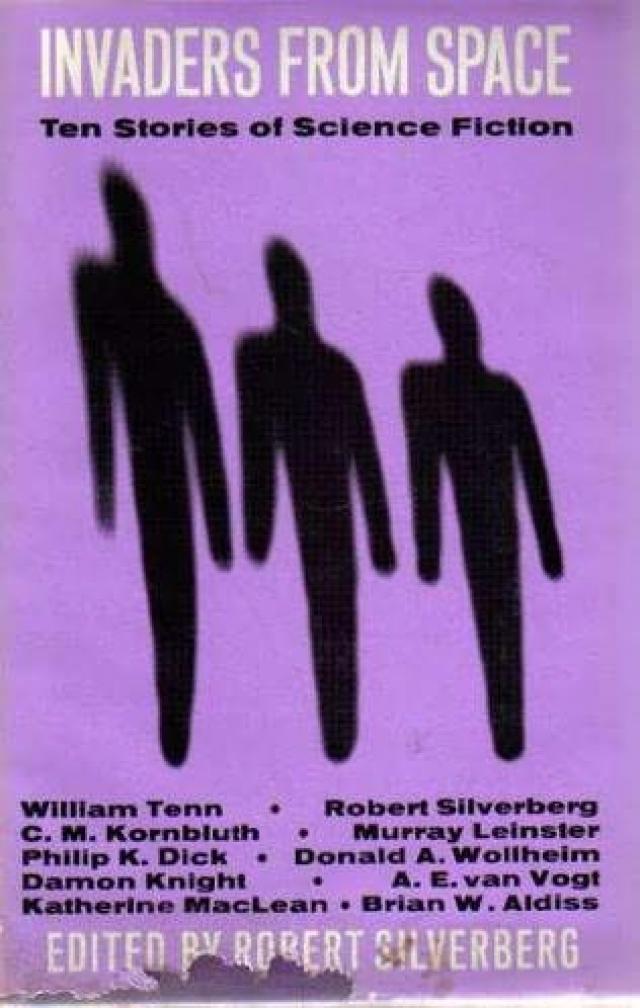
Invaders from space, p.16
Invaders From Space,
p.16


So there he is in the movie, watching and listening so he shouldn’t miss anything important, and some customer around him starts making loud comments to somebody else, rattling cellophane, and snapping a pocketbook open and shut every five seconds to find a kleenex. So he flips them into the next dimension, where they can make all the noise they want without bothering him.
And that’s the reason why there are so many ghosts that got theirs in the movies and places like that. On the streets of any city you can walk for miles without running into more than two or three really obnoxious characters, but in any kind of a theater there’s always somebody talking, or coughing, or rattling paper. You’ve noticed that.
I went even further than that. I checked with my notes and then looked in a copy of Cue magazine to find out what was playing at each of those theaters when the Martian was there.
I found out that the play was a long-run musical—the concert was musical, naturally—and one of the two movies was a Hollywood remake of a musical comedy. The other was a newsreel.
There it was. I as good as had him. Then I got another idea and went back through my notes to find out where the theater victims had been sitting. The guy in Carnegie Hall had been in the balcony; that’s where you hear best, I guess. But the other five had all been sitting down front, in the first four rows.
The little guy was nearsighted.
That’s the way I was thinking about him now—a little nearsighted guy who liked music better than Westerns, and was used to some place where everybody’s careful not to bother anybody else. It was hard not to feel sorry for him; after all, some people that come from places closer than Mars have a hard time in New York.
But it was me against him. That night the total rewards were up to almost twenty thousand dollars.
*
I thought of one thing I could do right away. I could write to the Mayor to make an announcement that if people didn’t want to be ghosts, they should keep from making unnecessary noise or being pests, especially in theaters. But one, he probably wouldn’t pay any attention to me, and two, if he did, twenty thousand other guys would be following my lead before I could turn around, and one of them would probably catch the Martian before I did.
That night, I did the same as before. I waited till Ma was sleeping, then went out to a movie on Broadway. It was a first-run house, they had a musical playing, and I sat down front.
But nothing happened. The Martian wasn’t there.
I felt pretty discouraged when I got home. My time was running out and there are over three hundred theaters in Manhattan. I had to start working faster.
I lay awake for a long while, worrying and thinking about it, and finally I came to one of the most important decisions in my life. The next morning I was going to do something I never did before—call in and pretend like I was sick. And I was going to stay sick until I found the Martian.
I felt bad about it and I felt even worse in the morning, when Rifkowicz told me to take it easy till I got well.
After breakfast, I got the papers and made a list of shows on my way uptown. I went to one on 42nd Street first—it was a musical picture about some composer named Handle, and the second feature was a comedy, but it had Hoagy Carmichael in it, so I figured I should stay for that too. I sat in the fifth row. There was plenty of coughing going on, only nobody got turned into a ghost.
Then I had lunch and went to another musical, on Broadway. I drew another blank.
My eyes were beginning to bother me a little from sitting so close to the screen, so I thought I would just go to a newsreel movie and then walk around a while before dinner. But when I got out of the newsreel I began to feel jittery, and I went straight to another double feature. The Martian wasn’t there, either.
I had seen plenty of ghosts standing around on the streets, but they were all just standing there looking kind of lost and bewildered, the way they did after a while. You could tell a new victim because he would be rushing here and there, shoving his hands through things, trying to talk to people, and acting all upset.
One thing I forgot to mention. Everybody was wondering now how these ghosts got along without eating. In this dimension where they we’re, there wasn’t any food—there wasn’t anything, just the stuff like rubbery clouds that they were standing on. But they all claimed they weren’t hungry or thirsty, and they all seemed to be in good shape. Even the ones that had been ghosts now for four days.
When I got out of that last movie, it was about eight in the evening. I was feeling low in my mind, but I still had a healthy appetite. I started wandering around the side streets of Broadway, looking for a restaurant that wasn’t too crowded or too expensive. I passed a theater that was on my list, except I knew I was too late to get a ticket for it. It was the premiere of the newest Rodgers and Hammerstein show, and the lobby and half the sidewalk were full of customers.
I went on past, feeling gloomier because of all the bright lights and excitement, and then I heard something funny. Without paying any attention. I had been listening to one of these raspy-voiced barkers inside the lobby going, “GET-cha program here.” Now, all of a sudden, he said, “GET-ch—” and stopped.
I turned around, with a funny prickling up the back of my spine. The voice didn’t start up again. Just as I started back toward the lobby, a ghost came out of the crowd. There was no doubt about him being a ghost—he ran through people.
He had a bunch of big booklets with slick covers under his arm, and his mouth was wide open like he was shouting. Then he showed his teeth, and his face got all red. and he lifted the booklets in both hands and threw them away as hard as he could. They went through people, too.
The ghost walked away with his hands shoved into his pockets.
*
Running into that lobby, I shoved my badge at the ticket taker, and told him to find me the manager, quick.
When the manager came up I grabbed him by the lapels and said, “I got reason to believe there’s a dangerous criminal going to be in this audience tonight. With your cooperation, we’ll get him.” He looked worried, so I said, “There won’t be any trouble. You just put me where I can see the front rows and leave the rest to me.”
He said, “I can’t give you a seat. The house is completely sold out.”
I told him, “Okay, put me back in the wings, or whatever you call them.”
He argued, but he did what I asked. We went down the side aisle, through the orchestra pit and through a little door that went under the stage. Then we went up a little stairway to back-stage, and he put me right at the edge of the stage, up front, where I could peek out at the audience.
There was a crowd of people running around back there behind the curtains, actors and chorus girls, guys in their shirt sleeves and guys in overalls. I could hear the hum out front—people were beginning to fill the seats—and I wanted that curtain to go up. I just couldn’t wait.
Finally the actors took their places, and the band suddenly started playing, and the curtain went up.
I understand that show is still playing to standing room only, even with all the trouble that’s happened since then, but I didn’t pay any attention to it and I couldn’t even tell you what it was about. I was watching the front four rows, trying to memorize every face I saw.
Right in the middle there were three that I paid more attention to than the rest. One of them was a young blonde girl with blue eyes like the color of Ma’s fancy china that she brought with her from the old country. Another was an old gent with chin spinach and glasses on a string. The third was a little guy with a sour expression and a derby hat.
I don’t know why I picked out those three, except maybe it was a hunch. Maybe I was looking at the blonde girl just because she was pretty, but then again, I never saw eyes that color before or since. It could be that Martians have china-blue eyes; how would I know? I might have had some wild idea that the old guy could be the Martian and was wearing the frizzy white whiskers because Martians don’t have chins exactly like us. And I think I picked on the little guy because he fitted the picture I already had in my head. And the way he was clutching that derby in his lap, like it was made of gold—I was thinking to myself, maybe he’s got some kind of ray gun built into that hat; maybe that’s how he does it.
I ADMIT that I wasn’t thinking very logical—I was too excited—but I never took my eyes off that audience for a second.
I was waiting for somebody to start coughing or sneezing and get turned into a ghost. When that happened, I would be watching the people, and if I was lucky I might see who was looking at the victim when it happened.
That’s what I was waiting for. What I got was a sniff of smoke and then somebody started screaming and yelling, “Fire!”
Half the audience was on their feet in a second. I looked up, and sure enough there was smoke pouring out at the back of the room. Some more women screamed and the stampede was on.
The girls on stage stopped dancing and the band stopped playing. Somebody—some actor—ran out on the stage and started saying, “Ladies and gentlemen, your attention please. Walk, do not run, to the nearest exit. There is no danger. Walk, do not run—”
I lost my head. Not on account of the fire. I knew the actor was right and the only bad thing that could happen would be people trampling each other to death to get out of there. But the seats were emptying fast and it struck me all of a sudden that I didn’t know my way through that tangle of scenery backstage. By the time I got down the stairs and out into the auditorium, the Martian might be gone.
I felt cold all over. I didn’t even stop to remember that I didn’t have to go back the way I came, because there were little steps right at the side of the stage. I ran out from behind the wings and started to jump over the musicians. At that, I would have made it if I hadn’t caught my toe in that little trough where the footlights are.
I had worse luck than that, even. I landed smack in the middle of the bass drum.
You never heard such a noise in your life. It sounded as if the ceiling caved in. Sitting there, with my legs and arms sticking out of that drum, I saw the people turn around and look at me like they had been shot. I saw them all, the girl with the china-blue eyes, the old gent with the whiskers, the little guy with the derby, and a lot more. And then, suddenly, all the sound stopped, same as when you turn off a radio.
The guy who owned the drum leaned over and tried to pull me out of it. He couldn’t.
His hands went right through me.
*
Like I said, this Martian annoys easy. I don’t know what he did about all those women screaming—maybe he figured there was a good reason for that and left them alone. But when I hit that bass drum, it must have burned him good. You know, when you’re excited already, a loud noise will make you jump twice as far.
That’s about the only satisfaction I got—that I probably annoyed him the worst of anybody in New York City.
That and being so close to catching him.
The company here is nothing to brag about—women that will talk your arm off and half your shoulder, and guys that say, “Peaceful enough for you?” and back-slappers, and people that hum to themselves—
Besides that, the place is so damned dull. Clouds to stand on, nothing to eat even if you wanted to eat, and nothing to do except stand around and watch the new ones come through. We can’t even see much of New York any more, because it keeps getting mistier all the time—fading away, kind of, like maybe this dimension is getting a little farther away from the ordinary one every day.
I asked Mr. Dauth yesterday how he thought the whole thing would wind up. Mr. Dauth isn’t bad. He’s a big, cheerful guy, about fifty. The kind that likes good food and good beer and a lot of it. But he doesn’t complain. He admits that his habit of sucking his teeth out real loud is aggravating and says maybe he deserved what he got, which you’ll admit is big of him. So I talk to him a lot, and the other day, when we were watching a new batch that had just come through, I asked him where he thought it would all end, because we can hear each other, you see, being in the same dimension.
He pursed his lips and frowned like he was thinking it over, and then said that as far as he could see, there wasn’t any human being that was perfect. Anybody is liable to do something aggravating sooner or later. That’s the way people are.
“And this Martian of yours seems to be thorough,” he said. “Very thorough. It might take him years to get through studying the Earth.”
“And then what?” I asked him.
“Well,” he said, “eventually, if he keeps it up long enough, we’ll all be over here.”
I hope he’s right. Now that I come to think of it, that cute waitress I mentioned has a habit of setting down a coffee cup so half of it slops into the saucer. If Mr. Dauth is right, all I’ve got to do is wait.
It stands to reason.
Resurrection
A. E. van Vogt
* * *
One of science fiction’s most celebrated writers, the author of such novels as The World ofNull-A, Sian, and The Weapon Makers, tells here of a lifeless Earth—and of the visitors from space who made the disastrous error of trying to learn why the planet had perished.
* * *
The great ship poised a quarter of a mile above one of the cities. Below was a cosmic desolation. As he floated down in his energy bubble, Enash saw that the buildings were crumbling with age.
“No signs of war damage!” The bodiless voice touched his ears momentarily. Enash tuned it out.
On the ground he collapsed his bubble. He found himself in a walled enclosure overgrown with weeds. Several skeletons lay in the tall grass beside the rakish building. They were of long, two-legged, two-armed beings with skulls in each case mounted at the end of a thin spine. The skeletons, all of adults, seemed in excellent preservation, but when he bent down and touched one, a whole section of it crumbled into a fine powder. As he straightened, he saw that Yoal was floating down nearby. Enash waited until the historian had stepped out of his bubble, then he said:
“Do you think we ought to use our method of reviving the long dead?”
Yoal was thoughtful. “I have been asking questions of the various people who have landed, and there is something wrong here. This planet has no surviving life, not even insect life. We’ll have to find out what happened before we risk any colonization.”
Enash said nothing. A soft wind was blowing. It rustled through a clump of trees nearby. He motioned towards the trees. Yoal nodded and said, “Yes, the plant life has not been harmed, but plants after all are not affected in the same way as the active life forms.”
There was an interruption. A voice spoke from Yoal’s receiver: “A museum has been found at approximately the centre of the city. A red light has been fixed on the roof.”
Enash said, “I’ll go with you, Yoal. There might be skeletons of animals and of the intelligent being in various stages of his evolution. You didn’t answer my question. Are you going to revive these things?”
Yoal said slowly, “I intend to discuss the matter with the council, but I think there is no doubt. We must know the cause of this disaster.” He waved one sucker vaguely to take in half the compass. He added as an afterthought, “We shall proceed cautiously, of course, beginning with an obviously early development. The absence of the skeletons of children indicates that the race had developed personal immortality.”
The council came to look at the exhibits. It was, Enash knew, a formal preliminary only. The decision was made. There would be revivals. It was more than that. They were curious. Space was vast, the journeys through it long and lonely, landing always a stimulating experience, with its prospect of new life forms to be seen and studied.
The museum looked ordinary. High-domed ceilings, vast rooms. Plastic models of strange beasts, many artifacts, too many to see and comprehend in so short a time. The life span of a race was imprisoned here in a progressive array of relics. Enash looked with the others, and was glad when they came to the line of skeletons and preserved bodies. He seated himself behind the energy screen, and watched the biological experts take a preserved body out of a stone sarcophagus. It was wrapped in windings of cloth, many of them. The experts did not bother to unravel the rotted material. Their forceps reached through, pinched a piece of skull, that was the accepted procedure. Any part of the skeleton could be used, but the most perfect revivals, the most complete reconstructions resulted when a certain section of the skull was used.
Hamar, the chief biologist, explained the choice of body. “The chemicals used to preserve this mummy show a sketchy knowledge of chemistry. The carvings on the sarcophagus indicate a crude and unmechanical culture. In such a civilization there would not be much development of the potentialities of the nervous system. Our speech experts have been analysing the recorded voice mechanism which is a part of each exhibit, and though many languages are involved, evidence that the ancient language spoken at the time the body was alive has been reproduced, they found no difficulty in translating the meanings. They have now adapted our universal speech machine, so that anyone who wishes to need only speak into his communicator, and so will have his words translated into the language of the revived person. The reverse, naturally, is also true. Ah, I see we are ready for the first body.”
Enash watched intently with the others as the lid was clamped down on the plastic reconstructor, and the growth processes were started. He could feel himself becoming tense.
For there was nothing haphazard about what was happening. In a few minutes a full-grown ancient inhabitant of this planet would sit up and stare at them. The science involved was simple and always fully effective.