Invaders from space, p.5
Invaders From Space,
p.5



Another year passed. I gained three pounds, drank too much, rowed incessantly with my staff, and got a tidy raise. A telegrapher took a swing at me midway through the office Christmas party, and I fired him. My wife and the kids didn’t arrive in April when I expected them. I phoned Florida, and she gave me some excuse or other about missing the plane. After a few more missed planes and a few more phone calls, she got around to telling me that she didn’t want to come back. That was okay with me. In my own intuitive way, I knew that the upcoming silly season was more important than who stayed married to whom.
In July, a dispatch arrived by wire while a new man was working the night desk. It was from Hood River, Oregon. Our stringer there reported that more than one hundred “green capsules” about fifty yards long had appeared in and around an apple orchard. The new desk man was not so new that he did not recall the downhold policy on silly-season items. He killed it, but left it on the spike for my amused inspection in the morning. I suppose exactly the same thing happened in every wire service newsroom in the region. I rolled in at 10:30 and riffled through the stuff on the spike. When I saw the “green capsules” dispatch I tried to phone Portland, but couldn’t get a connection. Then the phone buzzed and a correspondent of ours in Seattle began to yell at me, but the line went dead.
I shrugged and phoned Benson, in Fort Hicks. He was at the police station, and asked me: “Is this it?”
“It is,” I told him. I read him the telegram from Hood River and told him about the line trouble to Seattle.
“So,” he said wonderingly, “I called the turn, didn’t I?”
“Called what turn?”
“On the invaders. I don’t know who they are—but it’s the story of the boy who cried wolf. Only this time, the wolves realized—” Then the phone went dead.
But he was right.
The people of the world were the sheep.
We newsmen—radio, TV, press, and wire services—were the boy, who should have been ready to sound the alarm.
But the cunning wolves had tricked us into sounding the alarm so many times that the villagers were weary, and would not come when there was real peril.
The wolves who then were burning their way through the Ozarks, utterly without opposition, the wolves were the Martians under whose yoke and lash we now endure our miserable existences.
Roog
Philip K Dick
* * *
Not all invaders of Earth are domineering colossi who toss continents around with casual glee. Some, as Philip K. Dick shows here, are elusive, mysterious creatures, who go about their business unnoticed by everyone except an occasional household pet… .
* * *
“Roog!” the dog said. He rested his paws on the top of the fence and looked around him.
The Roog came running into the yard.
It was early morning, and the sun had not really come up yet. The air was cold and gray, and the walls of the house were damp with moisture. The dog opened his jaws a little as he watched, his big black paws clutching the wood of the fence.
The Roog stood by the open gate, looking into the yard. He was a small Roog, thin and white, on wobbly legs. The Roog blinked at the dog, and the dog showed his teeth.
“Roog!” he said again. The sound echoed into the silent half darkness. Nothing moved nor stirred. The dog dropped down and walked back across the yard to the porch steps. He sat down on the bottom step and watched the Roog. The Roog glanced at him. Then he stretched his neck up to the window of the house, just above him. He sniffed at the window.
The dog came flashing across the yard. He hit the fence, and the gate shuddered and groaned. The Roog was walking quickly up the path, hurrying with funny little steps, mincing along. The dog lay down against the slats of the gate, breathing heavily, his red tongue hanging. He watched the Roog disappear.
The dog lay silently, his eyes bright and black. The day was beginning to come. The sky turned a little whiter, and from all around the sounds of people echoed through the morning air. Lights popped on behind shades. In the chilly dawn a window was opened.
The dog did not move. He watched the path.
In the kitchen Mrs. Cardossi poured water into the coffee pot. Steam rose from the water, blinding her. She set the pot down on the edge of the stove and went into the pantry. When she came back Alf was standing at the door of the kitchen. He put his glasses on.
“You bring the paper?” he said.
“It’s outside.”
Alf Cardossi walked across the kitchen. He threw the bolt on the back door and stepped out onto the porch. He looked into the gray, damp morning. At the fence Boris lay, black and furry, his tongue out.
“Put the tongue in,” Alf said. The dog looked quickly up. His tail beat against the ground. “The tongue,” Alf said. “Put the tongue in.”
The dog and the man looked at one another. The dog whined. His eyes were bright and feverish.
“Roog!” he said softly.
“What?” Alf looked around. “Someone coming? The paperboy come?”
The dog stared at him, his mouth open.
“You certainly upset these days,” Alf said. “You better take it easy. We both getting too old for excitement.”
He went inside the house.
The sun came up. The street became bright and alive with color. The postman went along the sidewalk with his letters and magazines. Some children hurried by, laughing and talking.
About 11:00, Mrs. Cardossi swept the front porch. She sniffed the air, pausing for a moment.
“It smells good today,” she said. “That means it’s going to be warm.” In the heat of the noonday sun the black dog lay stretched out full length, under the porch. His chest rose and fell. In the cherry tree the birds were playing, squawking and chattering to each other. Once in a while Boris raised his head and looked at them. Presently he got to his feet and trotted down under the tree.
He was standing under the tree when he saw the two Roogs sitting on the fence, watching him.
“He’s big,” the first Roog said. “Most Guardians aren’t as big as this.”
The other Roog nodded, his head wobbling on his neck. Boris watched them without moving, his body stiff and hard. The Roogs were silent, now, looking at the big dog with his shaggy ruff of white around his neck.
“How is the offering urn?” the first Roog said. “Is it almost full?”
“Yes.” The other nodded. “Almost ready.”
“You, there!” the first Roog said, raising his voice. “Do you hear me? We’ve decided to accept the offering, this time. So you remember to let us in. No nonsense, now.”
“Don’t forget,” the other added. “It won’t be long.”
Boris said nothing.
The two Roogs leaped off the fence and went over together just beyond the walk. One of them brought out a map and they studied it.
“This area really is none too good for a first trial,” the first Roog said. “Too many Guardians… Now, the northside area —”
“They decided,” the other Roog said. “There are so many factors —”
“Of course.” They glanced at Boris and moved back farther from the fence. He could not hear the rest of what they were saying.
Presently the Roogs put their map away and went off down the path.
Boris walked over to the fence and sniffed at the boards. He smelled the sickly, rotten odor of Roogs and the hair stood up on his back.
That night when Alf Cardossi came home the dog was standing at the gate, looking up the walk. Alf opened the gate and went into the yard.
“How are you?” he said, thumping the dog’s side. “You stopped worrying? Seems like you been nervous of late. You didn’t used to be that way.”
Boris whined, looking intently up into the man’s face.
“You a good dog, Boris,” Alf said. “You pretty big, too, for a dog. You don’t remember long ago how you used to be only a little bit of a puppy.”
Boris leaned against the man’s leg.
“You a good dog,” Alf murmured. “I sure wish I knew what is on your mind.”
He went inside the house. Mrs. Cardossi was setting the table for dinner. Alf went into the living room and took his coat and hat off. He set his lunch pail down on the sideboard and came back into the kitchen.
“What’s the matter?” Mrs. Cardossi said.
“That dog got to stop making all that noise, barking. The neighbors going to complain to the police again.”
“I hope we don’t have to give him to your brother,” Mrs. Cardossi said, folding her arms. “But he sure goes crazy, especially on Friday morning, when the garbage men come.”
“Maybe he’ll calm down,” Alf said. He lit his pipe and smoked solemnly. “He didn’t used to be that way. Maybe he’ll get better, like he was.”
“We’ll see,” Mrs. Cardossi said.
The sun rose up, cold and ominous. Mist hung over all the trees and in the low places.
It was Friday morning.
The black dog lay under the porch, listening, his eyes wide and staring. His coat was stiff with hoarfrost and the breath from his nostrils made clouds of steam in the thin air. Suddenly he turned his head and leaped up.
From far off, a long way away, a faint sound came, a kind of crashing sound.
“Roog!” Boris cried, looking around. He hurried to the gate and stood up, his paws on top of the fence.
In the distance the sound came again, louder now, not as far away as before. It was a crashing, clanging sound, as if something were being rolled back, as if a great door were being opened
“Roog!” Boris cried. He stared up anxiously at the darkened windows above him. Nothing stirred, nothing.
And along the street the Roogs came. The Roogs and their truck moved along bouncing against the rough stones, crashing and whirring.
“Roog!” Boris cried, and he leaped, his eyes blazing. Then he became more calm. He settled himself down on the ground and waited, listening.
Out in front the Roogs stopped their truck. He could hear them opening the doors stepping down onto the sidewalk. Boris ran around in a little circle. He whined and his muzzle turned once again toward the house.
Inside the warm, dark bedroom, Mr. Cardossi sat up a little in bed and squinted at the clock.
“That damn dog,” he muttered. “That damn dog.” He turned his face toward the pillow and closed his eyes.
The Roogs were coming down the path, now. The first Roog pushed against the gate and the gate opened. The Roogs came into the yard. The dog backed away from them.
“Roog! Roog!” he cried. The horrid, bitter smell of Roogs came to his nose, and he turned away.
“The offering urn,” the first Roog said. “It is full, I think.” He smiled at the rigid, angry dog. “How very good of you,” he said.
The Roogs came toward the metal can, and one of them took the lid from it.
“Roog! Roog!” Boris cried, huddled against the bottom of the porch steps. His body shook with horror. The Roogs were lifting up the big metal can, turning it on its side. The contents poured out onto the ground, and the Roogs scooped the sacks of bulging, splitting paper together, catching at the orange peels and fragments, the bits of toast and egg shells.
One of the Roogs popped an egg shell into his mouth. His teeth crunched the egg shell.
“Roog!” Boris cried hopelessly, almost to himself. The Roogs were almost finished with their work of gathering up the offering. They stopped for a moment, looking at Boris.
Then, slowly, silently, the Roogs looked up, up the side of the house, along the stucco, to the window, with its brown shade pulled tightly down.
“ROOG!” Boris screamed, and he came toward them, dancing with fury and dismay. Reluctantly, the Roogs turned away from the window. They went out through the gate, closing it behind them.
“Look at him,” the last Roog said with contempt, pulling his corner of the blanket up on his shoulder. Boris strained against the fence, his mouth open, snapping wildly. The biggest Roog began to wave his arms furiously and Boris retreated. He settled down at the bottom of the porch steps, his mouth still open, and from the depths of him an unhappy, terrible moan issued forth, a wail of misery and despair.
“Come on,” the other Roog said to the lingering Roog at the fence.
They walked up the path.
“Well, except for these little places around the Guardians, this area is well cleared,” the biggest Roog said. “I’ll be glad when this particular Guardian is done. He certainly causes us a lot of trouble.”
“Don’t be impatient,” one of the Roogs said. He grinned. “Our truck is full enough as it is. Let’s leave something for next week.”
All the Roogs laughed.
They went on up the path, carrying the offering in the dirty, sagging blanket.
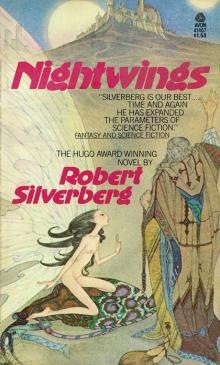
Nightwings
Robert Silverberg
* * *
The time is the unimaginably distant future; the Earth we know has been strangely transformed; and a guild of Watchers keeps uneasy vigil, awaiting an invasion so long overdue that it has become a legend. Such is the setting of this short novel, which received the Hugo award at the 1969 World Science Fiction Convention.
* * *
ONE
Roum is a city built on seven hills. They say it was a capital of man in one of the earlier cycles. I do not know of that, for my guild is Watching, not Remembering; but as I had my first glimpse of Roum, coming upon it from the south at twilight, I could see that in former days it must have been of great significance. Even now it was a mighty city of many thousands of souls.
Its bony towers stood out sharply against the dusk. Lights glimmered appealingly. On my left hand the sky was ablaze with splendor as the sun relinquished possession. Streaming bands of azure and violet and crimson folded and writhed about one another in the nightly dance that brings the darkness. To my right blackness had already come. I attempted to find the seven hills, and failed, and still I knew that this was that Roum of majesty toward which all roads are bent, and I felt awe and deep respect for the works of our bygone fathers.
We rested by the long straight road, looking up at Roum. I said, “It is a goodly city. We will find employment there.”
Beside me, Avluela fluttered her lacy wings. “And food?” she asked in her high, fluty voice. “And shelter? And wine?”
“Those too,” I said. “All of those.”
“How long have we been walking, Watcher?” she asked.
“Two days. Three nights.”
“If I had been flying it would have been more swift.”
“For you,” I said. “You would have left us far behind and never seen us again. Is that your desire?”
She came close to me and rubbed the rough fabric of my sleeve, and then she pressed herself at me the way a flirting cat might do. Her wings unfolded into two broad sheets of gossamer through which I could still see the sunset and the evening lights, blurred, distorted, magical. I sensed the fragrance of her midnight hair. I put my arms to her and embraced her slender, boyish body.
She said, “You know it is my desire to remain with you always, Watcher. Always!”
“Yes, Avluela. We will be happy,” I said, and released her.
“Shall we go in to Roum now?”
“I think we should wait for Gormon,” I said, shaking my head. “He’ll be back soon from his explorations.” I did not want to tell her of my weariness. She was only a child, seventeen summers old; what did she know of weariness or of age? And I am old. Not as old as Roum, but old enough.
“While we wait,” she said, “may I fly?”
“Fly, yes.”
I squatted beside our cart and warmed my hands at the throbbing generator while Avluela prepared to fly. First she removed her garments, for her wings have little strength and she cannot lift such extra baggage. Lithely, deftly, she peeled the glassy bubbles from her tiny feet, she wriggled free of her crimson jacket and of her soft, furry leggings. The vanishing light in the west sparkled over her slim form. Like all Fliers, she carried no surplus body tissue: her breasts were mere bumps, her buttocks flat, her thighs so spindly that there was a span of inches between them when she stood. Could she have weighed more than a quintal? I doubt it. Looking at her, I felt as always gross and earthbound, a thing of loathesome flesh, and yet I am not a heavy man.
By the roadside she genuflected, knuckles to the ground, head bowed to knees, as she said whatever ritual it is that the Fliers say. Her back was to me. Her delicate wings fluttered, filled with life, rose about her like a cloak whipped up by the breeze. I could not comprehend how such wings could possibly lift even so slight a form as Avluela’s. They were not hawk-wings but butterfly-wings, veined and transparent, marked here and there with blotches of pigment, ebony and turquoise and scarlet. A sturdy ligament joined them to the two flat pads of muscle beneath her sharp shoulderblades; but what she did not have was the massive breastbone of a flying creature, the bands of corded muscle needed for flight. Oh, I know that the Fliers use more than muscle to get aloft, that there are mystical disciplines in their mystery. Even so, I who am of the Watchers remain skeptical of the more fantastic guilds.
Avluela finished her words. She rose; she caught the breeze with her wings; she ascended several feet. There she remained, suspended between earth and sky, while her wings beat frantically. It was not yet night, and Avluela’s wings were merely nightwings. By day she could not fly, for the terrible pressure of the solar wind would hurl her to the ground. Now, midway between dusk and dark, it was still not the best time for her to go up. I saw her thrust toward the east by the remnant of light in the sky. Her arms as well as her wings thrashed; her small pointed face was grim with concentration; on her thin lips were the words of her guild. She doubled her body and shot it out, head going one way, rump the other, and abruptly she hovered horizontally, looking groundward, her wings thrashing against the air. Up, Avluela! Up!