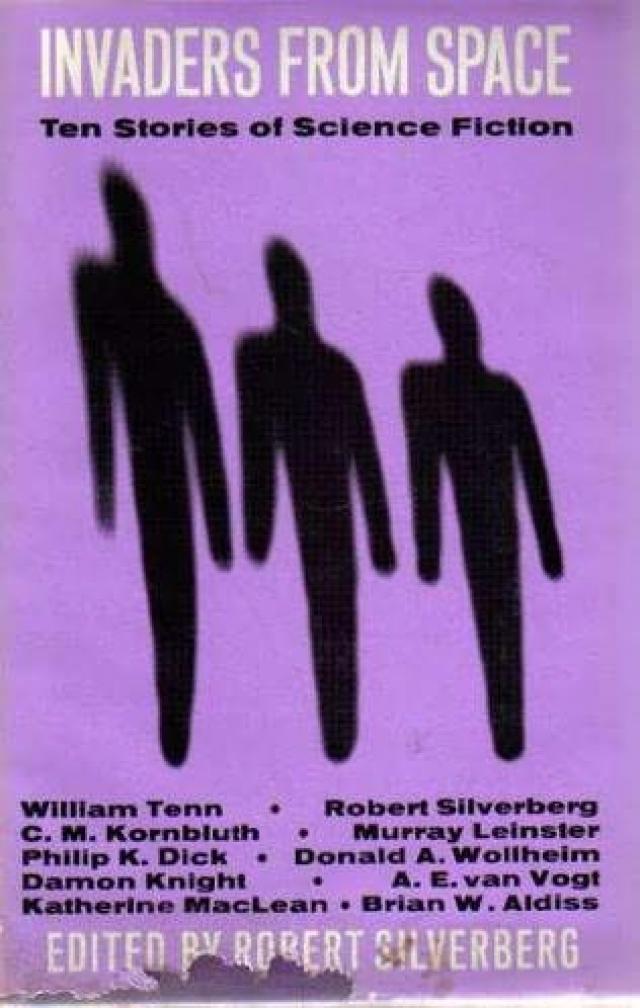
Invaders from space, p.17
Invaders From Space,
p.17


Out of the shadows of smallness, life grows. The level of beginning and ending, of life and not life; in that dim region matter oscillates easily between old and new habits. The habit of organic, or the habit of inorganic. Electrons do not have life and unlife values. Atoms form into molecules, there is a step in the process, one tiny step, that is of life if life begins at all. One step, and then darkness. Or aliveness.
A stone or a living cell. A grain of gold or a blade of grass, the sands of the sea or the equally numerous animalcules inhabiting the endless fishy waters, the difference is there in the twilight zone of matter. Each living cell has in it the whole form. The crab grows a new leg when the old one is torn from its flesh. Both ends of the planarian worm elongate, and soon there are two worms, two identities, two digestive systems each as greedy as the original, each a whole, unwounded, unharmed by its experience. Each cell can be the whole. Each cell remembers in detail so intricate that no totality of words could ever describe the completeness achieved.
But paradox memory is not organic. An ordinary wax record remembers sounds. A wire recorder easily gives up a duplicate of the voice that spoke into it years before. Memory is a physiological impression, a mark on matter, a change in the shape of a molecule, so that when a reaction is desired the shape emits the same rhythm of response.
Out of the mummy’s skull had come the multi-quadrillion memory shapes from which a response was now being evoked. As ever, the memory held true.
A man blinked, and opened his eyes.
“It is true, then,” he said aloud, and the words were translated into the Ganae tongue as he spoke them. “Death is merely an opening into another life, but where are my attendants?” At the end, his voice took on a complaining tone.
He sat up, and climbed out of the case, which had automatically opened as he came to life. He saw his captors. He froze, but only for a moment. He had a pride and a very special arrogant courage, which served him now. Reluctantly, he sank to his knees and made obeisance, but doubt must have been strong in him. “Am I in the presence of the gods of Egypt?” He climbed to his feet. “What nonsense is this? I do not bow to nameless demons.”
Captain Gorsid said, “Kill him!”
The two-legged monster dissolved, writhing in the beam of a ray gun.
The second revived man stood up, pale, and trembled with fear. “My God, I swear I won’t touch the stuff again. Talk about pink elephants”
Yoal was curious. “To what stuff do you refer, revived one?”
“The old hooch, the poison in the hip pocket flask, the juice they gave me at that speak … my lordie!”
Captain Gorsid looked questioningly at Yoal, “Need we linger?”
Yoal hesitated. “I am curious.” He addressed the man. “If I were to tell you that we were visitors from another star, what would be your reaction?”
The man stared at him. He was obviously puzzled, but the fear was stronger. “Now, look,” he said, “I was driving along, minding my own business. I admit I’d had a shot or two too many, but it’s the liquor they serve these days. I swear I didn’t see the other car and if this is some new idea of punishing people who drink and drive, well, you’ve won. I won’t touch another drop as long as I live, so help me.”
Yoal said, “He drives a ‘car’ and thinks nothing of it. Yet we saw no cars. They didn’t even bother to preserve them in the museums.”
Enash noticed that everyone waited for everyone else to comment. He stirred as he realized the circle of silence would be complete unless he spoke. He said, “Ask him to describe the car. How does it work?”
“Now, you’re talking,” said the man. “Bring on your line of chalk, and I’ll walk it, and ask any questions you please. I may be so tight that I can’t see straight, but I can always drive. How does it work? You just put her in gear, and step on the gas.”
“Gas,” said engineering officer Veed. “The internal combustion engine. That places him.”
Captain Gorsid motioned to the guard with the ray gun.
The third man sat up, and looked at them thoughtfully.
“From the stars?” he said finally. “Have you a system, or was it blind chance?”
The Ganae councillors in that domed room stirred uneasily in their curved chairs. Enash caught Yoal’s eye on him. “The shock in the historian’s eye alarmed the meteorologist. He thought: “The two-legged one’s adjustment to a new situation, his grasp of realities, was unnormally rapid. No Ganae could have equalled the swiftness of the reaction.”
Hamar, the chief biologist, said, “Speed of thought is not necessarily a sign of superiority. The slow, careful thinker has his place in the hierarchy of intellect.”
But Enash found himself thinking, it was not the speed; it was the accuracy of the response. He tried to imagine himself being revived from the dead, and understanding instantly the meaning of the presence of aliens from the stars. He couldn’t have done it.
He forgot his thought, for the man was out of the case. As Enash watched with the others, he walked briskly over to the window and looked out. One glance, and then he turned back.
“Is it all like this?” he asked.
Once again, the speed of his understanding caused a sensation. It was Yoal who finally replied.
“Yes. Desolation. Death. Ruin. Have you any ideas as to what happened?”
The man came back and stood in front of the energy screen that guarded the Ganae. “May I look over the museum? I have to estimate what age I am in. We had certain possibilities of destruction when I was last alive, but which one was realized depends on the time elapsed.”
The councillors looked at Captain Gorsid, who hesitated; then, “Watch him,” he said to the guard with the ray gun. He faced the man. “We understand your aspirations fully. You would like to seize control of this situation and ensure your own safety. Let me reassure you. Make no false moves, and all will be well.”
Whether or not the man believed the lie, he gave no sign. Nor did he show by a glance or a movement that he had seen the scarred floor where the ray gun had burned his two predecessors into nothingness. He walked curiously to the nearest doorway, studied the other guard who waited there for him, and then, gingerly, stepped through. The first guard followed him, then came the mobile energy screen, and finally, trailing one another, the councillors.
Enash was the third to pass through the doorway. The room contained skeletons and plastic models of animals. The room beyond that was what, for want of a better term, Enash called a culture room. It contained the artifacts from a single period of civilization. It looked very advanced. He had examined some of the machines when they first passed through it, and had thought: Atomic energy. He was not alone in his recognition. From behind him Captain Gorsid said to the man: “You are forbidden to touch anything. A false move will be the signal for the guards to fire.”
The man stood at ease in the centre of the room. In spite of a curious anxiety, Enash had to admire his calmness. He must have known what his fate would be, but he stood there thoughtfully, and said finally, deliberately, “I do not need to go any farther. Perhaps you will be able to judge better than I of the time that has elapsed since I was born and these machines were built. I see over there an instrument which, according to the sign above it, counts atoms when they explode. As soon as the proper number have exploded it shuts off the power automatically, and for just the right length of time to prevent a chain explosion. In my time we had a thousand crude devices for limiting the size of an atomic reaction, but it required two thousand years to develop those devices from the early beginnings of atomic energy. Can you make a comparison?”
The councillors glanced at Veed. The engineering officer hesitated. At last, reluctantly, he said, “Nine thousand years ago we had a thousand methods of limiting atomic explosions.” He paused, then even more slowly, “I have never heard of an instrument that counts out atoms for such a purpose.”
“And yet,” murmured Shuri, the astronomer, breathlessly, “the race was destroyed.”
There was silence. It ended as Gorsid said to the nearest guard, “Kill the monster!”
But it was the guard who went down, bursting into flame. Not just one guard, but the guards! Simultaneously down, burning with a blue flame. The flame licked at the screen, recoiled, and licked more furiously, recoiled and burned brighter. Through a haze of fire, Enash saw that the man had retreated to the far door, and that the machine that counted atoms was glowing with a blue intensity.
Captain Gorsid shouted into his communicator, “Guard all exits with ray guns. Spaceships stand by to kill alien with heavy guns.”
Somebody said, “Mental control. Some kind of mental control. What have we run into?”
They were retreating. The blue flame was at the ceiling, struggling to break through the screen. Enash had a last glimpse of the machine. It must still be counting atoms, for it was a hellish blue. Enash raced with the others to the room where the man had been resurrected. There, another energy screen crashed to their rescue. Safe now, they retreated into their separate bubbles and whisked through outer doors and up to the ship. As the great ship soared, an atomic bomb hurtled down from it. The mushroom of flame blotted out the museum and the city below.
“But we still don’t know why the race died,” Yoal whispered into Enash’s ear, after the thunder had died from the heavens behind them.
The pale yellow sun crept over the horizon on the third morning after the bomb was dropped, the eighth day since the landing. Enash floated with the others down on a new city. He had come to argue against any further revival.
“As a meteorologist,” he said, “I pronounce this planet safe for Ganae colonization. I cannot see the need tor taking any risks. This race has discovered the secrets of its nervous system, and we cannot afford…”
He was interrupted. Hamar, the biologist, said dryly, “If they knew so much why didn’t they migrate to other star systems and save themselves?”
“I will concede,” said Enash, “that very possibly they had not discovered our system of locating stars with planetary families.” He looked earnestly around the circle of his friends. “We have agreed that was a unique accidental discovery. We were lucky, not clever.”
He saw by the expressions on their faces that they were mentally refuting his arguments. He felt a helpless sense of imminent catastrophe. For he could see that picture of a great race facing death. It must have come swiftly, but not so swiftly that they didn’t know about it. There were too many skeletons in the open, lying in the gardens of magnificent homes, as if each man and his wife had come out to wait for the doom of his kind. He tried to picture it for the council, that last day long, long ago, when a race had calmly met its ending. But his visualization failed somehow, for the others shifted impatiently in the seats that had been set up behind the series of energy screens, and Captain Gorsid said, “Exactly what aroused this intense emotional reaction in you, Enash?”
The question gave Enash pause. He hadn’t thought of it as emotional. He hadn’t realized the nature of his obsession, so subtly had it stolen upon him. Abruptly now, he realized.
“It was the third one,” he said slowly. “I saw him through the haze of energy fire, and he was standing there in the distant doorway watching us curiously, just before we turned to run. His bravery, his calm, the skilful way he had duped us, it all added up.”
“Added up to his death!” said Hamar. And everybody laughed.
“Come now, Enash,” said Vice-captain Mayad good-humouredly, “you’re not going to pretend that this race is braver than our own, or that, with all the precautions we have now taken, we need fear one man?”
Enash was silent, feeling foolish. The discovery that he had had an emotional obsession abashed him. He did not want to appear unreasonable. He made a final protest, “I merely wish to point out,” he said doggedly, “that this desire to discover what happened to a dead race does not seem absolutely essential to me.”
Captain Gorsid waved at the biologist, “Proceed,” he said, “with the revival.”
To Enash, he said, “Do we dare return to Gana, and recommend mass migrations and then admit that we did not actually complete our investigations here? It’s impossible, my friend.”
It was the old argument, but reluctantly now Enash admitted there was something to be said for that point of view. He forgot that, for the fourth man was stirring.
The man sat up. And vanished.
There was a blank, horrified silence. Then Captain Gorsid said harshly, “He can’t get out of there. We know that. He’s in there somewhere.”
All around Enash, the Ganae were out of their chairs, peering into the energy shell. The guards stood with ray guns held limply in their suckers. Out of the corner of his eye, he saw one of the protective screen technicians beckon to Veed, who went over. He came back grim. He said, “I’m told the needles jumped ten points when he first disappeared. That’s on the nucleome level.”
“By ancient Ganae!” Shun whispered. “We’ve run into what we’ve always feared.”
Gorsid was shouting into the communicator. “Destroy all the locators on the ship. Destroy them, do you hear!”
He turned with glaring eyes. “Shuri,” he bellowed. “They don’t seem to understand. Tell those subordinates of your to act. All locators and reconstructors must be destroyed.”
“Hurry, hurry!” said Shuri weakly.
When that was done they breathed more easily. There were grim smiles and a tensed satisfaction. “At least,” said Vice-captain Mayad. “he cannot now ever discover Gana. Our great system of locating suns with planets remains our secret. There can be no retaliation for…” He stopped, said slowly, “What am I talking about? We haven’t done anything. We’re not responsible for the disaster that has befallen the inhabitants of this planet.”
But Enash knew what he had meant. The guilt feelings came to the surface at such moments as this, the ghosts of all the races destroyed by the Ganae, the remorseless will that had been in them, when they first landed, to annihilate whatever was here. The dark abyss of voiceless hate and terror that lay behind them; the days on end when they had mercilessly poured poisonous radiation down upon the unsuspecting inhabitants of peaceful planets, all that had been in Mayad’s words.
“I still refuse to believe be has escaped.” That was Captain Gorsid. “He’s in there. He’s waiting for us to take down our screens, so he can escape. Well, we won’t do it.”
There was silence again as they stared expectantly into the emptiness of the energy shell. The reconstructor rested on metal supports, a glittering affair. But there was nothing else. Not a flicker of unnatural light or shade. The yellow rays of the sun bathed the open spaces with a brilliance that left no room for concealment.
“Guards,” said Gorsid, “destroy the reconstructor. I thought he might come back to examine it, but we can’t take a chance on that.”
It burned with a white fury. And Enash, who had hoped somehow that the deadly energy would force the two-legged thing into the open, felt his hopes sag within him.
“But where can he have gone?” Yoal whispered.
Enash turned to discuss the matter. In the act of swinging around, he saw that the monster was standing under a tree a score of feet to one side, watching them. He must have arrived at that moment, for there was a collective gasp from the councillors. Everybody drew back. One of the screen technicians, using great presence of mind, jerked up an energy screen between the Ganae and the monster. The creature came forward slowly. He was slim of build, he held his head well back. His eyes shone as from an inner fire.
He stopped as he came to the screen, reached out and touched it with his fingers. It flared, blurred with changing colours. The colours grew brighter, and extended in an intricate pattern all the way from his head to the ground. The blur cleared. The pattern faded into invisibility. The man was through the screen.
He laughed, a soft curious sound; then sobered. “When I first awakened,” he said, “I was curious about the situation. The question was, what should I do with you?”
The words had a fateful ring to Enash on the still morning air of that planet of the dead. A voice broke the silence, a voice so strained and unnatural that a moment passed before he recognized it as belonging to Captain Gorsid.
“Kill him!”
When the blasters ceased their effort, the unkillable thing remained standing. He walked slowly forward until he was only a half dozen feet from the nearest Ganae. Enash had a position well to the rear. The man said slowly: “Two courses suggest themselves, one based on gratitude for reviving me, the other based on reality. I know you for what you are. Yes, know you and that is unfortunate. It is hard to feel merciful. To begin with,” he went on, “let us suppose you surrender the secret of the locator. Naturally, now that a system exists, we shall never again be caught as we were.”
Enash had been intent, his mind so alive with the potentialities of the disaster that was here that it seemed impossible that he could think of anything else. And yet, a part of his attention was stirred now. “What did happen?” he asked.
The man changed colour. The emotions of that far day thickened his voice. “A nucleonic storm. It swept in from outer space. It brushed this edge of our galaxy. It was about ninety light-years in diameter, beyond the farthest limit of our power. There was no escape from it. We had dispensed with spaceships, and had no time to construct any. Castor, the only star with planets ever discovered by us, was also in the path of the storm.” He stopped. “The secret?” he said.
Around Enash, the councillors were breathing easier. The fear of race destruction that had come to them was lifting. Enash saw with pride that the first shock was over, and they were not even afraid for themselves.
“Ah,” said Yoal softly, “you don’t know the secret. In spite of all your great development, we alone can conquer the galaxy.” He looked at the others, smiling confidently. “Gentlemen,” he said, “our pride in a great Ganae achievement is justified. I suggest we return to our ship. We have no further business on this planet.”