Invaders from space, p.20
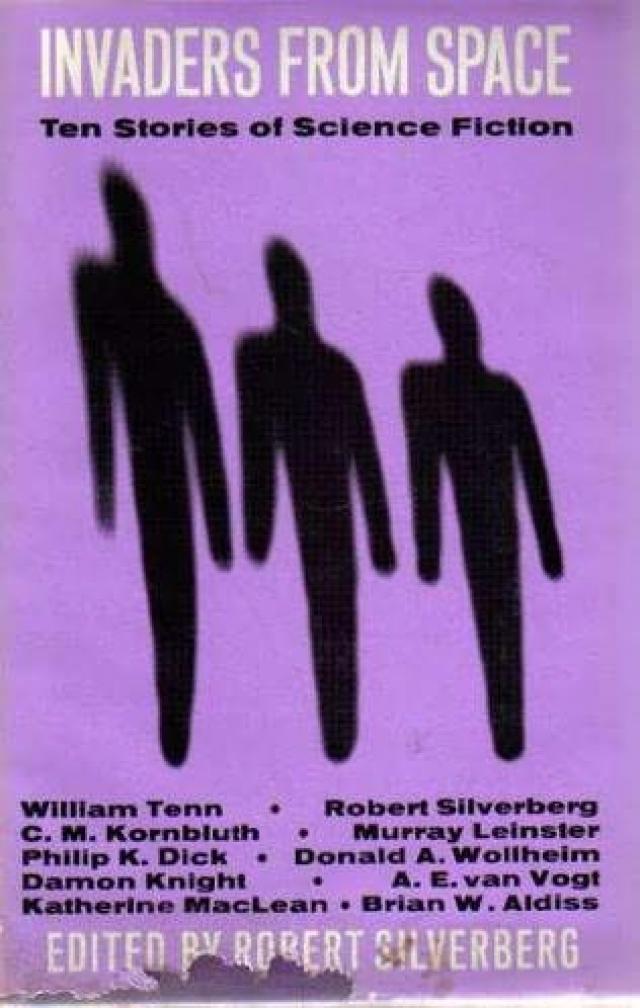
Invaders From Space,
p.20


Country-bred guy, thought the Times. “Jacob Luke, Times” he said, extending his hand.
Nathen gave the hand a quick, hard grip, identifying the name. “Sunday Science Section editor. I read it. Surprised to meet you here.”
“Likewise.” The Times smiled. “Look, have you gone into this rationally, with formulas?” He found a pencil in his pocket. “Obviously, there’s something wrong with our judgment of their weight-to-speed - to - momentum ratio. Maybe it’s something simple, like low gravity aboard ship, with magnetic shoes. Maybe they are floating slightly.”
“Why worry?” Nathen cut in. “I don’t see any reason to try to figure it out now.” He laughed and shoved back his black hair nervously. “We’ll see them in twenty minutes.”
“Will we?” asked the Times slowly.
There was a silence while the senator turned a page of his magazine with a slight crackling of paper and the scientists argued at the other end of the room. Nathen pushed at his lank black hair again, as if it were trying to fall forward in front of his eyes and keep him from seeing.
“Sure.” The young man laughed suddenly, talked rapidly. “Sure we’ll see them. Why shouldn’t we, with all the government ready with welcome speeches, the whole Army turned out and hiding over the hill, reporters all around, newsreel cameras—everything set up to broadcast the landing to the world. The President himself shaking hands with me and waiting in Washington—”
He came to the truth without pausing for breath.
He said, “Hell, no, they won’t get here. There’s some mistake somewhere. Something’s wrong. I should have told the brass hats yesterday when I started adding it up. Don’t know why I didn’t say anything. Scared, I guess. Too much top rank around here. Lost my nerve.”
He clutched the Times man’s sleeve. “Look. I don’t know what—”
A green light flashed on the sending - receiving set. Nathen didn’t look at it, but he stopped talking.
The loud-speaker on the set broke into a voice speaking in the aliens’ language. The senator started and looked nervously at it, straightening his tie. The voice stopped.
Nathen turned and looked at the loud-speaker. His worry seemed to be gone.
“What is it?” the Times asked anxiously.
“He says they’ve slowed enough to enter the atmosphere now. They’ll be here in five to ten minutes, I guess. That’s Bud. He’s all excited. He says holy smoke, what a murky-looking planet we live on.” Nathen smiled. “Kidding.”
The Times was puzzled. “What does he mean, murky ? It can’t be raining over much territory on Earth.” Outside, the rain was slowing and bright-blue patches of sky were shining through breaks in the cloud blanket, glittering blue light from the drops that ran down the windows. He tried to think of an explanation. “Maybe they’re trying to land on Venus.” The thought was ridiculous, he knew. The spaceship was following Nathen’s sending beam. It couldn’t miss Earth. “Bud” had to be kidding.
The green light glowed on the set again, and they stopped speaking, waiting for the message to be recorded, slowed, and replayed. The cathode screen came to life suddenly with a picture of the young man sitting at his sending set, his back turned, watching a screen at one side that showed a glimpse of a huge dark plain approaching. As the ship plunged down toward it, the illusion of solidity melted into a boiling turbulence of black clouds. They expanded in an inky swirl, looked huge for an instant, and then blackness swallowed the screen. The young alien swung around to face the camera, speaking a few words as he moved, made the O of a smile again, then flipped the switch and the screen went gray.
Nathen’s voice was suddenly toneless and strained. “He said something like break out the drinks, here they come.”
“The atmosphere doesn’t look like that,” the Times said at random, knowing he was saying something too obvious even to think about. “Not Earth’s atmosphere.”
Some people drifted up. “What did they say?”
“Entering the atmosphere, ought to be landing in five or ten minutes,” Nathen told them.
A ripple of heightened excitement ran through the room. Cameramen began adjusting the lens angles again, turning on the mike and checking it, turning on the floodlights. The scientists rose and stood near the window, still talking. The reporters trooped in from the hall and went to the windows to watch for the great event. The three linguists came in, trundling a large wheeled box that was the mechanical translator, supervising while it was hitched into the sound-broadcasting system.
“Landing where?” the Times asked Nathen brutally. “Why don’t you do something?”
“Tell me what to do and I’ll do it,” Nathen said quietly, not moving.
It was not sarcasm. Jacob Luke of the Times looked sideways at the strained whiteness of his face and moderated his tone. “Can’t you contact them?”
“Not while they’re landing.”
“What now?” The Times took out a pack of cigarettes, remembered the rule against smoking, and put it back.
“We just wait.” Nathen leaned his elbow on one knee and his chin in his hand.
They waited.
All the people in the room were waiting. There was no more conversation. A bald man of the scientist group was automatically buffing his fingernails over and over and inspecting them without seeing them; another absently polished his glasses, held them up to the light, put them on, and then a moment later took them off and began polishing again. The television crew concentrated on their jobs, moving quietly and efficiently, with perfectionist care, minutely arranging things that did not need to be arranged, checking things that had already been checked.
This was to be one of the great moments of human history, and they were all trying to forget that fact and remain impassive and wrapped up in the problems of their jobs, as good specialists should.
After an interminable age the Times consulted his watch. Three minutes had passed. He tried holding his breath a moment, listening for a distant approaching thunder of jets. There was no sound.
The sun came out from behind the clouds and lit up the field like a great spotlight on an empty stage.
Abruptly, the green light shone on the set again, indicating that a squawk message had been received. The recorder recorded it, slowed it, and fed it back to the speaker. It clicked and the sound was very loud in the still, tense room.
The screen remained gray, but Bud’s voice spoke a few words in the alien language. He stopped, the speaker clicked, and the light went out. When it was plain that nothing more would occur and no announcement was to be made of what was said, the people in the room turned back to the windows and talk picked up again.
Somebody told a joke and laughed alone.
One of the linguists remained turned toward the loud-speaker, then looked at the widening patches of blue sky showing out the window, his expression puzzled. He had understood.
“It’s dark,” the thin Intelligence Department decoder translated, low-voiced, to the man from the Times. “Your atmosphere is thick. That’s precisely what Bud said.”
Another three minutes. The Times caught himself about to light a cigarette and swore silently, blowing the match out and putting the cigarette back into its package. He listened for the sound of the rocket jets. It was time for the landing, yet he heard no blasts.
The green light came on in the transceiver.
Message in.
Instinctively, he came to his feet. Nathen abruptly was standing beside him. Then the message came in the voice he was coming to think of as Bud. It spoke and paused. Suddenly the Times knew.
“We’ve landed.” Nathen whispered the words.
The wind blew across the open spaces of white concrete and damp soil that was the empty airfield, swaying the wet, shiny grass. The people in the room looked out, listening for the roar of jets, looking for the silver bulk of a spaceship in the sky.
Nathen moved, seating himself at the transmitter, switching it on to warm up, checking and balancing dials. Jacob Luke of the Times moved softly to stand behind his right shoulder, hoping he could be useful. Nathen made a half motion of his head, as if to glance back at him, unhooked two of the earphone sets hanging on the side of the tall streamlined box that was the automatic translator, plugged them in, and handed one back over his shoulder to the Times man.
The voice began to come from the speaker again.
Hastily, Jacob Luke fitted the earphones over his ears. He fancied he could hear Bud’s voice tremble. For a moment it was just Bud’s voice speaking the alien language, and then, very distant and clear in his earphones, he heard the recorded voice of the linguist say an English word, then a mechanical click and another clear word in the voice of one of the other translators, then another as the alien’s voice flowed from the loud-speaker, the cool single words barely audible, overlapping and blending like translating thought, skipping unfamiliar words yet quite astonishingly clear.
“Radar shows no buildings or civilization near. The atmosphere around us registers as thick as glue. Tremendous gas pressure, low gravity, no light at all. You didn’t describe it like this. Where are you, Joe? This isn’t some kind of trick, is it?” Bud hesitated, was prompted by a deeper official voice, and jerked out the words.
“If it is a trick, we are ready to repel attack.”
The linguist stood listening. He whitened slowly and beckoned the other linguists over to him and whispered to them.
Joseph Nathen looked at them with unwarranted bitter hostility while he picked up the hand mike, plugging it into the translator. “Joe calling,” he said quietly into it in clear, slow English. “No trick. We don’t know where you are. I am trying to get a direction fix from your signal. Describe your surroundings to us if at all possible.”
Nearby, the floodlights blazed steadily on the television platform, ready for the official welcome of the aliens to Earth. The television channels of the world had been alerted to set aside their scheduled programs for an unscheduled great event. In the long room the people waited, listening for the swelling sound of rocket jets.
This time, after the light came on, there was a long delay. The speaker sputtered and sputtered again, building to a steady scratching through which they could barely hear a dim voice. It came through in a few tinny words and then wavered back to inaudibility. The machine translated in their earphones.
“Tried … seemed … repair …” Suddenly it came in clearly. “Can’t tell if the auxiliary blew, too. Will try it. We might pick you up clearly on the next try. I have the volume down. Where is the landing port? Repeat. Where is the landing port? Where are you?”
Nathen put down the hand mike and carefully set a dial on the recording box and flipped a switch, speaking over his shoulder. “This sets it to repeat what I said the last time. It keeps repeating.” Then he sat with unnatural stillness, his head still half turned, as if he had suddenly caught a glimpse of answer and was trying with no success whatever to grasp it.
The green warning light cut in, the recording clicked, and the playback of Bud’s face and voice appeared on the screen.
“We heard a few words, Joe, and then the receiver blew again. We’re adjusting a viewing screen to pick up the long waves that go through the murk and convert them to visible light. We’ll be able to see out soon. The engineer says that something is wrong with the stern jets, and the captain has had me broadcast a help call to our nearest space base.” He made the mouth O of a grin. “The message won’t reach it for some years. I trust you, Joe, but get us out of here, will you?— They’re buzzing that the screen is finally ready. Hold everything.”
The screen went gray and the green light went off.
The Times considered the lag required for the help call, the speaking and recording of the message just received, the time needed to reconvert a viewing screen.
“They work fast.” He shifted uneasily and added at random, “Something wrong with the time factor. All wrong. They work too fast.”
The green light came on again immediately. Nathen half turned to him, sliding his words hastily into the gap of time as the message was recorded and slowed. “They’re close enough for our transmission power to blow their receiver.”
If it was on Earth, why the darkness around the ship? “Maybe they see in the high ultraviolet—the atmosphere is opaque to that band,” the Times suggested hastily as the speaker began to talk in the young extra-Terrestrial’s voice.
That voice was shaking now. “Stand by for the description.”
They tensed, waiting. The Times brought a map of the state before his mind’s eye.
“A half circle of cliffs around the horizon. A wide muddy lake swarming with swimming things. Huge, strange white foliage all around the ship and incredibly huge, pulpy monsters attacking and eating each other on all sides. We almost landed in the lake, right on the soft edge. The mud can’t hold the ship’s weight, and we’re sinking. The engineer says we might be able to blast free, but the tubes are mud-clogged and might blow up the ship. When can you reach us?”
The Times thought vaguely of the Carboniferous era. Nathen obviously had seen something he had not.
“Where are they?” the Times asked him quietly.
Nathen pointed to the antenna position indicators. The Times let his eyes follow the converging imaginary lines of focus out the window to the sunlit airfield, the empty airfield, the drying concrete and green waving grass where the lines met.
Where the lines met. The spaceship was there!
The fear of something unknown gripped him suddenly.
The spaceship was broadcasting again. “Where are you? Answer if possible! We are sinking! Where are you?”
He saw that Nathen knew. “What is it?” the Times asked hoarsely. “Are they in another dimension or the past or on another world or what?”
Nathen was smiling bitterly, and Jacob Luke remembered that the young man had a friend in that spaceship. “My guess is that they evolved on a high-gravity planet with a thin atmosphere, near a blue-white star. Sure, they see in the ultraviolet range. Our sun is abnormally small and dim and yellow. Our atmosphere is so thick it screens out ultraviolet.” He laughed harshly. “A good joke on us, the weird place we evolved in, the thing it did to us!”
“Where are you?” called the alien spaceship. “Hurry, please! We’re sinking!”
*
The decoder slowed his tumbled, frightened words and looked up into the Times’ face for understanding. “We’ll rescue them,” he said quietly. “You were right about the time factor, right about them moving at a different speed. I misunderstood. This business about squawk coding, speeding for better transmission to counteract beam waver—I was wrong.”
“What do you mean?”
“They don’t speed up their broadcasts.”
“They don’t—?”
Suddenly, in his mind’s eye, the Times began to see again the play he had just seen—but the actors were moving at blurring speed, the words jerking out in a fluting, dizzying stream, thoughts and decisions passing with unfollowable rapidity, rippling faces in a twisting blur of expressions, doors slamming wildly, shatteringly, as the actors leaped in and out of rooms.
No—faster, faster—he wasn’t visualizing it as rapidly as it was, an hour of talk and action in one almost instantaneous “squawk,” a narrow peak of “noise” interfering with a single word in an Earth broadcast! Faster—faster—it was impossible. Matter could not stand such stress—inertia—momentum—abrupt weight.
It was insane. “Why?” he asked. “How?”
Nathen laughed again harshly, reaching for the mike. “Get them out? There isn’t a lake or river within hundreds of miles from here!”
A shiver of unreality went down the Times’ spine. Automatically and inanely, he found himself delving in his pocket for a cigarette while he tried to grasp what had happened. “Where are they, then? Why can’t we see their spaceship?”
Nathen switched the microphone on in a gesture that showed the bitterness of his disappointment.
“We’ll need a magnifying glass for that.”
Heresies Of The Huge God
Brian W. Aldiss
* * *
There are more things in Heaven and Earth than are dreamt of in your philosophy or mine. And, suggests the esteemed British writer Brian Aldiss, if a particularly large thing should happen to descend upon us from Heaven one of these days, the consequences might be distressing.
* * *
I, Harad IV, Chief Scribe, declare that this my writing may be shown only to priests of rank within the Orthodox Universal Sacrificial Church and to the Elders Elect of the Council of the Orthodox Universal Sacrificial Church, because here are contained matters concerning the four Vile Heresies that may not be seen or spoken among the people. For a Proper Consideration of the newest and vilest heresy, we must look in perspective over the events of history. Accordingly, let us go back to the First Year of our epoch when the World Darkness was banished by the Huge God, our truest, biggest Lord, whom all honour and greatly fear.
From this present year, 910 HG, it is impossible to recall what the world was like then. But from the few records still surviving we can gather something of those times and even perform the Mental Contortions necessary to see how the events must have looked to the sinners then involved in them.
The world on which the Huge God found himself was full of people and their machines, all of them unprepared for his visit. There may have been a hundred thousand times more people than there are now.
The Huge God landed in what is now the Sacred Sea, upon which in these days sail some of our most beautiful churches dedicated to his name. At the time, the region was much less pleasing, being broken up into many states possessed by different nations. This was a system of land tenure practiced before our present policies of constant migration and evacuation were formed.