Invaders from space, p.18
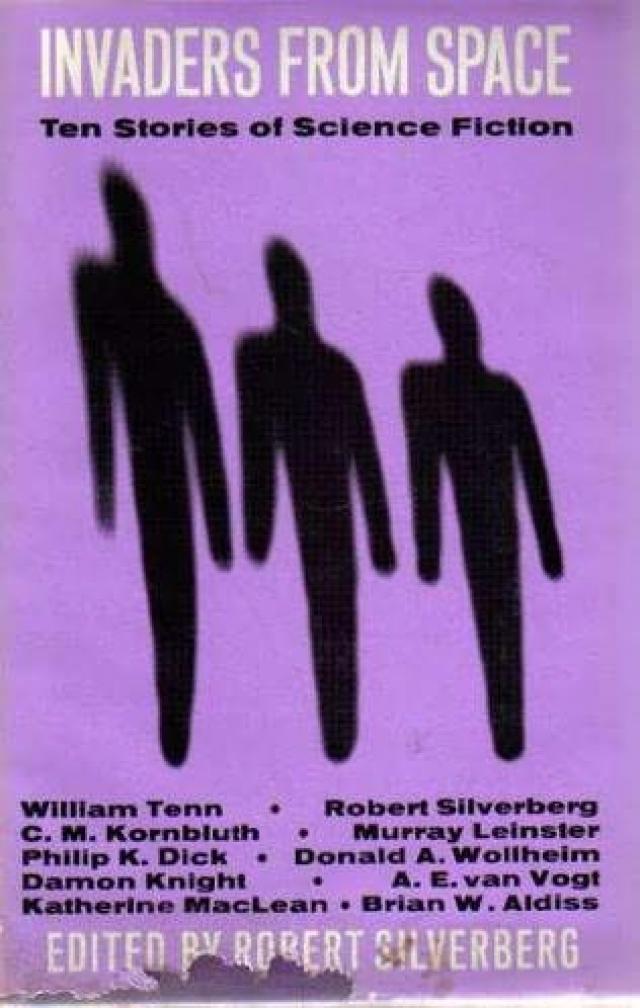
Invaders From Space,
p.18


There was a confused moment while their bubbles formed, when Enash wondered if the two-legged one would try to stop their departure. But when he looked back, he saw that the man was walking in a leisurely fashion along a street.
That was the memory Enash carried with him, as the ship began to move. That and the fact that the three atomic bombs they dropped, one after the other, failed to explode.
“We will not,” said Captain Gorsid, “give up a planet as easily as that. I propose another interview with the creature.”
They were floating down again into the city, Enash and Yoal and Veed and the commander. Captain Gorsid’s voice tuned in once more: “As I visualize it,” through the mist Enash could see the transparent glint of the other three bubbles around him, “we jumped to conclusions about this creature, not justified by the evidence. For instance, when he awakened, he vanished. Why? Because he was afraid, of course. He wanted to size up the situation. He didn’t believe he was omnipotent.”
It was sound logic. Enash found himself taking heart from it. Suddenly, he was astonished that be had become panicky so easily. He began to see the danger in a new light. Only one man alive on a new planet. If they were determined enough, colonists could be moved in as if he did not exist.
It had been done before, he recalled. On several planets, small groups of the original populations had survived the destroying radiation, and taken refuge in remote areas. In almost every case, the new colonists gradually hunted them down. In two instances, however, that Enash remembered, native races were still holding small sections of their planets. In each case, it had been found impractical to destroy them because it would have endangered the Ganae on the planet. So the survivors were tolerated. One man would not take up very much room.
When they found him, he was busily sweeping out the lower floor of a small bungalow. He put the broom aside and stepped on to the terrace outside. He had put on sandals, and he wore a loose-fitting robe made of very shiny material.
He eyed them indolently but he said nothing. It was Captain Gorsid who made the proposition. Enash had to admire the story he told into the language machine. The commander was very frank. That approach had been decided on. He pointed out that the Ganae could not be expected to revive the dead of this planet. Such altruism would be unnatural considering that the ever-growing Ganae hordes had a continual need for new worlds. Each vast new population increment was a problem that could be solved by one method only. In this instance, the colonists would gladly respect the rights of the sole survivor of this world. It was at this point that the man interrupted. “But what is the purpose of this endless expansion?” He seemed genuinely curious. “What will happen when you finally occupy every planet in this galaxy?”
Captain Gorsid’s puzzled eyes met Yoal’s, then flashed to Veed, then Enash. Enash shrugged his torso negatively, and felt pity for the creature. The man didn’t understand, possibly never could understand. It was the old story of two different viewpoints, the virile and the decadent, the race that aspired to the stars and the race that declined the call of destiny.
“Why not,” urged the man, “control the breeding chambers?”
“And have the government overthrown!” said Yoal.
He spoke tolerantly, and Enash saw that the others were smiling at the man’s naivete. He felt the intellectual gulf between them widening. The creature had no comprehension of the natural life forces that were at work. The man spoke again: “Well, if you don’t control them, we will control them for you.”
There was silence.
They began to stiffen. Enash felt it in himself, saw the signs of it in the others. His gaze flicked from face to face, then back to the creature in the doorway. Not for the first time, Enash had the thought that their enemy seemed helpless. “Why,” he decided, “I could put my suckers around him and crush him.”
He wondered if mental control of nucleonic, nuclear, and gravitonic energies included the ability to defend oneself from a macrocosmic attack. He had an idea it did. The exhibition of power two hours before might have had limitations, but if so, it was not apparent. Strength or weakness could make no difference. The threat of threats had been made: “If you don’t control, we will.”
The words echoed in Enash’s brain, and, as the meaning penetrated deeper, his aloofness faded. He had always regarded himself as a spectator. Even when, earlier, he had argued against the revival, he had been aware of a detached part of himself watching the scene rather than being a part of it. He saw with a sharp clarity that that was why he had finally yielded to the conviction of the others. Going back beyond that to remoter days, he saw that he had never quite considered himself a participant in the seizure of the planets of other races. He was the one who looked on, and thought of reality, and speculated on a life that seemed to have no meaning. It was meaningless no longer. He was caught by a tide of irresistible emotion, and swept along. He felt himself sinking, merging with the Ganae mass being. All the strength and all the will of the race surged up in his veins.
He snarled, “Creature, if you have any hopes of reviving your dead race, abandon them now.”
The man looked at him, but said nothing. Enash rushed on, “If you could destroy us, you would have done so already. But the truth is that you operate within limitations. Our ship is so built that no conceivable chain reaction could be started in it. For every plate of potential unstable material in it there is a counteracting plate, which prevents the development of a critical pile. You might be able to set off explosions in our engines, but they, too, would be limited, and would merely start the process for which they are intended, confined in their proper space.”
He was aware of Yoal touching his arm. “Careful,” warned the historian. “Do not in your just anger give away vital information.”
Enash shook off the restraining sucker. “Let us not be unrealistic,” he said harshly. “This thing has divined most of our racial secrets, apparently merely by looking at our bodies. We would be acting childishly if we assumed that he has not already realized the possibilities of the situation.”
“Eruishi” Captain Gorsid’s voice was imperative.
As swiftly as it had come, Enash’s rage subsided. He stepped back. “Yes, commander.”
“I think I know what you intended to say,” said Captain Gorsid. “I assure you, I am in full accord, but I believe also that I, as the top Ganae official, should deliver the ultimatum.”
He turned. His horny body towered above the man. “You have made the unforgivable threat. You have told us, in effect, that you will attempt to restrict the vaulting Ganae spirit.”
“Not the spirit,” said the man.
The commander ignored the interruption. “Accordingly, we have no alternative. We are assuming that, given time to locate the materials and develop the tools, you might be able to build a reconstructor. In our opinion it will be at least two years before you can complete it, even if you know how. It is an immensely intricate machine, not easily assembled by the lone survivor of a race that gave up its machines millennia before disaster struck.
“You did not have time to build a spaceship. We won’t give you time to build a reconstructor.
“Within a few minutes our ship will start dropping bombs. It is possible you will be able to prevent explosions in your vicinity. We will start, accordingly, on the other side of the planet. If you stop us there, then we will assume we need help. In six months of travelling at top acceleration, we can reach a point where the nearest Ganae planet would hear our messages. They will send a fleet so vast that all your powers of resistance will be overcome. By dropping a hundred or a thousand bombs every minute, we will succeed in devastating every city so that not a grain of dust will remain of the skeletons of your people.
“That is our plan. So it shall be. Now, do your worst to us who are at your mercy.”
The man shook his head. “I shall do nothing now!” he said. He paused, then thoughtfully, “Your reasoning is fairly accurate. Fairly. Naturally, I am not all powerful, but it seems to me you have forgotten one little point. I won’t tell you what it is. And now,” he said, “good day to you. Get back to your ship, and be on your way. I have much to do.”
Enash had been standing quietly, aware of the fury building up in him again. Now, with a hiss, he sprang forward, suckers outstretched. They were almost touching the smooth flesh when something snatched at him.
He was back on the ship.
He had no memory of movement, no sense of being dazed or harmed. He was aware of Veed and Yoal and Captain Goisid standing near him as astonished as he himself. Enash remained very still, thinking of what the man had said: “… Forgotten one little point.” Forgotten? That meant they knew. What could it be? He was still pondering about it when Yoal said: “We can be reasonably certain our bombs alone will not work.”
They didn’t.
Forty light-years out from Earth, Enash was summoned to the council chambers. Yoal greeted him wanly. “The monster is aboard.”
The thunder of that poured through Enash, and with it came a sudden comprehension. “That was what he meant we had forgotten,” he said finally, aloud and wonderingly. “That he can travel through space at will within a limit, what was the figure he once used, of ninety light-years.”
He sighed. He was not surprised that the Ganae, who had to use ships, would not have thought immediately of such a possibility. Slowly, he began to retreat from the reality. Now that the shock had come, he felt old and weary, a sense of his mind withdrawing again to its earlier state of aloofness. It required a few minutes to get the story. A physicist’s assistant, on his way to the storeroom, had caught a glimpse of a man in a lower corridor. In such a heavily manned ship, the wonder was that the intruder had escaped earlier observation. Enash had a thought.
“But after all we are not going all the way to one of our planets. How does he expect to make use of us to locate it if we only use the video…” he stopped. That was it, of course. Directional video beams would have to be used, and the man would travel in the right direction the instant contact was made.
Enash saw the decision in the eyes of his companions, the only possible decision under the circumstances. And yet, it seemed to him they were missing some vital point. He walked slowly to the great video plate at one end of the chamber. There was a picture on it, so sharp, so vivid, so majestic that the unaccustomed mind would have reeled as from a stunning blow. Even to him, who knew the scene, there came a constriction, a sense of unthinkable vastness. It was a video view of a section of the milky way. Four hundred million stars as seen through telescopes that could pick up the light of a red dwarf at thirty thousand light-years.
The video plate was twenty-five yards in diameter, a scene that had no parallel elsewhere in the plenum. Other galaxies simply did not have that many stars.
Only one in two hundred thousand of those glowing suns had planets.
That was the colossal fact that compelled them now to an irrevocable act. Wearily, Enash looked around him.
“The monster has been very clever,” he said quietly. “If we go ahead, he goes with us, obtains a reconstructor, and returns by his method to his planet. If we use the directional beam, he flashes along it, obtains a reconstructor, and again reaches his planet first. In either event, by the time our fleets arrived back here, he would have revived enough of his kind to thwart any attack we could mount.”
He shook his torso. The picture was accurate, he felt sure, but it still seemed incomplete. He said slowly, “We have one advantage now. Whatever decision we make, there is no language machine to enable him to learn what is it. We can carry out our plans without his knowing what they will be. He knows that neither he nor we can blow up the ship. That leaves us one real alternative.”
It was Captain Gorsid who broke the silence that followed. “Well, gentlemen, I see we know our minds. We will set the engines, blow up the controls, and take him with us.”
They looked at each other, race pride in their eyes. Enash touched suckers with each in turn.
An hour later, when the heat was already considerable, Enash had the thought that sent him staggering to the communicator, to call Shuri, the astronomer. “Shuri,” he yelled, “when the monster first awakened, remember Captain Gorsid had difficulty getting your subordinates to destroy the locators. We never thought to ask them what the delay was. Ask them… ask them.”
There was a pause, then Shuri’s voice came weakly over the roar of the static. “They… couldn’t… get… into the… room. The door was locked.”
Enash sagged to the floor. They had missed more than one point, he realized. The man had awakened, realized the situation; and, when he vanished, he had gone to the ship, and there discovered the secret of the locator and possibly the secret of the reconstructor, if he didn’t know it previously. By the time he reappeared, he already had from them what he wanted. All the rest must have been designed to lead them to this act of desperation.
In a few moments, now, he would be leaving the ship, secure in the knowledge that shortly no alien mind would know his planet existed. Knowing, too, that his race would live again, and this time never die.
Enash staggered to his feet, clawed at the roaring communicator, and shouted his new understanding into it. There was no answer. It clattered with the static of uncontrollable and inconceivable energy. The heat was peeling his armoured hide as he struggled to the matter transmitter. It flashed at him with purple flame. Back to the communicator he ran shouting and screaming.
He was still whimpering into it a few minutes later when the mighty ship plunged into the heart of a blue-white sun.
Pictures Don’t Lie
Katherine MacLean
* * *
Short stories by Katherine MacLean are infrequent events in the world of science fiction, and new ones generally receive an enthusiastic welcome. Her work is distinguished by clean, unfancy prose, by imaginative plotting, and by a happy habit of thinking every situation through to its logical ultimate conclusion—traits that may all be seen in operation in the present tale of an alien invasion.
* * *
The man from the News asked, “What do you think of the aliens, Mr. Nathen? Are they friendly? Do they look human?”
“Very human,” said the thin young man.
Outside, rain sleeted across the big windows with a steady, faint drumming, blurring and dimming the view of the airfield where They would arrive. On the concrete runways the puddles were pockmarked with rain, and the grass growing untouched between the runways of the unused field glistened wetly, bending before gusts of wind.
Back at a respectful distance from the place where the huge spaceship would land were the gray shapes of trucks, where TV camera crews huddled inside their mobile units, waiting. Farther back in the deserted, sandy landscape, behind distant sandy hills, artillery was ringed in a great circle, and in the distance across the horizon bombers stood ready at airfields, guarding the world against possible treachery from the first alien ship ever to land from space.
“Do you know anything about their home planet?” asked the man from the Herald.
The Times man stood with the others, listening absently, thinking of questions but reserving them. Joseph R. Nathen, the thin young man with the straight black hair and the tired lines on his face, was being treated with respect by his interviewers. He was obviously on edge, and they did not want to harry him with too many questions at once. They wanted to keep his good will. Tomorrow he would be one of the biggest celebrities ever to appear in headlines.
“No, nothing directly.”
“Any ideas or deductions?” the Herald persisted.
“Their world must be Earthlike to them,” the weary-looking young man answered uncertainly. “The environment evolves the animal. But only in relative terms, of course.” He looked at them with a quick glance and then looked away evasively, his lank black hair beginning to cling to his forehead with sweat. “That doesn’t necessarily mean anything.”
“Earthlike,” muttered a reporter, writing it down as if he had noticed nothing more in the reply.
The Times man glanced at the Herald, wondering if he had noticed, and received a quick glance in exchange.
The Herald asked Nathen, “You think they are dangerous, then?”
It was the kind of question, assuming much, that usually broke reticence and brought forth quick facts—when it hit the mark. They all knew of the military precautions, although they were not supposed to know.
The question missed. Nathen glanced out the window vaguely. “No, I wouldn’t say so.”
“You think they are friendly, then?” said the Herald, equally positive on the opposite tack.
A fleeting smile touched Nathen’s lips. “Those I know are.”
There was no lead in this direction, and they had to get the basic facts of the story before the ship came. The Times asked, “What led up to your contacting them?”
Nathen answered, after a hesitation, “Static. Radio static. The Army told you my job, didn’t they?”
The Army had told them nothing at all. The officer who had conducted them in for the interview stood glowering watchfully, as if he objected by instinct to telling anything to the public.
Nathen glanced at him doubtfully. “My job is radio decoder for the Department of Military Intelligence. I use a directional pickup, tune in on foreign bands, record any scrambled or coded messages I hear, and build automatic decoders and descramblers for all the basic scramble patterns.”
The officer cleared his throat but said nothing.
The reporters smiled, noting that down.
Security regulations had changed since arms inspection had been legalized by the U.N. Complete information being the only public security against secret rearmament, spying and prying had come to seem a public service. Its aura had changed. It was good public relations to admit to it.