

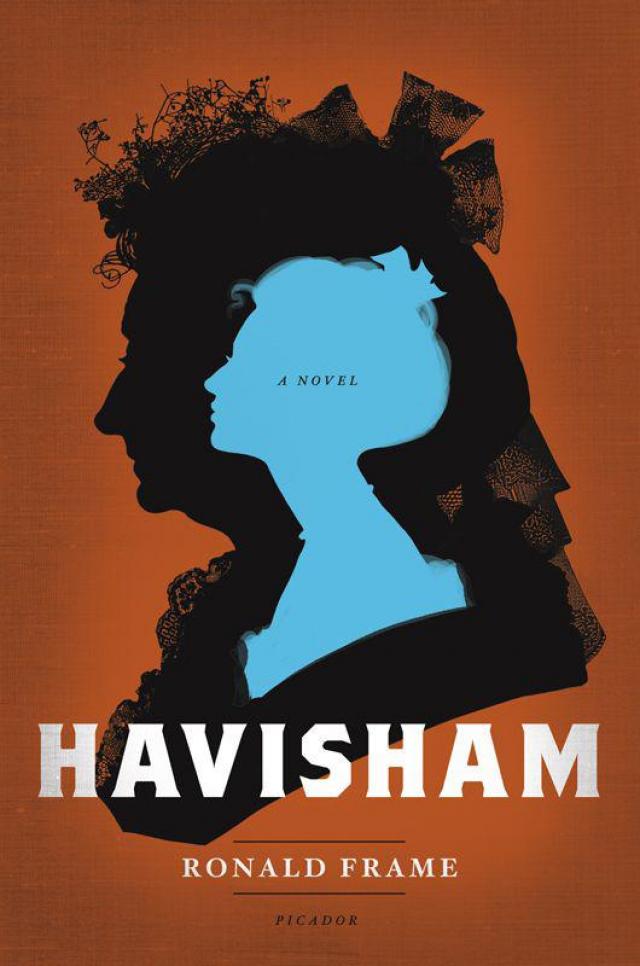
Havisham a novel, p.18
Havisham: A Novel,
p.18


Some days dawn with the trees and the rooftops already in situ, settled. The cranes in the brewery yard are cranes, the furniture in my room is solid and neither warm nor cold when I touch it. Other days, I roll out of bed and I’m in a tilting room. The floor runs away from me, and yet somehow – what magic is this? – the furniture clings on. The trees are gowned and stooped dons, and the rooftops are the lecterns they lean against, and the cranes aren’t cranes but arcane hieroglyphics, devilish script like the positioning of the windows and doorways in the brewhouse.
* * *
A crack is growing in my bedroom wall. It eats the old green silk paper, and now the fissure is wide enough in places to push a finger into. Plaster pulverises and trickles down inside the wall, for an age. The crack is a river traversing some vast deep, dark forest. I call into the gap and the sounds are scattered for miles; they snag on the topmost branches of trees too tiny to see.
How soon hath Time, the subtle thief of youth,
Stol’n on his wing my three-and-twentieth year!
My my …
A face rimous, crumbling, like the facade of an abandoned palace.
My hasting days fly on with full career,
But my late spring no bud or blossom showeth
* * *
Rain and wind have shaken the cherry trees to broken wire umbrellas.
* * *
And they haven’t washed the powder off me.
It hangs in my hair, like a nest for rats.
The powder has gathered about my body in folds of skin, drifting, solidifying between my toes.
Perfumed and sweet has turned musky and sour. I smell of unassuaged longing, and of accumulated bitterness.
‘If I’d worn green…’
‘I’m sorry, I didn’t catch –’
‘Green. Like the Immortals. They wore green.’
‘Who?’
Ignorance darkens the world, clouds of unknowing.
‘Oberon. Titania. Puck. Living forever. If I’d worn green…’
‘Rest now, miss –’
‘Oh, there’ll be time to rest afterwards.’
Decades of time. Centuries. Millennia.
* * *
I sit in the sun. The old walls trap the heat. Butterflies flit and flutter about the garden, scribbles of colour on the gassy air.
I sit in the sun watching the butterflies, and picking at a loose thread on my dressing-gown sleeve. The grass grows beneath my feet, and the earth sings.
A slow fly lands on the toe of my right shoe. I turn my foot in every direction, I stamp my shoe on the ground to shake off the fly, I shout at the interloper until it’s finally dislodged.
A window sash is raised in the house. I angle my head to see. I can hear them talking about me, not what they’re saying but the sibilant voices: droning, buzzing, cleverly drifting past my ear on the currents of air.
A ring of cathedral bells, carried over the wall.
I close my eyes. I command the bells to stop.
And lo, they stop.
The air clears of that complication. I open my eyes.
Butterflies are flitting and fluttering about the garden, like pastel scribblings. The air trembles. A slow fly lands on the toe of my left shoe, I turn my shoe in every direction, I stamp my foot on the ground, I shout at the fly …
* * *
I didn’t want to think that the Chadwycks might have known better than I.
I didn’t want to think at all.
But of course I would wake and catch him slipping out of my mind, with a backward glance and what might have been a smile on his face.
* * *
I asked if there had been any word of him.
‘Of who, miss?’
‘“Of whom”,’ I corrected them. ‘Who else d’you suppose I’d be talking about?’
There was no message from him, no communication from any third party, no clue as to his whereabouts.
The trail had gone cold.
Nothing.
* * *
A man in a golden mask. He turns round. On the reverse of his head, which might be the back or the front, is another face, in silver.
‘Eat, Miss Havisham. Can’t I tempt you to a tasty morsel? No? Miss Havisham –?’
‘It’s been a beautiful day.’
‘I’m sorry –?’
‘Oh, so am I. My trap among the gigs. But now, gentlemen, I think I’ve had an ample sufficiency.’
‘Please sit still –’
‘I really have to go now.’
‘– Miss Havisham –’
‘They’ll be expecting me.’
‘Who will? Who is expecting you?’
‘I … I can’t…’
‘No one, Miss Havisham.’
‘But…’
* * *
Later.
They feed me sorbet de crème. Because it is considered strengthening for the digestive system. Eating cream ices will help me to live to a ripe old age. (Six egg yolks to two pints of double cream: can this be true?)
There’s one flavoured with orange blossoms, and another with cherry kernel, and a third type with greengage.
The Italians stay clear of contagion this way. It’s a delicious conceit, and almost worth getting better for. Almost.
Sitting in the cafes of Paris, which I’ve read about: the Dubuisson by the Comédie, or the Caveau in the Palais Royal, or its neighbour the Foy, where I perch on a chair in the palace gardens. Picking genteelly at my pyramid of ice while I wait, wait for someone who never comes.
* * *
‘But leave the breakfast. Leave the breakfast.’
I must have had such fury in my voice, they knew not to disobey me.
The wedding feast remained where it was, set out on the extended dining table. If I were to lose that, I would be abandoning all hope.
* * *
In those first twenty-four hours, half of my hair had turned white with shock. I was left with a thick streak of white, which raced through the fair like a wave, roared like a flame. I had turned middle-aged overnight.
Nobody would have wanted to marry me. It was as if time had speeded up without mercy, and shown me the person who’d been hidden inside all along. I would have caught up with her, but not for another twenty or thirty years.
She was so cruelly different from me. The white bolt in her hair gave her eyes a hunted, obsessive look, as if the visible mattered much less than the mind’s dark fancies. She terrified me, because I also knew (in a clearer part of my brain) that she had no separate existence behind the mirror’s plane of wintry glass.
THIRTY-TWO
I ambled about the house, for hours on end, wearing only a loose sack gown and shawls. I waited for night, until I saw the watchmen’s brazier lit, and then trod circuits of the brewery yard. From the garden I watched dawn come up over the rooftops of the town. I walked for many miles without leaving the policies. Ceaselessly I was turning matters over in my mind, the how and why and what to do next.
The news must have travelled far and wide by now.
About the Havisham girl down in Kent. Queerest thing. Left standing at the altar.
It would be talked about for weeks, months. Remembered from years away. A very rum to-do there was, once upon a time, a brewery heiress in a Medway town, jilted on her wedding day she was.
They wouldn’t know exactly, but somehow they would never have forgotten.
* * *
I’d had my wedding dress hung on the hessian mannequin. The veil was draped over three chairs. Nobody had been allowed to touch the dressing table. My powders and combs were where I’d left them. The lid was still raised on the jewellery casket, and all the items to hand as they’d been that morning. Beside it was the other white satin slipper I’d been on the point of fitting on to my right foot.
Only the letter was missing. How it had been lost I didn’t know, and wasn’t going to enquire.
I had the dressing room locked. I removed myself to a bedroom on the other side of the house. I had no dressing room there, but all I meant to do with my life was work at brewery business. What time would I have now for the vanities of dressing up?
* * *
Once I was installed again in my father’s office I put on a sober dress and a very little jewellery, to appear my most purposeful.
But I noticed straight away the change in Tice.
For one thing, the smirk as he sauntered into the room. He sat down without being requested to do so; I stared at him until my displeasure was fully plain to him, and he got to his feet.
In that conversation and the ones to follow he didn’t allow me to forget that he’d taken on himself proctorship of the brewhouse in my absence.
He seemed to believe that we met now on altered terms: that he was privy to Havisham business as never before. (I realised he would have been able to acquaint himself with the contents of the ledger books in the Compting House.)
I attempted to put him right about that, without directly putting the man down. I couldn’t decide if he was being deliberately obtuse, or truly didn’t perceive my point. The former, I concluded, given that sly canny look of his.
I was obliged to be less subtle.
‘I fear you may be under a misapprehension…’
He bit his lip, otherwise he might have spoken his mind. As it was, his remarks became terser, without the encumbrance of grammar: single-word responses sometimes, or a ‘yes’ or a ‘no’. Not even a ‘miss’ to acknowledge my authority. Whenever I dismissed him, after informing him of my wishes, he would hold back for a few moments before turning to leave, as if he was awaiting some change of heart in me. I didn’t care for his expression: a wily reminder to me, I-know-a-thing-or-two.
The men, I heard through Mr Ambrose, were wanting to be ‘consulted’.
‘Who’s put that notion in their heads? Tice, let me guess.’
Mr Ambrose nodded.
‘Did my father allow “consultations”? We’ll have a revolution on our hands before we know where we are.’
I shook my head. It was the spirit of the times, but I was damned if I was going to entertain it here in Crow Lane.
‘Quite out of the question. You might intimate as much to them, Mr Ambrose. However you judge best.’
‘Very well, Miss Havisham.’
‘Someone respects the name! Thank God for that.’
* * *
The ordinary labourers – the semi-skilled men (and a few women) – were the most docile. The cooperage foreman was a calming influence, and probably the chief storehouse clerk. They had too much to do perhaps, those stokers and yeastmen, the spare-men and drawers-off. (The draymen and horsekeepers were mostly loyal, but several wavered.)
However, our esteemed superintendent of the brewers, Tice, was winning over some of the clerks in the Compting House, including the abroad-men I used to patrol my empire.
I had books from the Compting House brought in to my office, and I pored over them, believing them less and less as I scoured the entry columns for signs of tampering. I scrupulously examined every blot, every repeated stroke of the pen. I compared single numerals for consistency. I checked and double-checked for errors in the sums and subtractions, which involved hours more of that close work.
They presumed I’d lost the knack, if I’d ever had it. I wasn’t just a woman, I was a madwoman.
But the figures didn’t add up, the entries on one page failed to tally with those on the next – and they imagined I wouldn’t notice. The emendations appeared to have been made in various hands, so there must have been a more complex conspiracy afoot.
I might have banged the table and watched them jump out of their skins. Instead, when I was asking questions I dropped my voice and addressed my enquiry little louder than a whisper, and I hoped it made their flesh creep.
Who was responsible I couldn’t tell. Maybe it didn’t matter who. If I were to replace them all, I should have had to test the loyalty of their successors. But the brewery couldn’t prosper on mismanaged figures, with a proportion of the profits being siphoned out by whoever was clever enough to get away with it. Now I was appreciating for the first time the magnitude of this endeavour I had taken on, which had the makings of a moral crusade.
* * *
I didn’t immediately understand what he was meaning.
‘I don’t follow you, Mr Ambrose –’
When I did, I couldn’t curb my temper.
‘You dare to suggest such a thing?’
‘But only Mr Compeyson was permitted to –’
‘That’s a slander.’
Why on earth was I defending the man? What possible reason could I have?
‘Take back that accusation. At once.’
‘I would if I could, Miss Hav—’
‘At once, d’you hear me?’
‘I can’t. I’m sorry.’
‘You will be sorry.’
‘It’s my considered opinion.’
Whatever else Charles Compeyson had been, and done, I hadn’t doubted that he’d supported me here.
I told Mr Ambrose, with just a brief quaver in my voice, in that case – if he was refusing to resile – I must inform him that I, and Havisham’s, had no further need of his services.
* * *
A notice in the newspaper. The engagement was announced between the Honourable William Chadwyck and Lady Frances Tresidder.
I enquired about the name ‘Tresidder’. They were a Cornish family, owners of tin mines. For two generations they had lived in a mansion built by one of Queen Bess’s favourites.
Satis House had once entertained Elizabeth. It was she who had given rise to the name, after thanking her host for his abundant hospitality. That Cornish mansion must have been grander than Thurston Park, and tin mines an even better prospect than brews of ale.
Had I seen W’m’s fiancée-to-be when I was still accounted one of them, the Durley Set? Had she been persuaded to visit the hermitage with him? No, probably not; that was by very special invitation only.
Thespis had turned everyone into practised actors, all of us except myself perhaps: so adept at not betraying our private purposes and designs.
* * *
I wore the darkest clothes I had, short of mourning. I felt that light didn’t involve me for the present, either entering me or being expelled. I was a woman of business and nothing else. I left off powder and my other applications. I dressed my hair plainly. I chose a few older items of jewellery, those passed on to me. Havisham heirlooms. Others might have judged that time had taken the shine of desirability off them. But their value to me now was as tokens of my lineage, unshowy symbols of the legacy I embraced.
I spoke for les fondateurs venerables, those original Havishams no longer with us.
* * *
The ledgers continued to divulge secrets from the time of the Compeyson stewardship, so called.
I requested that Mr Jaggers send someone to help me go through the books: he confirmed that, yes, there had been consistent meddling. An attempt had been made to disguise handwriting, but he would wager it was by the same person.
At first I told myself it must have been the work of an unknown, intended to reflect badly on the man I had elected to be in charge, my fiancé. But it took this Londoner, interpreting the evidence for me as he viewed it with outsider’s eyes, to convince me finally of the unwelcome truth of the matter.
I had kept to the old method whereby surplus grains and the residue in the tuns were sold off, for cattle-fodder and as fertiliser. He – whose name I couldn’t bring myself to speak – had terminated the existing and long-established arrangements and made his own, presumably more profitable, ones (although the figures were deliberately obfuscated in the accounts).
He might have attempted to affect the means of production – by cutting costs, by altering temperatures and quantities and durations, mixing brews – but I would have been bound to hear about that. (Using wild yeast, say, would have foxed the beer and caused infection.) Instead he had confined himself to petty frauds on the housekeeping: reselling returned (stale) beer, buying an amount of used oak casks in any batch of new, even – I had trouble believing it – having the draymen collect the horses’ dung on their rounds and taking a two-thirds cut for himself on what was sold.
It was pathetic.
Worse, though. Mr Ambrose had suspected he was holding up on credit, and may have been dealing with individual publicans who had the misfortune of bad debts. That was the next matter I must investigate.
* * *
Meanwhile …
They wanted me to restore the full-time jobs. They also wanted the average of working hours reduced.
I told them we were fighting for custom with our competitors. Everyone was looking for ways to trim costs. If I reduced general working hours, there would need to be pay cuts.
Tice appeared with a delegation.
‘We know what price the barrels are being sold at.’
‘I can’t think who’s told you. But the manufacturing costs have risen, doubled.’
‘Brewers are like farmers. They never run at a loss.’
‘Who says? Look, beer duties up twenty-five per cent. Malt tax, three hundred per cent more.’
‘But is there a loss –?’
‘Quart pot of ale. It’s been fourpence for how many years. Now suddenly it’s sixpence. There are breweries up for sale all over the country.’
‘Not this one, though.’
‘Because I’m looking for fresh suppliers all the time.’
‘That’s what he was trying to do. Mr Compeyson.’
‘I’m in charge now.’
‘Isn’t he coming back?’
‘No. No, he’s not. I’m master.’
Tice spoke. ‘Don’t you mean…’ He paused for full effect. ‘… “mistress”?’
All their eyes crossed tracks. Smiles, but no actual laughter. They will repeat the remark all evening long, and with each new mention the tone of voice will become more caustic.
‘Whichever,’ I said, ‘there can only be one of them.’
They seemed disinclined to believe me.
* * *
I had written Mr Ambrose three letters. The third brought him back to the Compting House. I led him through to my office.


