

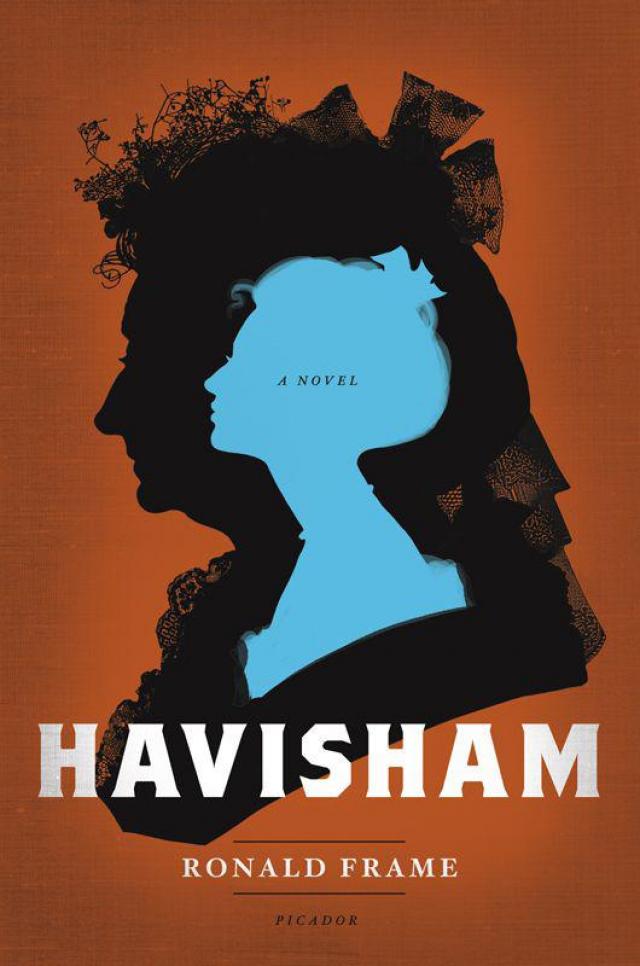
Havisham a novel, p.9
Havisham: A Novel,
p.9


Astonished, I picked them up on the tip of my finger. I was puzzling on the silver motes when I noticed some mud trails on the front outside of the cape, at hem level along the bottom. Not quite fresh mud, but not dried either: a few hours old.
I reminded myself, I should check Sally about wearing my clothes without asking me. Politely, almost casually, because she was my friend. But the speckles of silver leaf were what fascinated me. As if I must have started to dream about him already, and there – in a light scattering – amazingly was the actual evidence of my mind’s fancy.
FIFTEEN
As soon as I walked into Satis House I knew something had changed. No riding cloak, no boots, no crop, none of Arthur’s discarded effects. No stink of tobacco, or snuff. Arthur was living out.
‘There’s been a parting of the ways,’ my father said.
The lawyer Mr Snee was involved, because my father had decided he must change his will.
‘He’s not disinherited outright. There’s something for him. But only a minding.’
There had been terrible tantrums from Arthur, and those had put my father into a rage.
‘I had no alternative. “You’ll drain us dry,” I said. His spending was much worse than I thought.’
‘Is he coming back?’
‘I have no way of telling.’
‘It’ll be like old times.’
Not really, I realised, a moment after I’d said it. In times past, I hadn’t known my father was remarried, nor that I had a half-brother.
‘He knows where to go to receive his keep.’
My father picked up items of correspondence which awaited his reply. He coughed his chest clear. Then he fixed his spectacles on his nose to read with, and reached out for his pen. Back to business.
* * *
Along the Backs. The willows drooped down to the water and skimmed the surface. Dragonflies hovered in the blue air. The grazing cattle lowed in King’s meadow. Laughter, a woman’s and a man’s, trailed down from Clare Bridge. The bridge was beautiful but slightly askew, which made me think – as we drifted beneath it, through the small but suddenly dank tunnel of arch – that Moses had been right: beauty does always leave itself something short of perfection.
But my brief sobriety lifted as we re-emerged into sunshine. I felt I wanted to do no more than glance, dance, along the placid surface of this present time.
* * *
When we sat down to the play, on benches set out on duckboards in the college lea, the evening sun was still shining.
‘Built for your Ease and Pleasure, Sirs, behold,
This Night, our little Stage its Scenes unfold.
Here, to the Muse, your fav’ring Smiles afford:
Bid Genius flourish, and on Fancy’s wing
Mounted aloft, hear sweetest SHAKESPEAR sing!’
Time flew past. A wood near Athens. Another part of the Wood. Theseus’s Palace. A room in Quince’s House. I liked the Immortals best – Oberon, Titania, Puck, and the fairies – wearing their elfin green. I laughed as the love potion was sprinkled on sleeping eyelids, a juice to ‘make man or woman madly dote upon the next live creature that it sees’.
Later, a chill started to seep up from the pasture-grass. A shiver passed through the trees. Act V. The conclusion was in sight, but all would not be resolved to every character’s satisfaction.
Some of the players had to clear their throats, cough out croaks. Dampness must have got into the scenery, because corrugations were appearing on the painted backdrop of Theseus’s Palace. After the last lines one of the actors – Bottom unmasked – came forward to speak, to send us on our way.
‘Precepts from hence with ten-fold Vigour dart,
And seize thro’ Eyes, and Ears, the captive Heart.
Be VICE abash’d then, and be VIRTUE bold;
Be honour ever free, and never sold!
Protect the Stage on this determin’d Plan,
And prove that Reason is the Test of Man.’
* * *
We started to make our way back to W’m’s rooms, across the lawns. My feet felt wet through my shoes. A bright moon shone. The air was filled with our banter, our laughter, someone’s philosophical exegesis. At one point I was walking beside W’m, but he seemed oblivious. Now I felt nothing either, and I wondered at that person I had been. He was busy talking to someone, not about Plato or Tibullus, but about one of his Surrey neighbours, Lucinda Osborne, teasing out information as adeptly as if he were playing a fish.
We followed the river. On the opposite bank, boldly illuminated by moonlight, I noticed a young woman stand listening to us. She twisted her head on one side to hear. Then she started walking. Down the embankment, to a small sliver of strand.
She continued to walk, and I kept looking, wondering why she didn’t stop.
Into the river.
The water rose to her knees, then to her waist.
She kept on taking steps. A stumble on the stones at the bottom, but she stayed upright.
Now the water came up to the level of her chest.
(And the oddest thing, the detail I noted in these moments that seemed so slowed out of true, suspended from the rules of ordinary time: the young woman was wearing a hat.)
Moses was shouting down at her, then the others. Mouse screamed at her to stop, stop. Moses was first to go running down the bank, followed by two or three of the men. W’m held Sheba and Mouse close beside him. The woman had water up to her neck. Her face had a curiously seraphic and peaceful expression, she seemed to be smiling – smiling quite inconsequentially – over at us.
I was still supposing she was playing some queer game when her face disappeared beneath the water. (The hat on her head became detached: it was left floating while her face blurred palely beneath the surface. A straw hat with a scarlet ribbon and a white wax flower, adrift by moonlight.)
Moses had thrown off his coat and waistcoat and dived in. A hole exploded in the river. He swam out.
It was at the widest part of the river. By the time he reached the spot, the woman had disappeared from view. Moses reached down, tried grabbing, wrestled with the woman’s limbs, which were becoming caught in weed.
From the bank it was all quite clear and candid to us. Huge events occupied only a very few seconds. Time stuttered.
Another two had gone swimming out, arms thrashing. They helped Moses haul the woman back ashore. The shore watchers were afraid to touch her. Her eyes were open, staring up at the moon in the sky. She still wore the expression of beatific certainty.
But the person she’d been was now a corpse. The skin seemed to be turning blue, like rich ripe cheese.
Moses, in sodden clothes, was praying for her soul. Something about the gesture, Moses’s fervent bravery in the face of a terrible fact – or maybe the passion being wrung from a hopeless situation – moved me deeply. I was crying before I realised it. Sheba stared, transferring some of her horror at the night’s tragedy on to me.
Next day we discussed it endlessly among ourselves.
While the others talked, I watched from the window. Suddenly Cambridge appeared very small to me. A collection of beautiful tended gardens, enclosed by high excluding walls. Beneath a high, vaulting, indifferent fenland sky.
But yet the more we search, the less we know,
Because we find our work doth endless grow.
For who doth know, but stars we see by night
Are suns which to some other worlds give light?
Moses was saying even less than I was. It was as if a part of him were temporarily absent, attending the dead woman’s spirit.
I looked up at one point. He was staring across at me. Curiously, after his athletic heroism of the day before, his face now showed fear.
We avoided each other for the rest of that day and evening. By the next day he was coughing and sneezing, speaking through a blocked nose. I fetched him handkerchiefs and concocted a hot toddy for him to drink.
‘Why d’you think she did it?’
I told him I had no idea. He seemed disappointed that I shouldn’t know.
‘A broken heart,’ I suggested.
‘Do people suffer so much?’
‘For love? Oh, I imagine so.’
‘To drown herself?’
‘Why does that astonish you? Dido threw herself on the flames.’
‘In legend.’
‘And real life’s different?’ I asked.
‘Cursed creature.’
‘Hmm.’
‘Bedlam Bess.’
‘Aren’t you meant to pity her?’
He was staring at me again, how he had done earlier.
More sneezes.
A knock at the door. Another friend’s younger sister, asking if she could be of any help.
All this uncritical devotion to Moses. Even the memory of his vain dash to try to save the woman couldn’t temper my impatience.
I thought of that seraphic face, prepared for death, and I made mine the opposite. I pursed my lips drily, crinkled my nose.
Moses was watching me, deeply confused.
I felt it must be magnetic repulsion, this failure of mine – which shamed me a little – to wreathe him with honour as his devotees did.
SIXTEEN
‘And again!’
Sheba pointed.
‘Your Mr Compeyson. Well, well!’
When it was time for us to pass each other, he was ready with a smile. He nodded at my fan.
‘Hold on to that.’
Mouse whisked me away, with a vigour that surprised me.
‘You haven’t met all W’m’s friends, have you, Catherine? Here’re some more…’
* * *
There was an opportunity for a dance. I couldn’t locate my partner on my card, and he came up to me shortly after the music started, telling me he had been let down by his, would I please do him the honour?
It was a fast gavotte. We managed to keep up. I was out of breath by the end, though; I felt that normally I wouldn’t have been.
It was Moses’s turn next, for a more sedate old-fashioned minuet, and I wished it wasn’t. He tried too earnestly hard, treating it as another abstruse subject he should master. But dancing takes a certain lightness, a spring in the step, an elasticity in the calves; a kind of joie de vivre, or alternatively a leavening element of self-proclaiming stupidity in one’s make-up. It wasn’t Moses’s forte.
‘You show me,’ he mouthed at me.
I simulated incomprehension. He was trying to uncover my true talents, the few there might be, and buoyed up by the music and by my previous dance I didn’t intend to be patronised. I made my steps so deft and elegant, so sylph-like, but so deceptively simple, that I knew he would appear all the more of a clod.
* * *
After that ‘my Mr Compeyson’ was at the majority of the Assemblies and house-parties I went to with the Chadwycks. I could see the pleasure he took from my companions’ irritation, to find, hell and damnation, here was somewhere else he’d managed to get himself invited to. It was an entertainment for him, to see if the Chadwycks could ignore his presence for an entire evening. It was a divertissement for me, and literally, to continue acknowledging his presence, so that only he should be aware – furtive glances, and holding myself side on, and allowing a smile for someone else to become (over their shoulders) a smile intended really for him.
* * *
He wasn’t au fait with Virgil, or The Sorrows of Young Werther, or Clementi’s keyboard sonatas. But he had an incomparable mastery of racecourse runners and their riders. He had an infallible recall of their past showings, and on that he based his predictions of future form.
John Pond’s daughter, Miss Pond. Captain Shafto. Hugo Meynell, ‘Hunting Jupiter’. Lord Clermont in scarlet, Mr Panton in buff. Bunbury, pink and white stripes, the Dundas white with scarlet spots. Brown Queensberry, crimson Grafton, straw silk for Devonshire.
‘I’m the memory man.’
I couldn’t judge his tone of voice. I was a little flustered.
‘Of course,’ I said, obeying no logic, ‘Dido, she couldn’t forget.’
He smiled blankly.
‘The queen,’ I said. ‘Of Carthage.’
‘Poor old biddy. What couldn’t she forget?’
‘Oh…’ I shrugged, embarrassed. ‘It doesn’t matter. It’s just a myth.’
‘Best left to the artists, then. Painters, sculptors, that sort.’
‘Purcell.’
The name so revered at Durley Chase became entangled with nearby laughter. He was saved from having to reply, and I thought I caught a flicker of relief pass across his smoothly, evenly handsome face.
* * *
‘Coincidences happen,’ Sheba said. ‘But not that often.’
‘Sometimes,’ Moses began, ‘we’re too close to something, it’s really out of focus, it gets distorted –’
‘Nothing’s distorted,’ I snapped back.
‘It’s all right, Catherine,’ Mouse put in.
‘Something’s got under your skin,’ Sheba said.
W’m laughed.
‘That’s what friends are for,’ Sheba said.
‘I don’t know what they’re for,’ I told her.
‘So that we don’t get out of our depth,’ Mouse said.
‘So they’ll let us know –’ Sheba leaned closer, ‘– if we’re likely to make a tiny little fool of ourselves. Warn us if it looks as though we might be heading for a fall.’
I wouldn’t have tolerated a remark of that kind from anyone except Sheba: and even then, scarcely from her. I was furious with them all. I could either let them see that, or convince them of the opposite.
I knew what they were thinking. ‘My Mr Compeyson’ wasn’t our sort of person. Too forward, too familiar, and who had ever heard of a tribe with that name? I found myself smiling at them, but it was done with a cold heart.
Mouse slipped her arm under mine, then Sheba. W’m raised one eyebrow (as eyebrows always are raised) quizzically. Moses looked as unhappy as I felt; he was still thinking of the drowned girl.
* * *
But they couldn’t stop me; they wouldn’t keep me from him. There were always opportunities in an evening, and I was as adept as him at seeking them out.
A father who’d been a doctor at sea. A mother who didn’t keep well. Several siblings.
A harsh school somewhere in the West, attended by sons of mainly naval and military families.
An anticipated inheritance from a Scottish relative reneged upon.
Introductions from old school friends. Other people’s parties, in all the fashionable towns: Exeter, Salisbury, Nottingham, Chester, York, Tunbridge.
‘I’m obliged to do a little work too, I’m afraid. Norfolk way. To earn a living for myself.’
‘You shouldn’t apologise. Work is honest and true.’
‘That’s your father’s philosophy?’
‘No. It’s my own experience. I now realise that it is.’
And – before I could think to stop – I found myself telling him how it would give me no little pleasure at Durley Chase, but a private satisfaction I didn’t declare to them, to consider how back home I saw wealth make itself: how I smelt it in the rooms of Satis House when the windows were open on the yard side and I could hear the men at their unremitting labour.
When I was physically close to him – as I used to be with W’m, only more so now – I was aware of an energy that was transmitted from him.
I felt like adamant, impelled by a magnet; the hardness of my substance no longer signified, against the power of that attraction.
* * *
He remembered whatever I told him. He had complete recall. It was uncanny. The memory man. He could anticipate what I was going to say next. He seemed to have read the libretto of my thoughts beforehand.
He knew things, as if I must have told him but had forgotten that I’d told him. Only Sally previously had been granted such a degree of intimacy as I realised – without quite intending it – he enjoyed now, with the most elusive details of my life: my most personal past, my feelings, my dreams.
No Latin, no Dido and Aeneas.
(‘Why learn to speak like people who’ve been dead for a thousand years?’
‘Nearly two,’ I said.)
No Purcell.
(He whistled tunes he heard at the theatre, or which he heard the travellers at the racecourses playing on their fiddles and squeezeboxes.)
Again it was a reprieve for me, from too much sheer mental drudgery – not to have to come up with bons mots, or to weave the maxims of great men into my conversation.
* * *
‘On the 20th, you see, Escape was at two to one. Field of four, over two miles. Coriander, Skylark, Pipator, they all beat him. On the 21st, field of six, over six miles. Escape was four to one and five to one. Chifney had twenty guineas on the second race, not the first. Both were his rides. Escape raced past the favourite, Chanticleer, came home well to the front.’
Now – and I was to tell him honestly – what did I think of that?
* * *
‘But if he has all these friends…’ I objected.
‘Well, it’s an art,’ Mouse said, ‘I grant you.’
‘What is?’
‘Collecting friends. Only, I should say, they’re not.’
‘Not what, Mouse?’
‘Not friends, not properly. He drops their names, and they’re too well-mannered – most of them – to show Charles Compeyson the door. They suffer him –’
‘No, Mouse. That can’t be –’
‘– suffer him, because it seems everyone else does too, and we all hate to be different.’
‘Don’t they like him?’
‘He just isn’t one of them. He doesn’t belong to the past.’
‘You don’t like him either.’
‘I prefer to trust people.’


