

Havisham a novel, p.28
Havisham: A Novel,
p.28


I have to wear a shift. A simple shift of white cotton.
When I try to take it off, the girl calls out, ‘For pity’s sake, madam…’
White. As my wedding gown once was.
There are no mirrors here, except conscience.
* * *
I disprove their expectations. (‘Any day now surely, it can’t be for much longer…’)
One doctor or the other shuffles in, he examines me, shuffles out again.
They’ve doused my burns. Either the burns ache and keep me awake, or – mysteriously – I have no sense of them at all.
Sometimes I suppose that this business concerns me. And at other times it isn’t of the least significance to me; I’m flying above it, trailing my white shift like a proper angel.
‘If I’d worn green…’
‘I’m sorry,’ the girl says, ‘I didn’t catch –’
‘Green. Like the Immortals. They wore green.’
‘Who…?’
(Ignorance darkens the world.)
‘Oberon. Titania. Puck. Living forever. If I’d worn green…’
‘Rest now, Miss Havisham –’
‘Oh, there’ll be time to rest.’
Decades. Centuries. Millennia.
* * *
Estella places her hand on the counterpane.
I place my swaddled hand on top of hers.
She looks at it, and seems surprised. Or is she surprised to be feeling, in my exposed fingers, the ungentle, primitive grip of a dying woman?
‘I saw Mr Pirrip leaving.’
‘I’ve been asleep.’
‘He sat beside you for a while.’
I hold her hand captive, and she allows me.
‘In his novel,’ I say to her, ‘he will want me to die earlier. He will be evasive on the point. But you will know how it was.’
* * *
Mr Jaggers’s hand reaches inside his jacket. From a pocket he extracts a folded sheet of newspaper.
‘You have something you wish to show me, sir?’
He unfolds as much of the page as is relevant and lays it flat on the table top.
He steps back.
‘I shall leave it there, Miss Havisham. You can peruse it when I’m gone. Or have it read to you, by someone who has no inkling.’
‘Today you’re a delivery boy?’
He withholds his smile.
‘Won’t you explain?’ I ask him.
He puts his head on one side.
‘It is a private business, I think. What is recorded there.’
‘I see.’
My voice is baked. I force a smile, and it seems to me that he sorrows to see it.
‘I beg your pardon,’ he says. ‘If you judge I’ve done wrong.’
I nod.
‘Surely granted, my old friend.’
He smiles gratefully at that, looking not at me but at his famously peremptory index finger.
‘Some madeira, sir? Sherry wine and biscuits? Nothing better for the spirits on a frosty autumn afternoon.’
‘The afternoon is fine, Miss Havisham. And warm. We’re still in summer.’
The watch strikes in his pocket, and I’m back in the garden of Satis House hearing the cathedral bells in our ancient town fall across the vanished grey mornings of my life long ago.
* * *
Found drowned, the newspaper report tells me. Downstream on the Thames.
The deceased, one by the name ‘Compeyson’, with a long criminal record.
Not magniloquently, not romantically drowned. Not in a barque called Ariel, not capsizing in a summer storm.
Not like that.
But following a brawl with an escaped convict who bore a deep grudge, and churned beneath the paddles of the Rotterdam steamer, the life thrashed out of him.
Blood frothing the spume. A flotsam of soft swollen pulpy matter, muscle tissue and brain jelly …
His face has vanished completely from my recollection. I have no tears for him. I can’t cry, even for myself. A destroyer such as he, who is destroyed in his turn, he’s owed no grief.
* * *
Drowned. The location ought to have been that majestic and most serene city, at Carnaval time. He would have been wearing a mask. Its features are smooth and settled, untroubled. His youth is gilded. There isn’t a single defect on the face: if you disregard the eyes, that is, where the horror lives on, gelled into place, but only until the fish start nibbling for their supper.
These dear-bought pleasures had I never known,
Had I continued free, and still my own;
Avoiding love, I had not found despair,
But shar’d with savage beasts the common air.
Like them a lonely life I might have led,
Not mourn’d the living, nor disturb’d the dead.
* * *
After that, I suppose I – I too – must have died. It was a slow, tranquil drift. I lost the use of my legs, my feet, my arms, my hands, my fingers.
The struggling soul was loos’d, and life dissolv’d in air.
* * *
I continued to think, though.
Thought carried me over. From the bed, through the glass of the window, into the branches of the tree. Not literally, or the thrush would have flown; how I had lain in bed placing myself there for the past few days, but now I had nothing to bring me back. No pain, no drag of old bones, no thunder of blood in my temples.
I was somehow myself, or the disembodied essence afloat in the tree’s greenery. The thrush still sang, undisturbed.
VI
VALEDICTION
FORTY-SEVEN
Estella – in half-mourning – sits by candlelight four or five feet away from the cheval glass in her bedroom. She sits straight-backed, just as she was taught. She stares at her reflection, turning her head this way, that way.
The candles illuminate the damage, all down the left side of her face. Swollen patches of yellow, purple, and – on her jaw line – black. Her husband has hit her repeatedly, and hard.
Delicately she presses the tips of her fingers on the skin, as if she might shape it back into its correct contours. She winces, but she carries on, fascinated by the gruesome spectacle and by the pain of it. Rather than look away, she confronts her battered self with tears in her eyes.
‘Are you satisfied?’ she asks, although there is no woman in a wedding dress to answer her now.
What her upbringing in Satis House amounted to was the bleakest, most accidental kind of self-knowledge.
She somehow knows, by an intuition developed in Satis House, that for her guardian the terrifying awareness of what she had caused to happen came too late to alter anything. Catherine Havisham, even as she looked helplessly on at this marriage, was spared learning the worst.
* * *
Three years later.
Estella puts on one of the necklaces. Pink diamonds and fire rubies. This was one of Antoinette Havisham’s favourites. She picks up the hand mirror, engraved on the back with a baroque ‘H’, outsized for the taste of the day.
The necklace’s heavy gold filigree is likewise rather too fussy, but (she wonders to herself) the stones could be reset, couldn’t they, into a simpler arrangement? And what about the South Sea pearls?
She checks that the pearls are there, in the box where she placed them last time. It has come to her attention that several items have gone missing. Her husband is surely responsible, but naturally he blamed a maid, who was dismissed – and when the pilfering continued, of the same swanky types of trinket and bauble as before, another maid was accused and given her marching orders.
Either the bijoux have been passed on to some trollop, or he sells the pieces and uses the proceeds as petty cash for his gambling.
She should be angrier; she should at least – to his face – implicate him in the thefts, if not accuse him of doing the light-fingered deed himself. But the business of removing the gee-gaws keeps him occupied, and the female company and the habitués of the gaming tables distract him in other ways, possibly relieving her of more frequent roughings-up.
* * *
It’s six months since Drummle roared into death, after flogging the life out of his horse.
Dressed in the same half-mourning she wore for her guardian, Estella picks up a newspaper. She knows, even before she finds the words in the first paragraph, what it will say: which London bank it is that has failed.
She drops the newspaper, the room is turning turtle. Rising from her chair she loses her balance, she grabs hold of the curtain. The curtain pulls away from its rail and time slows as she falls forward, goes crashing down to meet the floor.
* * *
Ask for Mr Pirrip in the Crispin & Crispianus and they would point to that man with thinning hair and a Cairo complexion. But no one does ask for him. He keeps to himself, on a settle at the back of the pub.
He has lost his boyish looks. There’s an old burn mark from a fire on his neck. His brow carries the deep creases of someone who dwells too much in his thoughts. From his manner you would gather that he lives alone; he wears a wedding band, but the gold is lustreless and the ring is sunk into the flesh of his finger. He makes a drink last. It’s to eavesdrop that he comes in, to hear tales of the town as it used to be, two or three generations ago.
No one recognises him from his childhood. They could tell from his smooth, surprisingly plump hands that he hasn’t had to earn his living by manual labour. His hands show their real skill whenever he uses a pencil to dash down his observations or an overheard remark into the notebook he tucks back into his pocket.
He stares into the flames. What he sees is what he remembers, or what he thinks he remembers. He has the shape of a story in his head, and trims his details to fit.
There are different versions of the story, though. One story, with – he believes – three viewpoints.
Estella’s. His. The madwoman’s.
* * *
Ten years on from her lowest point, when she lost her home, Estella stands on a terrace. Supported by a walking cane, she watches her children and their friends on the lawn beneath.
Her hair shows grey. The paving on the terrace is crumbling, but there isn’t enough money on a doctor’s salary to make any repairs that aren’t essential. She is conscious of how reluctant she is to give herself to this moment, or to any moment. Her husband is a very nonpareil of patience; he treats her more kindly, she thinks, than she deserves.
She turns one of the rings on her fingers. A Havisham ring. Some of the remaining jewellery from Rochester days has had to be sold, discreetly. She hopes they might land a small windfall somehow or other, to tide them over.
They’ve lived in Shropshire since they were married. She doesn’t move in the same county circles as she would have done once. Her former friends – no, ‘acquaintances’ is what they were – deserted her gradually when news of her first husband’s violence got about. People started to think she was unlucky.
Maybe she was. Maybe she is.
Henry stridently, nobly, believes the best of her.
But – but she can feel her face going slack when, as now, there is nobody about to see, when the children are too far and making too much noise to notice.
She thinks often of that woman, and of her childhood in that big gaunt house. She feels bitterness towards her, and she feels pity too, and she becomes exhausted trying to balance her feelings. It’s as if the woman is still around, even on a mild late summer’s afternoon like this one: using the cover of the children’s voices to come closer, to creep up on her, to listen to the thoughts in her head.
She can shut her eyes and clasp her hands to her head to shut her out, but it doesn’t do: her visitor won’t go. So she stands there, swaying on her feet – unsteady on the uneven paving stones, until she feels she’s ready to swoon – and she knows she isn’t alone. Her past is just a shadow’s length behind her.
She spent long enough under that cursed roof, inside Satis House, to be able now to speak Catherine Havisham’s words for her. Death might have stolen the breath from old Havisham’s daughter, but he hadn’t concluded her narrative.
‘I only ever wanted to protect you, Estella mine, nothing else; I didn’t wish anyone to harm you. This is love: forget hearts and flowers and billets-doux. Love proclaims truest in adversity.’
* * *
In after years the contents of Satis House were scattered about several counties, sold at auctions or already in the hands of pawnbrokers or debt-collectors.
Furniture and effects continued to change hands. They were displayed in shop windows, with coded price tags attached: an ebonised cabinet; a marquetry commode; a canteen of engraved cutlery.
Showy stuff, it was called. Little featured in the text books on Georgian style. It was considered second-generation, semi-arriviste taste of its time.
The objects may have been less inanimate, however, than on first appearance.
A sideboard door creaking open – the secret drawer in a writing desk shooting out – the chime of a fish-tailed cartel clock which had once been stopped at twenty minutes to nine – reflections moving across the back of a silver spoon – the rasp as the frame of misted mirror in a triptych tilted upwards.
They were restless, and some supposed that the objects were trying to summon back their grander past. To others, it was as if a ghostly spirit haunted them. To others still, the items might have been trying to pass on a lesson: that the former owners of these things had suffered for them, and had also loved and laughed, and here – in a window display, or at the back of an auctioneers’ dusty sale-room – was the result.
* * *
In the branches of the tree, while the thrush sings its solitary song, Catherine Havisham has her final thought.
It all passes in the world, at least.
This is her summons to leave.
To fresh woods now, in Elysium.
The moment has come as it will, for her as for everyone, at its due time.
If I had a mantle blue, I would twitch it.
And so – away!
ACKNOWLEDGEMENTS
In the past I have – stoically, I reckoned – eschewed those extensive authors’ thank-you’s which have become the norm.
I should know to be more modest, and more realistic, and to fit in with my times. I owe many debts of gratitude.
With this novel you hold in your hands, or are reading on a screen, I wish to acknowledge full credit to publisher Stephen Morrison; his assistant, Peter J. Horoszko; managing editor Kolt Beringer; and their brilliant colleagues at Picador USA.
Also to editors Mary Morris and Lee Brackstone and the very dedicated team at Faber & Faber in London. To Adrian Searle, who restored my faith in literary agents, and to Matthew Bates at Sayle Screen, who has loyally stood by me.
What splendid company I’m lucky enough to keep!
Havisham was a drama, broadcast on BBC Radio 3.
Chambers Concise Dictionary provided information on the name ‘Estella’.
ABOUT THE AUTHOR
RONALD FRAME was born in Glasgow, Scotland, and educated there and at Oxford University. He is also a dramatist and winner of the Samuel Beckett Prize and the UK TV Industries’ Most Promising Writer New to Television Award. Many of his original radio plays have been broadcast by the BBC. His novel The Lantern Bearers was longlisted for the Man Booker Prize, named the Scottish Book of the Year, and cited by the American Library Association (Barbara Gittings Honor Award). He lives outside Glasgow.
This is a work of fiction. All of the characters, organizations, and events portrayed in this novel are either products of the author’s imagination or are used fictitiously.
HAVISHAM. Copyright © 2012 by Ronald Frame. All rights reserved. For information, address Picador, 175 Fifth Avenue, New York, N.Y. 10010.
www.picadorusa.com
www.twitter.com/picadorusa • www.facebook.com/picadorusa
picadorbookroom.tumblr.com
Picador® is a U.S. registered trademark and is used by St. Martin’s Press under license from Pan Books Limited.
For book club information, please visit www.facebook.com/picadorbookclub or e-mail marketing@picadorusa.com.
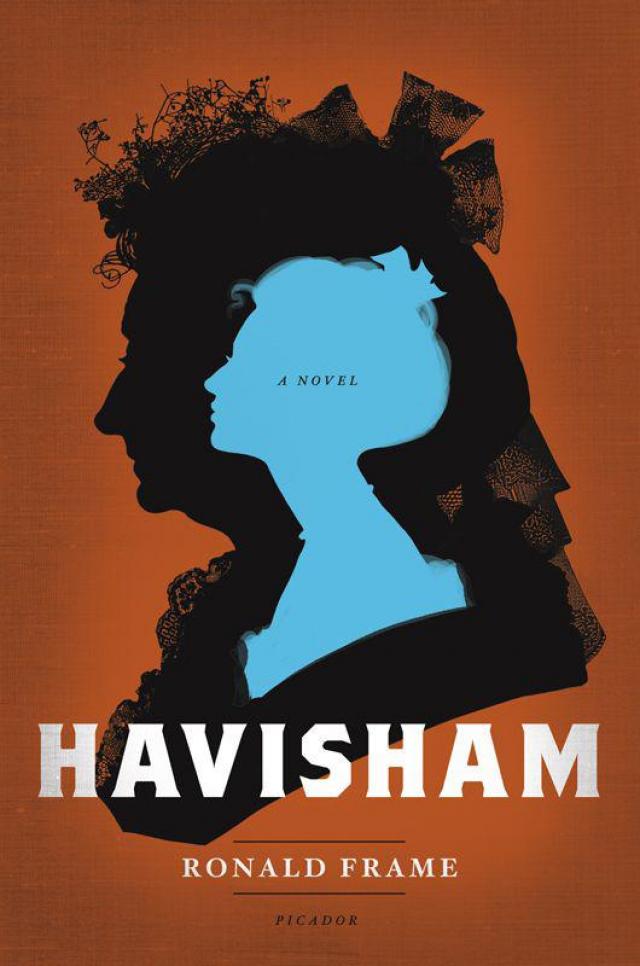
Cover design by Henry Sene Yee
Cover illustration by Alan Dingman
The Library of Congress has cataloged the print edition as follows:
Frame, Ronald.
Havisham / Ronald Frame.—First U.S. edition.
pages; cm.
ISBN 978-1-250-03727-5 (hardcover)
ISBN 978-1-250-03729-9 (e-book)
1. England—Social conditions—19th century—Fiction. I. Title.
PR6056.R262H38 2013
823'.914—dc23
2013003787
eISBN 9781250037299
Originally published in Great Britain by Faber and Faber Limited
First Picador Edition: November 2013
Ronald Frame, Havisham: A Novel


