

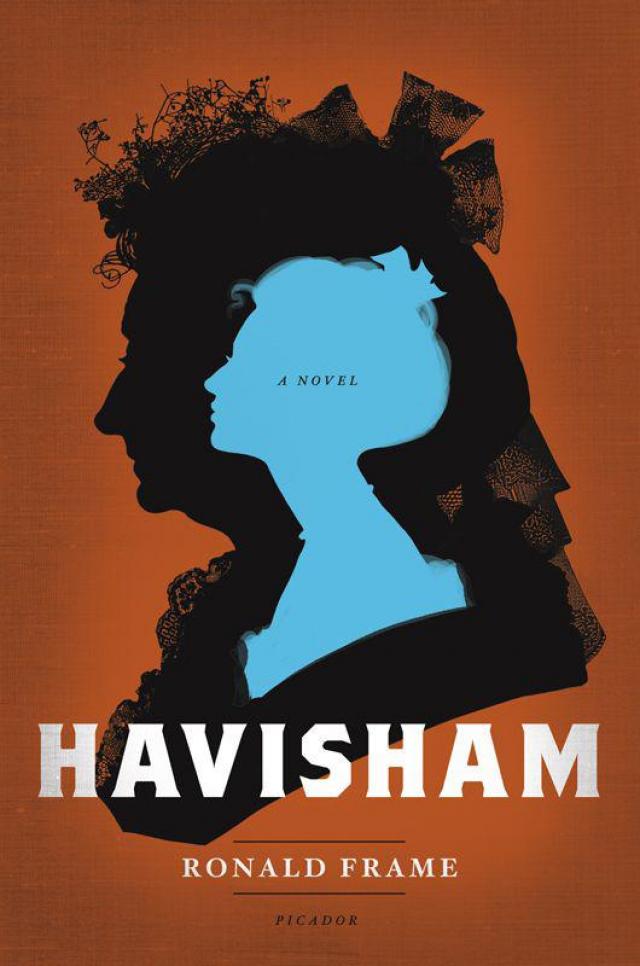
Havisham a novel, p.25
Havisham: A Novel,
p.25


My voice broke. Pip, pushing my chair, stopped quite still, drew sharply on his breath, as if he’d heard a banshee cry.
I listened to a falling echo of Estella’s voice in my own. And then I realised she was speaking to us from the doorway.
‘What’s this, what’s this…?’
She was smiling brightly: too brightly, as if she also was on edge.
‘… Is this how we welcome back Sir Hotspur?’
* * *
‘One day, he told me, he wants to write a novel.’
Estella paused to laugh.
‘Imagine – once a blacksmith’s boy!’
But she was giving him her time. If he were just a blacksmith’s boy, what would be the sense of that? It was because he could talk of such things, of writing a book, that she was exercised by the possibilities: just what he might make of himself in the future.
‘A novel, you say?’
‘He says. Yes.’
‘He’s got all that going on inside his head?’
‘Well, I expect he would base it on something.’
‘Such as?’
‘Something real. A place. The people he encounters. That academy he attends. If he ends up at university, or becomes a lawyer. Us.’
And so Estella helped me put my finger on it: why at another level I had instinctively distrusted Philip Pirrip. He had the ready charm of one who would betray you.
I’d been able to tell straight away that the forge was no more than an accident of birth. He was clever, he was one of that sort who can think themselves out of their initial lot in life, he learned quickly from watching others.
Our lives are fictions. How others interpret us. What we allow others to do with us. What we make of ourselves. What we fancy, make believe, we might do.
* * *
Now Estella wouldn’t automatically launch into an account of her travels. I was required to ask her questions, and she would reply. Some answers were quite full; others came slowly and were incomplete, I had to try wheedling them out of her.
She made me wait, playing on my curiosity, baiting me. She did it with a semblance of inattention she had been cultivating in the Assembly Rooms of southern England and northern France, all the while smoothing out the travel creases on her dress and twisting the ringlets of her hair round one finger.
In France she’d come of age, and the party had gone on long into the night; I was dealing now with someone, a bona fide adult, who considered me – not warmly – across a metaphorical channel, from the other far shore.
* * *
Why did she wound me like this?
All that I had given her, and the little that I looked to her to give me in return …
Where was the justice?
But who ought to have known better than I the uselessness of such reasoning? There was no fairness, there never is, so I shouldn’t seek to find it.
* * *
She mentioned a name I recognised. ‘Drummle’. It jarred with me. A few sentences further on, I took her back to that earlier point in the conversation.
‘Drummle?’ she repeated. ‘Yes, that’s right. Why?’
‘The Somersetshire Drummles?’
‘I’ve no idea. He didn’t mention anything about –’
‘You didn’t enquire? Afterwards?’
‘No. Should I have?’
‘Not if it wasn’t important to you.’
‘It’s important to you?’
‘Whatever concerns yourself, Estella…’
‘You know of him?’
‘It’s only the name.’
‘Am I to pay him attention in the future? Is that what you mean?’
‘I didn’t mean anything –’
‘I dropped my fan, and he picked it up for me. There.’
Fans, gloves. Oh Estella, don’t you realise, that’s the very oldest trick in the book.
* * *
‘He once came here,’ I said at dinner.
‘Who did?’
‘The Drummle boy.’
‘Are we still on about him?’
‘I merely point it out to you.’
I watched her push the food around on her plate. Doubtless we didn’t provide fine enough fare now.
‘He came with his great-aunts, the Wilcoxes.’
‘Why?’
‘Why what?’
‘Why did he come?’
‘He was brought here. To play with you.’
‘I can’t remember it.’
‘You were very young at the time.’
‘He didn’t say.’
She turned away.
‘Didn’t he?’ I asked her.
‘No.’
‘I wonder why.’
‘Because he must’ve forgotten.’
‘Surely not. Surely not.’
‘I don’t see why –’
‘How would that be possible?’ I said.
‘What be possible?’
‘That he could ever have forgotten meeting you? Not Estella Havisham.’
* * *
Pip assisted me to my feet. I could feel the vigour of youth in him, it passed along his arm. He smelled of soap. He scrubbed his skin, until it shone. He washed his hair before he came. Brushed under his fingernails.
He was a picture of cleanliness and good health. I watched him, smelt him, felt his vitality. He was no taller than average, carried no excess weight, but he was robust, foursquare. If I leaned more heavily against him, he didn’t waver. He volunteered every time, proffering me his arm, and we would set off, around the dining room. Round and round.
The table was a tempest sea of cobwebs, rising like waves over crystal jugs and plate-stands, all breaking around that great lopsided scar, the centrepiece, the cake which would have been kept until last at the feast.
The cobwebs tugged over skerries, layers of cobwebs, tides and riptides. I clung on to my pilot, and he steered me. We would discuss Estella. He thought she was ridiculing him, pillorying him. But he was taking her abuse manfully, or he pretended he was. I could tell that he had already forgotten what his existence had been like without Estella. She was an exquisite addiction, one that was slowly poisoning him.
* * *
I said the name to Estella. ‘Drummle’. But she immediately started talking about something else, a family quite unconnected, as if she hadn’t heard me.
When I repeated the name, she couldn’t ignore me.
‘Have you encountered the Drummle fellow again?’
She hesitated, and looked away.
‘Which fellow is that?’
‘His name was Drummle, you told me.’
‘Did I?’
‘You haven’t crossed paths with him again?’
‘I can’t have.’
She was looking past me, at the tubs and phials on my dressing table. Everything was in its customary place. She knew that the powder was replenished, and the fragrances in the bottles replaced. The presentation on my dressing table was a symbol. It would be twenty minutes to nine for ever, but – in order to be symbolic – the moment had to be reconstructed, and that meant replenishing and replacing but taking care that the containers weren’t moved, that the unworn slipper remained where it always was. It wasn’t a lie, what she saw: it was an artful illusion.
She had learned from my example. Her insouciance was what she intended me to see at this juncture, but she was having to work hard to maintain it. Perhaps she did resort to blatant untruths, but youth will always lack the subtlety which experience can bring to its cunning.
* * *
‘It’s Mr Pirrip again, miss, downstairs. Says he begs your indulgence.’
He came because he adored her. His eyes followed her everywhere, they didn’t let her alone for a moment: unless I knocked my cane on the floor, and spoke so loudly that he couldn’t fail to hear.
‘I’m sorry, Miss Havisham –?’
You will be, sir, you will be.
A navy was launched for the sake of one woman’s face. So why shouldn’t a facsimile gent risen from a blacksmith’s forge be turned head over heels?
I sometimes thought that I disappointed him. He would have liked me to be more of a ‘Miss Havisham’ than I was. Had he been directing me in a play, he would have heightened the effects. I should have laid the whole house waste, and not just the dining room. There wouldn’t have been any retainers coming and going. He would have had chains on the front doors. Every room in the building would have been shuttered. I would have treated Estella as my prisoner, had her permanently under lock and key.
* * *
Not all was left to the imagination, though. A sapling protruded from a window in the old brewhouse. Birds flew in and out of the building. The debris of smashed rooftiles from many storms lay in the yard.
The lettering on the wall had worn away; the green had washed out. The name was on the point of disappearing; it seemed to be doubting its own existence, or its ever having existed.
* * *
At first I hinted, but Estella was clearly being obtuse, and then I had to address the issue more directly. The Drummle men had never been known for considerateness to their women. They didn’t look after their money. They had hearty appetites.
‘Appetites?’ she repeated.
‘For life,’ I said.
She looked at me for a few seconds, puzzled. Something occurred to her, and her brow corrugated in folds. Then, just as suddenly, the folds vanished as she sent those moody thoughts packing; her face lightened because she had already – so soon – forgotten the need of my minding.
* * *
To Pip, I was his benefactress. Who else could it have been? I was the only wealthy person of his acquaintance, and he supposed he must know whoever had chosen to fund the lush mode of living he enjoyed.
He came back, to be humiliated again and again at Estella’s hands. Did he think this was the penance to be paid for his progress in the world?
* * *
I was on the street side of the house, by a shuttered window, when I heard the high-stepping trot of a brace of harness horses. For several moments I was returned to the brewery days, when I would stand by an open window waiting to hear the first footfalls of his sleek horses, and the singing springs of the phaeton’s suspension. My heart would be wound tight like clockwork, so tight that it hurt.
The horses this day stopped outside the gates. The bell on the wall was rung, impatiently, three, four times. A pair of feet in outdoor clogs hurried across the yard to open the gate.
I heard Estella’s voice, clipped and peremptory, before she turned to whoever had delivered her to me in their fast carriage. Perhaps she was explaining that I was a recluse, or was ill, and apologising for me, and all the time hoping her driver wouldn’t persist in wanting to meet me. She must have been persuasive on this occasion, and in my mind’s eye I saw her enter the yard alone behind her luggage, snapping her orders.
The carriage was being turned in the street. The horses whinnied on their close reins. A blasphemous cry, ‘Jesus wept!’, not in any coachman’s accent. Then the man made off, at the same brisk trot and, past the first narrow corner, whip-cracked the horses into a young blood’s madcap canter.
Her charioteer had brought her all this way.
Could his name be Drummle, by any chance?
She must have made an impression on him. With anyone else I would have been glad; in this case I was more troubled, to dwell on the risks I ran in sending out such an accomplished and desirable young woman to do my old witch’s sorcery for me.
* * *
In Estella my love lived on. But I imagined it as a love grown wise in its own dark way.
She knew not to make the mistakes that I’d made. She knew now to keep her love pure and – because no man was deserving of it – her own secret.
She would play at love, like the actress she was. She would convince her admirers, but it would only be a performance, a charade.
Take them as far as you can, Estella – and then, beautifully, abandon them.
Use your will to, finally, deny them.
Make them endure agonies.
Rule their hearts, and savour your sovereign victory.
You will only ever know your own strength through the spectacle of others’ weakness.
* * *
I was greedy for whatever news she might give me. I snatched at it, I wolfed it down.
My ambassadress, with her irrefutable credentials. Furred and bejewelled, and on her face an expression of the most professional inscrutability.
The cruel warrior that she also was laid out her scalps before me.
The names were all recognisable to me from Durley talk. She had no compunction about who they were, her admirers, how high she reached: no family was ineligible by their lofty rank.
But who, in all honesty, could have resisted her?
* * *
This was what the Havisham fortune was for. Estella was its creation. Every penny clawed in from each of those drinking-holes stinking of beer-slop and the huddle of poor folk, their piss runs on the alley walls. All of it was done in your name, Estella Havisham, so that you will never have to know a future like my past.
* * *
Pip’s voice was thick and croaky; his throat sounded parched. His eyes burned with the sight of her, but he couldn’t tear them away.
He stood stock still while Estella serenely catpawed around him. She aimed her laughter at his face, and he didn’t think to turn away, or to stop her. A certain blue vein appeared again on his temple, resembling a submerged forked twiglet; it throbbed, alarmingly, and I had no doubt that he was hers body and soul.
Whatever she did to him, he would accept his punishment, only to prove his undying fealty to her.
* * *
I asked Estella about him.
‘You’ve asked me before.’
‘You didn’t reply.’
‘What on earth have I got to tell you about Pip Pirrip? Nothing.’
‘Well, think.’
‘He hasn’t mentioned writing his novel again, anyhow.’
‘He may have changed his mind.’
‘He doesn’t want to work in some dingy chambers, pen-scratching, I’m sure.’
‘You sound’, I said, ‘as if you approve. Of his literary ambitions.’
‘I’m quite indifferent to what he chooses to do.’
‘Unless what he chooses to do – or plans to do – unless that involves you.’
‘How could it?’
‘He’s beneath your regard, I see.’
‘With the start he had in life?’
‘He’s quite the young milord now, isn’t he? With prospects.’
‘There are hundreds of those.’
‘Very well,’ I said. ‘We shan’t invite him any more.’
‘I didn’t say that.’
‘Give me one good reason why we should.’
‘He makes me laugh.’
‘Not because he means to,’ I said.
‘Don’t you find him entertaining?’
‘What about the hundred others?’ I asked.
‘We’ve trained him up to be our jester. Even if he doesn’t know that.’
‘Are you sure that’s the only reason, Estella?’
She picked up her needlework.
‘Well –’ She spoke without raising her head, and more curtly than before, ‘– what other reason could there possibly be?’
FORTY-FOUR
Mr Jaggers always carried the weather on his clothes. He wore a gold repeater watch on a heavy gold chain; it chimed the quarter-hours in his breast pocket, by which means he calculated the cost to his clients of his time.
‘What news do you bring me of the world?’ I asked him.
‘That’s a very wide field, I fear.’
‘There are few fields in London, Mr Jaggers.’
He put his head on one side.
‘So we narrow the news to London news? Let me think.’
I knew that he took a deep interest in the more disreputable sorts of crime, and their perpetrators. He was often about his business in Newgate. He was greatly respected but also greatly feared: no one read the criminal psyche better, and he was famous for his ruthlessness in court. But a good few felons who ought to have been convicted – including the low-born; he was no respecter of degree – owed their freedom to his slippery reasoning and silver tongue.
This wasn’t the news I had in mind to hear. But his house in Gerrard Street wasn’t on the social calling lists, even though so many knew his name. His view of life – from the offices in Little Britain – had a very particular bias.
Which was why the conversation took its strange turn merely by my making that simple, incidental first enquiry.
‘You appreciate my mind’s bent, Miss Havisham?’
‘Certainly,’ I answered.
He continued to favour the pause in our exchanges: as if to load what he said with some tangential significance, with an ironic allusion.
‘Certain matters, Miss Havisham, we have preferred to deal with in circumlocutory fashion.’
‘That is so.’
Pause.
‘In order for us to deal with them at all.’
‘Names’, I said, ‘don’t always need to be named.’
‘And it might be unwise to alter our tactics now.’
‘I trust your judgement on that, Mr Jaggers.’
Pause.
‘Our lives take us all in different directions. Even though we might presume a sympathy with particular individuals, to be disproved by later events.’
He was wanting not to tell me something. And yet he felt that he should put me on my guard.
‘Subsequent elucidation,’ he said, ‘however illuminating it is, might not prove to tell the whole story, though.’
There was more to know about that man than we had allowed for?
‘The disposition of a misdemeanant –’ He studied the tip of his index finger, polishing the nail with his handkerchief. ‘– It seldom improves. A fascination develops, to discover the excesses of which he – or she – might be capable.’
‘Even’, I asked, playing this elaborate verbal game along with him, ‘if he – or she – is under legal restraint?’
‘Impoundment limits company to one sort. And a thoroughly unsentimental education it generally turns out to be.’


