Antigone oedipus the kin.., p.18
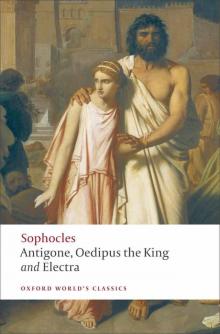
Antigone, Oedipus the King and Electra,
p.18


Endure to have me as a citizen.
1450
My home must be the mountains—on Cithaeron,
Which, while they lived, my parents chose to be
My tomb: they wished to slay me; now they shall.
For this I know: sickness can never kill me,
Nor any other evil; I was not saved
That day from death, except for some strange
doom.*
My fate must take the course it will.—Now, for my sons,
Be not concerned for them: they can, being men,
1460
Fend for themselves, wherever they may be:
But my unhappy daughters, my two girls,
Whose chairs were always set beside my own
At table—they who shared in every dish
That was prepared for me—oh Creon! these
Do I commend to you. And grant me this:
To take them in my arms, and weep for them.
My lord! most noble Creon! could I now
But hold them in my arms, then I should think
I had them as I had when I could see them.
1470
Enter ANTIGONE and ISMENE
Ah! what is this?
Ah Heaven! do I not hear my dear ones, sobbing?
Has Creon, in his pity, sent to me
My darling children? Has he? Is it true?
CREON. It is; they have been always your delight;
So, knowing this, I had them brought to you.
OEDIPUS. Then Heaven reward you, and for this kind service
Protect you better than it protected me!
Where are you, children? Where? O come to me!
1480
Come, let me clasp you with a brother’s arms,
These hands, which helped your father’s eyes, once bright,
To look upon you as they see you now—
Your father who, not seeing, nor inquiring,
Gave you for mother her who bore himself.
See you I cannot; but I weep for you,
For the unhappiness that must be yours,
And for the bitter life that you must lead.
What gathering of the citizens, what festivals,
Will you have part in? Your high celebrations
1490
Will be to go back home, and sit in tears.
And when the time for marriage comes, what man
Will stake upon the ruin and the shame
That I am to my parents and to you!
Nothing is wanting there: your father slew
His father, married her who gave him birth,
And then, from that same source whence he himself
Had sprung, got you.—With these things they will taunt you;
And who will take you then in marriage?—Nobody;
1500
But you must waste, unwedded and unfruitful.
Ah, Creon! Since they have no parent* now
But you—for both of us who gave them life
Have perished—suffer them not to be cast out
Homeless and beggars; for they are your kin.*
Have pity on them, for they are so young,
So desolate, except for you alone.
Say ‘Yes’, good Creon! Let your hand confirm it.
1510
And now, my children, for my exhortation
You are too young; but you can pray that I
May live henceforward—where I should; and you
More happily than the father who begot you.
CREON. Now make an end of tears, and go within.
OEDIPUS. Then I must go—against my will.
CREON. There is a time for everything.
OEDIPUS. You know what I would have you do?
CREON. If you will tell me, I shall know.
OEDIPUS. Send me away, away from Thebes.
CREON. The God, not I, must grant you this.
OEDIPUS. The gods hate no man more than me!
CREON. Then what you ask they soon will give.
OEDIPUS. You promise this?
CREON. Ah no! When I
Am ignorant, I do not speak.
1520
OEDIPUS. Then lead me in; I say no more.
CREON. Release the children then, and come.
OEDIPUS. What? Take these children from me? No!
CREON. Seek not to have your way in all things:
Where you had your way before,
Your mastery broke before the end. *
ELECTRA
DRAMATIS PERSONAE
ORESTES, only son of Agamemnon and Clytemnestra
PYLADES, his friend (he has no speaking part)
TUTOR, personal attendant of Orestes
ELECTRA, daughter of Agamemnon and Clytemnestra
CHRYSOTHEMIS,her sister
CLYTEMNESTRA AEGISTHUS
CHORUS of women of Mycenae
Attendants etc.
Scene: Mycenae, in Argos, before the royal palace
ELECTRA1
Enter ORESTES, PYLADES and the TUTOR, with two attendants
TUTOR. Here is the land of Argos. From this place
Your father Agamemnon led the Greeks
To Troy. How many years have you been longing
To see what now your eyes can look upon:
The ancient city Argos, once the home
Of Io and her father Inachus.*
Now look upon it: there, the market-place
That bears Apollo’s name,* and to the left
Is Hera’s famous temple. * The place where we
Are standing now—my son, this is Mycenae,
Golden Mycenae, and the blood-drenched palace
Of Pelops’ dynasty* is here, the place
10
From which your sister saved you, as a baby,*
When they had murdered Agamemnon. I
Took you to safety, I have brought you up
To manhood. Now you must avenge your father.
So now, Orestes, you and Pylades
Your loyal friend, resolve with no delay
What you will do. For dawn has come; the stars
Have vanished from the darkness of the sky;
The birds are striking up their morning songs;
People will soon be stirring. Little time
20
Is left to you; the hour has come for action.
ORESTES. My friend, my loyal servant:* everything
You say or do proclaims your true devotion.
Just as a horse, if he is thoroughbred,
Will keep his mettle even in old age,
Will never flinch, but in the face of danger
Prick up his ears, so you are ever first
To proffer help and to encourage me.
You then shall hear my plan, and as you listen
Give it your sharp attention, to amend
30
Whatever seems amiss.
I went to Delphi,* and I asked Apollo
How best I might avenge my father’s death
On these who murdered him. The god’s reply
Was brief; it went like this: Not with an army
But with your own right hand, by stratagem
Give them what they have earned, and kill them both.
Therefore, since this is what the god has said,
Your part shall be to have yourself admitted
Inside the palace when the moment favours.
Find out what is afoot; return to me
40
And tell me what you can.—They will not know you;
You have grown old, so many years have passed;
Your silver hair will keep them from suspecting.
Your story shall be this, that you have come
From foreign parts, from Phanoteus of Phokis*—
For he is one of their most trusted allies;
Tell them Orestes has been killed, and give
Your oath that it is true: he met his death
Competing in the Pythian Games at Delphi,*
Flung from his racing-chariot. Let this be
50
The tale. And for myself, the god commanded
That I should first go to my father’s tomb
And pay my tribute with a lock of hair
And wine-libation. This then will I do;
And I will find the urn which you have told me
Lies hidden in a thicket, and with that
I will come back. This urn of beaten bronze
Shall bring them joy—though not for long; for it
(So we will tell them) holds the ash and cinders
Of this my body that the fire consumed.—
Why should I fear an omen,* if I say that I
Am dead, then by this story I fulfil
60
My life’s true purpose, to secure my vengeance?
No need to fear a tale that brings me gain.
For I have heard of those philosophers*
Who were reported dead: when they returned,
Each to his city, they were honoured more.
And so, I trust, may I, through this pretence,
Look down triumphant like the sun* in heaven
Upon my enemies.
Only do thou, my native soil; you, gods of Argos,
Receive and prosper me. House of my fathers,
Receive me with your blessing! The gods have sent me,
70
And I have come to purify and purge you.
Do not reject me, drive me not away,
But let me enter into my possessions;
Let me rebuild my father’s fallen house.
Such is my prayer. My friend, go to your task
And do it well. We go to ours; for Time
Calls only once, and that determines all.
ELECTRA [within]. Ah me! Ah me!
TUTOR. Listen, my son: I thought I heard a cry
From near the gates, a cry of bitter grief. *
80
ORESTES. Electra, my unhappy sister! Could
It be her cry?—Let us wait and listen.
TUTOR. No. The command that God has given us,
That must come first, to offer your libations
At Agamemnon’s tomb. His aid will bring
Victory to us, and ruin to his foes.
[Exeunt ORESTES, PYLADES, the TUTOR, and attendants
Enter ELECTRA
ELECTRA [chants]. Thou holy light,
Thou sky that art earth’s canopy,
How many bitter cries of mine
90
Have you not heard,* when shadowy night
Has given place to days of mourning!
And when the night has come again
My hateful bed alone can tell
The tears that I have shed within
This cruel palace. O my father!
No Trojan spear,* no god of war,*
Brought death to you on foreign soil.
My mother killed you, and her mate
Aegisthus! As a woodman fells
An oak, they took a murderous axe
And cut you down.
100
And yet no other voice but mine
Cries out upon this bloody deed.
I only, father, mourn your death.
Nor ever will
I cease from dirge and sad lament
So long as I behold the sun
By day and see the stars by night;
But like the sorrowing nightingale*
Who mourns her young unceasingly,
Here at the very gates will I
Proclaim my grief for all to hear.
You powers of Death! you gods below!*
110
Avenging Spirits, who behold
Each deed of blood,
each faithless act
Dishonouring the marriage-vow,*
Desert me not. Come to my aid!
Avenge my father’s death!
And send my brother; bring to me Orestes! For I can no more
Sustain this grief; it crushes me.
120
Enter the CHORUS
[From here until line 250 everything is sung.]
Strophe 1
CHORUS. Electra, child of a most pitiless mother,
Why are you so wasting your life in unceasing
Grief and despair? Agamemnon
Died long ago. Treachery filled the heart,