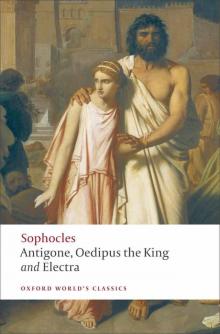
Antigone oedipus the kin.., p.9
Antigone, Oedipus the King and Electra,
p.9


From such as those I draw my own unhappy life;
And now I go to dwell with them, unwedded and
accursed.
O brother,* through an evil marriage you were slain;
and I
870
Live—but your dead hand destroys me.
CHORUS. Such loyalty is a holy thing.
Yet none that holds authority
Can brook disobedience, O my child.
Your self-willed pride has been your ruin.
Epode
ANTIGONE. Unwept, unwedded and unbefriended,
Alone, pitilessly used,
Now they drag me to death.
Never again, O thou Sun in the heavens,
May I look on thy holy radiance!
880
Such is my fate, and no one laments it;
No friend is here to mourn me.
CREON [speaks]. Enough of this! If tears and
lamentations
Could stave off death they would go on for ever.
Take her away at once, and wall her up
Inside a cavern, as I have commanded,
And leave her there, alone, in solitude.
Her home shall be her tomb; there she may live
Or die, as she may choose: my hands are clean;
But she shall live no more among the living.
890
ANTIGONE [speaks]. O grave, my bridal-chamber,
everlasting
Prison within a rock: now I must go
To join my own, those many who have died
And whom Persephone* has welcomed home;
And now to me, the last of all, so young,
Death comes, so cruelly. And yet I go
In the sure hope that you will welcome me,
Father, and you, my mother; you, my brother.*
For when you died* it was my hands that washed
900
And dressed you, laid you in your graves, and
poured
The last libations. Now, because to you,
Polyneices, I have given burial,
To me they give a recompense like this!
Yet what I did,* the wise will all approve.
For had I lost a son, or lost a husband,
Never would I have ventured such an act
Against the city’s will. And wherefore so?
My husband dead, I might have found another;
Another son from him, if I had lost
910
A son. But since my mother and my father
Have both gone to the grave, there can be none
Henceforth that I can ever call my brother.
It was for this I paid you such an honour,
Dear Polyneices, and in Creon’s eyes
Thus wantonly and gravely have offended.
So with rude hands he drags me to my death.
No chanted wedding-hymn, no bridal-joy,
No tender care of children can be mine;
But like an outcast, and without a friend,
They take me to the cavernous home of death.
920
What ordinance of the gods have I transgressed?
Why should I look to Heaven any more
For help, or seek an ally among men?
If this is what the gods approve, why then,
When I am dead I shall discern my fault;
If theirs the sin, may they endure a doom
No worse than mine, so wantonly inflicted!
CHORUS. Still from the same quarter the same wild
winds
Blow fiercely, and shake her stubborn soul.
930
CREON. And therefore, for this, these men shall have
cause,
Bitter cause, to lament their tardiness.
CHORUS. I fear these words bring us closer yet
To the verge of death.*
CREON. I have nothing to say, no comfort to give:
The sentence is passed, and the end is here.
ANTIGONE. O city of Thebes where my fathers dwelt,
O gods of our race,
Now at last their hands are upon me!
You princes of Thebes, O look upon me,
940
The last that remain of a line of kings!
How savagely impious men use me,
For keeping a law that is holy.
[Exit ANTIGONE, under guard, CREON remains
Strophe 1
CHORUS. There was one in days of old who was
imprisoned
In a chamber like a grave, within a tower:
Fair Danae,* who in darkness was held, and never
saw the pure daylight.
Yet she too, O my child, was of an ancient line,
Entrusted with divine seed* that had come in shower
of gold.
950
Mysterious, overmastering, is the power of Fate.
From this, nor wealth nor force of arms
Nor strong encircling city-walls
Nor storm-tossed ship can give deliverance.
Antistrophe 1
Close bondage was ordained by Dionysus
For one who in a frenzy had denied
His godhead: in a cavern Lycurgus,* for his sin, was
imprisoned.
In such wise did his madness bear a bitter fruit,
960
Which withered in a dungeon. So he learned it was a
god
He had ventured in his blindness to revile and taunt.
The sacred dances he had tried
To quell, and end the Bacchic rite,
Offending all the tuneful Muses.*
Strophe 2
There is a town by the rocks where a sea meets
another sea,
Two black rocks by the Bosphorus, near the
Thracian coast,
Salmydessus;* and there a wife had been spurned,
970
Held close in bitter constraint.*
Then upon both her children
A blinding wound fell from her cruel rival:
With shuttle in hand she smote the open eyes with
sharp
And blood-stained point, and brought to Phineus’
Two sons a darkness that cried for vengeance.*
Antistrophe 2
In bitter grief and despair they bewailed their unhappy
lot,
Children born to a mother whose marriage proved
accursed.
980
Yet she came of a race of ancient kings,*
Her sire the offspring of gods.*
Reared in a distant country,*
Among her fierce, northern father’s tempests,
She went, a Boread, swift as horses, over the lofty
Mountains.* Yet not even she was
Safe against the long-lived Fates, my daughter.
Enter TEIRESIAS, led by a boy
TEIRESIAS. My lords, I share my journey with this boy
Whose eyes must see for both; for so the blind
Must move abroad, with one to guide their steps.
990
CREON. Why, what is this? Why are you here,
Teiresias?
TEIRESIAS. I will explain; you will do well to listen.
CREON. Have I not always followed your good counsel?
TEIRESIAS. You have; therefore we have been guided
well.
CREON. I have had much experience of your wisdom.
TEIRESIAS. Then think: once more you tread the razor’s
edge.
CREON. You make me tremble! What is it you mean?
TEIRESIAS. What divination has revealed to me,
That I will tell you. To my ancient seat
Of augury* I went, where all the birds
1000
Foregather. There I sat, and heard a clamour
Strange and unnatural—birds screaming in rage.
I knew that they were tearing at each other
With murderous claws: the beating of their wings
Meant nothing less than that; and I was frightened.
I made a blazing fire upon the altar
And offered sacrifice:* it would not burn;
The melting fat oozed out upon the embers
And smoked and bubbled; high into the air
The bladder spirted gall, and from the bones
1010
The fatty meat slid off and left them bare.
Such omens, baffling, indistinct, I learned
From him who guides me,* as I am guide to others.
Sickness has come upon us, and the cause
Is you: our altars and our sacred hearths
Are all polluted by the dogs and birds
That have been gorging on the fallen body
Of Polyneices. Therefore heaven will not
Accept from us our prayers, no fire will burn
1020
Our offerings, nor will birds give out clear sounds,
For they are glutted with the blood of men.
Be warned, my son. No man alive is free
From error, but the wise and prudent man
When he has fallen into evil courses
Does not persist, but tries to find amendment.
It is the stubborn man who is the fool.
Yield to the dead, forbear to strike the fallen;
To slay the slain, is that a deed of valour?
1030
Your good is what I seek; and that instruction
Is best that comes from wisdom, and brings profit.
CREON. Sir, all of you, like bowmen at a target,
Let fly your shafts at me. Now they have turned
Even diviners on me! By that tribe
I am bought and sold and stowed away on board.
Go, make your profits, drive your trade
In Lydian silver* or in Indian gold,
But him you shall not bury in a tomb,
No, not though Zeus’ own eagles* eat the corpse
1040
And bear the carrion to their master’s throne:
Not even so, for fear of that defilement,
Will I permit his burial—for well I know
That mortal man can not defile the gods.
But, old Teiresias, even the cleverest men
Fall shamefully when for a little money
They use fair words to mask their villainy.
TEIRESIAS. Does any man reflect, does any know . . .
CREON. Know what? Why do you preach at me like
this?
TEIRESIAS. How much the greatest blessing is good
counsel?
1050
CREON. As much, I think, as folly is his plague.
TEIRESIAS. Yet with this plague you are yourself
infected.
CREON. I will not bandy words with any prophet.
TEIRESIAS. And yet you say my prophecies are
dishonest!
CREON. Prophets have always been too fond of gold.
TEIRESIAS. And tyrants, of the shameful use of power.
CREON. You know it is your King of whom you speak?
TEIRESIAS. King of the land I saved from mortal
danger.*
CREON. A clever prophet—but an evil one.
TEIRESIAS. You’ll rouse me to awaken my dark secret.
1060
CREON. Awaken it, but do not speak for money.
TEIRESIAS. And do you think that I am come to that?
CREON. You shall not buy and sell my policy.
TEIRESIAS. Then I will tell you this: you will not live
Through many circuits of the racing sun
Before you give a child of your own body
To make amends for murder, death for death;
Because you have thrust down within the earth
One who should walk upon it,* and have lodged
A living soul dishonourably in a tomb;
And impiously have kept upon the earth
1070
Unburied and unblest one who belongs
Neither to you nor to the upper gods
But to the gods below, who are despoiled
By you. Therefore the gods arouse against you