Complete works of willa.., p.70
Complete Works of Willa Cather,
p.70


Tillie is the last Kronborg left in Moonstone. She lives alone in a little house with a green yard, and keeps a fancywork and millinery store. Her business methods are informal, and she would never come out even at the end of the year, if she did not receive a draft for a good round sum from her niece at Christmas time. The arrival of this draft always renews the discussion as to what Thea would do for her aunt if she really did the right thing. Most of the Moonstone people think Thea ought to take Tillie to New York and keep her as a companion. While they are feeling sorry for Tillie because she does not live at the Plaza, Tillie is trying not to hurt their feelings by showing too plainly how much she realizes the superiority of her position. She tries to be modest when she complains to the postmaster that her New York paper is more than three days late. It means enough, surely, on the face of it, that she is the only person in Moonstone who takes a New York paper or who has any reason for taking one. A foolish young girl, Tillie lived in the splendid sorrows of “Wanda” and “Strathmore”; a foolish old girl, she lives in her niece’s triumphs. As she often says, she just missed going on the stage herself.
That night after the sociable, as Tillie tripped home with a crowd of noisy boys and girls, she was perhaps a shade troubled. The twin’s question rather lingered in her ears. Did she, perhaps, insist too much on that thousand dollars? Surely, people didn’t for a minute think it was the money she cared about? As for that, Tillie tossed her head, she didn’t care a rap. They must understand that this money was different.
When the laughing little group that brought her home had gone weaving down the sidewalk through the leafy shadows and had disappeared, Tillie brought out a rocking chair and sat down on her porch. On glorious, soft summer nights like this, when the moon is opulent and full, the day submerged and forgotten, she loves to sit there behind her rose-vine and let her fancy wander where it will. If you chanced to be passing down that Moonstone street and saw that alert white figure rocking there behind the screen of roses and lingering late into the night, you might feel sorry for her, and how mistaken you would be! Tillie lives in a little magic world, full of secret satisfactions. Thea Kronborg has given much noble pleasure to a world that needs all it can get, but to no individual has she given more than to her queer old aunt in Moonstone. The legend of Kronborg, the artist, fills Tillie’s life; she feels rich and exalted in it. What delightful things happen in her mind as she sits there rocking! She goes back to those early days of sand and sun, when Thea was a child and Tillie was herself, so it seems to her, “young.” When she used to hurry to church to hear Mr. Kronborg’s wonderful sermons, and when Thea used to stand up by the organ of a bright Sunday morning and sing “Come, Ye Disconsolate.” Or she thinks about that wonderful time when the Metropolitan Opera Company sang a week’s engagement in Kansas City, and Thea sent for her and had her stay with her at the Coates House and go to every performance at Convention Hall. Thea let Tillie go through her costume trunks and try on her wigs and jewels. And the kindness of Mr. Ottenburg! When Thea dined in her own room, he went down to dinner with Tillie, and never looked bored or absent-minded when she chattered. He took her to the hall the first time Thea sang there, and sat in the box with her and helped her through “Lohengrin.” After the first act, when Tillie turned tearful eyes to him and burst out, “I don’t care, she always seemed grand like that, even when she was a girl. I expect I’m crazy, but she just seems to me full of all them old times!” — Ottenburg was so sympathetic and patted her hand and said, “But that’s just what she is, full of the old times, and you are a wise woman to see it.” Yes, he said that to her. Tillie often wondered how she had been able to bear it when Thea came down the stairs in the wedding robe embroidered in silver, with a train so long it took six women to carry it.
Tillie had lived fifty-odd years for that week, but she got it, and no miracle was ever more miraculous than that. When she used to be working in the fields on her father’s Minnesota farm, she couldn’t help believing that she would some day have to do with the “wonderful,” though her chances for it had then looked so slender.
The morning after the sociable, Tillie, curled up in bed, was roused by the rattle of the milk cart down the street. Then a neighbor boy came down the sidewalk outside her window, singing “Casey Jones” as if he hadn’t a care in the world. By this time Tillie was wide awake. The twin’s question, and the subsequent laughter, came back with a faint twinge. Tillie knew she was short-sighted about facts, but this time — Why, there were her scrapbooks, full of newspaper and magazine articles about Thea, and half-tone cuts, snap-shots of her on land and sea, and photographs of her in all her parts. There, in her parlor, was the phonograph that had come from Mr. Ottenburg last June, on Thea’s birthday; she had only to go in there and turn it on, and let Thea speak for herself. Tillie finished brushing her white hair and laughed as she gave it a smart turn and brought it into her usual French twist. If Moonstone doubted, she had evidence enough: in black and white, in figures and photographs, evidence in hair lines on metal disks. For one who had so often seen two and two as making six, who had so often stretched a point, added a touch, in the good game of trying to make the world brighter than it is, there was positive bliss in having such deep foundations of support. She need never tremble in secret lest she might sometime stretch a point in Thea’s favor. — Oh, the comfort, to a soul too zealous, of having at last a rose so red it could not be further painted, a lily so truly auriferous that no amount of gilding could exceed the fact!
Tillie hurried from her bedroom, threw open the doors and windows, and let the morning breeze blow through her little house.
In two minutes a cob fire was roaring in her kitchen stove, in five she had set the table. At her household work Tillie was always bursting out with shrill snatches of song, and as suddenly stopping, right in the middle of a phrase, as if she had been struck dumb. She emerged upon the back porch with one of these bursts, and bent down to get her butter and cream out of the ice-box. The cat was purring on the bench and the morning-glories were thrusting their purple trumpets in through the lattice-work in a friendly way. They reminded Tillie that while she was waiting for the coffee to boil she could get some flowers for her breakfast table. She looked out uncertainly at a bush of sweet-briar that grew at the edge of her yard, off across the long grass and the tomato vines. The front porch, to be sure, was dripping with crimson ramblers that ought to be cut for the good of the vines; but never the rose in the hand for Tillie! She caught up the kitchen shears and off she dashed through grass and drenching dew. Snip, snip; the short-stemmed sweet-briars, salmon-pink and golden-hearted, with their unique and inimitable woody perfume, fell into her apron.
After she put the eggs and toast on the table, Tillie took last Sunday’s New York paper from the rack beside the cupboard and sat down, with it for company. In the Sunday paper there was always a page about singers, even in summer, and that week the musical page began with a sympathetic account of Madame Kronborg’s first performance of ISOLDE in London. At the end of the notice, there was a short paragraph about her having sung for the King at Buckingham Palace and having been presented with a jewel by His Majesty.
Singing for the King; but Goodness! she was always doing things like that! Tillie tossed her head. All through breakfast she kept sticking her sharp nose down into the glass of sweet-briar, with the old incredible lightness of heart, like a child’s balloon tugging at its string. She had always insisted, against all evidence, that life was full of fairy tales, and it was! She had been feeling a little down, perhaps, and Thea had answered her, from so far. From a common person, now, if you were troubled, you might get a letter. But Thea almost never wrote letters. She answered every one, friends and foes alike, in one way, her own way, her only way. Once more Tillie has to remind herself that it is all true, and is not something she has “made up.” Like all romancers, she is a little terrified at seeing one of her wildest conceits admitted by the hardheaded world. If our dream comes true, we are almost afraid to believe it; for that is the best of all good fortune, and nothing better can happen to any of us.
When the people on Sylvester Street tire of Tillie’s stories, she goes over to the east part of town, where her legends are always welcome. The humbler people of Moonstone still live there. The same little houses sit under the cottonwoods; the men smoke their pipes in the front doorways, and the women do their washing in the back yard. The older women remember Thea, and how she used to come kicking her express wagon along the sidewalk, steering by the tongue and holding Thor in her lap. Not much happens in that part of town, and the people have long memories. A boy grew up on one of those streets who went to Omaha and built up a great business, and is now very rich. Moonstone people always speak of him and Thea together, as examples of Moonstone enterprise. They do, however, talk oftener of Thea. A voice has even a wider appeal than a fortune. It is the one gift that all creatures would possess if they could. Dreary Maggie Evans, dead nearly twenty years, is still remembered because Thea sang at her funeral “after she had studied in Chicago.”
However much they may smile at her, the old inhabitants would miss Tillie. Her stories give them something to talk about and to conjecture about, cut off as they are from the restless currents of the world. The many naked little sandbars which lie between Venice and the mainland, in the seemingly stagnant water of the lagoons, are made habitable and wholesome only because, every night, a foot and a half of tide creeps in from the sea and winds its fresh brine up through all that network of shining waterways. So, into all the little settlements of quiet people, tidings of what their boys and girls are doing in the world bring real refreshment; bring to the old, memories, and to the young, dreams.
THE END
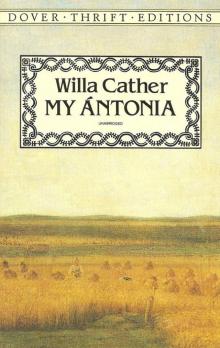
My Ántonia
My Ántonia was published in 1918 by Houghton Mifflin and it is the third and final book of Cather’s ‘Prairie Trilogy’. It is considered to be not only the best of the three novels, but one of her finest works overall. It is told in the first person, whereas the previous two novels in the trilogy are told in the third person. Cather felt that the deep emotions explored in this story were better suited to a more intimate perspective than the third person narrative can allow. In another departure, the lead character, Antonia, is the child of a family of Bohemian immigrants, whereas the previous two heroines in the trilogy have Swedish ancestry.
The story is told by Jimmy, later Jim (James Quayle) Burden, who on the opening of the tale is ten years old, recently orphaned and travelling by train to the town of Black Hawk, Nebraska, to live with his grandparents. Jimmy is from Virginia, so this vast landscape is in great contrast to the home state he knows. On the same train is the Shimerda family, newly arrived in America, who will play an important part in his life. Nebraska makes a strong impression on the boy from the moment he steps from the train and is taken by wagon to his grandparents – ‘There seemed to be nothing to see; no fences, no creeks or trees, no hills or fields. There was nothing, but land: not a country at all, but the material out of which countries are made.’ Jimmy’s new home is pleasant and his grandmother brisk, but kindly, his grandfather is also kindly, but much quieter than his wife. Jimmy learns from Otto, the farm hand, that he has been bought a pony, so that he can explore the landscape he is so intrigued by and very quickly he is a good enough rider to go on errands for his grandparents, travelling to the post office, six miles away, twice a week for them. Otto is typical of many men that worked the farms in the plains, ‘drifting, case-hardened labourers’ with hearts of gold and he is kindest of all to the young boy. Jimmy’s new house and gardens are perfect for a boy to explore and play in; very quickly, he knows he will be happy there.
Soon after his arrival, Jimmy and his grandmother go to visit their new neighbours, the Shimerda family, who are Bohemians that have taken over a poor quality homestead and plot of land. Grandmother takes them food and Jimmy makes friends with a girl four years his senior, the lively and friendly Antonia. The Shimerdas are very new to America and speak virtually no English, so Antonia is chosen to have reading and English lessons with Jimmy, so that she can be the spokesperson for her family in their dealings. Jimmy and Antonia become close friends, exploring the landscape together and discovering the plants, animals, weather and seasons with a child’s vivacious curiosity. The winter in particular is a treat for the youngsters: ‘the low sky was like a sheet of metal; the blond cornfields had faded out into ghostliness at last; the little pond was frozen under its stiff willow bushes. Big white flakes were whirling over everything and disappearing in the red grass… The wind had the burning taste of fresh snow…The cold stung and at the same time delighted one.’ Sleigh rides, gatherings round the stove in the evening, grandmother baking her bread in the kitchen; in spite of the fact that life is hard, Cather has Jimmy paint a picture of a rural idyll. However, the Shimerdas are not doing so well as their more established neighbours. They have one warm coat between the whole family and precious little food to keep them well. They disappear from Jimmy’s life for weeks, huddled as they are in their ramshackle home; it is almost as if they are afraid of the adverse weather. Then Jimmy wakes up one morning to find that an even worse catastrophe has befallen their neighbours – Mr Shimerda has committed suicide. He had never wanted to leave his mother country – it was his wife’s idea – and he could not cope any longer. The tragedy brings home to Jimmy and his family that the landscape and the way of life can claim victims as quickly as it can please.
A few years pass and Jimmy’s grandparents decide to move to a house on the outskirts of Black Hawk and rent out their farm. Jim as he is now known, is doing well at school and Grandmother helps Antonia obtain employment in the town too. Both the children are growing and learning, all against the backdrop of this remarkable landscape. What will adult life bring them, steeped as they are in the rural life that evolves slowly around them?
Of the three prairie novels, this one is the most lyrical and atmospheric, almost as if Cather, after two attempts, hit her stride with My Ántonia. The characters are well drawn, sympathetic without being mawkish and Cather paints stunning word pictures of the landscape. The winter months read like a character in their own right, arriving like a beautiful visitor to caress the landscape, then cruelly treating the people that inhabit the landscape, before becoming old, shabby and unwanted, like a drunken guest at a late night party. Cather clearly understood that such an environment was ruled by the weather and people lived or died according to its vagaries or kindnesses. The pace is slow, as befits the life that the people lead, yet filled with the usual interesting details of pioneer life, a boon for anyone researching rural life on the plains at the time and no doubt taken from Cather’s own personal observations as a child growing up in that very landscape. My Ántonia is an outstanding novel and if one only read one of the trilogy (they work extremely well as stand-alone works), this is the one to go for.
The first edition
CONTENTS
INTRODUCTION
BOOK I. The Shimerdas
I
II
III
IV
V
VI
VII
VIII
IX
X
XI
XII
XIII
XIV
XV
XVI
XVII
XVIII
XIX
BOOK II. The Hired Girls
I
II
III
IV
V
VI
VII
VIII
IX
X
XI
XII
XIII
XIV
XV
BOOK III. Lena Lingard
I
II
III
IV
BOOK IV. The Pioneer Woman’s Story
I
II
III
IV
BOOK V. Cuzak’s Boys
I
II
III
Pavelka house in rural Webster County, Nebraska, the setting of “Cuzak’s Boys”
TO CARRIE AND IRENE MINER
In memory of affections old and true
Optima dies... prima fugit
VIRGIL
INTRODUCTION
LAST SUMMER I happened to be crossing the plains of Iowa in a season of intense heat, and it was my good fortune to have for a traveling companion James Quayle Burden — Jim Burden, as we still call him in the West. He and I are old friends — we grew up together in the same Nebraska town — and we had much to say to each other. While the train flashed through never-ending miles of ripe wheat, by country towns and bright-flowered pastures and oak groves wilting in the sun, we sat in the observation car, where the woodwork was hot to the touch and red dust lay deep over everything. The dust and heat, the burning wind, reminded us of many things. We were talking about what it is like to spend one’s childhood in little towns like these, buried in wheat and corn, under stimulating extremes of climate: burning summers when the world lies green and billowy beneath a brilliant sky, when one is fairly stifled in vegetation, in the color and smell of strong weeds and heavy harvests; blustery winters with little snow, when the whole country is stripped bare and gray as sheet-iron. We agreed that no one who had not grown up in a little prairie town could know anything about it. It was a kind of freemasonry, we said.