Alien pregnant by elvis, p.10
Alien Pregnant by Elvis,
p.10
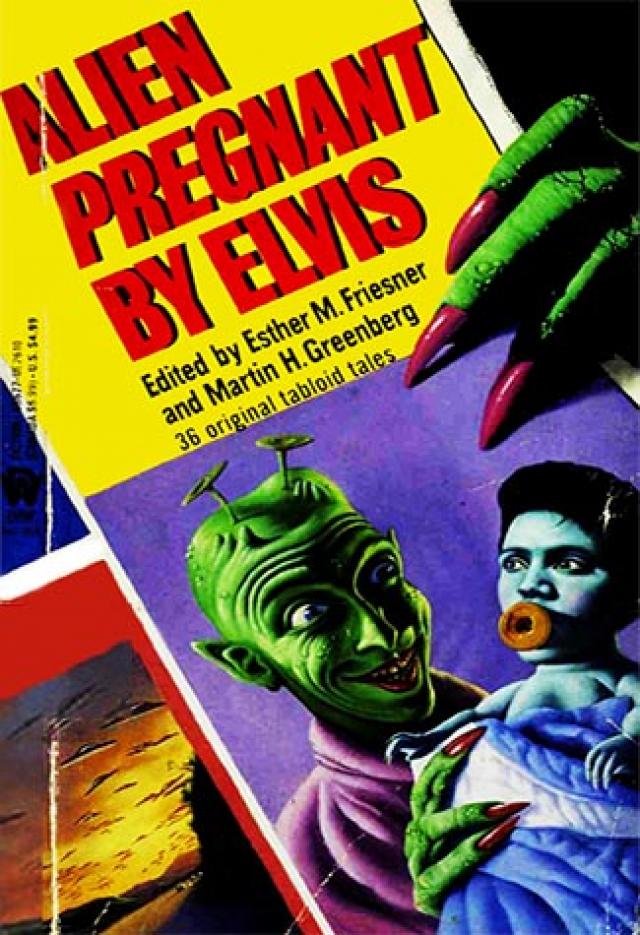


Rizzel started, surprised. “You’re kidding. You did that?” Orber settled back, self-satisfied and proud. “That was me. All those privileged spindleshafts enjoying the pleasures of terrorizing all those creatures on the third planet. Going down, scaring them with sudden appearances, sometimes abducting memories—not completely blocked, just enough to make them crazy after a while.”
He heaved forward, an angry slant to his eyes. “And they were hoarding it! Keeping it to themselves!” He chuckled. “Not after I finished my piece. Their monopoly crumbled. For a while there was a hell of an increase in joyriding, but it’s slacked off now. Thing is, the third planet’s just too damn boring. Those people have never caught on. And they call themselves intelligent.”
“They may be, only they’re preaware . . .”
“Pah! Preaware. That’s one of those trendy poplogisms you get from hanging around the Three P Institute. Meaningless.” He rolled Rizzel’s piece around on the desk. “So what exactly is this one about?”
Rizzel almost smiled. “Well . . . Honorable Fanal has been monitoring some of their media and discovered something interesting about them.” Rizzel waited till Orber grunted. “They give awards for it.”
Orber’s eyes slitted skeptically. “They do what?”
“They give awards. For the best in a given year. All kinds of awards. And they name them. Oscars, Emmys, Tonys—”
“Sound like people. Sort of.”
“Well, some of them are named after people. Dead people.”
“Oh? They have an award called an Elvis?”
“No, they still aren’t sure he’s dead.”
Orber chuckled. The glass rumbled sympathetically. Then he sobered. “Sounds absurd. If it’s good product, why award it? The award is in the reception by the public.”
“True, but the awards themselves become part of the media, a new form, and are consumed the same way the media being awarded is consumed.”
“Conspicuous.”
“I thought so.”
“So they recycle?”
“Seems so.”
Orber toyed with the little button on the desk before him. “Hard to swallow, Rizzel.”
Rizzel waited. Suddenly Orber popped the button into his mouth. Rizzel straightened anxiously. He couldn’t believe it. Now he just had to ride it out.
“Hmm,” Orber intoned. He frowned. “Interesting.” He closed his eyes for a few seconds, then they snapped open. Wide. Rizzel’s pulse raced. “My—oh, now wait—Rizzel!” Orber’s tail swung up to arc over his head. It twitched for a moment, then slammed back into the floor. Rizzel almost fell over from the shaking. Orber’s eyes were squeezed shut. He opened his mouth. Dark, blue-black smoke began to envelop his head.
“Ah! Ah! Ah!” He slammed his tail again. Rizzel made for the door.
“Sucksilt! How could you—”
Rizzel stopped and looked around. Orber’s eyes were wide and full of wonder. They were a vivid pink now and his skin was violet. Smoke filled the office.
The door opened. Trella peered in cautiously.
“What is it?”
Before Rizzel could answer, Orber leaned against his desk.
“It’s true,” he said quietly. “It’s true. It must be true.” He looked around at Rizzel. “Pulitzers . . .? To the reporters . . .?” He scowled, baffled. “No. . .”
Then his entire, huge body quivered. The tail began slamming in earnest, repeatedly, and Orber grunted painfully. The story was lodged in him, unwilling to come out either way, and it was poisoning his whole system. Rizzel watched the death throes with a twinge of regret.
A thick, wet sound followed the last beat of Orber’s tail. Rizzel glanced down at the tray behind the desk and saw an ooze of brilliant cobalt blue.
Then Orber keeled over and lay still.
“What did you feed him?” Trella asked, awed.
“Something he just couldn’t handle.” He moved around to the pallet. “But it looks like his last act was productive. What an editor.”
“Your story?” Trella asked. Others were crowding the door behind her, staring at Orber’s corpse.
Rizzel nodded.
“I guess that means you’re the new editor,” she said. “By tradition—”
“I know. I wish there was another way. But . . .” He looked up and frowned. “Okay, back to work. We’ve got a hungry public to feed!”
“Congratulations,” Trella said. “And if there’s anything I can do for you . . .”
Rizzel smiled. “We’ll talk about it later. Thank you.”
Trella closed the door behind her. Rizzel pushed Orber’s body aside and pulled the desk back into place. He made a note to contact Honorable Fanal at Three P later. The material he had gotten from him was just right. It might, with the proper preparation, really make his career. All it required was—what did they call it on the third planet?—the proper spin.
He picked up the pallet containing the last effort of a once great editor. Orber deserved some memorialization. This would have to do. Rizzel stabbed the button on the intercom.
“Copy!”
Elvis at the White House
by Kristine Kathryn Rusch
When I asked Kristine Kathryn Rusch the loaded question, “Tell me a little about yourself,” she went and gone and did: “Kristine Kathryn Rusch was assigned three names as a penance for smarting off one too many times in class. She also had to write on the blackboard lots which translated into a writing career, with ten novels sold to date (the most recent, Facade, features dead birds, actors, and cocaine). She has never seen Elvis, although she did have a ticket for his final concert in 1977.”
See where smarting off in class can get you, kiddies?
The gray Atlanta skyline had traces of red, left over from the unrest started by those short-sighted jurors in Simi Valley, California. I leaned against my office window, feet aching in my new low pumps, cup of coffee in my left hand. The digital clock on the bank across the street read 10:30 A.M., and eighty degrees. The first truly hot day of the season was upon us.
I never did understand how my momma could drink coffee in the heat, with the humidity dripping out of the air like a live thing. But I started with the coffee habit during those last few months in Louisiana, and it wasn’t one I was going to break.
A mound of paperwork waited on my mahogany desk, and three messages blinked red on my answering machine. I wasn’t up to clients that morning, especially the wackos a psychic investigations office could attract. I had come to Atlanta a few weeks before, figuring I would be safe here. The riots reassured me, unlike the rest of the country, that I was in a big modem city with big modem concerns. My business would drop off to the kind of business it should have been: a few difficult police cases, and a few true believers. I had no stomach for the nutcases, which was why I left Louisiana in the first place.
Atlanta, now. Atlanta’s ghosts were buried under steel and concrete, laid to rest by CNN, Coca Cola, and the most conference-friendly hotels in the entire country. Business heaven, where no one had the time to reflect on those niggly nightmares, those awful feelings.
No one but me.
A knock on the door almost made me spill the coffee on the blouse of my new tailored blue business suit. I slid behind my desk. I pushed some papers aside, and said, “Come on in,” with the most demure voice I could manage.
The door opened, revealing the sexiest six-foot hunk of male I’d seen since I’d left the bayous. “Chelsea LaFronde?” he said with an accent as soft and lilting as my own.
Right then I knew I was in trouble. The problem with these Southern boys was that they believed. Even if they never saw a spirit on their own, even if they never dreamed, even if no one in the family ever had a feeling that came true, these boys knew such things were possible. And they wanted results.
Problem was, the last time I encountered one of these boys, he claimed he was the reincarnation of John E Kennedy, and he had a secret to impart. That so? I said. Yep, he replied and leaned forward with the secret.
I was murdered, he said with all seriousness.
Tell me something I don’t know, I replied, and lost the commission right there.
“You Chelsea LaFronde?” the hunk repeated. I had no idea how long he had waited while I was lost in the memory of the murdered JFK clone.
“Yessir,” I said, resisting the urge to stand up to my full height. Not that it would have done any good. Five-two in low slung pumps is no match for six foot any day. “You were expecting someone different?”
He grinned and shook his head, a lock of black hair falling along his forehead. My heart started pounding—and not with fear. He reminded me of someone. “My Granny had a bit of the touch, too,” he said. “So I was trying not to expect anything at all.”
The touch. That put him right in the Alabama, Tennessee, Louisiana circle. I suppressed a sigh. I had a bit of the touch, too. Not enough to read someone on sight, like my Momma did, and too much to ignore it all together. We got a service to perform, Momma always said. It’s our duty so we can keep the gift.
I always wanted to give it back, but then, that was me. “What can I do for you, Mr—?”
“Neville,” he said, as if the name didn’t come out of his mouth that often. “Vernon Neville.”
“What name do you usually use?”
He looked down. A blush stained those high cheekbones. “Presley,” he mumbled. “I’m an impersonator.”
That was when it all fell into place. The cocky walk, the come-hither smile, those luscious eyes, and that unruly shock of black hair. Elvis. Not the old fat one who couldn’t remember lyrics on stage, but the gorgeous one—the one that caused me to subsidize the United States Post Office to the tune of $285, so that my fifteen hundred votes would guarantee his picture on the all-important Elvis stamp. I owed him. That sexy voice oozing out of my family’s black-and-white TV screen during a rerun of Love Me Tender made me cream my jeans for the very first time.
“Looks like you do pretty well, Mr. Neville,” I said, trying to remain professional. That young Elvis was my secret vice. I had all his movies on tape. Whenever the world got too much, I watched them in a darkened living room while I shoved chocolates in my face. I always thought I could forgo the chocolates. “What can I do for you?”
The flush still tinged his cheeks red. “My granny’s been dead going on ten years,” he said. “Last night, she came to me in a dream and said I’d better get some help with this.” I sighed. When someone with the touch spoke through a dream, it was usually worth listening to. “Help with what, Mr. Neville?”
“A murder.” He was examining his hands as if he had never seen them before. “You see, Elvis’s been telling me—
I stood up. I had heard enough. I thought I would get away from these kinds of crazies in Atlanta. “Elvis Presley was not murdered. I investigated it for the Elvis Presley Fan Club from St. Louis, Missouri, and all the reports are in order. He was fat, he was a drug addict, and he died facedown in his own puke in one of the ritziest bathrooms I’ve ever seen. Now, get out of my office.”
He put his hands up and slid his chair back as if he thought I was going to launch myself across the desk at him. “I know how he died—”
I slipped off my shoes to prepare myself before I used some of those fako karate moves I had learned in my women’s self-defense class.
“—and I know it was his own fault—”
I placed my hands on my desk to steady myself. The adrenaline was reaching an all-time high.
“—but that’s not why I’m here.”
“Glory Hallelujah, Mr. Neville, because if it was, you wouldn’t last another five minutes in this office.” I sat down, trying to retain some of my dignity. I had written three books on psychic investigation, and ever since my successful solution to the Bayou Bomber case two years before, I could be choosy about my clients.
“I thought you believed in this stuff,” he said.
“Elvis has been appearing to too many people lately.”
“Elvis has been with me since I was seven years old, Ms. LaFronde.” He got up and turned his back on me, as if the conversation was becoming too much to bear. “I’ll never forget that day in August, 1977. The rest of the country wore black, and I was happy because this guy said he would stay with me for the rest of my life if I wanted, and make me rich and famous. My Granny said he just walked right in, and took over, but he didn’t really. He always advises, never acts. I just listen to him a lot. He says he made too many mistakes to be entrusted with another life.”
The problem with having a bit of the touch was that I could tell when people believed what they were saying. And Vernon Neville, handsome hunk of human male that he was, believed every word.
“So what is Elvis telling you these days?”
He threw me a dark, hurt look over his shoulder. “No need to be snide, Ms. LaFronde.”
“Sorry,” I said. Too many wackos came to me about Elvis. I couldn’t take him seriously any more. I took a deep breath and kept my shoes off. If he mentioned Marilyn Monroe, John F. Kennedy, or Adolf Hitler, I would show him to the door. “Why are you here?”
“There’s a little boy in Dallas, Texas. Elvis says he’s going to be murdered.”
He found the best way to yank my heartstrings: talk about kids and death. Maybe it had to do with that day almost a decade before when I was living in Southern Louisiana and doing fortunes out of my home because Jesse was too little to carry on cases. The day my precious baby boy turned blue and stopped breathing just like the visions warned me he would do. And nothing the doctors did ever got that breathing started again. Of course, my husband blamed me, and so did the family, and so did I, more than a little. I vowed to pay attention to that touch and use it in all seriousness right then and there. Which was why the crazies bothered me more than most. They didn’t understand just how important all of this could be.
“Where in Dallas?” I asked.
“Don’t know,” he said.
“How?”
“Don’t know that either.”
“When?”
“Ma’am, if I knew the answers to all those questions, I wouldn’t need you, now would I?”
He had a point, one I wasn’t sure I wanted to investigate. “How does Elvis know about this?”
He shrugged. “I guess the kid’s grandma was a big fan. He gets special knowledge about fans sometimes.” He gripped the back of the chair, and gave me the sultry I-could-seduce-you-in-a-minute look. “Usually Elvis tells me where to perform, what to wear, and how much pelvis to shake. He stays away from my business affairs, and he never talks about family. This is the first time anything like this has happened.”
To him, maybe, but not to me. A little old lady in Manhattan came to me one afternoon, all embarrassed because her upscale religion didn’t prepare her for visions of her dead husband in his underwear, warning her that some teenage hooker in Chicago was going to die, and it was in her best interest to stop the murder. We did, and she paid me a king’s ransom for keeping her name out of the papers when the hooker spilled all she knew about the local mob boss who had been trying to kill her. The hooker went away rich, I made a nice commission, the papers took a heavy bribe, and no one connected that mob boss to the husband’s business fronts all up and down Second Avenue.
“All right,” I said, finally getting serious. “You need to tell me everything you know.”
Dallas was a lot like Atlanta, only worse. The concrete stretched for miles over land that looked like it didn’t have a history, even though it did. I didn’t like it. The psychic vibrations were powerful and bad. I wagered the number of crazies who came here on a pilgrimage to JFK’s death site made the number of crazies in New York look like a meeting of Shakers.
I brought Vernon with me. He had the room next to mine in a big corporate hotel that had rooms twice the size of those in Atlanta. Dallas amazed me the more I drove in it. Somehow, I never expected Ross Perot country to be Strip Mall Ville U.S.A.
Vernon thought he was along to see if Elvis would give us any more guidance. I figured he was along to protect me from embarrassment. If the press got wind of this, and it turned out to be wrong, I had no qualms about throwing Vernon to the wolves.
What are Elvis impersonators for, anyway, except to take up all that loathing that humanity had lying around, and bear it like a cross on the road to Calgary?
Once we got there, though, I found I spent more of my time trying not to think about the lock on the door separating our rooms. Vernon imparted flashes of wisdom about the boy, wisdom Elvis would suddenly “remember.”
The boy lived out near the airport, in a part of Dallas I never could keep straight. Was it Dallas, Fort Worth, or one of those odd little towns that blended into other little towns that made up the concrete megalopolis that stretched as far as the eye could see? It didn’t really matter since we weren’t going to mail the kid anything. We hadn’t even decided on a plan. Vernon’s information was that vague.
And Elvis wouldn’t give, unless he thought I really needed to know.
Vernon said that was because Elvis didn’t like me. What a blow to my teenage soul! He said Elvis thought I was too loud and too rude to be a lady. I wondered if he’d seen Priscilla in Naked Gun, but decided silence was the better part of valor.
Besides, he probably would have blamed her transformation on that tennis pro or yoga instructor or whoever it was she ran off with.
All we knew was that by the first of June, that kid would be toast. The kind I make. Burnt and smoking.
Vernon just wanted to knock on the door, and inform the kid, I could imagine it. Excuse us, but we ’re from LaFronde Psychic Investigations, and Elvis told us you ’re going to die by June unless you listen to everything we have to say. That would go over big. I’m sure he’d march right out of that house, into our car, and off to protective custody.
Elvis would dish out information like pennies on allowance day. He finally told us that the kid’s name was E.P. White, and he lived with his grandmother in a two-bedroom house that had stood on that spot since the mid-1950s. I did the rest of the legwork. E.P. was a good student who played six instruments and sang too loudly for his choir teacher’s satisfaction. (“And he has a jukebox slide,” the teacher told me later as if it were original sin. “Just kinda falls into the notes. No discipline at all.”)