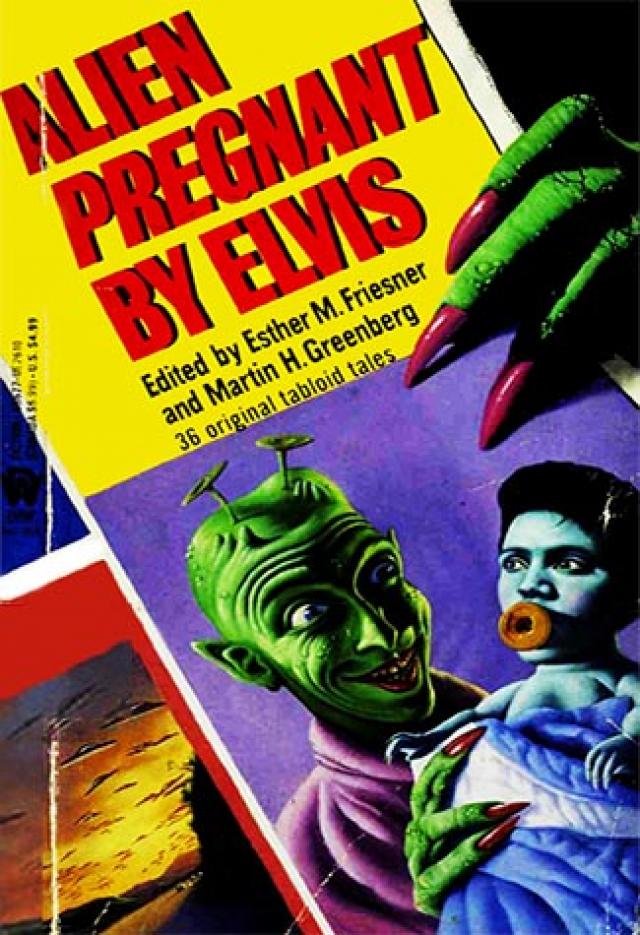
Alien pregnant by elvis, p.12
Alien Pregnant by Elvis,
p.12


They gave me a pretty damn impressive sales pitch. I took notes furiously. They had a solvent which carried the ink so deep into the skin that the bar code would never wash or wear off. It could be painted on the right hand or the forehead in a minute, and no one would ever notice it. Once people were coded, all they had to do was wave their hand by a scanner, or show it their forehead, and the computer automatically identified them. No need to worry about leaving a badge in the wrong suit, forgetting a password, or losing a key.
They had lined up contracts with the feds and some big security companies. They had a prototype working at the government weapons lab which had laid them off. Everybody going into the lab was being coded. A computer kept track of who was authorized to be inside, and what areas they could enter. Monitors checked people going in and out. “Total security, based on infallible hard-coded symbols,” they boasted.
And they had more plans, all outlined in a five-year business strategy. They would sell bar-code readers for household security systems. Stick your hand into the reader, and it would identify you instantly. It would tell the homeowner if the guy in the gas company uniform really was the meter reader. The venture capitalists had a scheme to use bar-code readers for verification of checks and credit cards. They wanted to go big time; in five years, they told me, you would have to be bar-coded if you wanted to buy anything with a check or credit card.
They also mentioned that they would be looking for a manager of marketing communications in a couple of months. It was clear they were talking big bucks that you don’t get in the trade magazine business. Believe me, it was mighty tempting.
I was mighty proud of that story. We don’t do much reporting; we usually crib our new stories from press releases or the daily papers. But we had this before anybody else. I wrote a full-page story, to open the news section, with a full-color photo. And, just for laughs, I closed my Rumors column with the crackpot’s tale about the number of the beast. I turned the issue over to the production department and got on with the next one.
When you’re in the monthly magazine business, anything that’s in print on your desk is ancient history. So my mind was a million miles from bar codes when “John mumble, from a British newspaper” called early one morning, a couple of weeks after the issue came out. If I had been about two cups of coffee further into the morning, I would have asked him what newspaper, but I was too busy trying to cope with the morning and the mountain of mail in my IN basket.
He had seen my articles on bar codes. Turns out they clip just about every magazine that’s printed, looking for interesting stories. Mine were sitting in front of him. Could I tell him a bit more?
Sure, I talk faster than I think. Don’t we all? I went over the whole thing with him. Bar codes on the hands and forehead, and lasers reading the symbols for the security computers. Great for paranoid suburbanites with a few thousand to drop on home security systems, I told him. And great for the government security establishment, too.
Then he asked me about the rumor column and the number of the beast.
“Just some crackpot,” I laughed. “We get them all the time. Not many of them quote the Bible, though.”
He tried again, asking what I knew about the numbers coded in the extra bars.
“The bars are real; you can see them yourself. But I don’t know what the hell they mean.” I offered to look up a phone number for an outfit that would know what the codes were, but he told me not to bother.
By this time, the coffee was kicking in, and I realized I didn’t know where he was from.
“The Sunday Sport,” he said. “It’s an entertainment weekly.”
“Oh!” Our British sales rep once told me that the tabloids of his native land make ours look like The New York Times. As I put the phone down, I had visions of my head grafted onto an alien body on page 1. I couldn’t remember if I had spelled my name for the reporter; I hoped he got it wrong in print. I told myself that no one I knew would ever see it.
Ten days later, I arrived at the office to find a fax taped to my door. ‘LASERS READ SATAN’S SIGN’ heralded the front-page headline. “YANK CALLS BIBLE ‘CRACKPOT’ ” it said below. “VICAR WARNS OF EVIL CODE.” My bleary eyes opened wider as I read. I couldn’t remember exactly what I’d said, but I could tell it wasn’t what John Mumble had written. He had me reciting Chapter 13, Verses 16-18 from the King James Bible, which I’d never even read. I know I hadn’t told him that the United States government was going to make every citizen wear a bar code that included 666. John Mumble had made up more quotes from me in his first three paragraphs than I’d made up in the last issue of Laser News.
“It’s an utter fabrication,” I told the publisher, waving the fax in my hands. “I didn’t say any of this!”
She read it and looked at me, and read it again, and looked again, and finally she laughed. “I can’t imagine anyone believing this,” she sighed, and handed it back to me. “But next time be careful who you talk with.”
Relieved, if not totally reassured, I walked back to my office, tossed the fax onto the pile of papers to be filed, and sat down to dig into the mail. The phone buzzed urgently. A panicked-sounding receptionist announced, “it’s Senator Hokum, and he says he has to talk with you immediately.”
I remembered the name, but I couldn’t quite place it. I asked her to bring me a cup of strong black coffee, and punched the button. “What do you know about this Satanic scheme?” bellowed the senator, prompting my memory. He was the one who thought God had created digital technology to help the senator play rock music backward to hunt for Satanic messages.
“It’s all a fabrication . . .”
“It’s nothing of the sort, and you know it. You’d better come clean, or I’ll have you hauled before my committee.” I tried to explain. I told him I didn’t know what digits were in the blocking codes. I told him I’d call and check, but he told me not to bother. I told him about the identification system, and he said that was right straight out of the Bible, which said specifically that no man might buy or sell unless he wore the mark of the beast on his right hand or forehead. “We can never allow that to happen to law-abiding, Godfearing citizens,” he thundered, and pledged to stop it in its tracks.
Sure enough, he did. That night he was on every television news program, warning of hellfire, brimstone, and bar codes. He stood shaking hands with someone from the American Civil Liberties Union, who denounced the identification scheme as un-American, and said he was pleased to find something on which he and Senator Hokum could agree. The senator stood with various other dignitaries who nodded their heads while he thundered. He stood beside a very pale young woman with very thick glasses who pronounced that the blocking digits on the bar codes were indeed sixes. He boasted to the camera that he had single-handedly uncovered this devilish scheme. I was not about to challenge him. I was just glad he didn’t mention my name.
I still haven’t sorted it all out. The angry call I had expected from Entrance Control Systems never came. When I tried to call them, nobody answered their phone. The people at the Bar Code Institute won’t talk to me, so I still don’t know if those are really sixes, or if the senator’s assistant needs new glasses. But I’ve got other things to worry about now. Somebody is projecting a full-color life-size hologram outside my window. It’s light-years beyond the state of the art, with real-time motion and lifelike color. It shows this guy all dressed in white, hovering in the air with some kind of big fake wings, and he’s raising this golden trumpet to his mouth.
De Gustibus . . .
by Anthony R. Lewis
Anthony Lewis is another of the newer writers represented in this book. His work has appeared in other publications, including Aladdin: Master of the Lamp.
Anyone familiar with the workings of Wall Street may argue that this is not a work of fiction.
Lily Blak bowed her head as Schuyler Hamish Arcot, the oldest senior partner in Arcot, Wade & Morey: Brokers recited the blessing from the book of Tao Jhonj. However serene she appeared to the others at the banquet table, she was gamboling inside her mind. Here she was—a success at 27, on her way to greater successes in the financial world. She was now an Associate in the firm. It had been close; both she and Freddie Mack had been in contention and, had her startling projections of the Azeri truffle harvest not proved out, Freddie would be in her seat and she would be in the kitchen.
The kitchen . . . the kitchen of Uomani’s, the best restaurant in the Manhattan Financial District, possibly the best restaurant in the world. Certainly, it was one of the most exclusive. It never advertised; it did not need to. It was never reviewed; its patrons had sufficient influence to keep it private. Price would keep out most undesirables, but there was new money and such people did not understand. Only one cover was turned each night, but that was enough. And she and her colleagues were in the private dining room, the inner sanctum, the holy of holies, das Urspeisenzimmer. Lily was happy to be in this room; she never wanted to go into the kitchen.
“We welcome our new Associate, Miss (they were very traditional) Lily Blak, into the firm,” Mr. Arcot said. “It was a fair contest, and to the victors, go the victuals, if I may be permitted to utter such a pleasantry.” He looked about; however, no one was going to tell him he couldn’t utter whatever he pleased. Aging, balding men, with six billion (or so) dollars have a rare form of charisma. “They both played the game. No smoking—not for aspiring Associates, no drugs, but,” and here he smiled, “a little drink now and then is not amiss. I have always thought of it as a marinade.” All smiled. “Mr. Mack made no fuss when I told him that Miss Blak would be the new Associate. He understood that there must be penalties for failure, or our firm would be no different from those parvenus whose antics have so disgraced our profession.” Cries of “hear, hear” were heard. “His family will not suffer for this. As we have done for six centuries and more, the recoverables have been converted to solid investments in trust for his children.” He looked at the serving door, “now to the meal,” and he sat down.
The first course was a fine clear consommé; Lily had never tasted anything so delicate. It coyly hinted at rather than declaring it possessed a taste. This was followed by a liver pate with those marvelous rye wafers that only the Finns can make properly.
With the main course, rump steak swimming in gravy, a red wine was served. No wine tasting ceremony was ever held in Uomani’s, since all the restaurant’s wines were of an excellence, and no diner would presume to refuse a wine selected by the proprietor. The meal continued in a companionable silence, only the occasional clinking of silverware against china was to be heard. Even this slowed as the food disappeared.
“Freddie was a man of good taste,” Eliot Rensselaer Morey IV remarked to no one in particular, as he carefully chewed his meat the requisite amount before swallowing (his parents had been very strict in all his training). Only “the Eel,” as he was known to his subordinates, would joke at such a solemn occasion. Like the rest of the Associates, Lily responded with a twisted half smile, letting the others know that while she respected Morey for his position, she did not think such levity was appropriate. There were college stories about Morey—one involved a pair of Jehovah’s Witnesses as the main course at a fraternity house dinner. Adam’s representative had been served with an apple in his mouth; Eve’s stuffing had been of a more ophidian nature. Lily didn’t believe it. That sort of prank would not be tolerated at Harvard, not with the Commonwealth’s strict health codes. Yale? Possibly. Dartmouth? Certainly. But not Harvard (who knew what went on down the Charles at MIT. It upset her digestion to think of such things).
Now, as she had been warned, he would tell his one joke. “You know,” said Morey, “ours is a dog eat dog profession.” The obligatory chuckles rose and fell as the waiters wheeled in the dessert carts. Lily chose a chocolate mousse. Now that she would not be served, she was exempt from the code and need not keep her cholesterol and fat level to a minimum. She ate slowly, savoring the sensation as the rich dark substance embraced her taste buds. It was true that the sex act was only a poor substitute for eating chocolate.
The meal was ending. Replete with the failed competitor, the diners leaned back in their seats. As she sipped her tokay essenzia, Lily knew that as a junior partner, she no longer need fear being eaten; it was as if she had tenure at a university. When she retired or died, her body would be cremated. No one, not even the worms of the earth, got to eat the winners, the partners in the Wall Street brokerage house of Arcot, Wade & Morey. Tomorrow, she would write to her parents back in Highmore, South Dakota, and tell them her mother’s fears had been groundless. “Don’t go to Wall Street, honey,” her mother had sobbed. “They’ll eat you alive.” Nonsense! No one had done that since the 1930s. Life was truly full and good.
Is Your Coworker a Space Alien?
by “Bob” bes Shahar
eluki bes shahar informs me that she “was raised by great apes in the ruins of Fort Zinderneuf The last descendant of the once-numerous Rassendyll family, she bears the purple pimpernel birthmark entitling her to rule the small Graustarkian country of her choice. Her hobbies are ranching dust lepusae and getting her own way.”
That said, who are we to doubt it? But do read her wonderful SF novels Hellflower, Darktraders, and Archangel Blues.
Not that it actually matters, but this is a true story. Some of the best full-roleplaying, live-action SF of our age occurs in the tabloids, y’know. Space-alien baby born to gorilla, three-hundred pound Argentinian grandmother by age 4, Australia found to be lost continent of Atlantis. That sort of thing. Real Philip K. Dick country.
Space aliens. Right. I remember back when they were called just plain aliens. There’s some truth to the theory that the language is being devalued as a medium of communications by excessive modifiers. If the salt shall lose its savor, wherewith shall it be salted? Which is okay, since nobody talks to anybody anymore anyway.
Which is, in its way, the lead-in to my wail of toe (to quote Wallace Tripp).
I’m a writer, (which is what I’m doing here, of course. Where do you think books come from, typesetters?) which you would think would be the reason I had a bizarre, dead-end job about ten years ago in a place called Houston Graphics. Pronounce that “How-ston,” because this is a New York story. It’s also about space aliens, honest.
Anyway, Houston Graphics was a design and mechanicals studio that did book design, layout and pasteup, and mechanicals (which are the things they use to make the dies that stamp the actual covers of the books which no one looks at any more since the invention of the dust jacket). Once you read between the lines (or know something about publishing) you’ll know that Houston Graphics was a dead-end job on the way to dying, since all that stuff is done nowadays by computers. The only way the place survived was by underbidding machines, which gives you an idea what Mikey the owner paid us.
And I was not there as a writer looking for quaint employment to put on my resume. (That came later, when I could truthfully boast that I had once killed vampires for a living) What you called me in those days was recently-divorced-with-no-job-skills—except, of course, for a long-standing fannish publishing habit that made for damn sure I knew layout, pasteup, and design. Also where to go to steal the parts to repair an obsolete-model Gestetner, but that’s another long story.
So with one thing and another—and the help of someone whose real life was as Magus of a White Lodge I can’t mention by name because in addition to being old established and English they’ve got real good lawyers—I was there at Houston, razor-blade in hand, trying to make sense of my life.
If you’ve ever been divorced, Gentle Reader, you’ll know that space aliens could have landed during the next year and I wouldn’t have noticed. I came from New Jersey—yeah, like in the old joke: “Hey, you’re from Jersey? What exit?” In this case Exit 19 off the Garden State Parkway, I mean, I’d heard of New York . . .
So when I got here, New York was a summer festival and Rodger-my-in-the-process-of-becoming-ex was being a pain (the man who thought I was too strange for his projected lifestyle had moved to L.A. and taken up historical crossdressing, but not before trashing my complete collection of X-Men and my nude Darth Vader poster).
Anyway, then it was a year later, I was still working at Houston Graphics, and I’d sort of gotten to know my fellow inmates—at least a little—which is actually where the trouble started.
Houston, as has been previously intimated, was the universal Day Job. Everyone there was something else—actresses, painters, magicians, slumming preppies . . . If I’d been conscious when I took the job I would probably have run screaming into the street, but by a year later familiarity had bred inertia. Everybody there was weird, and I fit right in, which tells you something about me, I guess, but what the hell?
Anyway. Factoids. Working at Houston with me was a guy named Royce whose serious ambition was to achieve a vision of the Holy Grail (and he did, but that, too, is another story), a Neo-Pagan private detective (I never asked what kind of cases she specialized in), a Thai-citizen fine-artist who had regular exhibitions of his abstracts in Germany and who was exactly as Chinese as Leslie Charteris, and a French nurse who supplemented her income working at Houston which made sense until you realized she was making six dollars an hour at Houston and private duty nursing in Manhattan paid a minimum of $27.50 an hour.
I swear I am not making any of this up.
There were others, too, since the turn-over rate for the kind of scutwok and abuse that Houston Graphics provided was high. There was also the strange fact that some people actually didn’t like Mikey Pontifex, which is about on a level with having a personal opinion of the Black Death, but that is a volume in itself. Anyway, at the time of my tale there were about eight of us regulars (people there over a year; I was the newest) plus four more spearcarriers who lasted on the average about six months each, max. One of them never did bring back my hat.