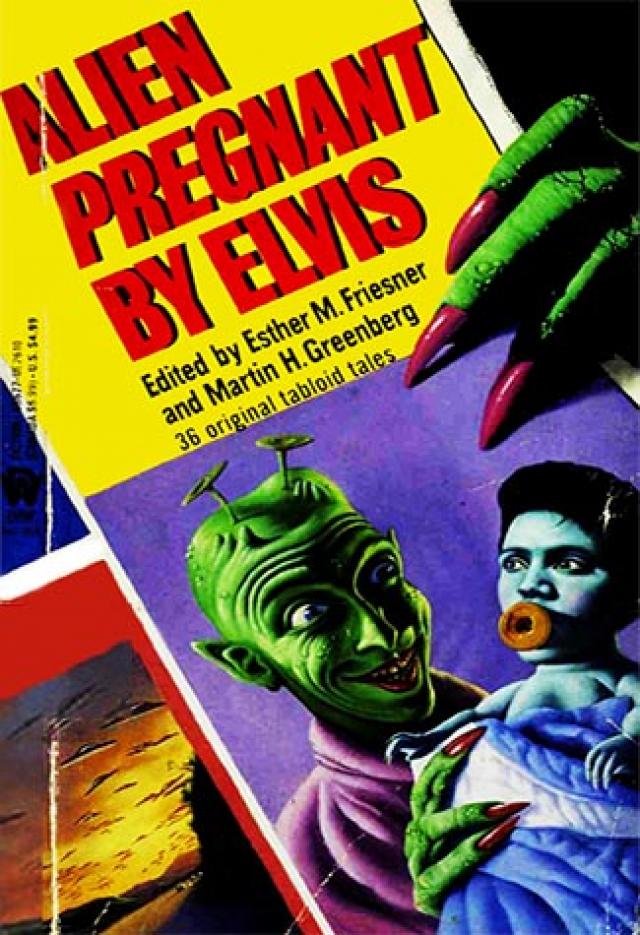
Alien pregnant by elvis, p.11
Alien Pregnant by Elvis,
p.11


No discipline, and no enemies. Most of the kids he went to class with had no idea he was there. Only a few of the girls noticed him—and they didn’t look at his face. Seems that twelve-year-old E.P. White was unusually well endowed. Puberty came early to boys living beneath the fumes of 747s.
Vernon was doing a number on Granny. They met in a bar, and he said he could have brought her home the first night. I didn’t like her irresponsibility—imagine leaving a kid who was about to be murdered home alone—but Vernon said she couldn’t be expected to know everything.
I hated the way he was defending her, and I hadn’t even met her yet.
At that point, we hit a dead end. I was beginning to wonder why I took the case—I hated Dallas and the lock on the door between our rooms remained bolted tight. Vernon spent most of his evenings with Granny, and I spent too many alone in my car, watching E.P. make peanut butter mash for dinner, study six dull sitcoms, and crawl into bed.
At least Vernon would drop Granny off at a reasonable hour. I would have hated to watch a dark house past midnight, especially when I might miss the sound of squeaking bedsprings from the room next to mine.
Vernon had said there were perks to being an Elvis impersonator. I just didn’t expect humping grandmas to be one of them.
It all changed the night of the concert. It was like the Lord stepped down from Heaven and gave me a vision, a sign—or maybe Elvis was speaking to me, and I just didn’t know it.
E.P. was performing in the all-school year-end concert. Granny had asked Vernon to go with her, and I trailed along like a dutiful bodyguard, three paces behind and five rows up.
The concert was in a big gymnasium that smelled like dirty sweatsocks and was filled with oversized people hunching on bleachers built for children. A good handful of the men looked like overage Elvises. I shook my head. This case was getting to me.
Sam Hill Elementary had quite a music program. Each kid had the chance to perform in at least one choir, one orchestra, and one band. Most students, deserving or not, were given solos. The concert started at six-thirty, and about an hour-and-a-half into it, I realized my eardrums would never be the same. I was beginning to like the discordant sound of youthful voices warbling one-quarter step off-key.
Then the school’s pride and joy came out. The big kids. The sixth graders, all muscle and toughness, filled with knowledge that they were the best.
Which, in this group, was not saying much.
They climbed on the risers and the teacher ducked behind the piano, playing a rousing medley of late fifties-early sixties hits, and directing with her head. A few kids bounced off the bleachers to attempt solos: One boy did a lousy “Rock Around the Clock”—he couldn’t decide if he was supposed to be Bill Haley or Richie Cunningham. A little blonde girl, wearing too much makeup, pouted her way through “It’s My Party,” and then the piece de resistance:
E.P., singing “You Ain’t Nothing But A Hound Dog.”
And I knew why Elvis, the old dog, had been interested all along.
He hadn’t lied when he told Vernon he shouldn’t be entrusted with another life. He had a bunch of other lives, and he was manipulating them all to become the King again.
Either that, or E.P. White was one hell of a natural at pelvis grinding.
The kid finished, and the whole crowd was on its feet, shouting “El-vis! El-vis!” Even Vernon was standing, but he wasn’t clapping. He knew, same as I did, that E.P. didn’t stand for Ernest Paul, and that that kid was more of an Elvis clone at twelve than most impersonators were at twenty-nine.
I ran down the bleachers and grabbed Vernon’s hand. “We got to go,” I said.
Granny looked over at me, spots of pleasure on both cheeks slowly fading. Jane Fonda had taught too many women that fifty didn’t mean the end of beauty, and this woman had taken it all to heart.
I wanted to rip the red bow from the back of her long, silver-blonde hair.
“Where?” Vernon said.
“Backstage!” I shouted over the din. “Come on.”
He let me yank him up the bleachers, past the rows of shouting parents, and through the back door into the hallway. The air was cool here and smelled of dust. It was refreshing after smelling dirty sweat socks for the better part of the evening.
I scanned. The hallway was empty. To my left, stairs ran down to the first floor. “We’ve got to get backstage,” I said.
I started down the stairs. Vernon followed, his feet clumping on the tile. “Why?”
“Because tonight’s the night E.P.’s going to bite it.”
We had reached the main floor. Some parents in the hallway were smoking cigarettes. I ran around them to the huge double doors which had to lead to the back of the gymnasium.
“How do you know?” Vernon asked as I pulled open the door.
“See them?” I pointed to the men working their way down the bleachers to the wooden floor. None of them were wearing white lame jumpsuits, but none of them had to. The resemblance to Elvis hadn’t been coincidental. “The kid’s too talented. They’re going to kill him.”
“I was thinking of that myself,” Vernon mumbled.
I shot him a dirty look.
He held up his hands. “Just kidding.”
“You better be.” We crossed the wooden floor behind the performance shell. Granny saw us, got to her feet, and started waving. “Yoo-hoo!” she shouted. “Vernon!”
I grabbed his arm and yanked him through the wooden doors on the other end of the gymnasium. Kids milled in the back. E.P. stood near the outer doors, a cigarette dangling from his long thin fingers. I took the cigarette and stomped on it, then put my arm around his shoulders and pulled him outside.
“Hasn’t Elvis been warning you?” Vernon said as he followed us onto the concrete steps. In the flickering fluorescent light, I saw E.P.’s face go red. So Elvis was talking to him, the creep.
“I—I don’t know what you’re talking about, Mister.”
“You’re just about the greatest Elvis impersonator who ever lived, you got the King inside you, and he’s been telling you you’re gonna die. Don’t you get it, boy? You’re not going to live if you don’t listen to him.”
“Jesus,” E.P. said to me. “You go out with this nutcase?”
“Actually,” I said, “Your grandmother does.”
Then the inside doors burst open and a horde of Elvis impersonators flooded the halls. Vernon picked up E.P. and we ran across the dew-covered grass. This was the point in all my other cases that I turned things over to the cops. I had no plan. I didn’t even know what a plan was.
“The car,” Vernon hissed.
Something zinged by us, then I heard a pop. “Jesus,” E.P. said. “They’ve got guns.”
“You threaten someone’s livelihood, they get a little pissed,” I said. Well, I actually didn’t say. I huffed each word as my breath got shorter and shorter.
We could have parked in a nearby parking lot, but no. We had to choose one clear across the street. Bullets pinged off the concrete beside us.
“Wish I had me a gun,” Vernon said in a deep, sexy voice that didn’t belong to him.
“Shut up, Elvis,” I snapped. “This isn’t a movie.”
We finally reached the car. A bullet smacked into the windshield, shattering the glass. Vernon threw E.P. in the back and I sat up front, a sitting duck, as I fumbled for my keys.
“Start the damn car,” Vernon said.
“You got the keys?”
“This isn’t the time to lose your keys.”
“Well, I didn’t plan on it.”
“How old is the car?” E.P. piped.
“It’s a rental. It’s new.”
“Damn. New ones are almost impossible to hot-wire.”
More bullets pinged against the sides. Good thing Elvis impersonators only killed people with song. If they had had any practice with those guns, we’d have been dead a long time ago.
I turned my pockets inside out and finally found the keys. I jammed them in the lock, put my foot on the accelerator, and started the car. It hopped over the parking bump like a little bird.
“Jesus, Chelsea, drive it. Don’t smash it up.” Vernon had peeked his head over the back seat.
“It’s a car chase, isn’t it? Aren’t cars supposed to get smashed up?” My hands were shaking. The impersonators were crossing the street. They were leaving me no choice but to mow them down.
Then the cavalry arrived. We heard them before we saw them, sirens echoing off in the distance, blue and red lights changing the pictures of the landscapes. The Elvises didn’t stop. They were too intent on us. They fired again, just as the first cop cars zoomed around the comer.
Sometimes the luck is with you.
Of course we didn’t tell the cops everything. They didn’t need to know about my touch or Vernon’s Elvis voice. We told them that Vernon had heard about this kid in Dallas who was really good from another impersonator who made it clear that the kid would die. Vernon called me and we came down together, to see how good the kid really was. And found ourselves in a nest of impersonator vipers.
Granny thought Vernon was the biggest hero she had ever seen. I thought I was going to puke.
The case ended when we went back to the White house. Granny went back to her bedroom to look for some Elvis memorabilia. Vernon started to join her when E.P. grabbed his arm.
“Elvis really talk to you?” E.P. said.
“He sure does, kid.”
“And he told you I was going to die.”
“Yep.”
“Doesn’t it seem kinda strange to you that he would have all that foreknowledge? Do you think he’s working with some of those impersonators that were there tonight?”
Vernon looked at me. I shrugged. “He never said a kind word to me,” I said. “How would I know?” Vernon sat at the table, a frown creasing his beautiful forehead. “I wonder how many people he’s suckering into this kind of life.”
E.P. nodded. “He’s been telling me it’s great, but I keep having visions of myself singing in smoky nightclubs for women who make my grandmother look old.”
“Your grandmother isn’t old, kid,” Vernon said.
I hit his shoulder. He wasn’t supposed to say that.
He glanced at me as if he hadn’t understood. “Well,” he said. “Sometimes it’s better than that. Sometimes you get to go to Vegas.”
“Great,” I said. “Where you can lose all the money you earn.”
“Sometimes,” Vernon said.
E.P. leaned back in the chair, tapping his finger against his lips. “You mean it’s not teenage girls screaming and fainting? Lots of sex and all the food you want?”
“Vernon!” Granny’s voice floated from the bedroom. She was doing girlish and cute. “I got something here you might like.”
“There’s sex,” I said.
Vernon blushed. He pushed away from the table and hurried down the hall.
“With Grandma?!?” E.P.’s mouth fell open. “Gross.”
“My take on it, E.P., is that if you want girls swooning over you, you’ve got to do it your way. Pretending to be someone else isn’t going to cut it for you.”
He got up and peered down the hall. A series of girlish giggles had ended in a moan. “No shit,” he said. “Come on, let’s get out of here—”
We left a note saying we’d be gone for a while. Good thing, too, since, over double fudge chocolate sundaes, E.P. convinced me to find an exorcist for him. The only one I knew was my Great-aunt Louisa in Louisiana, so we drove there, and she worked on him for two days. She finally got the chunk of Elvis out, bottled it, and sold it to the Elvis Presley Museum in Nashville for a hefty chunk of change. Seems some people will pay a fortune for even a whiff of Elvis.
I took E.P. back home to find that Granny and Vernon hadn’t even missed him. They had gone to Vegas to get married. E.P. assured me he’d be fine—seems Granny had done this before—and I caught the earliest flight back to Atlanta.
Where I sit now, behind my big mahogany desk, shoes off, feet sliding on the polish. Five lights blink on my machine, and I’m cradling a cup of coffee against my chest.
I really didn’t want Vernon. Permanently anyway. But it would have been kinda nice if he had snuck into my room at least once. I could have pretended he was Elvis and well, you know.
Except Elvis hated me. Elvis was probably the one who talked him out of it. When I got back to Atlanta, I immediately went to my apartment and threw out all those old Elvis movies. Chocolate would have to do. I was getting too old for that teenybopper stuff anyway. I had seen the future and it was Granny.
There’s a knock on my door. I take my feet off the desk, sit up, and invite the caller in. A slender, well made man in his early twenties shuffles through the door. “Ms. LaFronde?” he asks. If he had a hat, he would be twisting it between his fingers.
‘That’s me,” I say.
“I got a problem,” he says. “And I want you to tell me if I’m crazy.”
I suppress a sigh. Half the nuts in the world think I can diagnose better than their psychiatrist. “I’ll do what I can.” I lean forward sympathetically and indicate the chair.
He folds into it, still twisting that imaginary hat. “It’s Elvis,” he says. “I—I know you won’t believe this, but he ain’t dead. I know him personally.”
“So do I,” I say as I lean back. A psychic investigator never escapes her fate. “And isn’t he a disappointment? Those big stars are just never quite what they’re cracked up to be.”
The Number of the Beast
by Jeff Hecht
This one came in over the transom (which is a neat trick in a transomless suburban Colonial house) and I’m glad it did.
Jeff Hecht is the author often nonfiction books, numerous nonfiction articles, and has had about a dozen stories appear in places including Twilight Zone, Analog, and Robert Silverberg’s New Dimensions. He was also once misquoted in the Sunday Sport, a real British tabloid. He says he in fact does get calls from people with strange theories about bar codes. He’d better be ready to get more.
Run a laser magazine, and you get all kinds of crazy calls. The one that started it was from some guy in God-Knows-Where, Vermont. He’d seen something in my Raw Rumors & Random Data column about bar-coding jail inmates. Not with old-fashioned striped prison uniforms, but with little plastic bracelets with striped symbols like you see in the supermarket. They wanted to keep track of the inmates, just like a supermarket keeps track of its inventory. Makes sense.
This guy wanted to talk about another idea. Some hotshot security outfit was going to put the bar codes right on people, and use them for identification. None of this futuristic automatic reading of retinal patterns or fingerprints. If you wanted to get into a controlled area, you’d stick your right hand into the scanner, and it would read the bar code. If you were on the list, it would open the door and let you in. If you weren’t . . . well, he didn’t say what happened then.
Sounded interesting, so I took some notes. He said the technology came from Entrance Control Systems, a start-up out in Silicon Valley. I asked him if he knew how it worked.
“It’s all in your Bible, you know,” he assured me.
“What?” We publish an annual industry guide, but I’d never heard anybody take it that seriously before.
“The Book of Revelation. Where it says that people shall wear the number of the beast.”
“What?” This time a bit louder. He must have thought I was pretty dense.
“The bar codes. They’d all be wearing bar codes. And you know what’s hidden in the bar codes, don’t you?” He didn’t wait for me to reply. “Remember the blocking digits? The ones that aren’t printed as numbers, but define the start, the middle, and the end?”
“Yeah?” Clearly this guy knew something about bar codes. If you look very carefully at your typical can of soup, you’ll see that most bar codes have two groups of five numbers printed under them. On each end and between the two groups of digits are bars that are longer than the rest. Those are the blocking codes, which help the scanner orient itself, but don’t contain any data. Or so the techies tell me, anyway.
“Each one of those digits is a six!” he concluded, pouncing verbally. “So everyone with the code would be wearing Satan’s mark!”
The number of the beast, 666. I groaned to myself. Was this crackpot being visited upon me for my one venture into horror fiction? “Radio 666” had netted me a check for $23.36, which bounced, and two copies of what turned out to be a poorly printed amateur magazine. I wound the call down. I am always polite; the publisher regularly reminds us that anyone might someday become a potential advertiser.
At least the crackpot’s news tip panned out. Information found me the phone number for Entrance Control Systems in San Jose. Not only was the company real, but they were working on bar-code identification systems. Four bright young engineers had started the company about a year ago, after they were laid off from the nuclear weapons program when the Cold War fizzled out.
“We weren’t about to sell our souls to some third-world dictator who wanted to build bombs,” said one engineer, when the conference call was set up.
“It’s a good thing we didn’t. We had to sell them to the venture capitalists to get the company going,” added a second voice.
‘That’s why they called them vulture capitalists,” I kidded them.
As I listened, I could see those guys had some good ideas. Nobody wanted to use permanent visible tattoos; it looked too much like Nazi concentration camps. So they had developed special permanent infrared inks. They left the skin looking perfectly normal in visible light, but in infrared light the inks looked bright and shiny, while ordinary skin is dark. “At four microns, you couldn’t tell the grand dragon of the Ku Klux Klan from Bill Cosby,” one engineer said. Our eyes don’t work at four microns, he added, so nobody would care if they stamped infrared bar codes right on people’s foreheads.