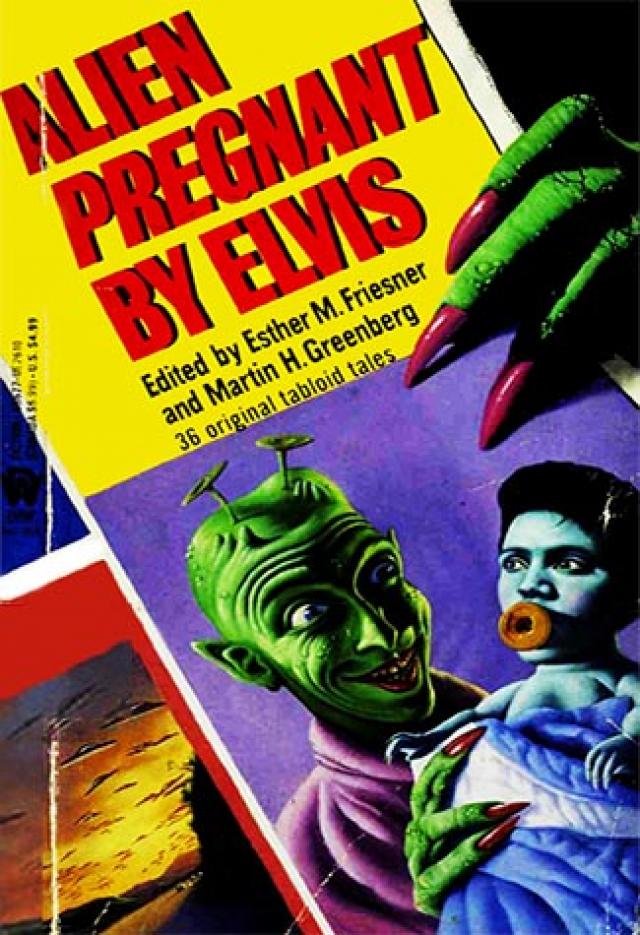
Alien pregnant by elvis, p.24
Alien Pregnant by Elvis,
p.24


The one floating up by the ceiling—George—made a come-hither gesture to Mort and Katie, who duly went thither The closer Mort looked at George, the less he looked like a human being, or even a Star Trek makeup job. For one thing, his head was too small. Making a head look bigger than it really is wasn’t any great trick, but how did you go about shrinking one unless you were a South American Indian?
Nose, ears, mouth—details were all wrong: nothing you couldn’t manage with makeup on any of them, maybe, but why would you? Besides those come-hither qualities, George’s fingers had a couple of extra joints apiece. He had no nipples. Farther down . . . well, Mort was damned if he’d let a makeup man do that sort of thing to his family jewels.
And if George wasn’t an alien, what was he doing up here by the ceiling, and how had he gotten Katie and Mort up here with him? Mort’s gut had needed a little while to catch up with his brain, but now he believed all over.
The alien extended the middle finger of his left hand toward him, the middle finger of his right toward Katie. Mort wanted to flip him off right back, but didn’t have the nerve. George’s finger touched the center of his forehead. He’d expected blazing heat. Instead, it was cool.
After that—the only person who understood what happened to him after that was Katie Nelligan, and only because it happened to her, too. He felt his brains getting systematically emptied and copied, as if he were a floppy being backed up onto an enormous hard disk. Everything he remembered, from the Pythagorean Theorem to losing his cherry under the football stands in high school, got sucked up and flowed out through the alien’s finger.
So did things he’d never imagined his brain retained: what he’d had for breakfast five years ago last Tuesday (two eggs over medium, wheat toast, grape jam, weak coffee); what his father had said when, sometime under the age of one, Mort spat up on the old man’s best suit (not to be repeated here, but prime, believe me). Amazing, he thought, and hoped he’d keep one percent of what the alien was getting.
Even more amazing, though, was the backwash he got, as if a few random little documents from the hard disk snuck onto the floppy while the floppy played out onto the hard disk. Some of them came from Katie: the smell of her corsage on prom night, a sixth-grade spelling test where she’d missed the word revolutionary; what cramps felt like, and a long-distance call to her sister in Baltimore the spring before.
And some of those little documents had to come from George the alien: using those peculiar private parts in the manner for which they were intended, what felt like a college course on how flying saucers or whatever they were worked (which would have been worth a mint, and not a chocolate one, if Mort had understood the concepts), the taste of fancy alien food (by comparison, that ever-so-ordinary breakfast seemed nectar and ambrosia).
Mort also picked up a few impressions about what George thought of mankind. In two words, not much. He went about his job with all the enthusiasm of an Animal Regulations officer counting stray dogs around the city dump, except an Animal Regulations officer might actually like dogs.
The alien didn’t like humans. Mort could think of a lot of reasons why benevolent aliens wouldn’t like humans: they were busy polluting their planet; they fought wars; they discriminated on the basis of color, gender, sexual preference, and the size of your bankroll. If any of that had been in the backwash from George, Mort would have been chastened but not surprised.
It wasn’t. George felt about humans much as a lot of nineteenth-century British imperialists had felt about the peoples they ruled: they were wogs. They were ugly, they smelled funny, they had revolting habits, and, most of all, they were stupid. George’s view of what humans had in the brains department was somewhere between a badly trained dog and what that badly trained dog was liable to leave on your front lawn when it went out for a walk.
Given that George was currently pumping him and Katie dry of everything they’d ever known, Mort had to admit that, from his point of view, he had a point. But if George was a benevolent alien, he devoutly hoped he’d never run into one in a lousy mood.
All of a sudden, he was empty. The inside of his head seemed to be making the noise a soda straw does when you’re still sucking but the soda’s all gone.
A few more impressions backwashed into the sodaless expanse between his ears. One was a mental image of two scared-looking rubes in hunting gear getting the same treatment he was undergoing now. I’ll be damned, he thought. They weren’t making it up after all The second was a flash of alien mentation: As long as we have to do it, this is the perfect spot for the survey. They’d never—He never found out who they were or what they’d never. The document was incomplete.
George turned to his buddies by the door. He wiggled his ears. Mort didn’t know what that meant, but the rest of the green-and-glowing Fab Four did: job’s over for today. They went out the door. They didn’t bother opening it first.
The floating alien looked from Mort to Katie and back again. Mort got the idea that if it had been up to him, he’d have dropped them both on the floor, kzrsplat. But maybe he had a supervisor watching him or something, because he didn’t. He floated them down the same way they’d come up, only faster.
As they were descending, George went down the invisible stairs he’d gone up before. He left the Intelligencer office the same impossible way his colleagues had, except he left his nether cheeks on this side of the door for a couple of seconds while the rest of him was already on that side. “Jesus,” Mort said. “The moon from outer space.”
Katie laughed—hysterically, sure, but can you blame her? Mort couldn’t see what anybody else was doing, because the room was dark again now that the nightlights that walked like men had gone.
Then the lights came back on. It was as if that broke a spell; for all Mort knew, maybe it did. People started jumping and hollering and running to the door (but not through it) to find out if the aliens were still in sight. Mort didn’t run to the door. Having seen the aliens more up close and personal than anybody but Katie Nelligan, he didn’t want to see them again.
Katie said, “Whoever was taking those pictures, get them developed this instant, do you hear me? This instant! Don’t leave the shop while they’re being processed, either—wait for them right there.”
That got three people out of the office. Mort glanced down at his watch, wondering how long he’d floated by the ceiling. What he saw made him blink and exclaim, “Katie, what time do you have?”
She looked at her watch, too, then stared at him, bright blue eyes wide with surprise. “It felt like we were up there for an hour, not a couple of minutes.” She pointed to the wall clock. “But that says the same thing. Weird.” She was not the sort of person to let weirdness overwhelm her; that was one of the reasons she was editor and Mort, older and arguably more experienced, just a staff writer. “We’ll do drafts of the piece right now, while we still remember everything. When we’re done, we’ll compare notes. This one has to be perfect.”
“Right.” Mort all but sprinted for his computer. He’d never imagined being in the middle of a story like this. Woodward and Bernstein, eat your hearts out, he thought as he hit the keyboard.
He plunged in so hard and deep that he started violently when Katie tapped him on the shoulder. “I just wanted to say thanks,” she told him. “That was brave, what you did.”
“Oh. That. Yeah. Sure,” he said. “Listen, why aren’t you writing?” Katie laughed softly and went away.
The next thing Mort remembered apart from words flowing from his mind to the computer was the pictures coming back. For that he was willing to get up from his desk. He’d expected something would go wrong—they’d be fogged, or black, or something. But they weren’t. There was the alien, doing the mind-probe on him and Katie while all three of them floated in midair. There were the other aliens by the door. Shot after perfect shot—it was just a matter of picking the best ones.
“We’ve got ’em,” Katie said. Everybody nodded.
Five o’clock came and went. Mort never noticed. Neither did Katie. Finally, at about half past six, she printed her story. Mort said, “I’ll be done in just a few minutes.” He pulled his sheets out of the laser printer when he was through, then said, “We both must have run way long. Shall we,” he hesitated, then plunged, “compare and cut over dinner?”
She gave him not the wary, thoughtful look he’d expected, but a sidelong glance and half a smile, as if she knew something he didn’t. “All right,” she said. “Let’s go to Napoli. It’s right down the street, and we have a lot of work to do to get this the way it has to be.”
They went through each other’s stories alongside lasagna and Chianti. Time on real newspapers had made Mort sharp at writing lean and tight; he boiled away a quarter of Katie’s piece without touching the meaning at all.
She attacked his differently, looking more at what it said than how it did the saying. About halfway through, she looked up and said, “Backwash? That’s a good way to put it. I felt it, too. I wondered if you had. But somebody reading the piece is going to need more explanation than you’ve given it here.” She scribbled a note in the margin.
Over spumoni (“To hell with the waistline; today I earned it,” Katie said), each looked at what the other had done. Most of Katie’s comments asked for more detail here, less there, and made Mort’s story more tightly focused and coherent. He tipped the cap he wasn’t wearing. “Thanks. This’ll help.”
“I like what you’ve done with mine, too,” she answered. “It’s a lot crisper than it was. We make a pretty good team.”
“Yeah.” Mort beamed. He’d had just enough wine to improve his attitude, not enough to hurt his thinking.
Katie dabbed at her lips with a napkin. “Now let’s get back to the office and hammer ’em together.”
Mort almost squawked, but he didn’t. What did he have to go home to? An empty apartment and celebrity dog wrestling on ESPN? Real work, important work (something he’d never imagined at the Intelligencer till now) was more important than that, and the company better. He took out his wallet, tossed bills on the red-and-white checked tablecloth, got to his feet. “Let’s go.”
“Hey, I was going to pay for mine,” Katie said.
He shrugged. “I’m not broke, and I’m not trying to take advantage of you. If you want to buy for both of us one of these days, I’ll let you.”
She gave him that funny sidelong look again, but rose from the table without saying anything more. The night watchman scratched his head when they went back to the Intelligencer officer. “You folks don’t usually work late.”
“Big story—a real ‘Hey, Martha!’ ” Katie said solemnly. “Yeah?” The watchman’s eyes lit up. “Does it have Madonna in it?” When Mort and Katie both shook their heads, his shoulders slumped in disappointment. “How can it be a big story if it don’t have Madonna in it?”
They went inside without answering, then settled down to work side by side. A couple of hours later, sheets slid into the laser printer tray, one after the other. Mort scooped them up, saying, “Let me go over these one more time. I’ve been using a computer for ten years now, but I still edit better on hard copy.”
“Yeah. Me, too.” Katie read over his shoulder. They each made a last few changes, then printed out the altered pages again. This time Katie took them from the printer. She slid them into their proper places, made a neat little pile of the story, and stuck a paper clip in the top left comer. “It’s done.”
“Wait,” Mort said. “Let me have it for a second.” He took it over to the xerox machine, made two copies. “I’ll take one of these home, and I’ll stash the other one in my desk—just in case.”
“In case the aliens come back, you mean?” Katie said. He nodded. She went on, “I don’t think it’d help, but it can’t hurt, either. First thing tomorrow, I go upstairs and lay this,” she hefted her own copy of what they’d done, “and the photos on Mr. Comstock. If he says no, I quit.”
“Me, too,” Mort said. Some things, by God, were more important than a job.
Katie yawned. “Let’s go home. It’s been a long day.”
“Boy, hasn’t it just?”
Everyone in the Intelligencer office stared nervously at the door through which the aliens had departed. Mort wasn’t anticipating their return; like the rest of the tabloid crew, he was waiting for Katie Nelligan to come back from her conference with the publisher. She’d been up there a long time.
The door opened, which proved it wasn’t the aliens coming back. Everyone jumped all the same. In stamped Katie, looking the way a Fury might have if she were Irish instead of classical Greek.
Mort could find only one reason for her to look like that. “Mr. Comstock won’t go for it?” he exclaimed in dismay.
“Oh, no. He will. We lead with it, next week’s issue.” Katie bit off the words one by one. Little spots of color that had nothing to do with rouge rode high on her cheeks. “But he doesn’t believe it. He doesn’t believe us.”
Cries of outrage echoed from walls and ceilings. “What does he think, that we made it up to sell his stinking papers?” Mort yelled. “We’ll all go up there and tell him—”
“No, we won’t. I told him the same thing, and he said we’d regret it if we tried.” Katie’s scowl grew darker. “And yes, that’s just what he thinks. On the photos, he thinks he spotted the wires holding us up in the air.”
“Jesus!” If he hadn’t already been starting to bald, Mort would have tom his hair. “There weren’t any goddamn wires!” The memory of yesterday’s terror flooded back, sharp as a slap in the face.
“I know that as well as you do, Mort,” Katie said. “So here’s what I’ve got in mind: we’re going to pretend we don’t care what Mr. Comstock says. We’ll put this out the right way, and people will believe it.”
The staff sprang to work with the fire and dedication mutiny can call forth. They threw themselves at the story with the dogged, fatalistic courage of English infantry climbing out of their trenches and marching into German machine-gun fire at the Somme. Mort was astonished at what some of the people—men and women whose total illiteracy he would till now have reckoned a boon to mankind—could do.
“You know, Katie,” he said when the editor walked by, “this is gonna be a ‘Hey Martha!’ to end all ‘Hey, Marthas!’ Everybody will want to read it.”
“I think you’re right. And we’ve got a real Freddie Krueger of a picture on the front page to grab ’em and pull ’em in.” She bristled. “I had to stop Comstock from using the one that looked right up my skirt. That man!” She clenched her fists till the knuckles whitened.
Mort looked at his watch. It was getting close to five. “Do you want to drown your sorrows in another bottle of Chianti?” he asked.
She’ll say no, he thought with the automatic pessimism of a man who’d been through a divorce and taken a few knocks afterward for good measure. But she said yes. And after a truly Lucullan feast at Napoli (or Mort thought so, anyhow, but he was too happy to be objective), she went back to his apartment with him. The mess it was in proved he hadn’t expected that. If it bothered her, she didn’t let on.
Afterward, still on the disbelieving side but happier—much happier—than he had been at the restaurant, he ran a hand down the smooth skin of her back and said, “What made you decide to—?” He let it hang there, so she could ignore it if she wanted to.
She gave him that I-know-something-you-don’t-know look again, the one he’d seen on her face when he asked her to dinner the day the aliens came. It stayed there long enough that he thought she wasn’t going to answer. But she did, if obliquely: “Remember the backwash?”
“Huh?” he said, but then, realizing what she had to be talking about, he went on, “From the alien, you mean? Sure. What about it?”
Katie hesitated again, then said carefully, “I didn’t mean just from the alien. Bits came from you, too, just like you got bits from me. And one of them happened to be . . . how you feel about me. It’s hard to be sure about a man—I suppose it’s hard for a man to be sure about a woman—but this time, I didn’t need to have any doubts. And so—” She leaned forward on the rumpled bed and kissed him.
Absurdly, he was jealous. He’d gotten bits from her, sure, but nothing like that (as far as he was concerned, the prom corsage didn’t count). The one he remembered most vividly had come from the alien, that contemptuous They’d never that broke off unfinished.
From what had happened since, Mort was beginning to think he knew who they were and what they’d never, but he didn’t tell that to Katie. He might have been wrong—and even if he was right, what the hell could he do about it?
If you went into a market or a convenience store a few weeks ago, you probably saw the Intelligencer on its rack, jammed in there with the rest of the tabloids. You probably took at look at the front page photo, shook your head, and walked on by to get your beef jerky or pipe cleaners or whatever it was you needed.
And even if you plunked down your eighty-five cents and read the whole piece, odds are you just took it in stride. After all, a tabloid’d do anything to sell copies, right? You’d never believe in aliens, would you?
Katie cried when the story went belly-up. The late-night talk-show hosts didn’t even take it seriously enough to make jokes about it. Mort wasn’t surprised. The green-and-glowing guys had known just where to take their sample, all right.
But don’t think this is a story without a happy ending. Mort and Katie are getting married next month. They still have a lot of planning to do, but they’ve agreed on one thing: the wedding won’t be in the Intelligencer
Loch Ness Monster Found—
in the Bermuda Triangle!
by David Vierling
David Vierling is a new writer who lives with his wife and son (and an inordinate number of edged weapons) in Virginia, where he is active in several medieval reenactment groups. Many local supermarket clerks were bemused when he told them that he was reading the tabloid headlines as research. In his own words: “I got a Bachelor of Science degree in Journalism for this?”