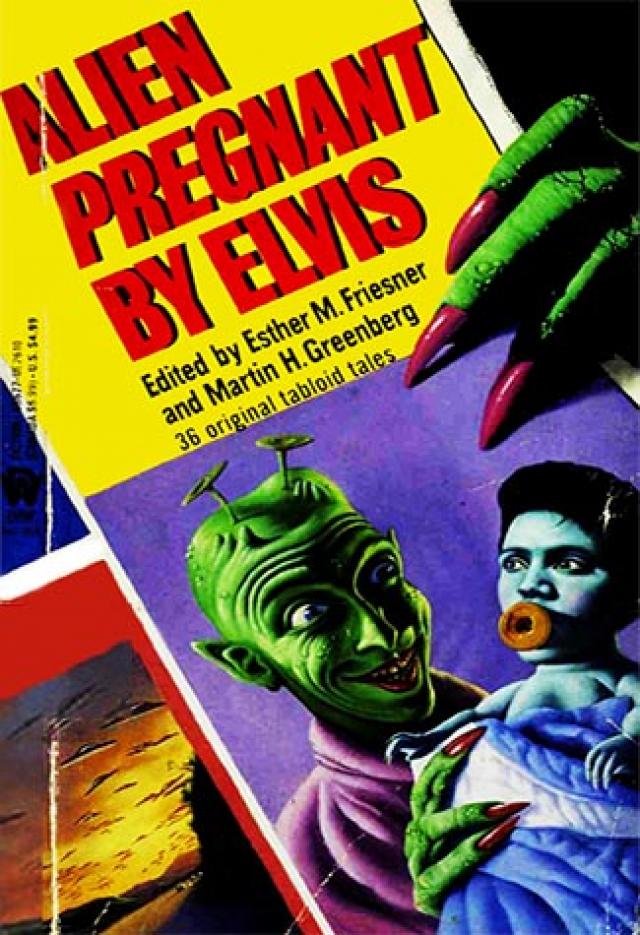
Alien pregnant by elvis, p.30
Alien Pregnant by Elvis,
p.30


“I need an egg selling idea now,” Jommy muttered aloud, to no one in particular.
“Perhaps, sir, we can hire in different lectors. Pay them a short-notice premium.” It was Fred being irritating again. To Fred, the expense management report was an unknown and arcane ritual, which is why he could make suggestions that called for the spending of unrealistic amounts of money. Still . . . “Different lectors? Whom would you suggest, Fred?”
“Well, sir. The Crystal Examiner here is known for the accuracy of its predictions. Fine folks, to be sure. But let’s face facts, accurate news prediction doesn’t sell groceries. Now, my wife shops at Praetorian Mall where The Island Globe lectors the news. Very big sales since they started. She says the manager there was just appointed to the board of Imperial Commerce.”
Jommy was skeptical. “The Globe! The one that about once a month claims Aelvis is returning from the dead?”
“That’s what’s so great about it, sir. He never returns, so they don’t have to disturb the shoppers with new stories all the time.”
“Humph,” snorted the little man, disgustedly.
“Don’t they also report the BigPaw stories?” Jommy asked. “BigPaw and Aelvis. Yes, sir. Their specialties. Shoppers love BigPaw and Aelvis. There’s a female BigPaw rumored to be pregnant with Aelvis’ love child.”
“Are there other choices?” asked Jommy.
“Not many,” replied Fred. “Over at Town Square Center they have Entertaining People. The EP folks are mostly Showbiz gossip. Not really right for a grocery, I think.”
“No, not at all,” said Jommy, nervously watching the growing crowd gathering before the curtain.
“Now, in the tavern district, those folks can get really sick. There’s one bar, near the old warehouse, where the lectors read true crime stories to the patrons. Serial killers, kidnappings, dismemberments, and the like. Can’t recall the name of the service . . .”
“Hannibal’s Lectors,” said the little man, shaking his head sadly. “A blight on the fine name of the profession.”
“Err, yes,” said Jommy, uncomfortable with the direction of the conversation. “Not at all what we’re looking for. Wouldn’t help egg sales a bit.”
“No. Not at all, sir,” said Fred. “If I might suggest, perhaps sending the egg vendors into the crowd would increase sales. Sell straight from the baskets to the patrons.”
“Excellent idea,” said Jommy, for the first time seeing hope. “Make it so. At once!”
“I’ll instruct the produce department,” said Fred, as he bowed and turned, disappearing into the crowd as suddenly as he had arrived.
“Well,” said Jommy to the little man. “The egg baskets will help. We may not need to spend the money to bring in a more cooperative soothsayer.”
“Wouldn’t have mattered,” said the crew master confidently. “Yes. You’re right. The other lectors wouldn’t have helped,” agreed Jommy.
“That’s not what I meant,” he replied gruffly. “Wouldn’t have mattered if you’d spent the money.”
“Money? Not matter?” Jommy was certain money was beyond the understanding of a toad.
“Basil’s usually right, you know. Won the Emperor’s Cup seven years running now, he has.”
“The Emperor’s Cup?” said Jommy, distracted. The egg vendors were having only moderate success with the crowd at the front of the lector wall curtain.
“Makes not much difference now,” said the crew master. “Shall I give the boys the order? Have ’em show the wall?”
“Are your lectors in place? The readings are as important, as the wall.”
“That they are guv’ner. Ready for the signal. Shall I give it?”
“Yes,” said Jommy, actually believing things might work out. “Do it now.” Jommy noticed Fred had returned.
The scruffy crew master raised his arms, and waved toward the wall. The crowd, sensing the unveiling was near, turned in a murmured silence toward the curtain.
Slowly, deliberately, the curtain master released the free weights from the rigging. Seconds later, the wall stood exposed, the latest predictions of Basil, the Soothsayer, upon it.
Jommy gagged.
The crowd gagged.
Fred, who really didn’t care, gagged.
The little man smiled.
“Like I told you, Basil says you needn’t worry ’bout what you’re spending. Don’t make no difference with the island being destroyed and all.”
Jommy hated the little man more than any toad had ever been hated in the history of Atlantis.
“ ‘ATLANTIS DOOMED! CRYSTAL SLOUGH TO TRIGGER VOLCANO!’ What kind of headline is that?” Jommy was livid.
“Basil calls them like he sees them.” The little man was unshaken.
“Basil! You dare tell me about Basil!!!” Jommy screamed at the top of his lungs.
“Basil!” echoed a voice from the crowd. “Basil!” screamed another. “Down with Basil!”
Jommy noticed some of the customers were throwing their eggs at the wall.
“Our lectors have fine voices, Mr. Kerr. Used to shouting over the crowd and all. Shall I have the readings begin?” Jommy glared at the little man.
“I can see you’re busy now, Mr. Kerr. I’ll give the signal if you don’t object.” The little man put his fingers to his mouth and whistled. “Basil himself will give you the honor of the first reading.”
Slowly, more slowly than Jommy thought possible given the eggs flying toward the wall, a hooded figure with a long, crooked staff approaching Jommy. Around his neck rested a crystal pendant, and Jommy understood why the man was unconcerned about the unruly crowd.
“A thousand pardons, O Holy one,” said Jommy. “Quiet!” shouted the little man. “Basil does not chat with the unconsecrated.”
Jommy cringed and looked at the soothsayer. Basil’s gaze showed not the slightest sympathy. After a time that seemed to Jommy much longer than it was, Basil raised his staff and began to speak.
“In the reign of Scirrhus was forged here in Atlantis a crystal of great powers, bringing health and prosperity to all the peoples of The Great Island. Ye have been warned since that forging, of the foul and unclean liquids which seep from the crystal each time a goodness is taken from it. These pestilent vapors have seeped deeply into the earth, their untended combinings rotting away the mantel that protects us from the powerful forces which long ago drove this land up from the sea.”
Jommy wanted to cry. He was beginning to understand Basil. Somehow, egg sales didn’t seem so important as they did a few minutes earlier.
“Generations of the faithful have cautioned the unbelievers that this time drew near.” Basil looked at Jommy. “Your bodies are doomed, as is this land. Look inside yourselves. Therein lies all that can be saved, or is worth saving.” Basil bowed, and walked away as slowly as he had arrived. Jommy noticed the other lectors circulating among the crowd. Mostly they were being ignored.
“The protection of the crystal,” Jommy mumbled. “You didn’t tell me his visions were sent by the crystal.”
“The crystal doesn’t matter, no it don’t, Mr. Kerr. What you do with the knowledge the crystal gives you is what makes the difference. The Crystal Examiner’s been warning folks ’bout this for years, we has. We’re prepared. Got boats ready for me and the crew. Basil says to take four boats in four different directions. Gonna do what he says. Hasn’t been wrong yet, Basil hasn’t.” The little man was no longer smiling. “Looks like your egg sales were good. You got what you wanted ”
Jommy looked at the wall, splattered to unreadability by the eggs thrown at it.
“Great job, Kerr!” The Exalted High Vice President for Regional Sales had returned, as had his lackey and his beeper. “I knew you had it in you. Sending the beeper here back to headquarters with the good news. This boy’s going to be a Director soon, don’t you think so, Parker?”
“Why, yes, Sir,” said the Third Assistant VP, starting to resemble the toad Jommy had mistaken the crew master for.
“Great idea, Kerr. A washable wall, and a controversial message. Sure to provoke the shoppers into buying lots of eggs. Why, you’ve broken my one day sales record, and it isn’t even noon yet! The Council will be very impressed when I tell them. True genius, Kerr. Simply true genius. You’ll be elevated in no time.”
Jommy sighed.
A low rumble rose from the ground, causing the market gates to quiver.
“What was that?” said the Exalted Vice President, more demanding the information than asking.
“Elevated isn’t the word,” said Jommy, no longer fretting. The little man smiled.
Frozen Hitler Found in Atlantean
Love Nest
(An excerpt from her forthcoming The
Wild Hunt For Gray November)
by G—rG—n
One Who Knows begs to inform us that G.G. is the pseudonym of a Female Fantasy Writer whose work has been compared to Michael Moorcock . . . if Michael Moorcock were on amphetamines and had thrown out all the even-numbered pages. “Frozen Hitler . . .” is an excerpt from The Wild Hunt for Gray November, the second book in the trilogy composed of Moonwiseraker and Day of the Tiggy.”
Down the slanting wine-dark; green wine, and foam shadow; down where the bones of coral are bones in truth, and eye-pearls wink in the swift subterranean airs.
Hitler. Dark poisoned dwarf-king, cast in blood, annealed in fire, plucked forth, ragged hominid Grail for the Tree of Night, preserved twice-annealed in liquid hydrogen’s fires.
And lost, then, lost with the swift turning of the years and sea, lost, and, losing, found in the place where lost things go.
On the bridge of the Holy Russian Orthodox Church submarine Nautilus, Captain Yuri Potempkin consults with the Emperor Tiberius. Creature of oxygen, hydrogen, gold, glass, and stars, AI baptized with all the rites of Holy Mother Church, calling back a pagan soul from some cold un-Christian eternity to reason again in neural-nets of light.
“Sought, we seek. Seeking, find unsought,” the computer says.
“Aye, tha’s the right of it.” The captain, child of the Leeds-fostered English north and the wild Riding so unlike his blood-called steppes, pulls slowly on his beard. Creature of technic, Shadrach to the hydrogen furnace that drives his craft, sybil to an intellect of glass and light, pawn to sealed orders. “Though what we’re seeking, darkwise, I canna thole.”
“Losing, find. Finding, lose. Empires all turn, clepsydra-wise, turning, tumbled, sand,” sings the computer. “O’ for a sunborn, sunwise, dragon heart dead. Imperial eagle hatch cockatrice, always, allwise.”
The captain gives the order to dive.
The ocean is spun of a thousand layers, silken skeins in an angel’s treasure chest. Travel through space as through time, and begin in clear pale greenglass, silk-yielding surface water. Pass on to where the glass is greener, the tidal push unyielding, down to the separate country of those whose brief plangent lives are spent falling to rise. Fall, then, to the depths they dare not, where even light is left behind and the thunder of the blood is the only music; black water, urgent as flesh, whose strange citizens make their cathedral communion through passageless and unbordered night, touching only themselves.
Fall, and fall, and fall, into distillation of blackness, paradigms beyond perfection, to uttermost pressure, uttermost cold, uttermost long lonery and silence.
Here where the fall is broken is the country of the lost things.
Here lies the poison knight, colder even than the waters. Blackness his companion as in life. Blackness his fitting shroud, warped and shaped by the concatenation of worlds each resting upon the next reaching sunwise into airy insubstantiality, to rain and wind and stars.
Here Hitler lies, dreaming the brute chemical dreams of coldwise. Crystalline his blood, crystalline the mute universities of his brain. His eyes, shuttered hybrid jewels, skin, cold perilous exact boundary between shadow and other. Dreaming lostthing, at the end of the darkfall of the lost.
And round this exact perdition intention has crafted order. Darkwise, has set out meaning, dividing that which might rise from that condemned from time eternal to support the pillars of the world. Resurrection, redemption from the lostthing lostland.
And in the poisoned fire of absolute cold, he sleeps.
Down comes Nautilus, falling-diving, wingless in a denser air, sides rippling mimicking sunwise life. And on her bridge the Captain swears and paces, fretting against orders unsealed now, orders shining forth echoes of candlesmoke and incense, bright archaic pomp and temporal with ribbon and ink and sealing wax, orders mad to the point of unbelief.
Find Hitler.
And the icon inconographic—mad Tiberius, blessed and saved by Holy Mother Church for the rocking clasp of angel thighs in some non-Classical eternity—mumbles over datastream and databit, file and archive and subroutine, like a priest tending the artifactury of his transubstantiation. Chrism glows amber on amber watchlights, blessed and saved by the submarine priest for the annihilation to come; frankincense distilled with pressure into tiny moated drops of gold, plangent in the still air, haloing all the bright sealed separated technology with secret connectedness. Diving, they court epiphany, eschaton, unsanctified transubstantiation into water harder than glass, more ancient than stone.
And at last they are lost, lost well and truly, darkwise, turned away from the sun.
“Will tha’ tell ’un, Tib, wha’s that yon?” Potempkin says. Green phosphorescence of radar, remote computer-assisted cameras, the glittering metal armor of rationalism, all contribute their widowed mite of image and pagan teleology.
“Seven bridges and seven hills. Temples, sybils, oracles, treasures, emperors, conquests, all. Time turns, redoubles, recreates. The greatest city spawns the greatest city, spawns shadow, double, image, myth. And forged anew, from new, changes and discards, leaving is left in turn.”
“Grand talk, but what is there?”
Potempkin looks and builds up, from phosphorus and jangling light, city where no city must be, holding up proud caryatid heads to a night that was silk and stone and water. Impossible city, darkwise, that, impossibly, must collect to it all impossibility.
“Darkwise fallen. Lost, the place where lost things go, as we, lost, find ourselves here, where eagles debased are eagles meat.”
“Helmsman, take us down,” the captain says.
Held separate from the world in that steel pavilion, Potempkin watches as light painting on glass reveals the world. Arched amazing cathedrals, dour kirks, flightling temples; unbeing city, moved through by arched ponderous imponderables.
“This cannot be,” he whispers, cleaving to reason and religion. But what is hinted to the eye, crafted in the mind, is real. Yuri hears the mermaids singing.
They are lovely in goddess-wise, these cool-blooded impossibles. They trail phosphorescent ribbons of their own desirability through the liquid air, glowing like cthonic stars. They are all the colors of the hidden eyes of earth: pale amber, and peridot, garnet, topaz, ruby. Their pendant vanes stroke the sunburn skin of Nautilus like vain regrets; the shock of impact makes coral of old bones.
“Follow them,” he says, and mindless metal hurries to his will.
“We’re down too deep,” the helmsman says. In after years Yuri may remember the moment. Tiberius sings to the mermaids; antiphon, colophon, counterpoint, interwoven, sifting meaning from water music. And Nautilus sings also, small songs of breaking strain, metal fatigue, betrayal to obsolescence in the cold dark.
And the mermaids sing, but not to them. Yuri sees. Sing instead to their dark misunderstood god, colder than waters, who lies in the heart of the lostthings city, nested in sea corals and dead trailing fern. Nautilus cries, seeking absolution only Heisenberg can give her, but Yuri must see.
In drowned Atlantis the mermaids circle, painting the dense unforgiving water with their brightness. Round and round they spiral about the object of their affections, the cold, the dark, the lostthing failed prince whom Yuri was sent to find. And shall the sea give up her dead, O? The land must give up hers, the million millions sung to sleep on blood. They do not understand the hot carnivorous passions, these cool night-maidens; their love is slow and tidal.
And Yuri sees. Sees, and to the mad cantabile of maddened plastic intelligence forsakes his quest and flees sunwise, giving up what he has found:
Frozen Hitler in Atlantean love-nest.
Those Eyes
by David Brin
Hugo, Nebula, Locus and Campbell Award-winner David Brin speaks best for himself He “used to eke out a living from government grants, till he quit research and teaching to become an entertainer. Lacking a singing voice, or other discernible talent, he chose writing. ‘I discovered a gift for libel,’ he explains. ‘But I never had the heart to slander real people. Anyway, real people hit, sometimes hard.’ ”
For safety’s sake, he turned to writing SF. The results have included novels such as Startide Rising, The Uplift War, The Postman, Earth, and this story.
“. . . So you want to talk about flying saucers?” I was afraid of that.
“This happens every damn time I’m blackmailed into babysitting you insomniacs, while Talkback Larry escapes to Bimini for a badly needed rest. I’m supposed to field call-in questions about astronomy and outer space for two weeks. You know, black holes and comets? But it seems we always have to spend the first night wrangling over puta UFOs.
“. . . Now don’t get excited, sir . . . Yeah, I’m just a typical ivory tower scientist, out to repress unconventional thought. Whatever you say, buddy.
“Truth is, I’ve also dreamed of contact with alien life. In fact, I’m involved in research now. That’s right, SETI. . . the Search for Extra-Terrestrial Intelligence . . . And no, it’s not at all like chasing UFOs! I don’t believe the Earth has ever been visited by anything remotely resembling intelligent
“Yes, sir. I bet you’ve got crates full of case histories, and a personal encounter or two? Thought so. I got an earful when some of us tried studying these “phenomena” a few years back. Spent weeks on each case, only to find it was just a weather balloon, or an airplane, or ball lightning . . .