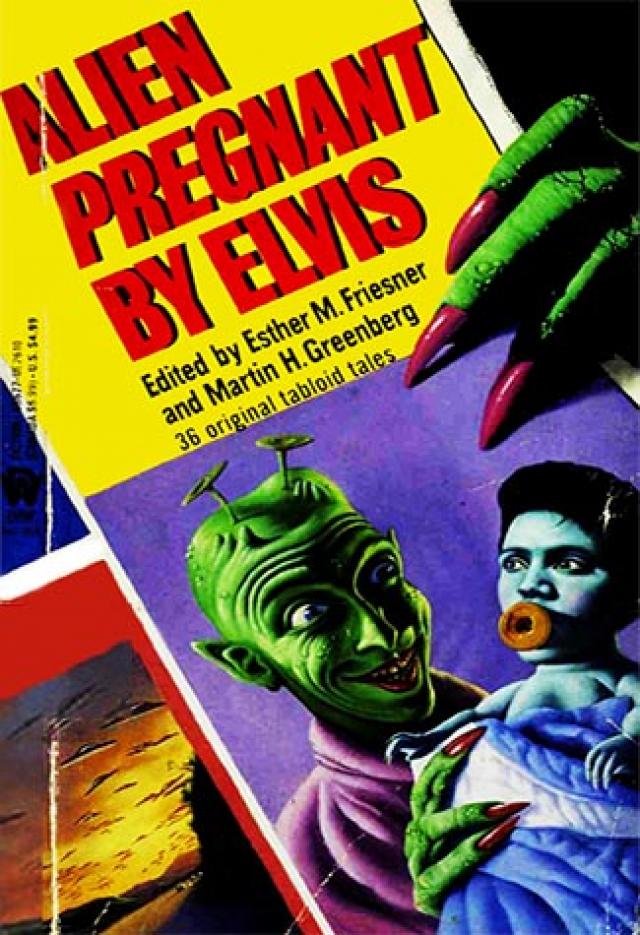
Alien pregnant by elvis, p.33
Alien Pregnant by Elvis,
p.33


Martian Memorial
to Elvis Sighted
by George Alec Effinger
George Alec Effinger is living proof that it is possible to write great SF and fantasy comedy as well as the serious side of the genre. His story, “Schroedinger’s Kitten,” won the Nebula and the Hugo. He is also the author of the hilarious Muffy Birnbaum tales. His most recent novel is The Exile Kiss.
I firmly believe that “Martian Memorial to Elvis Sighted,” is the perfect finish to this book, as well as a wonderfully fitting tribute to “the King.”
August 16, 1987. Ten years to the day since Elvis’ death. Priscilla had almost forgotten the mysterious envelope that lay hidden in the back of one of Lisa Marie’s sock and underwear drawers. Her nineteen-year-old daughter had not forgotten, however. In fact, she’d been counting down the days until she could finally open her father’s final testament. The day before, Lisa Marie had called her mother in California; Priscilla had flown back to Memphis for the occasion of the opening of the envelope.
Graceland was closed to tourists for this special day. Priscilla and Lisa Marie made certain they had undisturbed privacy. Holding her breath, Elvis’ daughter opened the clasp on the manila envelope and tore away the masking tape that sealed it. Glancing at Priscilla’s eyes, she opened the package and took out about twenty handwritten pages. Handwritten by Elvis himself. Priscilla and Lisa Marie recognized the handwriting of the King of Rock ’n’ Roll.
“What does it say?” Priscilla asked breathlessly.
“I’ll read it to you, mama.”
And here is Elvis’ last communication from beyond the grave:
(Mrs. Presley: My name is Milt Vessman, and I had the privilege of serving with your husband in the Army in Germany. A short time ago, Elvis came to me and asked if I would help him tell the fantastic story that follows. He recited the events in great detail, and I dictated it back to him, improving his grammar and vocabulary. Whether or not you believe these things is, as Elvis says, up to you.)
Dear Priscilla—
I am a very old man; how old I do not know. Possibly I am a hundred, possibly more. You might think this is some fantasy or delusion of mine, but as clearly as I recall my childhood in East Tupelo, I also recall a life—several lives—before those days. How many births and deaths and rebirths have I had? Maybe I’ll never know for sure. And maybe I’ll never understand why I have been given this gift. A gift, I say, or is it a curse? I do not know.
You may believe all that or not, as you choose. I am writing this in 1966. I have just finished filming Spinout and I am about to begin an all-singing, all-dancing, all-Elvis rock ’n’ roll musical version of a book called The Prisoner of Zenda. I’ve left instructions that this message should not be opened until ten years after my death. I hope that’s a long, long time from now, and I hope that you are reading this surrounded by all the children we will have soon, but of course all that is in the hands of the Lord.
Between movies, Priscilla, you know I like to take a little vacation to clear my head. If you remember, I told you after Spinout that I just had to get away by myself for a while. That wasn’t the complete truth. The truth is that I had a strange and—
I’ll start from the beginning. I promise you that I’m not making any of this up. I may be a poor Southren boy, but I’m not crazy.
Anyway, Spinout wasn’t much of a challenge, although I really liked being around all those fast cars. One day, near the end of the picture, I was called from the set. That was surprising, because Joe Pasternak and MGM hated interruptions like that. They ate up a lot of time at union pay rates. I wondered what the trouble was.
It turned out there wasn’t any trouble—not on the set, at least. I was led to one of the production trailers where Norman Taurog, the director, had his office. Inside, Norman wasn’t there. Instead there was a man in a dark blue suit. “Do you know me, Mr. Presley?” he said.
“No, I can’t say that I do.”
“My name is Dean Rusk. I have an office in Washington, D.C. I am President Johnson’s Secretary of State.”
Well, all right. I thought it was kind of an honor, getting a visit from the Secretary of State and all. I was just curious about what was so doggone important about it that we had to stop filming.
“I’m right proud to meet you, sir,” I said.
Dean Rusk smiled, stood up, and offered me his hand. I shook it. “I was briefed rather extensively. In your dossier, a few people remarked on your politeness. I’m pleased to see that they weren’t mistaken.”
I might have blushed, I don’t know. I didn’t even know what a dossier was. “Deep down,” I said, “I’m still a shy country boy from Mississippi.”
“Shy,” Dean Rusk said. He seemed amused. “Certainly. Just as you say.”
“Now, I don’t suppose you come all the way down here from Washington just to tell me you’re a big fan of rock ’n’ roll.”
Dean Rusk nodded. “Very astute guess, Mr. Presley. I’m here to set up a meeting between yourself and a very important person. Let me ask one question: Are you proud to be an American?”
I didn’t know why he’d asked that. “I served in the Army a while back, and I’m proud of my accomplishments there. I have never said or done anything to make anyone doubt my loyalty, and I never will.”
“That’s good enough for me, Mr. Presley.” He stood up and went to the door. He opened it and talked quietly with some men outside. They were wearing suits, too, and I guessed they were Secret Service agents.
The Secretary of State held the door open and three men came into the trailer. The first was big and tall and strong-looking, and I knew immediately it was Lyndon Johnson, the President of the United States. I’ve got to admit, I was so shocked that I nearly swallowed my gum.
The President took the seat Dean Rusk had vacated. Mr. Rusk leaned against one wall of the trailer, and a Secret Service man leaned against the door. The third man was short but well-muscled; he just stood near the desk, a few feet from me. He was studying me closely.
“How do you do, Mr. Carter?” Lyndon Johnson said. “Excuse me, Mr. President. I’m not anyone named Carter. I’m Elvis Presley, the singer and movie star.”
The president nodded slowly and ponderously. “I understand that,” he said. “I also understand that to maintain your privacy, you use the name John Carter when you check into hotels.”
Aha. A slight misunderstanding. “Carpenter,” I said. “Dr. John Carpenter is the name I use.”
Dean Rusk frowned. “And your secret postal name is John Burroughs. We were sure—”
“My security code name is Burrows, Mr. Rusk. Not Burroughs.”
“That’s what I said,” Dean Rusk. “Didn’t I?”
I shook my head. Listen closely: Burroughs . . . Burrows. Here the difference?
“Carpenter? Burrows?” Dean Rusk said, a puzzled expression on his face. “Maybe we’ve made a terrible mistake.”
“Maybe not,” Lyndon Johnson said. “Mr. Presley, is it possible that during your life, sometime you learned to use . . . a sword?”
“Right now,” I said. “I’m rehearsing for a swordfight picture. Double Trouble it’s titled, and it’s based on this book called The Pris—”
“There,” the President said, “we haven’t made a mistake after all. Please sit down, Mr. Presley. I have a long story to tell you, and then I’ll be asking if you care to help our country and others similarly dedicated to freedom and democracy.”
“Why, now, of course I’ll be willing—”
Dean Rusk said, “maybe you should hear the entire story, Mr. Presley, before you commit yourself to this venture.”
I sat back and let Lyndon Johnson tell me the most incredible tall tale I’d ever heard. I won’t repeat the whole thing to you. Altogether it was about how a race of men on the planet Mars had sent a representative to Washington. They needed help in finding their long-time defender, a stalwart swordsman and warrior named John Carter, from Virginia. Instead, they somehow located me—“Dr. John Carpenter,” from Memphis, Tennessee. The Martians needed a hero, and if John Carter couldn’t be located, they were willing to take me instead.
Now these men from Mars aren’t little green men. The shorter man was a Martian named Antor Thon. The race of Martian humans had normal Caucasian features, but they were a trifle smaller than an Earth human.
Antor Thon had come to Earth without a flying saucer. It was sort of a mental thing. He got himself into the right frame of mind, then just flung himself into space between the planets. He had come to teach me the method. He wanted me to return to Mars with him and save their little Martian asses.
“Well, uh, Mr. President,” I said. “I’d surely like to help the little fella, but he wants me to go to Mars. How do I know I’ll be able to get back? And swordfighting—I’ve only been practicing that for six weeks. I don’t know if I’m good enough to stand up to a crowd of angry giant Martian critters.”
Antor Thon spoke up. “On Mars, you will have an advantage in strength because of your Earth muscles. Mars is smaller than Earth, and therefore it has a weaker gravity.”
I wasn’t exactly sure what he was talking about. “You mean I’ll be stronger there?”
“Exactly,” Antor Thon said. “You’ll be able to leap much higher, lift greater weights, have proportionally better endurance. You will be the greatest warrior on Mars.”
I wanted to say that I never really thought of myself as a warrior, but then I recalled that I’d been in a number of tussles over the years, and I never run from none of ’em.
I looked from the Martian to President Lyndon Johnson. “Of course, if I decide to go,” I said, “I’ll expect nothing in the way of reward. Just the regard of my country and the people of Mars.”
“Very good of you, Mr. Presley,” the President said in his low, drawling voice.
“But—” I said. “But there are a few things I’ll need if I’m going to go to Mars and rough up some space monsters for the little fella.”
“Just name it,” Antor Thon said, “and if at all possible, it shall be yours.”
“Cheeseburgers,” I said.
“Four frozen,” Dean Rusk said, “just the way you like them.”
“Pepsi. The good stuff, not diet. And I want the caffeine, too.”
“Six cases,” Dean Rusk said.
“Bottles, not cans.”
“All right. Anything else?”
“Uh-huh,” I said. “Cold, dry hot dog buns, hold the hot dogs.”
Dean Rusk clenched his jaws, but agreed.
“And Neutrogena soap. Colgate toothpaste. My little Martin acoustic guitar. And my boys. I always warm up with the Jordanaires. They have to go with me.”
“Impossible!” the President said. “We can’t send a bunch of gyrating—”
I raised a hand. “I always warm up with the Jordanaires. If they don’t go, I don’t go. If you can’t arrange it, then go get Bobby Vee to be your hero.”
Dean Rusk, a master at negotiation, said, “Instead of the Jordanaires, what if we double the number of cheeseburgers and Pepsi Colas?”
I had to think about that for a moment. “It’s a deal,” I said.
Antor Thon smiled. “Then think of me as your brother-in-arms,” he said.
“All right, then, little buddy,” I said. All that was left was hammering out the final details. I’d picked up some negotiating skills myself from listening to Colonel Parker.
We all agreed that I would leave for Mars with Antor Thon in two weeks. I had enough time to call you and make up that excuse about wanting to be by myself for a while; we also had to wait for the government of the United States of America to put together the cheeseburgers and Neutrogena and all the rest of the stuff.
In the meantime, the little Martian fella coached me on the proper meditation routine. That part came easy, because of all my karate training and yoga and the other mystical Eastern techniques I’ve studied.
Exactly two weeks later, about midnight, the clouds cleared and revealed a beautiful sky full of stars. Antor Thon pointed out one low above the horizon. I could see it beaming steadily, and I knew from its reddish color that it had to be Mars. My little buddy started murmuring his traveling chant, and I did the same. I found myself relaxing more and more, and soon I was in a light hypnotic trance. Then Antor Thon began speaking in a low voice, right near my right ear.
I felt a strange tingling all the way from my scalp to the soles of my feet. I sunk deeper into the trance, and soon I experienced an unpleasant twanging, breaking sensation. I opened my eyes and saw that I was standing beside the dead body of Elvis Presley. I shuddered. Before I could say a word, Antor Thon pointed toward Mars. I looked, and I felt a great longing to cross the vast distance between the planets. I closed my eyes again. There was an instant of tremendous cold, and when I opened my eyes, I knew I was no longer on Earth. I had traveled across time and space to the ancient, dying world of Mars.
“Welcome to Mars, as you call it,” Antor Thon said. He, like myself, was completely naked now. For some reason, that didn’t seem to matter. He indicated that we were going to head off toward the north.
I took my first step on this terrible and marvelous new world. What happened next was a great surprise. I went sailing up into the air, maybe twenty feet. “Earth muscles,” Antor Thon called, grinning. I was going to have to spend a little time learning how to get around without flying off into Mars’ thinner atmosphere.
When I was settled back on the red dirt, I picked up a rock and threw it as hard as I could. It rose in a flat arc until I couldn’t see it anymore. It may have cleared the far horizon. I felt like Superman, except I didn’t have X-ray vision.
We had only walked a mile or two, when we topped a low ridge and looked down at a horrible scene being played out below us, maybe a hundred yards away. A small party of Antor Thon’s fellow men were being attacked by a company of tall, ugly critters. It was clear that the big monsters had the upper hand, and unless we intervened successfully, all the Martian humans would be dead in a matter of minutes.
“I have to go help my brothers,” Antor Thon said with a sad smile. “It is a matter of honor.”
“I understand honor,” I said. “I’ll come with you.” I followed my little buddy down toward the scene of carnage. I still had quite a bit of trouble keeping my feet on the ground. I wondered if I could turn that to my advantage when we reached the battlefield.
Antor Thon gave a shrill, shrieking cry that I’d soon learn was the fighting song of his clan. He stooped briefly to pick up the sword of one of his fallen brothers. I followed suit, and together he and I fought back-to-back on the red-rocked surface of Mars. I didn’t have time to remark on what an unlikely thing this was for a poor boy from Mississippi to get mixed up in. Of course, I wasn’t a poor boy anymore, and those Mississippi days were long ago in the past. It seemed more appropriate that the King of Rock ’n’ Roll should lend a hand to the little people who needed him.
I learned very quickly that I was not yet a great sword-fighting hero. I managed not to get killed, but only because of my leaping ability and my immense strength. I had only a minor skill with the rapierlike long sword that was the favorite weapon of both the Martian men and their attackers. I saved myself time after time, and I accounted for three slain monsters. One time I saw Antor Thon desperately trying to defend himself against two of them. I gave a Southern rebel yell and skewered one of his opponents; while the second one stared at me in disbelief, Antor Thon dispatched him to his ancestors.
The battle came to an end shortly thereafter. Three of the big things mounted their great lumbering mounts and took off toward the west. Only myself and Antor Thon remained—all the other Martians had perished in the ambush. Antor Thon sang over their lifeless bodies, then laid each and every one to rest with all the necessary honors and prayers. I didn’t understand the ceremony, of course, so I just stood by respectfully until he finished. Then, at last, we continued on toward the north.
I hadn’t had much of an effect, despite all my so-called advantages. I promised myself that I would practice with the long sword; my next meeting with the Martian monsters would end differently.
We marched northward for two more days. I was pushing a shopping cart from a Winn Dixie ahead of me, loaded with cheeseburgers, Pepsi, hot dog buns, and the other things I’d asked for. I shared my rations with Antor Thon.
“You know,” he said, “during that battle, I could see that you needed some more instruction with the long sword. Because you’ve proven to be such a good companion, and because you’re being so generous with your food and that fizzing brown sweetwater, I’ll be happy to fill you in on the history and current problems of our race on this planet.”
“Thank you, little buddy,” I said. “When all of this is over, how ’bout I buy you a Cadillac? Would you like that, huh?”
Antor Thon shook his head. “What is a Cadillac?”
I frowned. “Here, then,” I said. “Have another Pepsi. They’re good for you.”
The situation was this: The city of Gornath, Antor Thon’s city, had been put under siege by a powerful army-clan of the ugly critters. The food was beginning to run out for the humans, and they doubted that they could hold out for another Earth month. My little buddy had volunteered to come to Earth in search of this John Carter. When he couldn’t locate the man, he turned to the government of the most generous and fair-minded nation in the free world—the good old U. S. A. -
With the help of the State Department and the FBI, they had finally located . . . Dr. John Carpenter, “expert” swordsman.
Me.
Although it was all a mistake, I was determined to do what I could for my little buddy and his city of Gornath. As he had said, it was a matter of horror.
When we finally arrived at Gornath, Antor Thon told me that we had to circle around to a secret gate in the city’s walls. We had to wait until darkness fell, and then slowly make our way through the ranks of besieging ugly critters. It was a dangerous assignment, and I suddenly got a better understanding of Antor Thon’s courage. He had volunteered to leave safety and familiar surroundings behind to travel to what was for him an alien planet, in search of a hero.