Riders of the dead, p.14
Riders of the Dead,
p.14
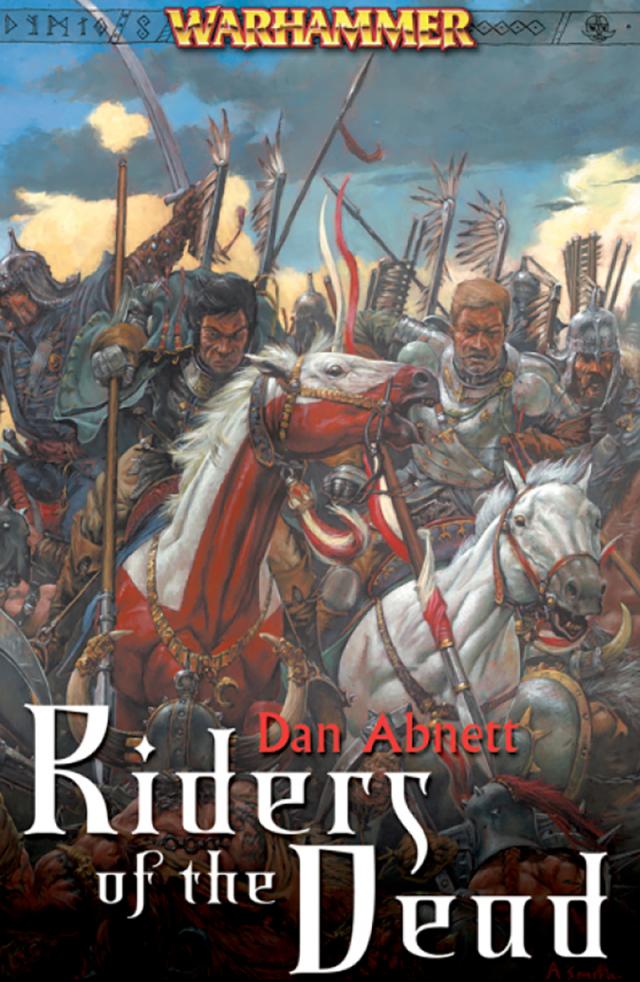


The fatalism shown by Beledni, and by many of his men, seemed apt now. The slight, dismissive frown, the odd little turn of the wrist as if he were spilling out a handful of corn, ‘Is of no matter’. So typically careless, so typically Kislevite. They had been raised in this emptiness, and it bred in them a dismissive philosophy.
Is of no matter. For nothing mattered. For nothing was big enough to matter in the long run, except the passing centuries and the empty steppe. All the rest was just dust, spilling from a tilting hand into the oblast wind.
Dushyka stanitsa. Dushyka town. A trading post on the route from nothing to nowhere.
A long, beamed hall with a handful of izbas packed around it inside a timber stockade. It was so old the elements had worn the wood pale as snow.
It appeared up suddenly, amid the limitless grass, under a sky that was just the blue side of colourless. It surprised Gerlach to come upon it so unexpectedly. Nothing but grass, then a township. The line of hills to the north-east still seemed as far away as when the journey began.
The men of the rota had somehow been aware of Dushyka before it came into view. The pace slowed, and conversations were exchanged between the front riders.
There was no sign of life in the town, except goats and short-necked ponies that grazed outside the stockade fence. The rota reined up in a line half a league short of the town and, at Beledni’s gesture, Yevni the horn blower sounded his horn.
The sound rolled away across the open steppe and was eaten by the distance. They waited, horses twitching ears and tails.
An answering note came from the stockade, strong and clear. Gerlach saw movement as the town gates opened.
‘Yha!’ Beledni cried, and the rota broke towards the town.
II
Steppe life, Gerlach decided, was like an islander’s way of life. The grass was the sea, and the scattered stanitsas the little island communities.
The greeting at Dushyka was very different from the one the demilancers had received at Choika. The townsfolk – what few of them there were – came out onto the packed earth of their yards and rattled busy welcomes with empty pots and pans. Hellos were called out, and men strode forward to clasp the hands of each rider in turn as the rota dismounted. Gerlach found his hand shaken by a dozen people he didn’t know. They greeted him with cheerful informality as if he was a cousin or a brother returning home after a short time away.
The men of the rota seemed to know the townsfolk and vice versa, but it was hard to be sure. Maybe they simply knew each other as fellow sons of Kislev. Maybe that was enough.
The ataman emerged from the log hall. He was a bearded man with a wind-scoured face. He wore an old, spiked helmet with a wide fur brim on his head, a long cherchesska tunic with rows of charges down the chest, and a fleece draped over one shoulder. His deputy, the esaul, followed him, carrying a small mace. This – the bulava – was the ataman’s symbol of power.
The ataman took the bulava from his deputy and handed it to Beledni. Simultaneously, the rotamaster handed the staff of the rota’s eagle wing banner to the ataman. They each touched the totem they had been given against their foreheads and gravely uttered some oath or ritual remark. Then banner and bulava were taken back and returned to the hands of the deputies. Beledni and the ataman spread their arms wide and embraced each other, laughing and smiling. After that, Beledni, Maksim and Borodyn followed the ataman and his esaul into the hall.
Outside, the men of the rota sat around in the little yard, or saw to their mounts. Womenfolk brought bowls of pickled fish and sour cream, pitchers of chalky water, cups of koumiss and baskets of small seed cakes.
Gerlach accepted some from a little woman in a headscarf. They hadn’t eaten much on the journey: just strips of dry salt-meat and biscuit handed out from saddlebags. Gerlach tried to show how grateful he was. Vaja and Vitali joined him, chuckling and tutting, to teach him how to say thank you like a Kislevite. There was a ritual to be observed, though they didn’t explain it well. As usual, they were contradicting each other’s use of Reikspiel.
You took the water first of all. Sip, rinse the mouth of the journey’s dust and spit, then drink some more. Then a modest fingerful of the fish, to be eaten with relish. Then a seed cake, torn so that some of it could be handed back to the giver. The idea was, Gerlach worked out, that the folk of the stanitsa were selflessly offering their precious supplies to the visitors, and the ritual vouched for the visitor’s willingness to share. Once this had been established, the words for thanks were spoken, and the koumiss drunk.
There seemed to be no warriors resident in the stanitsa, and no sign of armour, but a row of round, hardwood shields hung on the inner wall of the stockade and most of the men carried short, recurved bows, unstrung, in eastern-style bowcases on their belts. Several spare bowstrings were looped around the cases.
His spirits lifted by the food, Gerlach followed the lead of the other riders and worked on his horse and armour. He stripped the harness and rubbed Saksen with handfuls of straw. Then he walked him to a water trough that the local boys were filling from a pump. Women were shaking out armfuls of hay.
The younger boys took great interest in the Imperial troop horse. Gerlach realised how odd Saksen looked amongst the Kislevites’ hairy, squat mares. Saksen was the biggest horse by far, with a longer neck and a much more powerful build. His fine grey colouring and tightly docked tail made him look an alien in their midst.
‘Byeli!’ the boys said, apparently impressed. ‘Byeli!’
They turned their attention to the rider of the strange horse. It seemed Gerlach’s own colouring and fair hair was just as intriguing. They followed the vexillary, cautiously, as he walked back to his harness and started to lay his kit and armour out on the hardpan.
Dented and battered in places though it was, his fine half-armour was still in reasonable shape. He hadn’t worn it or his burgonet since the night they had camped on the hillside. His fabric clothing was in much worse shape, all of it dirty and torn. He’d almost forgotten that the beshmet he was wearing as a coat had belonged to Vaja.
His sabre was notched, and he couldn’t remember where he’d lost his lance. His dagger was still intact. One pistol remained in his possession, but with precious little powder or shot.
He went through his saddlebags, finding there wasn’t much in them. The company’s supply wagons had been carrying most of their personal effects. Aside from his water flask and bedroll, there was a little comb of tortoiseshell, a folding razor, a tinderbox, a whetstone, a shoe-awl, a small bottle of polishing oil, a rag, a candle, and some beeswax in a pot. There was also a curry-comb. Gerlach looked at this particular item with a frown. He’d always been so scrupulous in his grooming of the gelding, yet he’d just brushed Saksen down with straw, in the brisk manner of a Kislevite outrider, without even thinking of this comb.
At the bottom of one bag were a few scraps of twisted silver and enamel chips.
It was all that remained of a symbol of Sigmar his father had presented him with the night before he set out. He wore a smaller, gold version on a chain round his neck that his mother had given him on his tenth birthday.
His father’s gift had been altogether too large to wear except for ceremonial occasions. He carried it in his pack as a trophy. It had been entirely shattered. A brief examination revealed a blackened hole the size of his middle finger in the side of the buff saddlebag. A ball of shot had passed through it. He hadn’t seen any of the enemy using firing pieces, though anything was possible. This was more likely a miserable stray shot from his own side during the chaos at Zhedevka. The holy symbol had stopped the shot and been destroyed as a result. Nothing else in the bag had been touched. But for that, Gerlach would have had Saksen killed or crippled under him on the field.
It was curious. It made him feel strangely grateful and humble.
III
Gerlach set to work oiling his armour and edging his sword. The boys gathered round with interest. They pointed to various details – the design of Gerlach’s sabre and the style of his armour – that were foreign to them, discussed them amongst themselves with almost professional concern.
Then he began to clean his wheel-lock, and they fell silent in awe.
One of them finally dared to address him. Gerlach looked up. The boy, no older than eight or nine, with fierce dark eyes and a mess of black hair, repeated his question quickly. None of them had any Reikspiel at all, and Gerlach had a passing knowledge of only a half-dozen Kislevite words.
‘I don’t understand you, boy,’ he said at last. The boy frowned. ‘I…’ Gerlach pointed to himself, ‘…don’t understand you.’ He pointed at the boy.
‘Douko,’ said the boy.
‘Dowkoe?’
‘Douko,’ the boy repeated, tapping his chest.
‘You’re Douko? Your name is Douko?’ Gerlach asked, trying to do better with the name’s pronunciation. This seemed to please the boy and his friends.
‘Heileman,’ said Gerlach, indicating himself. There had been a time, not all that long before, when vexillary Heileman would have considered chatting idly with peasant children to be beneath him. But some inner tension had relaxed, like a clock spring uncoiling, and he could think of nothing finer than wasting time under a wide blue sky.
The boy made a few struggling attempts to repeat Gerlach’s name, but it was beyond him. The children urged Gerlach to repeat it so they might try again.
He did. They failed and laughed at themselves in a way that made Gerlach smile. He tried something else.
‘Vebla,’ he said, patting his chest.
They laughed so hard they were helpless with mirth. They repeated the word and then ran away across the yard, calling it out.
Shaking his head, Gerlach returned to his work. His pistol was clean, his sword whetted. He went back to his armour and tried to beat out the deep dent on his right vambrace. The damage had been done by the sword blow that had knocked the draco standard from his hand.
For a moment, the tension coiled in him again, as he recalled the proud anger that had propelled him through the battle. The old, arrogant Gerlach Heileman, who had ridden to war believing he could drive out the enemy was reinstated. A flush rose in his neck.
He hammered bitterly with his dagger pommel, as he had seen the Kislevites doing, but he was no armourer. Such repairs were the job of the smith who rode with the supply wagons.
Had been the job.
‘Let me see to that.’
Gerlach glanced up. Borodyn, the horse master and master of metals, stood behind him. He had re-emerged from the ataman’s zal, and now was going round the compound with his farrier’s hammer, pliers and little anvil, making field repairs to the armour and harnesses of the riders.
Borodyn held out his hand. ‘Please. I can get the dent out and stop it rubbing your arm.’
Gerlach gave him the vambrace and Borodyn put it over the anvil’s nose and began to work out the twist with little, expert taps.
‘They seemed to welcome us here.’
‘It is the way,’ replied Borodyn.
‘What happens now?’
‘What do you mean?’ Borodyn asked, looking up at him.
‘We spent three days getting here. What do we do now?’
‘Rest, water our horses. Join the ataman at the Dushyka krug tonight.’
‘What is a “krug”?’
‘Literally? A circle. Any close circle. The circle of warriors around a fireside. The folk of a village like this gathered for a feast. And so, they refer to the band of warriors themselves, as well as the village community as a body. Tonight, the Dushyka krug – these people – welcomes the Yetchitch krug – that’s us – to join them for a krug.’
‘It’s complicated. Your language is complicated. One word with so many meanings.’
‘Just one meaning. The circle. It’s simple. It is the world. Every journey comes back to where it starts, for the world goes round and if you ride forever you come back upon your own tracks. Every strong people is a circle. Every rota is a circle. The circle holds us in and holds us together. True circles are strong.’
Borodyn held up the vambrace and showed it end-on to Gerlach. He had beaten the dent out and, looking down into it, it now formed a perfect circle.
Gerlach smiled and took it. ‘Like armour? A good illustration for your point.’
Borodyn frowned and thought about this. ‘Oh, I see. I hadn’t intended that symbolism.’
Gerlach shrugged. He was quite sure Borodyn had. There was something of the teacher in the armourer, even something of a priest. Implying simple things without drawing attention to them.
Gerlach slipped the vambrace on and rotated his clenched fist. ‘It’s good. Thank you.’
‘Is of no matter,’ Borodyn said, the true Kislevite.
‘Where did you learn my language, horse master Borodyn?’ he asked.
‘In your country,’ Borodyn replied, as if this was a strange question.
‘You have been to the Empire?’
Borodyn nodded. ‘Years ago, when I was a young man and hungry for journeys. Before Yetchitch called me home to the steppe.’
‘Yetchitch. That’s your home village?’
‘Yes. It is where all the men of the rota come from. It is north and east of here. In the highlands of the open steppe.’
‘Isn’t this the open steppe?’
Borodyn chuckled. ‘Of course not.’
‘So I ride in the company of the rota of Yetchitch krug?’
‘Yes,’ Borodyn smiled.
‘Because – like krug – rota means more than one thing? A banner, and the men who follow the banner? Who might also be called a krug?’
‘Exactly. I told you it was simple.’
IV
As evening fell, a slow, languid process in the open vista of the oblast, they congregated in the long, beamed zal, where fires had been burning for an hour or more to heat the place. An extensive meal was being cooked; heavy, rich smells wafted out.
The men of the rota had put on their armour again, including szyszak helmets, snow leopard pelts and the tall wing crests, so as to look dignified and noble for the krug. They had spent some time out in the yard in the fading light, buffing up their gold and silver wargear, helping to set and straighten crests and details of each other’s trappings.
They looked impressive, Gerlach had to admit, far more splendid than anything in this meagre stanitsa.
Dutifully, he dressed in his own half-armour and plumed burgonet. The warriors applauded him loudly when they saw him so accoutred.
Before casting off their ragged travel clothes and donning their fine wargear, the men of the rota had performed an odd rite. They had unfixed the long tips of their main horse lances, sharpened them, and then shaved. Heads, cheeks, chins, everything, with painstaking care – except for their topknots and drooping moustaches. Beledni had inspected each man’s face for signs of stubble. Then they wound their top knots on their bald heads, slipped their leather cauls over them to form a cushion, before putting on their helms.
Beledni had mentioned shaving before, as if it was significant. It seemed to be the only piece of grooming these habitually grubby men worried about.
The winged lancers secured their lance tips back onto the hafts, and then left the lances and their swords at the door of the zal.
Gerlach, with his full beard in the Empire fashion, simply trimmed the proud point with his knife and longed for a bowl of hot water. He walked to the doorway of the hall, and placed his demilance sabre with the other weapons in the porch.
Inside, it was dim and smoky. The zal was full. Everyone from the village was there, even the children. Bolsters and rugs and quilted blankets covered the open floor, and the guests, ducking so their huge wing crests would not strike the low beams, took their seats on the ground to the clapping welcome of the villagers. A Dushyka man was banging a tambor, and another was playing a lively tune on a horse-head fiddle.
The music and clapping died away so that the old ataman, regal in furs and a striped dolmen, could pronounce words of welcome. Beledni rose stiffly to his feet and made a formal answer. Everyone clapped.
The younger women then went around with circular trays on which heavy stemmed glasses sat cup-down beside small bowls of salt. Gerlach was surprised to see such a delicate commodity as drinking glasses in this remote place. Clearly, the ataman was entertaining his guests with his finest chattels.
The lancers each took a glass, as did the ataman. When Gerlach was offered one, he picked it up and examined it. It was old and heavy and shaped like a handbell. The stem had no base. The only way to put it down was to empty it and overturn it. A toasting glass.
‘Other of you hand!’ Vaja hissed at Gerlach.
He was holding the glass in his right hand and saw all the lancers had theirs in their left. He corrected the mistake.
‘Now… sol!’ Vaja added. Each lancer had taken a pinch of salt between the fingertips of his right hand.
The esaul went round the circle of guests, filling each man’s glass with clear liquid from a tall flask. This, according to Vaja, was kvass.
With a full glass that he couldn’t put down in his left hand, and a pinch of salt in his right, Gerlach waited and watched the others to see what to do.
The ataman made a toast. It was loud and furious. He raised his kvass.
The lancers – and Gerlach – raised theirs. ‘Starovye!’
Now that word, at least, he knew.
As the cry went up, the lancers licked the salt from their right hands and then downed the drink. The whole glass in one swallow.
Not wishing to offend, Gerlach did the same.
Someone had filled his glass with molten lead. It burned like flaming pitch as it poured down his throat. He wasn’t even sure it had gone down his throat. It felt like it had simply burned its own way down into his gullet. He coughed and spluttered, eyes streaming.