Riders of the dead, p.23
Riders of the Dead,
p.23
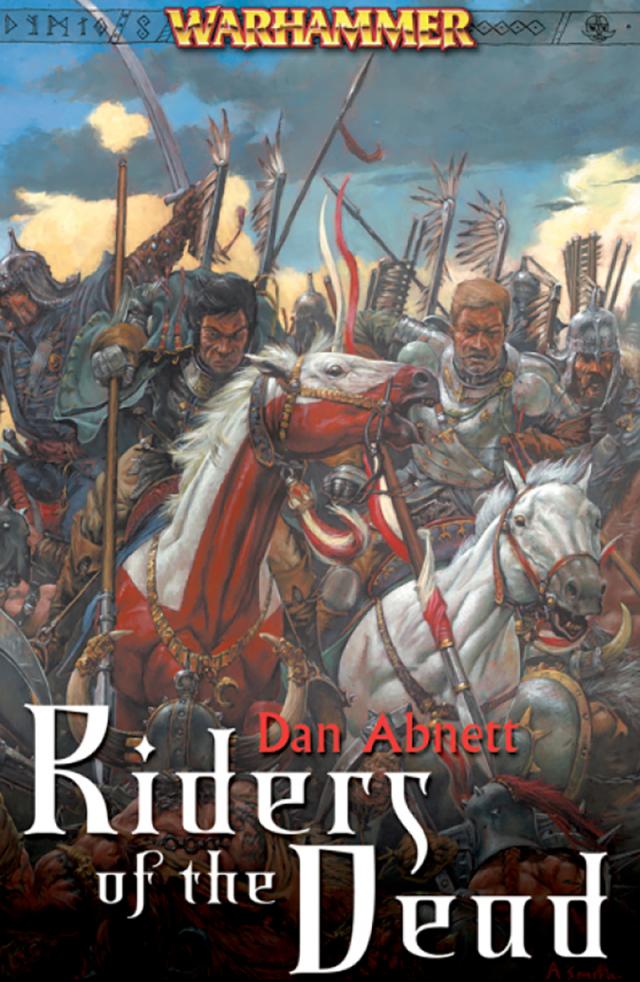


A fifth horseman appeared. Kvetlai raced back into the melee. He had no armour or troop weapons, but he had drawn his saddle-sword. It was really too long to use while riding, too clumsy for a mounted duel. But the Kul had their backs to him and Kvetlai’s blade ripped through the axeman’s spine.
The man fell and his horse came over with him in a flurry of dry soil. The Kul’s round shield skidded away across the dust.
Gerlach locked his sabre with the blade of the Kul he was fighting, and turned the enemy’s sword aside so hard the tip of it stabbed into his mount’s neck. The horse shrieked and kicked back, bucking and throwing its rider. It charged away into the gathering night.
Gerlach rode forward as the thrown man began to pick himself up out of the grass and dust, and lopped his head off.
The remaining Kul rider stopped short. He lowered his dirty iron blade. Gerlach faced him, blood dripping off his raised sabre. Kvetlai closed in from behind.
With a terrified cry, the Kul took off, and rode away into the west.
Gerlach and Kvetlai sheathed their swords and trotted forward to meet each other. Gerlach held out his hand, but the young Kislevite hugged him instead.
‘Vebla!’ he declared. He declared a lot of other things too, but Gerlach did not understand. Kvetlai had the least Reikspiel of any lancer in Beledni’s rota.
It made Gerlach smile. Starved of company, his first encounter was with a friend who spoke nothing of his tongue.
Gerlach took Kvetlai by the hands and examined his wound. The long gash on his hand and arm was oozing pink, but it was healing. Borodyn had been right. A lancer simply had to trust in Dazh and ride out until the poison sweated out of him. Kvetlai had got on his horse and healed himself.
What adventures he had experienced in the course of that healing, Gerlach did not know. He took up the banner, and tried to beckon Kvetlai.
‘South!’ Gerlach said, pointing. ‘We must go south!’
‘Nyeh!’ Kvetlai said emphatically, and pointed west.
Gerlach was about to argue. Then he looked south.There were fires on the horizon. Torches clutched in the hands of six dozen horsemen. Kul horsemen.
Gerlach looked at Kvetlai and nodded. ‘You’re right. Let’s head west.’
VI
They rode into the west together, and into the deepening twilight. The fires followed them, flickering: bobbing specks against the almost-black land, like grounded stars. There were more than six dozen now, and they straggled right across the south-east skyline.
Kvetlai gabbled as they rode. He was excited and talkative. Though he knew Gerlach couldn’t understand him, he didn’t seem to care. It was of no matter. Just the sound of a voice pleased Gerlach. He recognised occasional words as they tumbled out of the young lancer’s mouth. Kvetlai said ‘pulk’ several times, with emphasis.
‘Pulk?’ Gerlach asked.
‘Shto?’
‘Pulk?’ Gerlach repeated, wishing he had a smattering of Kislevite. Kvetlai chattered something else, and Gerlach gave up.
They’d ridden for over an hour, and night had swallowed day. It was utterly black. The only way they could tell land from sky was the fact that above a certain line, there were stars. Except behind them, where low, yellow stars burned and moved.
Something vast rose before them, slowly and grandly. At first, Gerlach thought it was a rising moon, or that a piece of the bright moon had fallen onto the steppe. It was a great slab of white stone, ghostly in the starlight, at least a league across: a single, oblong crag sprouting from the flat vista of the steppe.
They approached it. It was hauntingly beautiful, and illuminated the steppe as the moon and star light reflected off its icy whiteness. It was also immense.
‘Zamak Spayenya,’ Kvetlai said.
They rode onto the lower slopes of clattering scree, weaving between slabs and blocks of skewed rock that time had sloughed from the high faces of the table mountain. The rocks had a warm, damp smell as if they still radiated the heat of the day. Kvetlai led Gerlach around the northern edge of the crag. He clearly knew this place. It was hardly surprising. This rock – this Zamak Spayenya – was so singular it had to be a well-known landmark of the endless grassland.
Still chatting cheerfully, Kvetlai located a narrow gorge in the side of the giant rock, and they rode down its steep defile, entering a cool darkness with only a ribbon of starry sky high above. The horses’ hooves cracked and clicked on the bared, uprisen rock.
The slope grew steep and their mounts slowed. Kvetlai jumped down and motioned for Gerlach to do the same. They led the horses the rest of the way on foot.
The gorge opened out into a great bowl of space open to the sky. Echoes of their every move rolled around the sides. The bottom of the bowl was filled with black water, the moons and the stars reflected there in an unrippled mirror.
Kvetlai pulled off his saddlebags, pack roll and water skin, and let his pony loose. The steppe horse immediately went to the pool to drink and stirred circles out over the faces of the mirrored moons. Kvetlai joined it to replenish his water skin.
Gerlach slipped his saddle kit off Saksen’s harness. The troop horse trotted over to slake its thirst the moment Gerlach slipped the reins.
Kvetlai splashed his face with water from the great cistern of rainfall, and then jumped up.
‘Vebla!’ he beckoned. Gerlach followed him. The boy clearly believed their horses would be safe here in this inner place.
Kvetlai clambered up the smooth, sloping surfaces of the inner rock, making his way into its upper levels. He stopped to help Gerlach with his kit, but respectfully refused to touch the rota banner Gerlach was lugging.
They left the pool basin behind them, and scaled the steep paths and slopes of scree up to the summit of the rock.
Gerlach looked out. The steppe lay below, spreading out into the dark. A cool wind ruffled his hair. This was higher than he had ever been – higher even than the steeple of the church at Talabheim. His brother had taken him up there when he was six or seven, and he’d gasped at the vista of streets and roofs and tiny people, and the pattern of fields and woods laid out beyond. Even though it was dark, this was somehow more impressive. An endless void spread out below him, and he was aware of a great depth of space. From up here, the steppe was not so much diminished as emphasised and increased.
He could no longer see the fires of the Kul.
Kvetlai took him to a deep cave high in the rock, the mouth of which overlooked the humbling emptiness. It was cool and dry inside. Kvetlai gleefully sat down in the dark and rummaged in his saddlebags. After a short time, he had coaxed to life a small fire, and fed it with pieces of animal bone that he had stockpiled for just such a purpose.
The fire rose, washing the smooth walls of the cave with shivering light. Gerlach divested himself of his kit and the heavier parts of his armour, and respectfully set the rota banner upright against the cave wall. Then he sat down opposite Kvetlai and warmed his hands at the fire.
Kvetlai recommenced his casual, unending chatter.
‘Zamak Spayenya?’ Gerlach asked, gesturing around them.
‘Yha, Vebla! Yha!’
Kvetlai’s saddlebags miraculously provided strips of dried salt-fish, wafer biscuits, lumps of cured pork and four eggs. The eggs had been hard boiled in vinegar to preserve them. Kvetlai showed Gerlach how to rub the eggs between his palms to crush off the shell. They had their water skins, and a small leather bottle of kvass that Kvetlai ceremonially unstoppered.
It was the best, most satisfying meal Gerlach Heileman would ever eat.
It grew colder as they settled back, passing the kvass between them. Kvetlai threw his last few bones onto the crackling fire, and the pieces of eggshell too. He was talking still, and from his tone, Gerlach realised Kvetlai was telling a formal tale, a traditional myth for the krug. Every now and then, apparently as part of the indecipherable story, he sat up and laughed a false, loud laugh at the shadows of the cave.
When he finished, he looked at Gerlach expectantly.
‘Vebla gyavaryt,’ he said.
‘What?’
‘Vebla… Vebla… you,’ he said, nodding eagerly.
Gerlach realised it was his turn. He took a suck on his water skin and began: ‘In the old times, there was a tribe of men that was called the Unberogen, and to them a child was born. His name was called Sigmar, and on the night of his birth, a star with two tails sailed across the sky…’
Gerlach told his story gently, and Kvetlai listened, rapt. Gerlach was reaching the famous part about the Black Fire Pass when something wailed in the dark and interrupted him. Kvetlai gave it no notice. Gerlach carried on, and then stopped again as the infernal buzzing and laughter that had stalked him on the steppe whispered past.
Kvetlai sat up straight and laughed his loud, false laugh at the shadows.
The noise faded.
The laughter came again, from the back of the cave, with a tiny hammer-beat mixed into it. Kvetlai turned and laughed in that direction. The sounds stopped.
Gerlach recommenced, but halted yet again as whispering voices chattered out of the jumping shadows at the edge of the fire. Kvetlai leaned over and laughed at them, making the voices ebb.
‘Spirits… phantoms of the steppe?’ Gerlach asked.
Kvetlai nodded, not knowing what he was nodding at.
‘They have stalked me. I have been afraid of them.’
Sibilant whispers rushed in around the mouth of the cave. Kvetlai turned his head and laughed once more, hearty but false.
‘Aha ha ha ha!’
‘And laughing at them scares them away…’ Gerlach breathed. He smiled. When a hinge began to squeak in the roof of the cave halfway through the tale of the mantling of Johan Helstrum, they both looked up and bawled out a roaring laugh.
‘Ha ha ha ha!’
Kvetlai settled back. ‘Johan,’ he prompted. ‘Johan…’
Gerlach grinned. ‘As I was saying, Helstrum was thus the first of the line of Grand Theogonists…’
VII
Kvetlai was asleep before the history of the Sigmarite Empire was done. Gerlach sat for a while, then took a burning rib out of the fire and wandered into the back of the cave. His eyes had not tricked him. There were markings on the white limestone walls.
Primitive markings, made with graphite and ochre dust. Men riding to the hunt, their charcoal-streaked javelins wounding leaping deer and elk. Crude though it was, the depiction of the horses was instantly recognisable. The low, brown shapes of hardy steppe ponies, with shaggy, black manes. The riders were drawn naked, simple and angular, but great eagle wings grew out of their backs.
Gerlach moved the light of the crisping bone further down the wall. Here were boars, and sheep. A great mound surrounded by horses that looked as if they had been raised stiff on stakes. A star with two streaming tails of fire. Horse warriors, clad in gold.
The gold was real foil leaf, tamped against the cave wall. Gerlach looked again, and realised he was not looking at horse warriors at all. The prancing figures were horse-and-man. The bodies of flying steeds, with the torsos of men growing out where the horse heads should have been. Their arms were spread wide, triumphant, brandishing recurve bows and charcoal-streak javelins.
The centaurs of myth. Men who were horses. Horses who were also men. Or, Gerlach thought, an ancient people whose lives had been so wholly dependent on the horse that there was no separating the two.
His bone-light went out. The ancient drawings vanished, as if they had galloped away into the shadows.
Gerlach crept back to the dying fire where Kvetlai slumbered.
He was about to sit down, when he heard a low, welling moan. He laughed at it, but it did not fade. He laughed again, louder and more vigorously, but the moan remained and rose as a whispering chatter.
It was coming from the mouth of the cave.
Gerlach walked to the opening and laughed wildly and loudly into the darkness. He heard the phantom laughter wash through the night and indignantly prepared to guffaw again to see it off.
A hand closed over his mouth, silencing him.
It was Kvetlai.
The lad pointed down the slope. Far below, around the skirts of the great rock, Kul torches were moving.
VIII
Kvetlai kicked out the fire and then watched the cave mouth, his saddle-sword in his hand, as Gerlach dressed himself in the parts of his half-armour that he had taken off. Gerlach began to prime his wheel-lock too, but Kvetlai stopped him and patted his sword blade. His meaning was obvious. If they were going to live, they had to act quietly.
Gerlach put his handgun and its equipment aside, and followed Kvetlai out into the moonlight. He was holding his sabre, and drew his knife in the other hand.
There were flickering torch lights below them still, but other scads of flame could be seen moving up the rocks and along the gorges that cut into the table mountain.
The Kul were not moving directly towards them. There was a good chance these kyazak could spend the rest of the night searching the rock’s mighty system of caves and ravines for them.
Gerlach and Kvetlai settled back in silence to wait it out, their swords gripped in their hands.
IX
The moons rose and set. Voices and the occasional clatter of dislodged scree echoed down to them. They waited. Hours crawled by.
Below, the flames jiggled around the foot of the rock.
Gerlach woke up very suddenly. He had no idea how long he’d been asleep, but the sky was just beginning to turn pale. Kvetlai was sleeping, hunched against the far side of the cave mouth.
Gerlach was about to hiss his name when he saw they were not alone. A Kul warrior was softly approaching the lip of rock beyond the cave mouth. He could see the kyazak only as a dark shape with glittering eyes.
Gerlach waited, playing dead. Through half-shut lids, he watched the Kul coming closer. There was another one a short distance behind him. Gerlach’s sabre had slid from his grasp while he slept, but the knife was still in his left hand. He kept still as the Kul crept up to him. The man had a short-hafted adze, and as he bent down, Gerlach heard him sniffing like a hunting dog.
Gerlach lunged, grabbing the Kul by the hair and ramming the knife up into his chest. The Kul squealed and struggled, but Gerlach kept him pinned. The second Kul at the edge of the rock-lip let out a guttural shout and raised a bow. The heavy arrow hissed as it flew, and splintered against the cave wall beside Gerlach’s head. Gerlach fought to retain his grip on the first Kul, who was becoming limp and awfully heavy. He had to keep the man’s body between him and the archer.
Running forward, the bowman fired again. The arrow smacked through the upper body of the corpse and travelled with such force that the head of it came through the other side, penetrated Gerlach’s pauldron and stabbed a thumb’s depth into his shoulder. Gerlach yelped out in pain. Before the archer could fire a third time, Kvetlai had sprung up and cut him through the ribs with his saddle-sword.
There was movement all around them as Kul scurried to close in on the source of the commotion. The flames of several torches showed close by. Kvetlai ran to one side of the rock-lip and hacked at another kyazak, sending his body slithering away down the sloping face. A fourth appeared, and Kvetlai turned to repel him. Their swords clattered against each other.
Having fought to hold on to his human shield, Gerlach now battled to rid himself of it. The man’s deadweight pulled hard and painfully against the arrowhead and made Gerlach cry out again in frustrated anguish.
The arrow snapped, leaving a small, broken, finger length protruding from Gerlach’s shoulder. The body fell away sideways, Gerlach’s knife still wedged in its chest. Gerlach grabbed his sabre, pain flaming down his arm. Kyazak blood was all over his left hand and down his front.
Gerlach ran forward in time to contend with two more Kul sliding down the slope onto the rock-lip from the left side of the cave. He killed one with a swift thrust, and then battled with the other, who lunged and slashed at him with a short sword and a crackling torch. Gerlach’s face was singed as the rushing flames jabbed at him.
Kvetlai had slain another Kul, and now struck out at more, moving so he was shoulder to shoulder with the demilancer. Gerlach finally managed to tear his sabre against the threatening torch and send it sparking and flaring down the incline. Then he overwhelmed the kyazak’s untrained sword hand with three clean, proficient blows and finished him with a body-thrust.
Between them, with frantic effort, they killed or drove off the four Kul who had managed to get onto the rock-lip. Many more were approaching, from either side and below.
Kvetlai cried out something, and ransacked the body of the first kyazak he had taken – the archer who had gored Gerlach. He got the man’s bow and his case of arrows, and began to fire them into the darkness. The spitting sounds of arrows were answered, more than once, by a cry of pain.
Dawn was on them. The sky had gone slate grey, and the crag side was slowly illuminating with watery light. The steppe below remained as dark as pitch right out to the line where it joined the cold, pale sky.
The kyazak rushed them again, from below and to the left, and it took all the effort and skill of the two men to hold them off. The Kul dropped back. To prepare bows, Gerlach thought.
Kvetlai called to him in this brief intermission and gestured upwards. Pausing only long enough for Gerlach to gather the banner, they began to scramble up the steep stone slope above the cave mouth, heading for the highest part of the crag. A few wayward arrows rattled off the rocks around them, and Kvetlai paused occasionally, legs spread and braced against the sharp incline, to loose an arrow or two back.
Gerlach concentrated on climbing and avoiding slithering back down to an ignominious doom. Half-armour was not made for such an activity, and the long, heavy banner was a downright hindrance. But he could not leave it for the filthy kyazak. He crawled up the hard, dry face of the rock, sometimes using the shaft of the banner as a prop. He was sweating freely. More arrows rushed up at them, striking the rock with brittle cracks or purring past their heads like bees.