Riders of the dead, p.28
Riders of the Dead,
p.28
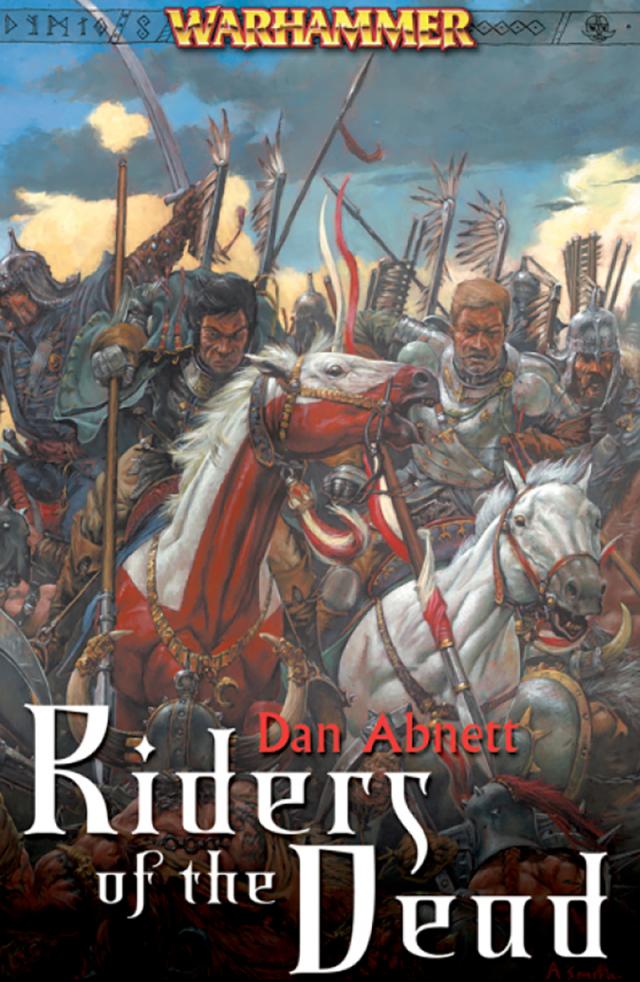


Karl tipped his sword over, and let Ons Olker slide under his own weight off the razor-edged steel.
The shaman, convulsing, sprawled with a splash into the spreading lake of von Margur’s lifeblood.
‘I have done what I should have done at Zhedevka, Ons Olker,’ Karl said. ‘May you burn in the daemon pit.’
‘Please, p-please, Azytzeen–’ pleaded the shaman as he spasmed in his agonised death-throes, his roping guts coiling out of his ruptured torso, his drumming feet flecking blood into the air. ‘P-please… say thee a fair word for m-my sake to Tchar–’
‘Damn you,’ Karl said.
Ons Olker twitched and shrieked his way to the end of his messy, painful death. When he finally fell silent, Karl looked at the doorway of the mound chamber. Chegrume followed his gaze, but could see nothing.
Karl raised his hand and pointed. ‘Zar Blayda! I see you, you worm! I see you out there, cowering in the shadows!’
Blayda, clad in his black, inscribed armour, slowly stepped into the torch-glare of the chamber. He gazed down at the butchered bodies of von Margur and Ons Olker lying in the slick of stinking blood and sank to his knees with a moan of mortal dread.
‘I submit to you, Karl-Azytzeen,’ Blayda said, bowing his head. ‘I submit.’
‘Blayda…’ Karl growled. ‘Look at me. Look at my face.’
Hesitantly, terrified, Blayda looked up at Karl. He cried out at what he saw.
‘Look at me. Look upon Tchar. Let what you see blind you forever. You will follow me until the end of all days.’
‘Yes… yes! I will!’ Blayda yelled, his left hand on his heart, and tears streaming from his eyes. A heart-truth.
Arrows thumped into his back, one after the other. The tips came out through his chest, one pinning his hand to his heart. Blayda pitched forward onto his face, transfixed and still kneeling.
Berlas, Diormac and Efgul burst into the tomb chamber, recurve bows drawn back and nocked with ready arrows. Behind them came Hzaer, Fegul One-Hand, Lyr, Sakondor, Yuskel, and many others, their sword blades dripping red-wet from the men of Blayda’s band they had been forced to kill to gain entry to the mound.
His fellow riders had come to save him, as they had pledged. Karl-Azytzeen smiled.
‘Aside! Get aside, you dogs!’ a voice roared outside in the tunnel. ‘Yuskel? Where are you?’
Uldin strode into the chamber, pushing violently through the gathered men and splashing into the great puddle of red. He glared down at the bodies, the blood and tumbled gold.
‘What is this bloody crime, Berlas? What have you done, Diormac? A zar cut down, against the peace-pledge… and on sacred soil th–’
Uldin balked as he saw Karl clearly for the first time. He made a warding sign and, like Blayda, fell on his knees. Karl could see the Hetzar’s scared eyes flashing through the slits of his wolf-mask helm.
‘A Hetzar such as you should not bow to a man like me,’ Karl insisted. ‘My life has belonged to you since Zhedevka. You could have taken it, but you chose not to. You told me that all the while I remembered the power you had over my life, I was no danger to you. Get up, Hetzar Uldin.’
Uldin did so.
‘I don’t belong to you any more, Uldin. I am Tchar’s now.’
‘I know that,’ Uldin said, his voice wavering slightly.
‘And you should have listened to Skarkeetah slave lord’s advice,’ Karl said. He lashed out with his true killer, and the slim blade of Drogo Hance’s dagger punched in through the sight-slit in Uldin’s wolf mask, through his eye and deep into his brain.
Karl wrenched the knife out and Uldin fell onto his back, another bloody offering to the altar of Chamon Dharek littering the chamber floor.
Karl looked at the stunned faces of the men in the warband.
‘Well?’
‘Karl-Azytzeen!’ Efgul yelled.
‘Karl! Karl seh!’ bellowed Hzaer and Yuskel.
‘Zar!’ Karl spat back at them, his ring-wrapped arms raised in triumph.
‘Zar Azytzeen! Zar Azytzeen!’ the men cried. ‘Zar Azytzeen!’
VEBLA
I
They barely made it to Yetchitch before deep winter established its rule of raspotitsa. The word meant ‘roadlessness’, and referred to the period when the oblast succumbed to such a weight of snow that even the simplest of paths and tracks were lost and indecipherable.
All through the last week of their trek – the longest and most arduous Gerlach had undertaken – the snow fell, until the grass ocean of the steppe became a pure white flatness that hurt the eye.
They were in what Borodyn called the open steppe now. This great waste of plains extended across the north-east parts of the Kislev oblast, a higher and more open country than ever before. Gerlach had been awed by the vacant flatness of the steppe where Dushyka and Leblya and Zamak Spayenya lurked like little secrets, and could not imagine anywhere with a greater scale of emptiness. Level land and the surrounding horizon could surely only express so much.
But the open steppe was the wilderness’s masterpiece. Even the lancers seemed humbled by its void. The sun and moons, as they cycled through the sky, appeared to have been reduced in size themselves so the landscape was vaster by comparison.
Through icy dawns and blizzarding days, they made their route, until thick snow reduced their pace to a trudge. Armour was too cold to wear, or even touch, for fear of flesh sticking fast to frozen metal. Huddled in layers of furs and beshmets, the men shivered into the frost-wind. Before departing Zoishenk, Beledni had obtained two coats for Gerlach: a sheepskin cloak, leggings and woollen hood-cap with a fur trim, all of which had seemed impractical purchases in the lazy heat of summer on the Tobol.
But Beledni knew what lay in the north to greet them.
In the final days, white hills and a hint of green forest could be glimpsed ahead of them through the fast-falling snow. This was the territory of Blindt, the hill country at the edge of the Sanyza region, the wooded highlands where Yetchitch lay.
The frozen mood of the rota thawed as they rode up at last into the deep pine forests. They began to sing krug songs with raw voices. The giant, black-trunked conifers rose around them, dusted with ice, and snowflakes fluttered down. They glimpsed elks, and flighty arctic foxes that pricked their ears at the sound of the men’s voices and took away into the snow.
Gerlach could feel the rota’s delight that home was close. He let Vaja and Vitali teach him the words to one of the songs, so he could join in. Their attempts were so confused, and so hindered by numb lips and muffles of fur, all three fell into uncontrollable laughter that rang out through the trees.
Ifan spied the lights of Yetchitch first and put up a cry. Yevni carefully warmed the mouthpiece of his horn, and blew a great blast that rolled away into echoes. A lonely horn sang back in reply from the stanitsa.
Yetchitch was a place the size of Dushyka. Thatched izbas huddled around a long zal, whose tiled roof was thick with snow except for the melt-hole around the chimney flue. The stanitsa had no defensive stockade, but was surrounded by a high fence of pine boards that acted as a barrier against the drifting snow. They walked their horses in through the fence gate and entered the yard.
The folk of Yetchitch flocked out in heavy clothes to greet them. There was no banging and clattering of pots, no ritual exchange of shared food and drink, just a warm, silent embrace of figures greeting lost sons. Parents and friends, siblings and, in some cases, children hurried through the snow to wrap their arms around their loved ones.
For a forlorn moment, Gerlach sat alone on Saksen, watching the wordless relief and joy, utterly ignored.
Eager boys led the horses away and the townsfolk gathered the weary, chilblained warriors into the warmth of the zal. A youth in furs, his top lip struggling to produce a moustache, came to Gerlach and greeted him with a nod as the demilancer dismounted. Other townsfolk grouped around, puzzled by the sight of a stranger holding the rota banner.
The youth held out his hand to take Gerlach’s reins.
‘What is his name?’ he asked.
‘He called Byeli-Saksen,’ Gerlach answered in broken Kislevite. ‘Take care him of good.’
The youth nodded solemnly, and led the tired troop-horse away with the rest.
The townsfolk grouped around Gerlach.
One of them, a thin, elderly woman, looked into his eyes. ‘Why does Mikael Roussa not the carry banner?’
‘Is dead he,’ Gerlach said.
The woman frowned, as if this was not an answer. ‘I know he is dead. Where is he?’
‘At Zhedevka place, fell he,’ Gerlach answered, wishing his fragile command of Kislevite was less basic.
The woman nodded at this, very matter-of-fact, and turned away. Other townsfolk closed around and put their arms around her heaving shoulders.
Beledni appeared. He took Gerlach by the sleeve and led him through the huddle of onlookers into the zal.
The sudden heat was shockingly fierce. Gerlach thought he would pass out. The hall was packed with the people of the stanitsa, many of whom were joking and laughing with the lancers, and feeding them hot staya as they helped them strip off their heavy travel garments.
Beledni took Gerlach to the end of the zal, and up onto a hardwood platform above the fire. This was the stage from which the village ataman presided over his people. The ataman himself, a middle-aged man with long, shaggy hair and the heavy upper body of a woodcutter, stepped up to join them with his esaul, who carried the ataman’s bulava, the small mace that was his statement of power.
The ataman looked at Gerlach with a curious frown. Beledni turned to the assembled people and raised his stout arms for silence.
‘This is Gerlach Heileman, of Talabheim!’ he roared in Kislevite. ‘The rota has braved much in this dark year, and lost many of our comrades. When Mikael Roussa fell down to his death, this brave man saved our banner, and for that duty, Beledni rotamaster has made him rota bearer!’
The townsfolk cheered out their approval.
Beledni tried to shush them a little. ‘He is one of us now. He is of Yetchitch krug. Embrace him as a brother. We have called him Vebla!’
The people cheered again, though this time the applause was mixed with great laughter.
Gerlach looked at Beledni ‘You make words kind, rotamaster,’ he said, as best as he was able.
‘Vebla deserve as much,’ Beledni said, switching to his unpolished Reikspiel. ‘Vebla deserve praise of krug. Now… Vebla give back rota banner to ataman.’
Gerlach turned to face the ataman and hand him the banner. Just before he let it go, Gerlach pulled it back and kissed the haft. The ataman took the banner, and carefully slipped the tip of its shaft down through a hole in the wooden stage so that it stood upright, watching over the zal. Then he crushed Gerlach to his chest in an enthusiastic bear-hug.
The people cheered again.
At the esaul’s urgings, kvass and salt were brought out for the toasting. Gerlach made sure he knew where the nearest seat was.
II
They feasted well, slept and feasted again. The storerooms of Yetchitch, loaded with salt meat and cured pork from the autumn slaughter, yielded a plentiful supply of food, and there was a never-ending provision of kvass and koumiss.
Through the long nights of feasting, stories were traded. The lancers recounted the details of their adventures, their deaths and losses, their victories and escapes. The townsfolk and the families returned the favour with tales of the harvest, of animals sick or lost, of births and deaths and marriages. Music was played on the horsehead fiddle and the tambor.
Vitali proudly introduced Gerlach to his aged mother. Vaja showed off two little children he didn’t look old enough to have sired. Mitri had Gerlach meet his plump, beautiful wife.
Kvetlai, nervous and hesitant, took Gerlach to meet the girl he was betrothed to marry. She was stunning and shy and, like Kvetlai, little more than a child. Her name was Lusha.
She had three sisters, and insisted they were all prettier than her. Her only brother, older than all the girls, had been Sorca.
When she saw the look of pained surprise on Gerlach’s face, she told him, ‘I have mourned him already. I mourned him when he went away.’
Mitri’s wife, Darya, wanted to know why Gerlach did not shave his hair like the other warriors.
‘A topknot and a moustache is so much more fetching,’ she insisted.
‘Men here, they not shave,’ Gerlach said, pointing to the ataman and some of the other male townsfolk.
‘They are not warriors!’ she clucked.
III
The winter passed by. Maksim led a small band of men out from Yetchitch to recruit warriors from the other villages in the territory, hoping that the rotas of other stanitsas would be up to strength for the thaw.
Five youths from the Yetchitch krug had reached the age to join the rota. The men and the townsfolk spent one riotous, drunken night initiating them. This involved lewd drinking games, and the ceremonial shaving of their heads down to a tuft.
Beledni performed this duty with the sharpened tip of his own lance.
‘Vebla not understand,’ Gerlach said to Vitali, as they watched the shaving pantomime.
‘We shave before battle, all of us,’ Vitali said.
‘This Vebla know. Vebla understand it nyeh.’
Vitali grinned his small-toothed grin. ‘Before battle, we sharpen our swords and speartips. Make them trusty and sure. Then we shave our heads and cheeks and chins. If the rotamaster finds any men with stubble, he knows their edges are not battle-sharp.’
Gerlach sighed at the simplicity of it.
Heads pale and bare – and, in some cases, bleeding – the shivering, gawky supplicants stood straight as Beledni inspected them. Then he had each one touch the hem of the banner cloth on the stage and utter an oath of allegiance. Proud mothers wept.
The five boys were called Gennedy, Bodo, Xaver, Kubah and Valantin. Kubah was the youth who had come out on their arrival to lead Saksen away. He was, Gerlach learned, Beledni’s own son. He could see it now. The familial similarity. Add a good few pounds, a few years and take away the front teeth…
Beledni then explained the philosophy of the last battle. Every battle, he told the boys, was the last. It was the one that would steal their life. If they treated any combat less seriously, they would surely die. A man of the rota fought every battle as though it was his very last.
Then Borodyn brought out their wings. Each one was fletched with the feathers of birds the youngsters had killed. Crow, crossbill, magpie, jay, kestrel. More illustrious plumes – eagle and hawk – would come later, once war skill had been tested.
These were the wings a rider needed to carry him up into the heavens to be with Dazh.
The laughter had died away. Everyone trooped out into the cold night, pulling on their outer garments and furs, and walked to a lamp-lit plot behind the zal. The snow had been cleared and five open graves were exposed, cut from the black earth.
The people of the stanitsa stood round as funeral prayers were said for the five boys. Their mothers and sisters cast dried summer flowers and the boy’s shorn hair into the graves, and cried brokenly with loss. The boys were dead now, dead and passed away beyond the bosom of the family. They would be grieved now so that the grief could be set aside. No one would wait out the length of the year to hear news of their boy’s fortune. They were dead, and gone to the fate of the rota.
They were, forever, riders of the dead.
IV
Late in the midwinter, Gerlach had a vivid dream that woke him suddenly. He was lying in the zal, under furs, and sweating. All the men of the rota slept in the zal. Their family izbas had no beds for them now.
He found Borodyn sitting nearby, watching the great hearth crackle and spit.
‘Vebla had dream,’ Gerlach said, coming to sit by him.
‘I suspected as much. We all have. I have seen it also in the stars. What did you see?’
‘Vebla see–’
‘In your own tongue, Vebla. I can manage that.’
Gerlach smiled. ‘I saw a battle. A great field of men. Kurgan and the banners of Kislev, opposed. I had to ride out and fight their warlord.’
Borodyn horse master nodded. ‘This I have seen, we all have seen. Dazh has written it in the krug of the sky.’ He looked at Gerlach, his eyes reflecting the red sparks of the hearth.
‘I thought you had come to us to save the banner. The rota banner. I thought that was why Dazh and Ursun had sent you. But that was just the start. The meeting point of Yetchitch rota and Gerlach-who-is-also-Vebla.’
‘And now?’
‘If the gods ride with you, you will fight the champion of Khaos.’
‘Archaon? I will fight Archaon? Is that my destiny?’
Borodyn shrugged. ‘Dreams don’t lie, but they confuse. All I know is you are the one who will do battle with a great beast of Khaos. If you win, the oblast and your great Empire will live on. If you fail, and this monster beats you, then the Old World will sink away in a sea of blood. So, yes. I believe you are the warrior who will contest with Archaon, for no greater evil lives in the world.’
‘Will I win?’ Gerlach asked.
‘The stars do not say, and neither do the dreams.’
‘But will I win?’ Gerlach insisted.
‘Of course. You will have the rota of Yetchitch krug at your side.’
V
The land was crusted with heavy snow, but the skies were clear and blue. Midwinter was behind them, and they were in that static place where the fallen cold simply lingered.