Riders of the dead, p.25
Riders of the Dead,
p.25


Karl stared at his face for a long time. He was unshaven and his teeth were dirty. His black hair was so long now he wore it permanently in a tail. The three blue dots of Zar Uldin’s mark looked like an old bruise on his right cheekbone.
He had been aware that all the Kurgan he had encountered since his wounding seemed to regard him with some measure of fear or apprehension, and averted their gaze whenever he was around. This seemed strange considering they were quite used to horrific injuries and mutilations. But they hadn’t been showing revulsion.
Looking into the glass, Karl could plainly see what had scared them.
He had one eye. One blue eye. To make it worse, indelible powder burns from the injury had stained lines across his face, both over and under his good eye. The lines were twisted, and looked like snakes.
A single blue eye surrounded by snakes. No wonder no one dared look at him.
He handed the glass back to Chegrume.
‘You should have let me die,’ he told him.
II
Surtha Lenk’s horde had obliterated the army of the Reik outside Aachden. It was a notable victory. The town fell soon after, and many hundreds of its inhabitants, as well as men captured in battle, passed into the possession of the slave lord, Skarkeetah. Uldin, along with Blayda, Herfil and six other zars, had killed enough with his warband to earn the glory of a skull stack.
Chegrume had carved the new victory mark on Uldin’s cheek. Four now, on that side.
Then Uldin gathered his warband for a victory feast – indeed all the bands in the High Zar’s horde were celebrating the victory. Afterwards they would divide the spoils of war between them. Many trophy rings were made.
Wolfenburg lay close by. Uldin hoped to earn a fifth victory mark there before the last one had even scabbed over.
III
Karl-Azytzeen’s left forearm was now wound with trophy rings from the elbow to the wrist, and there were three more around his right arm. Once he was well enough to walk, Uldin took him into a muddy field behind the ruins of Aachden and offered him his pick of the captured horses.
‘I’ll keep the one I have.’
‘It is a poor thing, Karl-Azytzeen. Old and broken.’
‘It serves me. It does not stop for anything. I will not trade it.’
Uldin shrugged. Even the zar refused to look directly at him. ‘Then you should name it.’ The Kurgan had no sentiment at all. They only gave a name to a thing when it became important. Most horses weren’t named until they had carried their man through at least one battle.
‘It doesn’t need a name,’ Karl replied. ‘It is old, and has gone for this much of its life without one. It is simply my horse.’ After this blunt dismissal, the men of the warband began to call the old nag Horse-of-Karl-Azytzeen.
‘You are due a share of gold,’ Uldin informed him.
‘I have no use for gold. Give me a good fur and a saddle. I’m damned if I will fight on with a spear and no stirrups. And a decent sword.’
These things were provided within an hour, at the zar’s orders. A good box-saddle with a brass harness, rowel spurs that Karl had nailed to his heavy boots, a heavy brown bear-pelt and a brooch to hold it. The brooch was Scythian gold, formed into the shape of a long-backed, leaping horse.
Uldin himself presented Karl with a sword. A superior pallasz, forged from steel rather than iron, with a straight bar guard and two hands of grip. Karl took a whetstone to its blade, and worked it until it was sharp enough to split a bough from a tree with one stroke, from either edge.
It was high summer, a time Karl had once particularly enjoyed. The weather was fine and warm, and the landscape – where it had not been touched and marred by the High Zar’s massive host – was lush and green.
The horde left Aachden to rot and moved on to Wolfenburg.
IV
Wolfenburg, the great sentinel city of Ostland’s northern marches, lay in the foothills of the Middle Mountains amid vast blankets of forest. Even in the heat of summer, the mountains were white-capped and grim. Their huge blue-black shapes, fogged by cloud, dominated the skyline.
The city itself was a fortress town of ancient construction. Occupying a raised hillside above the river bend, it was well fortified with curtain walls and high, towered inner walls of great thickness. It had shut itself up in advance of the Northers’ advance. Large tracts of forest outside the walls had been freshly cleared to remove available cover for an attacking force and to fill the city’s stockpile of firewood.
The first warbands to reach the city made a hasty assault of the gatehouse and the south wall. But they were driven off, with costly losses, by vase-guns, hails of arrows, and scalding oil sluiced down through the murder holes above the gate.
The main part of the horde arrived and encamped around the city. More wood was cut, in great quantity, by berdish axe this time. This wood fed the camp-fires, and was also used to construct mobile shields that were pushed forward to allow the Kurgan archers with their powerful recurve bows to pepper the wall tops and the machicolations. Once the wagon train had arrived, the horde’s sturdy old ballistae, trebuchets and catapults were trained on the city. The ballistae – essentially gigantic crossbows – launched savage bolts of iron-tipped hardwood two spans long at the walls. The trebuchets and catapults hurled rocks, weighted bales of burning straw, flasks of boiling oil and rotting human heads, collected from the field at Aachden expressly for the purpose.
The siege began in earnest. It was quite the dullest kind of war Karl had ever experienced. There was a feebly slow routine. The siege engines lobbed missiles at the wall, and the guns, slings and cannon of the town fired in reply, sometimes hurling the Kurgans’ own projectiles back at them. This continued for days. Every few minutes there would be a sharp creak, a thump or a squeal of metal as one of the war machines fired. The drums beat continually.
The war bands were forced to bide their time. As horsemen, they had little part to play in this slow, erosive war.
Karl found himself gazing south-west across the forest for hours at a time. No more than fifteen days’ good riding in that direction lay Talabheim, the home he could never now return to, unless it was to storm its noble walls and set its towers to burn.
V
The siege ground on for twelve weeks. There were a precious few bursts of activity. The Knights of the Order of the Silver Mountain, along with greatswords from the city garrison, made several sorties out of the gatehouse to harass the enemy. The warbands rode to meet them. Karl won two new trophy rings: one for a greatsword who almost filleted his horse, and another for a knight-at-arms whose silver plate-mail proved the sharpness of Karl’s new pallasz beyond doubt.
Dismounted, Uldin’s warband took part in most of the foot assaults against Wolfenburg’s admirably solid walls. These usually happened at dusk or dawn. Covered by the hissing sheets of arrows sent up by the archers from behind the wooden screens, the Kurgan warriors charged the walls, hefting scaling ladders between them. Teams of straining warriors rolled up the massive timber ram under its protective portico of stretched animal hides.
The foot assaults were costly. Even if the ram reached the gates without being set ablaze, it failed to make a dent in the colossal doors. The scaling parties were decimated by the rains of arrows, rocks and pitch, or died from broken limbs and backs when their ladders were pushed away from the walls. Karl was grazed across the left shoulder by a crossbow bolt and his left hand was blistered with boiling oil. His wounds were typical of those received by the other men in the warband. Diormac lost an ear. Lyr was pinned through the leg by an Imperial arrow. Utz had his lower jaw smashed by a rock. He lived for two days, wailing and screaming, until Uldin could bear it no longer and cut his throat. Uldin was clearly upset about this, and openly blamed the High Zar for making one of his riders die ignominiously, out of the saddle. Surtha Lenk, opinion went, was not doing enough to finish this siege. There was dissent amongst the horde.
Karl filled his time between the brief periods of action helping Berlas and the other archers in the band to compose bows. It was a complex business, as the bows were fashioned from three parts. A central stave of maple or mulberry, woods which took glue well, was laminated with animal sinew on the back and horn on the front, in order to withstand the tension and compression. For special bows, Berlas used human sinew and bone. This stave, the grip, was fixed to the two arms of the bow, along which bone from longhorn cattle had been glued. Bone tips were attached, and the bows tied up tight against the shape they would be drawn to. Then the bow was left to dry, for weeks, or, if time permitted, months.
After that, more tendon sinew, beaten with a hammer into fibres, was applied in layers to the bow arms, and the bow was back-strung tightly again for more drying.
Dried, they were carefully warmed and then strung up the way they would be shot, ready for the tillering. This was a process of gentle filing and adjustment that ensured that the arms bent evenly at full draw for maximum accuracy.
Karl was not at all good at any of these stages, but Berlas was happy to have him handle each piece during the stages of construction, as if Karl’s touch somehow conveyed a blessing on the weapons. They were valuable pieces, because of the effort of manufacture, and Berlas told him that, unlike swords, armour and horses, bows were never buried with the dead unless they were broken. It was too great a waste.
Once word spread that Karl was blessing bows, other men, some from rival warbands, came to him to have him touch bow components, arrowheads or even whetstones. He deeply resented the attention and what it implied, but he did not refuse any man.
Karl learned to shoot a bow. He had grasped basic archery skill using ‘self’ bows as a youth, but the recurve bow was a revelation. Each one imparted a draw equal to the body weight of a good-sized man with a simple, smooth pull, and suffered no stacking of power-weight at the release, as was the case with bows of a single piece of wood. He quickly found he was more accurate with the alien weapon than he had ever been with a longbow as a boy.
Berlas finessed his bow skill. He told Karl to forget the southern manner of drawing a bow with three fingers. Instead, the Kurgan drew with the thumb, and with the first three fingers locked over it. The thumb was guarded by a ring of bone or brass. Because of this, a Kurgan loosed his arrow from the right side of his bow, rather than the left as was the practice in the Empire. A recurve bow could send an arrow over three hundred spans, but was only considered accurate over forty-five bow lengths. Any target further than that was, in Berlas’s expert opinion, a waste of arrows. However, an archer could shoot ‘in arcade’, which was to draw and loose upwards so that the dart came down on the target from an almost vertical angle. Unlike the Imperial toxophilists, who were infantry-based and could manage a long ‘self’ bow, the Kurgan needed a weapon they could fire easily from the saddle. Only the smooth-pulling recurve bows were effective in this respect.
Karl was practising arcade shots from the saddle in a tract of woodland away from the main force, when the riders came looking for him. It was the fourth month of the siege, and word had spread that the High Zar, aggrieved by the dissent showing in the horde, was intending to call up the powers of the Dark Gods and end the siege.
There were twenty riders, all from Surtha Lenk’s bodyguard. One of the big men with bull horns sprouting obscenely out of his skull led them. He approached Karl and handed him a human skull that had been polished to a pearlescent finish. Karl took hold of it and then the horned man took it back. The gang of riders sped away after him.
Karl laughed. Now even the High Zar was looking to him to bless his instruments of war.
VI
That night, the phosphorescent flickers of the Northland Lights danced above Wolfenburg. Then a winter storm came in, barging through the summer night. The tempest was ferocious. Thick frost covered the landscape and ice weighed down the thrashing trees. Lightning struck like repeated hammer blows against the city walls. It was so savage and unrelenting that the gatehouse collapsed.
Jeering and yelling, the Kurgan entered Wolfenburg, broke it open, and put everyone inside it to the sword.
VII
At dawn, as the city burned, Uldin raised his skull-stack. His warband had done well, and the favour of the High Zar was upon them. Once Uldin had anointed the skull-pile with captive blood, he called for the mark to be made. Chegrume approached with the flint knife, but Uldin sent him back and called for Karl-Azytzeen.
Karl came forward and, under Chegrume’s instruction, made the fifth victory mark on Uldin’s cheek. At the last moment, he tossed the flint knife away and used Drogo Hance’s true killer to slash the ritual mark on Uldin’s face.
VIII
‘We’re going north,’ Uldin told them. The truth was more complex than that. Autumn was upon them, and the leaves were just turning. Outriders reported a sizeable mass of enemy soldiers developing in the north, in the skirts of the Kislev oblast. Archaon wanted them denied, and Surtha Lenk’s horde was the nearest.
Surtha Lenk summoned Uldin and made him a Hetzar, placing him in command of six warbands – his own, Zar Blayda’s, Zar Herfil’s, Zar Kreyya’s, Zar Skolt’s and Zar Tzagz’s. As Hetzar, Uldin was to ride north and wipe out the harassing enemy. It was a great honour, though it was clear Uldin’s warband had only been chosen because of Karl-Azytzeen. Blayda and Herfil were particularly enraged and resentful.
For the second time that year, Karl found himself advancing northwards into the fringes of the Kislevite oblast as part of a horse troop. The soft, decaying touch of autumn showed in the scenery, and the villages they passed through were either ruined by war or abandoned.
The air was turning colder, and it bore the smoky odour of leaf-fall. Dawns brought the first early frosts, and wet gales beat down for many of the days. For over two weeks, they didn’t see another living soul in the woods, the fields, the pastures or the open grasses.
On the afternoon of the day they crossed the Lynsk, fording it where it was wide and shallow, they sighted riders on a stretch of open plain below forested uplands. They had left the broadleaf forests of the south behind them, and these woods were still green, despite the time of year. Fir trees, oblast pine and other evergreens formed a dark backdrop to the string of horsemen in the distance.
At first, they believed they had found the first traces of the rumoured Kislevite army they had been sent to quash. The warbands urgently readied themselves for battle.
But the riders were not Kislevites. They were kyazak horse bandits, probably Kul or Tahmak from the look of them. Efgul sneered to Karl. In his opinion, kyazak – Kul especially – were vermin and cowards. ‘We have the numbers, Karl-Azytzeen,’ he said. ‘Mark my word, they will run before us.’
But in this, the hairy Northerner was wrong on two counts. The kyazak did not run at the sight of the Kurgan war company. And they had the numbers.
‘They have put the lie to you, Efgul seh,’ said Hzaer, riding on Karl’s other side. The horse bandits were turning and riding down the plain towards Uldin’s troop with mounting speed. Uldin had six warbands – almost four hundred horsemen – at his disposal, but the kyazak, who at first seemed to be just forty strong, quickly became a hundred, two hundred, five hundred. They came pouring out of the forest, joining the men already in the open.
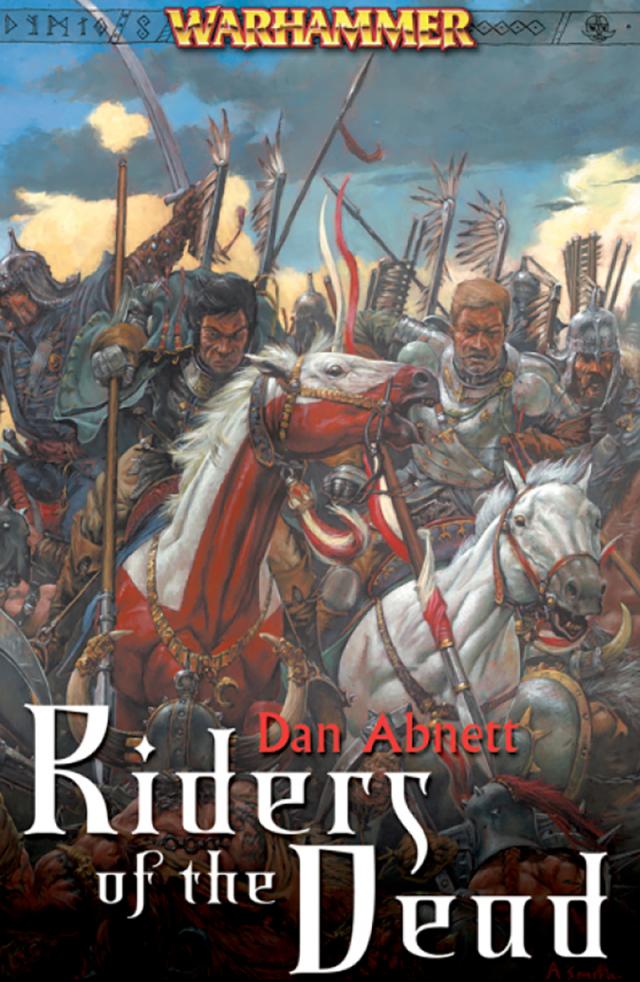
Uldin roared a command, and Hzaer and the other carnyx-blowers blared out battle notes. The six standard bearers raised their banners, Yuskel hefting the largest of all. Uldin’s standard of the gilded skulls and the one-eyed wolf face had been supplemented by huge elk antlers strung with bead-cords of human teeth to denote his status as Hetzar. The massed warriors immediately kicked forward into a hard gallop, drawing their weapons and shouting for blood.
Their warhorses at full stretch, the two cavalry hosts met and ran in amongst each other. The collective concussion was huge, as if the rival armies were like mountain rams slamming together and locking their horns. As the charge lines came together and overlapped, Karl was surrounded by a dizzying sequence of cracks, impacts and blows. The whole world shook and thrashed violently. Spear shafts snapped, shields shattered, bones broke. Horses went over and brought down the riders racing behind them. Men were smashed out of their seats. Karl’s sword-arm already ached from the six or seven jarring blows he had landed.
All around them was a constant patter of wood splinters, metal shards, flecks of mud, beads of sweat and spats of blood. Their momentum robbed by the collision, the horse armies were now at a virtual standstill. Every man fought like a demented daemon in the saddle with those enemies within reach. Karl knew his pallasz had claimed the lives of at least four kyazak, but the combat was such a blur of overloaded sensations, he ultimately lost count.
Both forces sustained their battle-fury for over a quarter of an hour, but then the kyazak, who had taken the worst of it, lost spirit. Within minutes those that were still able to quit the plain had fled into the trees. The warbands of Zar Blayda and Zar Herfil broke away and chased the fleeing enemy, mercilessly hunting them into the depths of the forest. The remainder of Uldin’s force rallied and pulled up, panting and shaken. The sheer effort of the brief but explosive battle had left many exhausted.
And many dead. Uldin’s war-force had lost forty riders, with another dozen badly hurt. The kyazak had paid for defeat with above three hundred lives.
The Kurgan were shouting and singing their victory chants. Karl rode back into the line. Efgul, bleeding from a deep scratch across his chest, hooted and shook his fists in the air. Hzaer blew loud, discordant flourishes of triumph, even though a kyazak sword had taken the little finger of his right hand entirely away, and he was spattering blood with every movement he made. Apart from the gore of other men, Karl-Azytzeen was entirely unmarked.