Riders of the dead, p.24
Riders of the Dead,
p.24
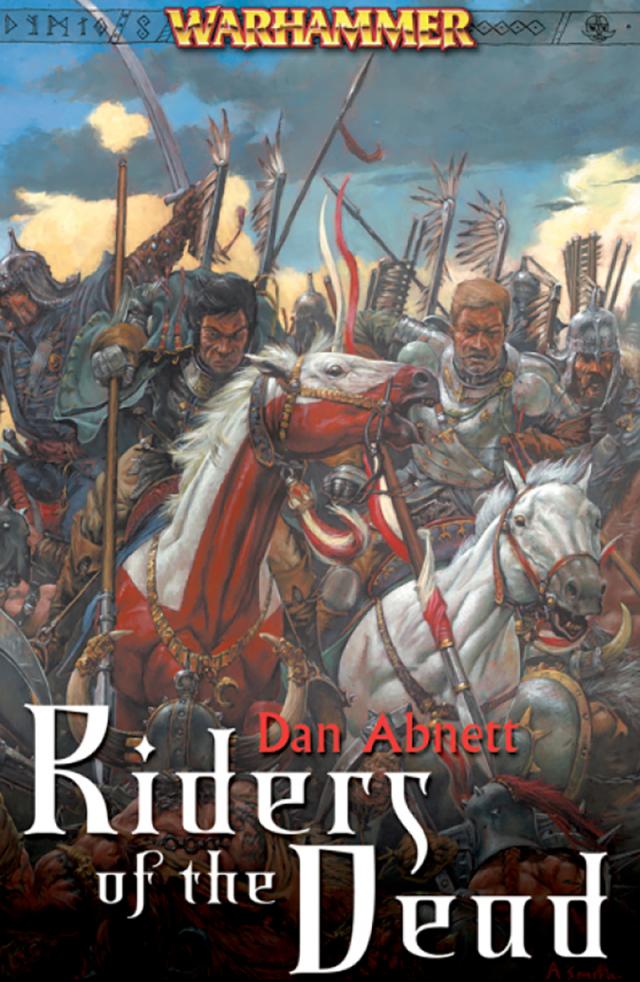


They reached the top – a small platform of rock – just about the highest part of Zamak Spayenya. The limestone sloped away on all sides of it and to reach it any bandit would have to scale the open face as Gerlach and Kvetlai had done.
They sat down and recovered their breath. The waking day was much brighter now, and the light was falling with a silver radiance. A dawn breeze blew. They could see for many leagues in every direction. Gerlach could spot no sign of life except an eagle, gliding in the thermals a long way up.
They kept a careful watch over the edge of the platform. Some of the kyazak attempted to climb after them, and were dissuaded by a few arrows and hurled rocks. But all the Kul had to do was wait. It was already warm. The summer heat would make that exposed platform as hot as a griddle. Without water and cover, and with nowhere left to run, the two men would not last for any great time. From one side of the platform, it was possible to see down into the cool, shadowy basin in the heart of the crag where they had left their horses. They looked down at the pool and its tantalising promise of an end to thirst.
The silvery dawn became bright morning, blindingly white. The rising heat of noon broiled the sweat out of them. They became so torpid that one effort by the Kul to reach them almost succeeded. Gerlach only managed to knock the kyazak warriors back down the rock face using the pole of the banner as a makeshift spear.
The scalding heat did not seem to diminish as the long day ground on into the slow afternoon. Gerlach watched the smudges of cloud pass by overhead. They were meaningless, unformed, not even suggestive of character. But the gliding eagle returned, closer now, banking above them, and shortly after that a cloud appeared that was almost a circle or a ring.
‘Krug,’ Kvetlai said, his lips dry. He was watching the cloud.
Gerlach got to his feet.
‘Shto, Vebla?’ Kvetlai asked, supposing another rush of kyazak was coming. Gerlach slowly scanned the horizon, turning full circle. It had to be… it had to be…
Dazh did not send men messages lightly.
A tiny flash, out in the north-west, right at the very brink of the visible world.
‘Kvetlai! Look there!’ Gerlach pointed, and the boy stood up. Their movement at the edge of the platform provoked a couple of arrows up from below.
Kvetlai didn’t seem to see, yet Gerlach was sure. The flash of sunlight on silver. But so far off, and perhaps moving away.
He grabbed up the banner and raised it as high as he could, holding the shaft by its very end in both hands and swinging the head so the banner cloth itself fluttered out in the high air. It was a huge effort, and he had to set it down every few moments to ease his arms. Every time he hoisted it up again, the Kul below loosed angry arrows and shouted curses and cat-calls. A few began to try climbing again. He waved the banner like a castaway mariner trying to hail a passing ship from a desert atoll. Gerlach’s notion that the steppe was like a sea where its people lived like islanders now seemed desperately apt.
The distant flash was no longer visible, as if it had gone, or had never been there. A trick of the light, a trick of the eye.
Then Kvetlai called out, and pointed excitedly. A dot. Several dots in fact. A line of dots, moving gradually towards them.
Gerlach laughed out and set to waving the banner more vigorously.
The dots became shapes. The shapes became horsemen. Galloping horsemen, over fifty of them, clad in silver. Tall wings rose from their backs.
At some point, as the lancers raced closer, the kyazak saw them too. There was a round of hectic shouting from below the platform, and then the voices of the Norscya bandits receded. By the time the rota reached Zamak Spayenya, the bandit pack had fled, riding their ponies east into the steppe.
Gerlach and Kvetlai scrambled down from the platform, slithering most of the way. They gathered up what remained of their saddlebags and possessions from the cave where the looting Kul had scattered them, and climbed down into the shadows of the rainwater basin. Saksen and Kvetlai’s horse had gone, but before they worried about that, the two men plunged into the pool to cool their baked, dry bodies and slake their thirst.
They emerged from the gorge into the sunlight. Their horses, either driven off by the Kul or simply fled away from them, were grazing in the scrub between the scattered boulders around the foot of the crag. Their ears twitched as they heard the drumming of hooves.
The rota appeared, riding around the bluff of Zamak Spayenya. Beledni was at their head. Kvetlai cried out and ran towards them as they reined to a halt.
Gerlach took a deep breath, lifted the banner, and walked after him.
X
The men of the rota were silent. Kvetlai was puzzled, not really sure what was going on or why Beledni rotamaster was glaring with such venom at the outlander they called ‘Vebla’.
Beledni dismounted and walked towards Gerlach. Kvetlai went to him, and began a hasty account in Kislevite. Beledni ignored him and continued striding towards Gerlach. Then Kvetlai said something that made the rotamaster stop, turn back, and fire off a series of rapid questions.
Beledni finally silenced Kvetlai’s eager answers with a curtly raised hand, and turned back to Gerlach. They stood face to face in the bright afternoon light, horseflies buzzing around them and the strong steppe wind ruffling the grass. Gerlach handed the banner to Beledni. He took it, and held it beside himself, upright in his left hand.
‘Vebla steal rota banner,’ he said at last. His eyes were dark and dangerous behind the visor of his szyszak.
‘Yes,’ Gerlach replied.
‘Vebla steal rota banner so rota would follow him.’
‘Yes, rotamaster.’
‘Follow to find pulk. To find war.’
‘Yes, rotamaster.’
‘Even though Beledni rotamaster say nyeh.’
‘Yha, rotamaster.’
They were not really questions. It was as if Beledni wanted to make sure he had the facts straight. He glanced up at the flapping banner for a moment, then looked back into Gerlach’s face.
‘Vebla save Kvetlai from kyazak.’
‘We saved each other, rotamaster.’
‘Kvetlai make ride to sweat out sickness. He not never come back, if Vebla not help him with kyazak.’
Gerlach shrugged.
‘Kvetlai find pulk at Zoishenk.’
‘What?’
‘Kvetlai ride back to tell this to Beledni rotamaster.’
‘I… I had no idea of this, rotamaster.’
Beledni nodded.
‘Yetchitch rota go to Zoishenk now,’ he said, briefly. With a casual movement, he handed the banner back to Gerlach and returned to his horse.
XI
Three days’ ride into the south brought them to the cattle town of Zoishenk. It was larger than Leblya and Dushyka, larger than Zhedevka and Choika put together. It had a large livestock market and sat at the edge of a great grass plain on the banks of a wide, shallow river called the Tobol. The Tobol flowed down from some distant oblast mountains, and the locale of Zoishenk was riven with a range of rocky hills and dense thorn-wood.
Riding out his sickness, deliriously sweating the poison from his wound, Kvetlai had come to Zoishenk almost by chance, and there found the masses of the Sanyza pulk. In the months following Zhedevka, the broken elements of the Kislevite pulk had assembled at Zoishenk instead of Leblya because of the threat of the kyazak bandit-army loose in the steppe to the north.
The stanitsa was teeming with soldiers. Almost seven hundred warriors were gathered there – three other rotas of winged lance, several bands of horse archers, and foot companies of pike and axe, along with the cruder assortments of levies and partisans. There was also the remainder of several Imperial pike companies that had fled Zhedevka and come here under the pulk’s colours, combining their strengths to make one full regiment. Sanyza pulk – that is to say the army raised and recruited from the Sanyza area of the oblast – was under the command of the Boyarin Fyodor Kurkosk, a second cousin of the tzarina herself.
Additions and reinforcements – like Beledni’s rota – were being added all the time, and scouts had been sent out to locate other scattered parts of the pulk and to drum up new support from the neighbouring regions. Word was that the Uskovic pulk, an army of much more considerable size, was already en route to join the Sanyza pulk. With those sort of numbers at his disposal, the boyarin would advance south, perhaps even as far as the Ostermark, and engage the Kurgan horde. By the end of the summer season, or by the start of the autumn, they would have joined with the foe and perhaps be driving him out of the Reik.
At long last, Gerlach had the chance to fight for his homeland, the chance he had been craving since the spring.
But Sigmar – or perhaps Dazh – had other plans for him.
By the time the rota reached Zoishenk, Gerlach was sick.
XII
No one could say what filth had been caked on the tip of the kyazak arrow, and it had not helped that the barb had remained, lodged and festering, in Gerlach’s shoulder for over a day. Borodyn had managed to dig it out with a flame-heated knife, but the wound was dirty. Gerlach became feverish, and his upper arm swelled so badly he could no longer wear armour around the limb. Defiantly, despite his progressively ailing state, he carried the banner all the way to Zoishenk. Vitali and Vaja were concerned he was about to pitch out of Saksen’s saddle and they suggested Maksim should take the standard.
Once they had arrived at Zoishenk, Gerlach was carried to one of the livestock barns that had been converted into barracks for the pulk. He was laid out on a straw mattress. The flesh around his wound had gone black and the injury stank. He fell into a turbulent sleep, and did not regain consciousness for several days. Borodyn, Vaja, Vitali and Kvetlai took turns to watch him, spooning sips of gruel and water into his mouth and dressing his wound with salves of astringent herbs.
Like clouds across the steppe, fever dreams passed mysteriously through Gerlach’s mind. In one, his father and brother came to him, both dressed in the full plate of the Order of the Red Shield, but neither would speak to him. In another, he lay helpless in long grass that knotted around him and held him down as Talabheim burned. Then he was running into the empty steppe at night, chasing a white horse that remained out of his reach. A blazing star with two long streamers of flame arching out behind it fell out of the night. The star flew at him. In its fiery heart was a staring blue eye ringed with writhing snakes.
Delirious, he became afraid. His dreaming mind recalled the fact that he and Kvetlai hadn’t had time to blind the kyazaks they had killed at Zamak Spayenya. The spirits of the dead, loose in the darkness outside life, could see him and were coming to claim his soul. He cried out so fearfully and thrashed about so much, Vaja and Vitali had to hold him down for fear he would injure himself further.
After ten days, the death-fever broke. The fretful tremor left Gerlach and he woke suddenly, with apparent clarity, long enough to sip water and broth. Then he fell into a profound but untroubled sleep. Borodyn pronounced that Gerlach would live after all.
And he lived, but his recovery was slow. It took another week before he properly regained his senses, and another two before he could sit up unassisted. He was miserably weak and his undernourished flesh clung to his bones.
Well over a month after riding into Zoishenk, just as he was able to walk around for short periods, Maksim and Beledni came to him. They both looked serious and a little uncomfortable.
‘What is it?’ he asked.
‘Beledni need your permission, Vebla,’ said the rotamaster.
‘For what?’
‘For Maksim to carry rota banner,’ Beledni said. Maksim made a little, respectful nod of his head.
‘Why?’
‘The boyarin has make decree. Pulk is to advance.’
‘That’s good! Good! I’m keen to get on myself, and–’
‘Nyeh, Vebla.’ Gerlach hadn’t realised that Borodyn had been lurking in the shadows behind the lancers. ‘You are not fit enough to walk across this room, let alone get up on a horse. You cannot come. You would not live a day.’
Gerlach shook his head fiercely.
‘Is so, Vebla,’ murmured the rotamaster. ‘Beledni is sorry. You not come.’
Miserably disappointed, but knowing they were right, Gerlach looked away.
‘Please to give Beledni permission for Maksim to carry rota banner,’ Beledni said quietly.
‘I give it,’ Gerlach replied.
XIII
The pulk departed at dawn the next day. Gerlach managed to get himself as far as the stable doorway to watch the army move out. Drums and horns sounded as the files marched out through the streets, and it was still possible to hear them a long time afterwards, as an echo from the valleys of the south.
XIV
Gerlach battled to bring himself back to fitness. He ate everything he could get hold of to rebuild his strength, and exercised his weak limbs to restore decent mobility. Three weeks after the pulk’s departure, he was strong enough to walk and ride. He knew he was yet nothing like as strong as he had been, but it was enough. He gathered his possessions, collected some saddle supplies, and prepared to follow the pulk south.
It was late summer by then, hot and lazy. The days were drawing out and the land had become dry and dusty. The herders of Zoishenk were taking their grazing flocks higher into the foot hills to look for fresher pasture, and traders were arriving with harvested corn and grain from the farmlands in the south-east. The Tobol was now so parched by the high summer heat that its course was just a wide dusty track threaded by a feeble stream. Everywhere, the withered grass clicked with the sound of steppe crickets.
Then the pulk returned.
XV
The Boyarin’s army had got as far south as Pradeshynya, contesting twice along the way with small warbands of raiders. At Pradeshynya, they sighted a massive host of raiders three or four times their size, undoubtedly the collective warbands of a significant High Zar. The pulk had withdrawn across the Tobol headwaters to avoid annihilation, and waited for the Uskovic pulk to arrive with reinforcements.
It never came. Whether it had been delayed, or annihilated, the men of Sanyza pulk could not know. The Boyarin decided to wait two more days, but in that time the enemy made its move. A host of warbands, a large chunk of the High Zar’s horde, attacked the pulk across the Tobol salt-pan. It could have been a disaster, but the pulk was well prepared. The battle lasted for about five hours, right on into the late evening, whereupon the Kurgan fell back, badly mauled and suffering huge casualties at the hands of the resilient Kislevites. The withdrawal gave the boyarin a grace period to retreat back into the oblast before the entire horde massed and fell on them.
They were pursued for a time but, with a higher proportion of mounted troops than the Kurgan forces, the pulk outdistanced its adversaries.
Fyodor Kurkosk, in consultation with his commanders, was forced to make a hard decision. The summer was as good as over, and the hard weather of autumn and winter would be fast on them. The pulk would disband, and its constituent companies return to their own lands over winter. This gave them all time to recruit, resupply and raise more levies, and then build support from adjoining regions. Kurkosk decreed that the Sanyza pulk would reform at Zoishenk early after midwinter, preferably at the first thaw. With luck, it would be two or three times its current size. With more luck, it might be one of several pulks coordinated and drawn together over the winter season by the urgent efforts of the boyarin warlord and his officers.
Beledni’s lancers were heading home into the steppe, to Yetchitch.
‘You will come, Vebla, yha?’ Vitali asked eagerly.
Gerlach had a poor choice. He could hardly ride south on his own into the enemy. And he didn’t fancy staying alone in a cattle town for the winter. Besides, Zoishenk had become a place of repeatedly dashed hopes for him, and he was weary of it.
He would ride to Yetchitch with the rota. Even if it did feel like running away.
CHAMON DHAREK
I
‘Give me a mirror,’ Karl snapped.
‘A…?’
‘A looking glass,’ said Karl. ‘I know you have one. I’ve seen you using it in your doltish sorceries.’
Chegrume scowled for a moment. Then he reached into the roughly sewn pelts of his spirit-bag. ‘It is not meant for looking in. Only for seeing in. Only shamans should–’ The shaman shrugged. ‘Perhaps one such as you might be permitted to use it.’ He took the precious glass from the bag and held it out to Karl in his bony, long-nailed fingers.
Karl took it. It was an irregular piece of silver-backed glass fixed into a spoon-like paddle of fig wood. He held it up and stared into it.
It was the first time Karl had seen his own reflection since leaving the garrison at Vatzl, what seemed like years before. Karl Reiner Vollen no longer looked back at him.
The demilancer’s pistol ball had struck him on the corner of the brow ridge over his left eye. The bone had shattered, and the whole area from the eyebrow down to the cheek was an ugly weal of distorted scar tissue. It was pinky-white and black-scabbed, but now, a week after the battle, the swelling was beginning to go down.
The injury had destroyed his left eye. Pain still throbbed in the dead socket, and he had a constant stabbing hurt in the skull above the eye. Chegrume had cleansed the wound and the ruined socket with hot iron and herbal tinctures. He had probably saved Karl’s life from blood fever, but his face and sight would never be repaired.