Riders of the dead, p.21
Riders of the Dead,
p.21
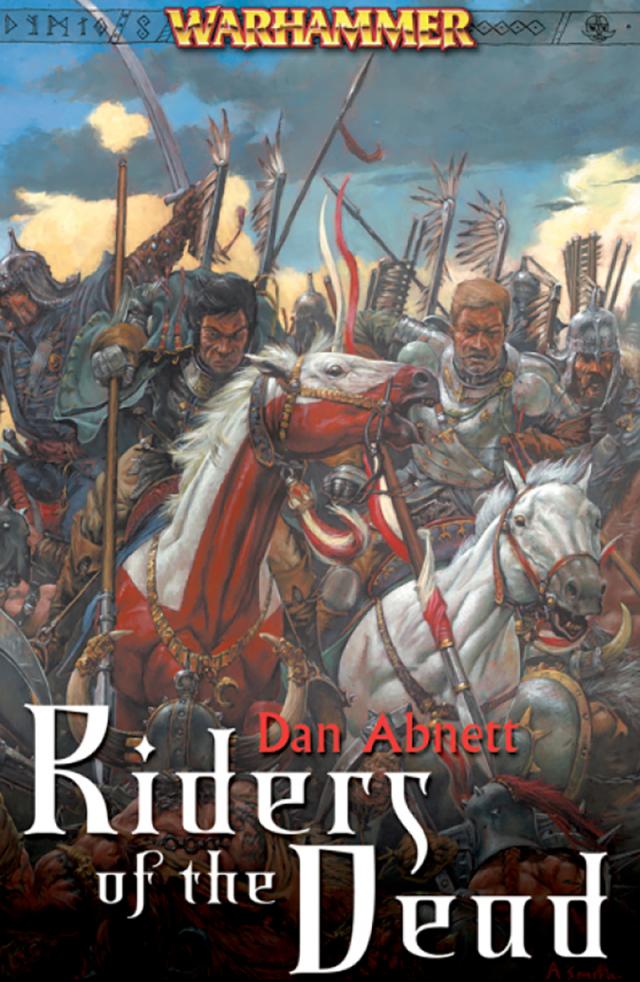


Uldin’s men let Karl keep the garments and armour pieces they had clad him in at Brunmarl. They gave him a sturdy spear with a black horsetail fixed behind the long tip, and an old brown mare without a saddle or a name. He rode in the band between the watchful eyes of Efgul and Hzaer the hornblower, and followed them into the fire.
V
At Aachden, an Imperial army had assembled to stop Surtha Lenk’s horde. They occupied the upland fields of crops and pasture just north-east of the town, with a broadleaf forest to their north and the plain of the river Aach to their south. They were a great glittering mass in the summer light, like a patch of sea sparkling with the sun, fretted by banners of blue and gold, red and white. A huge force of professional soldiery, supported by significant sections of levies. They were dug in to deprive the host of any further advance, and to halt them dead before they reached Wolfenburg.
The countryside presented no obvious way around them, but then again going around an enemy was not the Kurgan way.
VI
Uldin, hungry for a share of victory, had steered his warband through to the leading edge of the Kurgan host. They had ridden overnight to get a good place for themselves, running their horses hard the moment word spread that the Empire had rallied to meet them at arms on the field at Aachden. Karl wondered if his old nag would be able to keep up with the huge, black horses of the Kurgan riders, but it was indomitable and seemed to have fathomless stamina.
Chegrume, the shaman, rode with them on an ugly, ill-tempered tarpan. Its coat was brown, its mane and tail uncombed black, and its nature so foul that the antlered shaman had to tie himself to its back. He ran wild, weaving in and out of the galloping riders, chanting spells of fortitude and protection from metal.
Chegrume seemed a curious fellow to Karl. Not that all shamans weren’t curious, given their calling. But he was young and fierce, more like a warrior than a witch priest. His youth troubled Karl too. He had supposed a shaman needed age to attain the feats of lore and wisdom necessary to his office. Subotai had been an older man, and Zar Blayda’s wizard Ons Olker was not young. None of the shamans he had yet seen were younger than mature middle age.
But Chegrume was little more than a boy. It seemed as if he had been born with the arcane knowledge he needed. Or maybe acquiring that weight of lore so young had cost him something: his middle fingers, perhaps.
The day was clear and warm. The sky was blue. The weather paid no heed to the death about to take place, Karl thought.
The warband pushed their horses through the gathering press to win their ranking, as rival banner bearers, shaman and zars roared out reproachful challenges. But Uldin had chosen a place near to the lee of the river where bands of infantry spearmen had congregated, and none of them cared much to oppose five score warriors on warhorses.
The glittering army waited for them just over a league away. They had the advantage of height, for the gently rolling fields had a deceptive slope.
Breathing hard, their horses sweating and panting, the warband took its place and got its wind back. Men took off their helms and drank thirstily from skins, or daubed their faces and chests with pigment. Chegrume thumped up and down the serried rank, ululating and casting. Karl had the distinct feeling the shaman’s frantic activity had less to do with magic and more to do with the fact his bastard tarpan would not stand still.
Karl sat on his mare with his spear across his iron-plated thighs and gazed at the army facing them. They were so close he could make out their banner colours and the details of their standards. He wondered whose companies they were, and what lord had command, and he tried to identify symbols he knew.
The main battle standard. A white skull with a garland wreath around it on a crimson field. That was…
To its left, a figure of death, armed with a lance and a black crossed white shield, mounted on a maned and speckled cat, walking through a flame. On the turquoise field behind it, a star with two burning tails swooped down. He knew that one, certainly. It was the… the…
Karl shivered despite the balmy heat of the morning. He knew none of them. He could not recognise a single design or emblem. Where had his memory of them gone?
‘What’s the matter, Karl-Azytzeen?’ Efgul asked.
Karl looked round, as if blinking out of a dream. The hefty, hairy Kurgan was offering him a wineskin. Karl took it and drank deeply.
‘You are afraid of the Empire?’ Efgul added.
Karl shook his head. ‘These last days, I have fought them already,’ he said, and tapped the new-wrought rings on his arm.
‘Not an army such as this,’ Hzaer snarled from his other side. ‘You must not shy. You are not of them any more.’
‘If you shy,’ Efgul said, ‘the zar says we must kill you.’
‘I will not.’ Karl handed the skin to Hzaer, and the hornblower rotated his great brass carnyx back over his shoulder so it would not slide off while he was drinking.
‘Yes, I do not think so, seh,’ Efgul murmured, staring at Karl.
‘I’ve come a long way,’ Karl said to both of them and no one. ‘A long and bloody way, and I can only go forward because going back now would be too hard.’
Efgul nodded, and buckled his houndskull helm into place.
‘I don’t recognise the emblems any more,’ Karl confessed suddenly. ‘Not one of them. The banners of my… of the Empire. I thought I knew them, but I can’t place a single one.’
Hzaer grinned. His broken teeth made the grin a leer. ‘That is Tchar’s doing, Azytzeen,’ he said.
‘What is?’
‘He favours you. Great Tchar has changed your mind to make it easier to forget. Give thanks for that.’
Karl supposed he did. Memory of his old life would make the life he had now far harder to endure.
Hooves thundered up. It was Uldin, on his great black steed. His wolf-mask helmet had been polished, and his pallasz was drawn.
‘Word has been given!’ he shouted to the hornblower. ‘The High Zar has ordered we wait for the enemy to engage.’
‘Engage?’ Karl laughed. ‘They’ve got the slope on their side and they’re dug in. They’re waiting for us to come to them.’
Uldin glared at him. ‘They will not come?’
Karl snorted. Then, seeing the disapproving looks around him, he set his right hand across his heart and spoke more deferentially. ‘They will not come. They’ll do nothing if we sit here. Their aim is to block our advance and look! I believe that’s what they’re doing already, without lifting a finger.’
Uldin thought about this, his horse turning in circles.
Finally, he pointed at Karl and said, ‘Come!’
VII
So it was that, on that morning in early summer, Karl-Azytzeen came face to face with Surtha Lenk.
The High Zar’s pavilion was pitched behind the head of the ranked Kurgan mass. Its fabric was composed of tanned human hides, its guy ropes were plaited from sinew, and its posts calcified struts wrought from spines. It stank of decay and perfume.
Zar Uldin dismounted and pulled Karl off his mare. Karl scrambled and staggered as he was dragged towards the entrance of the battle tent.
Huge axemen with long horns rising from their heads blocked Uldin’s path and it took a lot of talk to convince them to let him past. Only when Uldin had dragged Karl inside did Karl realise that the axemen at the door had not been wearing helmets. The tusk-horns sprouted directly from the bones of their distended skulls.
He felt sick.
But he was to feel sicker still, once he was inside. It was dark in the battle tent. Brass pendant lamps fumed out an acrid pall of incense. Things brushed against his skin like feathers and chittered in the dark.
The floor seemed to be composed of a carpet of snakes. Smooth, dry coils slipped around his feet.
‘Welcome, Uldin,’ a tiny voice said.
Uldin bowed. ‘My lord.’
‘Is this the changeling you have spoken of?’
‘It is, lord seh.’
Karl glanced around. There were shadows everywhere, but none of them seemed like a person. He knew he had to keep his head bowed low.
‘He smells of change. I like that. What did you call him?’
‘Azytzeen,’ Uldin said.
‘Karl-Azytzeen,’ Karl corrected.
‘Oh! Spirited!’ The miniscule voice moved closer. ‘And why have you brought him here, Uldin?’
‘He declares the enemy will not move, lord seh.’
A huge, armoured figure stood over Karl now, plated in crimson steel, more massive even than Hinn.
‘Look at me, Azytzeen,’ Surtha Lenk said.
Karl slowly turned his head up. Lenk was a giant three spans tall, plated in brass and iron.
Except he was not. A twisted, deformed thing, no bigger than a swaddling child, was strapped in a harness across the breast plate of the giant. It seemed to be all swollen face, with tiny, wasted, half-formed hands and feet sprouting from it. This was Lenk: a loathsome, slack face mottled with warts and suppurating blisters. One eye was very human and brown, the other, lower in the rugose flesh of the cheek, was swollen and glazed milky blue. The mighty horned helm of the giant carrying him had no visor piercings or eye-slits.
Karl could not stifle a gasp.
Surtha Lenk laughed. His little pink slit-mouth wobbled and let out a child’s giggle.
‘I find spirit usually ebbs at the sight of me. In return for my service, Tchar has been bounteous with his gifts. Am I not beautiful?’
Karl nodded.
‘Nothing pleases the Eye of Tzeen so much as a man changed completely. Now… why will the enemy not move?’
‘B-because they have the rising ground. They would rather deny us than battle us, so they will not give up their advantage by coming down the field to look for a fight. The basis of the Empire’s might is the pike block. That strength is best used defensively. They… they will not come to us, and all the while we wait, they will stand there too, and the victory will be theirs without spill of blood, for their purpose will have been served.’
Karl’s voice trailed off. Had he said too much? Too little? Surtha Lenk took another step forward, so Karl could feel the breath of the baby-thing on his face. The horned giant nursing it slid off his left gauntlet and reached out to stroke Karl’s cheek with its bared fingers. The hand, though unnaturally large, looked human, but it moved as if the bones inside it were not solid. The palm and fingers writhed and curled fluidly like the feeling antlers of a slug.
Karl knew that it was the High Zar who was touching his face. The whole figure – giant and shrivelled thing combined – was Surtha Lenk.
‘I have considered these things too,’ Surtha Lenk whispered. ‘I have fought the Old World before, and know something of its ways. My battle-shamans augur that a delay might spook the army before us, and trick them into rash action.’
The boneless hand withdrew. ‘But Tchar speaks in you, and I am content to hear him. For I am restless and done with waiting. Spread word abroad. We will commence.’
The audience was apparently over. Uldin, plainly unnerved himself, hauled Karl out of the pavilion into the daylight.
Karl took a look back at the foul tent. He vowed he would never willingly go back inside it. He had imagined the High Zar to be that rare sort of man who commanded such power he could alter the face of the world and redirect the course of history. But he had imagined wrong. The High Zar was not any sort of man at all.
VIII
The horde stirred. A clattering ripple ran through the dark ranks as spear shafts were raised and shields knocked together. Somewhere to the left line, kettledrums began a frenzied beating, then fell silent. Then they began again and did not stop.
Karl and the zar rode back to the warband. Uldin did not speak.
As they waited in rank, Karl suddenly felt cold, and the bright sunlight abruptly dimmed. The sky above Aachden and the enemy army was still clear and blue, but when he looked to his rear, he saw broad swathes of low dark cloud spoiling in from the east. The clouds were moving with visible speed, racing in to cover the heavens with a pitchy mantle. Spears of lightning blinked above the woodland to the east. Within minutes, the light had gone and the valley was muffled in a dead twilight. The first spats of rain began to fall, tapping off armour-iron and shield-wood. A vapour that was not quite a fog breathed over the land, making it harder to see.
Up the long slope of the field, the army of the Empire had become partially obscured. Storm clouds hovered above them too now, and there was no piece of summer blue left visible. An anxious murmur seemed to stiffen the silver-steel echelons of the Reik. Karl heard distant drums start up, and cymbals clash. He smelt gunpowder and hot pitch on the wet air.
Thunder boomed overhead, and the rain began to pelt torrentially. The vapour in the air thickened. Karl glanced down the wide front line of the horde, and realised it was moving. Not fast, but creeping forward, like spilled oil seeping across a floor.
Uldin called out, and they began to walk their horses. Berlas and the other archers slid their bows from their cases and nocked shafts to the strings.
Drums were thrashing a frenetic tempo that made the pulse rise in every man. Then the warhounds were let loose.
Karl saw them as they broke out from the rolling rank and began the chase up the slope of the field. They were dark and monstrous things, hundreds of them, loping and bounding and sending up a chilling howl.
The advance speed increased, as if the Kurgan were now keen to keep up with the dogs. Horns blew all through the host, and Hzaer blasted on his carnyx. They were cantering, with spearmen from the middle ranks running forward between the horses and baying like the hounds. The horde shook the ground as it flooded towards the standing army.
The pike walls came up, bristling in a thicket three men deep. Even to trained men, pole arms and pikes were aggravating weapons to handle. The great length of the shafts meant they wobbled under marching conditions and caused discomfort, and they were too long to be easily accommodated in close woodland or town streets. Sometimes it was even hard to find space enough to stack them out in an overnight camp.
But the nuisance they caused was worthwhile. With perfect drill, they made a lethal barrier that would stop even the heaviest cavalry. The hammer might be the symbol of the Empire, but the pike was the weapon on which its reputation was built.
As they broke into a gallop, Karl began to consider the odds. Uldin’s warband was ferocious and fearless, but horse against pike had only one outcome. These pike men and halberdiers were ready and pitched square, unlike their poor brothers at Zhedevka. Kurgan blood was about to be spilled in great quantity.
And then it was spilled. There was a series of thunderclaps that was not thunder. The Imperial cannon, anchored in sets on either wing of the enemy’s battle order, had fired. Pluming cones of yellow flame and mud spray burst up amongst the charging Kurgan. The bodies of men and horses were tossed into the air. Wood and steel and bone splintered. The huge shot from mortars dropped on the horde like rocks thrown from the heavens. Shrieking fire from the great cannon and the volley guns ripped horizontally down the field and tore into the front ranks.
Then the longbows, loosed from behind the pike wall, and a wave of white-feathered shafts arced over with a rasping hiss. Kurgan toppled and fell all around, struck through the helms and pauldrons and skewered from above by the long arrows. A heartbeat later, and the second wave hissed down, followed by the first massed volley of the arquebusiers and crossbowmen laced amongst the pike men in the wall. Karl felt a ball shot burn past his ear and a quarrel cracked into slivers as it came off the iron rim of his shield. To his left, one of Uldin’s riders crashed over, horse and man together.
For a moment, Karl felt a twinge of martial pride for the culture that had raised him. The greatest army in the world. He would be content to die at its hands. He would ride his nameless nag into the pike wall and find his end.
The pike wall was right ahead now, and unmoving.
The hounds reached the pike wall. Hounds are not like horses, they do not quail and veer aside from obstruction. Whether this means horses are smarter than dogs, or dogs braver than horses, is hard to call. Hounds are unlike horses in other ways too: they are lower and smaller and fleeter, and much harder to strike with a pole blade four spans long. And they have the teeth of meat-eaters.
A few of the great hunting dogs were gashed and run through by the stalwart pikes. A few more were shot by handgun and crossbow and left yelping and lame on the mud. The bulk ran in under the pikes and into the men.
At once, the wall broke in several places. Men screamed and fell back, trying to dodge the ravening war-dogs. They crashed into the ranks behind them. Pikes dropped into the mire. Some parts of the rank unformed completely as frantic pike men turned their weapons too far and too suddenly to check the murderous hounds.
The Kurgan charge slammed into the Imperial front row and poured into the breaks and gaps. Men in white and red went down under the weight of horses or the thrust of horned spearmen. Once the enemy was in amongst them, the pike men were forced to abandon their shafts and equip themselves with hand weapons. They had no shields, and none of the Kurgans’ momentum.
Karl crashed through beside Efgul, his mare snorting and squealing. Without saddle or stirrup, he had no brace to enable him to couch his spear, so he stabbed down with it, overarm. His first thrust went through a thigh, the second clean into the side of a sallet helm. Mud splashed everywhere, churned up by the chaos, and the roaring tumult was a concussive force. Efgul was hacking with his war-axe, cutting deeper into the slowly-giving resilience of the enemy file. All around Karl, the men of Uldin’s warband, together with Kurgan spear and axe on foot, were striking and killing. A berdish axe smote down an arquebusier. A pallasz split a pike man. A crossbow bolt struck a Norther swordsman with such force his body slammed backwards and his round shield spun upwards into the air. Uldin’s man Diormac caved skulls with his heavy flail, and his black warhorse kicked out its hooves. There was no room to move in the choking press, and no possibility of seeing further than a few spans in any direction.