Riders of the dead, p.2
Riders of the Dead,
p.2


‘Say it as it is,’ he instructed as they came up.
‘There’s no victuals here, captain,’ Heileman replied. ‘The town’s been picked bare by the companies that have preceded us. They have some food cooking, but it’s the last dredgings of their larders. We should look to our own supplies rather than deprive these people.’
Stouer nodded.
‘Karl was all for taking the food by force, but I think we owe it to these kind folk to be respectful.’
Stouer glanced at Vollen.
‘That true?’
The clarion stiffened, and looked like he wanted to spit. He said simply, ‘My appetite got the better of me, captain. The vexillary is right.’
Stouer scratched an ear. He knew full well there was more to it than that, but he wasn’t really interested. There was never any sense pampering soldiers. If what he’d been told at the Vatzl garrison was true, there were hard times ahead for all of them. Stouer had seen service in the oblast before, five summers previously. It was a hard country, more brutal in climate than any part of the Empire, and it seemed to go on forever. The people were by turns dour and hearty, though he’d never had much time for any of them. Their great, harsh territory, only partly conquered by civilisation, formed a natural buffer between the Empire and the Northern Wastes. He’d heard Kislev men state emphatically that they were the true protectors of the North, keeping the Empire’s border secure. That was nonsense, of course. The Empire had the greatest army in the world, and when it moved north in times of invasion-threat, as now, it usually ended up saving the skins of the Kislevites too. But for the grace of Sigmar they held this land, and but for the army of the Emperor they would lose it.
And now the Northern tribes were rising again. Rising as never before. Thick and dark, like ants upon the tundra, spilling south. There had been omens, prophecies, signs. Even if the threat was exaggerated, it was going to be a hard year. Stouer had certainly never known the Imperial army to dispose a force of this size into the north, nor bind itself to so many allies. Bretonnian heavy horse, trained bands from Tilea, and from the damnable Old Races too. Everyone was taking this seriously.
The captain walked over to his saddlebags and took out a scroll-case. ‘Karl! Your eye, please!’ he said. Gerlach and the clarion were still regarding each other poisonously, and Stouer knew they needed a distraction or two. Like siblings, the pair of them. Constantly locking horns.
Stouer opened the case and unrolled a small chart. ‘This is Choika, yes?’
Vollen examined the map and nodded. ‘Yes, sir.’
‘Here, the river. The crossing, here.’ Stouer traced lines with his fingertip in a general way. It was all inky scratches to him, but he didn’t want to betray his lack of learning.
‘This is the Lynsk,’ Vollen said, pointing. He was well aware of the captain’s lack of letters, and knew that Stouer often used him as a clerk. ‘Here’s the crossing. About a league upstream.’
The captain studied the map and nodded sagely as if it made perfect sense. ‘Our orders are to join up with Marshal Neiber and the Wissenland pike north of the crossing by noon tomorrow. At a place called Zhedevka. Now then, Zhedevka… Zhedevka…’
‘There, sir,’ Vollen pointed.
Stouer straightened up and took a deep, thoughtful breath. ‘Still a few hours of light left. Gerlach, take three horse and scout the crossing. See what you can see. And be back by nightfall.’
‘Yes, sir,’ Heileman said. He pulled on his rein-worn gloves. ‘Sebold? Johann? You too, Karl.’
Stouer bristled slightly. His intention had been to keep Gerlach and the boy apart and occupied. What the hell! If they were busy, they couldn’t fight each other.
VI
Fields of unripe barley and rye stretched out from the trackway east of the town, and to the north, jumbled marshes and thickets of bulrushes clustered in the sodden flood plain of the river. The sky had clouded over and turned a peculiar, flat shade of white, though it was still bright. Where the track ran beside the river, damsel flies darted through the air, bright and exquisite as living jewellery.
Their lances slung secure in saddle-boots, the four demilancers hacked up the river trail and broke into a gallop where the track widened. All had their stirrups cinched short, as per regulations, so that when they rose, heads lowered for the chase, there was a good hand’s breadth between them and their saddles. Gerlach led the way on his big grey, a seventeen hand three-year old called Saksen. The companies favoured young horses for their spirit and energy, though they could be skittish and difficult, and Saksen was unruly at the best of times.
Vollen came behind, alongside Sebold Truchs, a long-faced man who, at twenty-nine, was about the oldest trooper in the company besides the captain himself. Truchs was considered something of a veteran, and the younger men looked to him because of his experience. He rode a big chestnut gelding with a star on its brow. Vollen’s mount, Gan, was a black of sixteen hands with a ferocious spirit, but more even tempered than Gerlach’s grey.
Johann Friedel rode at the back of the group. He was nineteen years old, the third son of a merchant baronet, and as boisterous as his young black troop horse. For all of them except Truchs, this was their first experience of war. Real war. Their careers thus far had been spent in training and cavalry schooling, manoeuvres and ceremonial duties. They were all eager and scared in equal measure, but they showed only their eagerness.
Truchs had seen action four times: two border disputes and two scourge campaigns against the bestial filth in the Drakwald Forest. His colourful stories were numerous and, to be fair, contradictory. For though he had seen action, as the phrase went, he hadn’t actually seen much action. A shield wall, at a distance, through the rain. A border town shelled by Imperial cannon, from the vantage of a windy hill three leagues away. An aborted charge and rally into what turned out to be an empty wood. And four dead bodies in a dry field outside Wurschen, terribly split and twisted by sword cuts. That was an image that still woke him some nights.
But still, his stories were good, all the better for the constant embroidery. And whatever he had done or had not done, it was more than any trooper in the company – except the captain, who had been in a real war once. Sebold Truchs would have been quite content not to have ridden north that summer, preferring to linger in the spartan enclosure of the Cavalry School at Talabheim, training and drilling and practising.
For there was one thing he knew for certain about this deployment to the bitter north: there was a real war waiting there for all of them, and their days of monotonous practice were gone forever.
The river was fast and high from the spring melt. Its headlong rush sounded like jingling coins. The track following it bent north in a long, slow curve. They came to the crossing: a broad timber bridge raised out of the water on five stone piers. Gerlach didn’t break stride. He just nosed his grey on, and pounded across the boards, spitting sideways from the saddle to avert the ill fortune of iron hooves on wood.
The other three did the same, though Vollen merely did it out of custom. Gerlach’s spittle, flying back in the slipstream, spattered across Vollen’s cuirass. The vexillary could have aimed his mouth aside, but he hadn’t bothered. Vollen said nothing and wiped it off.
They came off the bridge into the reeded banks of the north side, standing upright in the stirrups to urge their steeds up the sodden slope. Open grassland lay before them, wide and flat, vaster than any landscape Vollen had ever seen. Under the flat, white sky, it looked like a grey sea, the stalks rippling in the wind like waves. To the north-west, several leagues away, the horizon swelled up in a great mound, a curve rising proud of the grass like a pregnant bulge.
Gerlach reined in, and paced his excited, snorting mount. The others drew up behind him.
‘Zhedevka? Over there?’ he asked.
‘It lies on the grasslands near a mound of the Old People,’ Vollen said. ‘So… yes, I’d say.’
‘Old People?’ Johann Friedel called out. ‘You mean… the Slight Ones?’
He meant elves. Just say it, Karl Reiner Vollen thought. In this modern age, it was preposterous for a man to be coy about saying a simple word. Mentioning them by name was said to bring bad luck. And men still believed that, damn them for fools.
‘Not elves,’ Vollen said, and Johann jumped in his saddle at the word. ‘The Scythians, the horse warriors of old. The Gospodars – and therefore the Kislevites – trace their ancestry back to them. They ruled here once, before Sainted Sigmar came. These lands were theirs. They built the towns whose ruins are said to haunt the Steppes. They raised the kurgans.’
‘The kurgans?’ Truchs said with alarm.
‘That’s a kurgan,’ Vollen said mildly, pointing to the distant mound.
‘Where? Where, damn it?’ Truchs turned his horse in an agitated circle.
‘Be still!’ Gerlach snapped. ‘Karl’s playing with you. Using his damned education again, eh, Karl?’
The clarion sat back against his saddle rest and shrugged.
Even the most poorly schooled son of the Empire knew the word kurgan. It was the name of the bogeyman, the term for the dark tribes who lurked in the north under the Shadow. Kurgans were the very monsters they had come there to fight.
‘A kurgan,’ said Vollen, ‘is a man-made hill, a burial mound from the early times. The vile tribes of the North are known by the term. Presumably…’ he smiled, ‘presumably because they want to hide the bones of all of us in the south under similar hills.’
Truchs touched the iron of his sword-hilt to ward against evil charms, and spat again. There was too much loose talk and bad luck in the air for his liking.
They rode north-west at a hard lick, Friedel just in the lead now. The cold wind was fierce in their faces and made them breathless.
As they got nearer to the mound – and realised just how huge it truly was – Johann Friedel pulled up sharply and called out a warning.
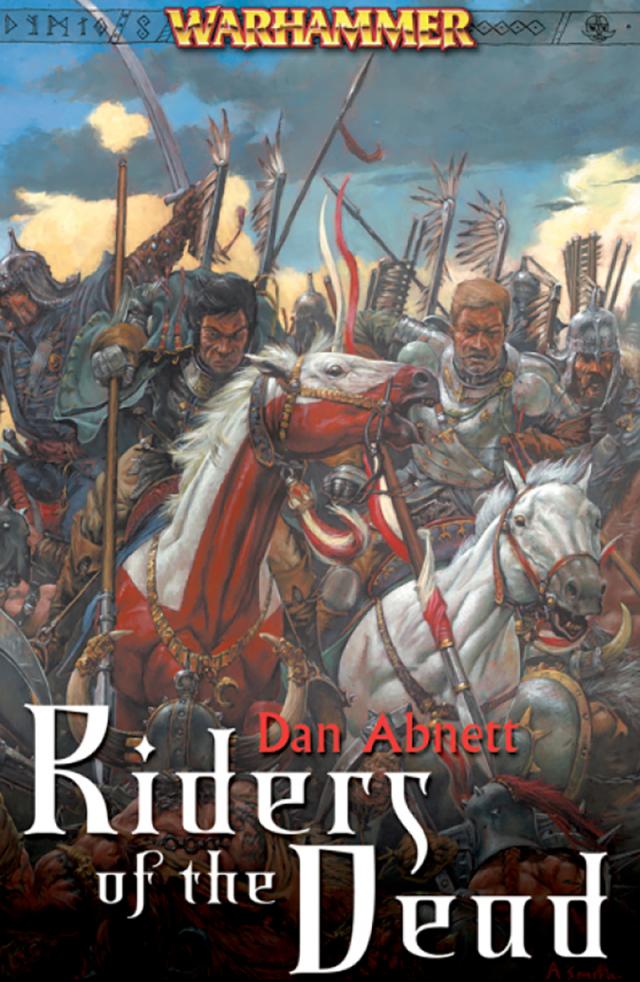
There were riders on the track ahead of them. A dozen horsemen emerged from the long grasses, silent and slow. Their horses were small, rangy mares, brown and bay, little more than ponies, with full, heavy tails and shaggy manes. The men were swaddled in cloaks, furs and blankets. Barbarian riders, there could be no doubt.
Gerlach slowed to a trot and moved to the fore. The shabby riders halted their horses and watched them approach, unmoving. Gerlach Heileman suddenly felt vital and proud of his gleaming armour and his sleek charger with its braided mane and docked, bound-up tail.
He stood in the stirrups again as Saksen pulled slow, glancing back past his shoulders at his outriders.
‘What do we do? What do we do?’ gabbled Johann.
‘Hail them, vexillary,’ advised Vollen.
‘Hail them? Look at them, Karl! They’re Northers! Raiders! Why should I hail them?’ Gerlach unclasped the pistol holsters on his saddle-bow, and quickly cocked the firelocks of the ready-primed pieces. Then he drew his cavalry sword. It was a basket-hilted weapon with a straight, double-edged blade a span long. It had two deep fuller grooves down the length of the blade, and its tip was pointed like a spear. It was made for thrusting, as outlined by regulations.
‘No,’ said Vollen quickly, in disbelief. ‘Oh no… vexillary…’
‘Rise in the saddle to address!’ Gerlach called out. Truchs and Friedel fell into step with him, and walked their horses forward, their sword blades resting upright against their right arms. Ahead of them, the riders remained motionless.
Vollen lagged behind, his sword still in its scabbard. Gerlach, Truchs and Friedel increased their pace to a brisk trot, their sword-hands now steadied on their right thighs with the sword points inclined slightly forward.
‘Gerlach!’ Vollen shouted.
‘Get into line, clarion!’ Heileman yelled back. ‘Damn you! Get into formation or the captain will hear about this!’
The brisk trot was turning into a gallop. They were less than eighty lengths from the stationary horsemen.
‘Present and charge!’ Heileman howled. Three sword arms lifted, the swords pointed towards the enemy and carried crosswise to each rider’s head.
The shabby horsemen stirred. Their horses wheeled around and there was a dull flash in the flat light as sabres were uncased and flourished.
Vollen tore his bugle out of its case and blew hard. A quadrille. Short-long-long-short. He did it again.
The three demilancers broke their gallop, swords waving, confused. The enemy horsemen spread wide, to either side of Gerlach’s abortive charge. One of them raised a bone horn and returned Vollen’s hoot.
Vollen spurred Gan forward and rode up to position himself face to face with the heathen men. Gerlach, Friedel and Truchs were riding out in a wide turn to come around.
The warriors were caked in mud and dirt, and Vollen could smell the sweat and soil of both horses and riders without trying. They sheathed their thin, curved blades and closed around him, curious. Raw, mustachioed faces glared at him from the folds of furs and grease-heavy cloaks.
‘Imperial?’ asked one. He was a big man whose bulk seemed to be crushing his ragged pony. His front teeth were missing.
‘Yes,’ nodded Vollen. ‘The Second Company Hipparchia Demilance, ridden out of Talabheim. Hail and met.’
‘You? You is leader of men?’ pressed the toothless giant.
‘No,’ said Vollen. ‘I’m clarion.’
‘Klaaryen?’
Vollen gestured with his bugle.
Gerlach and the other demilancers galloped up and reined hard to stop. The cluster of filthy steppe riders broke to let them through.
‘What the devil are you doing, Vollen?’ Gerlach roared.
‘Vexillary Heileman, may I present…’ Vollen looked expectantly at the gap-toothed brute on the shaggy pony.
The big Kislevite pursed his lips and then said, ‘Beledni, rotamaster, of rota of Yetchitch krug, of Blindt voisko, of Sanyza pulk, of Gospodarinyi, syet Kislevi.’
‘They’re on our side,’ Vollen said to the vexillary, as if it wasn’t clear enough. ‘They’re Kislevite lancers. Allies.’
‘El-ays, yha!’ the Kislevite leader of horse cried, and bowed low in his worn saddle to Gerlach, doffing his fur hat. His head was entirely shaved except for a long, braided top-knot and his drooping moustache. His men called out, and rattled the staves of their lances together. Each one had three spears slung in long canvas boots against the fore of their saddles: two short, slim javelins with long, sharp tips and one long pole, thicker and tipped with a narrow blade and a crossbar.
‘These heathens?’ asked Gerlach, incredulously.
‘Heeth-eyns?’ Beledni echoed, looking at Vollen for clarification.
‘We show only respect,’ said Vollen, slowly and carefully. Beledni thought about this and then nodded heavily.
Gerlach spat contemptuously. ‘They don’t even talk our tongue,’ he said.
‘Yurr tung?’ said Beledni.
‘They speak our tongue better than you speak theirs,’ Vollen ventured.
Gerlach glared at him. ‘Apologise,’ he said.
‘Apologise?’ Vollen repeated.
‘Yes, dammit! For our mistaken attack.’
Vollen paused. Unblinking, he returned Gerlach’s gaze for a moment. ‘You ask a lot of me, sometimes.’
‘Are you refusing?’ the vexillary asked. His face was flushed.
‘Of course not,’ Vollen replied. He took a breath and looked across at Beledni. The big man and his riders had been trying to follow the exchange between Vollen and Gerlach.
‘Rotamaster, we are most sorry for our mistaken challenge, and uh…’
Beledni used the tassels of his riding crop to chase away a marsh fly that was buzzing around his face and made an odd little gesture with his other hand. It was a dismissive slight turn of the wrist as if he was spilling out a handful of corn. ‘Is of no matter,’ he added with a careless, almost theatrical frown.
‘We meant no disrespect, sir…’
The gesture again, the down-turned corners of the mouth. ‘Is of no matter,’ Beledni said once more, and walked his shabby little horse ahead a few steps so that he drew level with Vollen. Beledni patted him on the arm, an informal, avuncular action. ‘We will all live,’ he said sagely. Then he leaned forward, his lips to Vollen’s ear, so close Vollen was assailed by the smell of body sweat and rank breath. ‘Vebla?’ he said, and indicated Gerlach with his crop.
‘Vebla, yha?’
Some of the Kislevite riders heard this, and snorted out chuckles.
‘What did he say?’ asked Gerlach sharply.
‘I don’t know, vexillary. I don’t know the word.’
Heileman sat back against his saddle rest. He was annoyed. They were laughing at him, these heathens. Making him the butt of some crude joke.
He’d heard many stories of Kislev lancers, stories that described them as triumphant, spectacular, armoured in finery and feathers, masters of horse, as magnificent as Imperial knights. Someone had once told him that the lancers often scared their enemies from the field by the sheer splendour of their wargear, which attested to their prowess by all the riches they had won.
Not these dogs. It seemed that every story about the North was a lie. There was no magnificence in its landscape or its people, and their famous lancers were positively squalid.
‘Zhedevka,’ he said to Vollen. ‘Just ask him where Zhedevka is.’
VII
Without comment or ceremony, Beledni’s little troop of lancers led them another league north until the great kurgan was behind them. Zhedevka lay on the plains behind it, looking out across undulating grasslands and the distant shadow of a forest. Small patches of woodland dotted the landscape around the town.