Eqmm march april 2008, p.10
EQMM, March-April 2008,
p.10
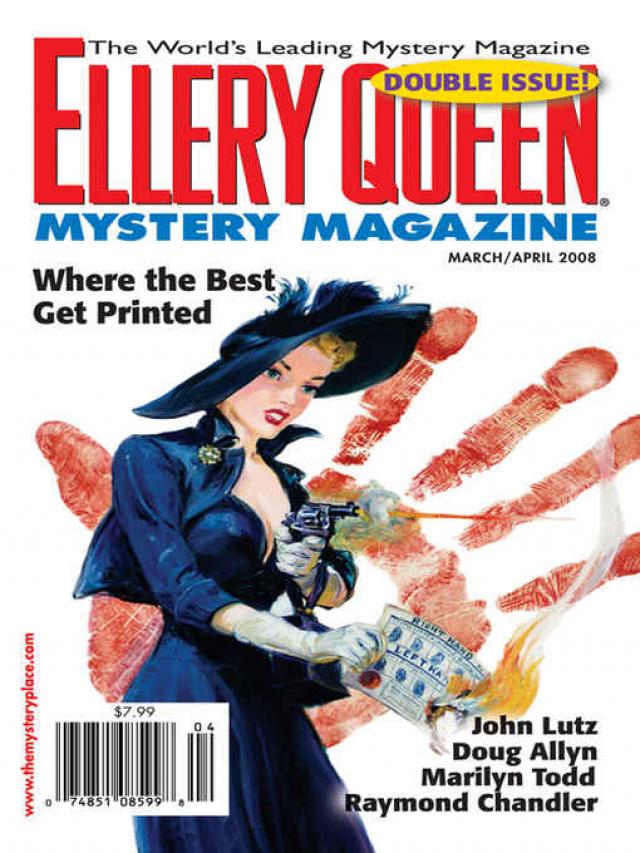


Something clamped itself onto my heart and squeezed. I guess I hadn't wanted her to know where Parrish lived, at least not down to the room number. The fact that she did made me picture something I didn't want to see.
"You keep extra clothes there?” My teeth had stayed stuck together as I'd said it.
Her eyes turned to flint. “None of your damn business."
I eased off my teeth. “You're right. Thanks for the news.” I turned toward The Minnesotan and waited for a streetcar to pass before crossing the road to get to the other side.
"We live in the same building, that's all,” she said, raising her voice so I'd hear her over the rattling roar of the trolley.
I turned toward her. The streetcar rumbled away.
She was twirling a lock of her platinum-blond hair. “I live in 401.” Then she smiled a murderous smile. “I like it that you care."
I glanced up and down the street. The only people in sight were a couple of drunks trying to navigate the rough seas of the sidewalk. I tried to keep my wits about me, but Reason was already drifting down the block. He gave me a knowing smile and a tip of the hat before he turned and walked away, whistling a happy tune, content to meet up again later.
I gave her the toughest look I had. “It's a dangerous night,” I said. “You should have an escort."
She walked toward me, one high-heeled stiletto placed directly in front of the other, her eyes taking on the sharp, seasoned focus of the hunter. I never asked her for her real name and she never offered it. All she had to do was what she did: look at me like the Santa Anas had returned.
Her voice turned breathy. “You never know where you might find trouble."
She offered me her arm and I took it. I knew I was making the wrong choice, but like following prey into an unfamiliar building through an unmarked door, sometimes you can't help but go where you shouldn't. That's not just a sin that P.I.s commit.
* * * *
I knocked on the peeling varnish of the door to Room 316, but I had the growing sense I'd get no answer.
I'd left Lana sleeping soundly in her bed in 401. Doing three shows a night must have exhausted her, because she'd been out the minute she'd climbed off. The whole thing had taken less than ten minutes—she had the kind of body that kills self-control—but I was beginning to feel I'd been distracted too long. The storm had pounded on her window as if raging against what was going on inside. As if it could scour away with its fury the permanent stains—the permanent sins—of skid row. Ten minutes later, it still hadn't given up on its hopeless mission.
I tried the knob. The door wasn't locked.
A single lamp on the table in front of the window lit a small part of the room, leaving the rest in shadows that rose and fell with the flashes of lightning that flickered through the drawn shade. There wasn't much to light up, just a single bed, a dresser, and a padded vinyl chair that was losing its stuffing. A cigarette languished in an ashtray.
Tommy lay on his side on the floor, his front bathed in light, his blood making a black pool in front of him on the low-pile maroon rug. A pearl handle stuck out of his chest. It moved in irregular fits with Tommy's shallow breaths.
I kneeled at his side. “Just hold on. I'll get help."
"No need.” He pushed out the words without any air to carry them.
"Baird?"
His head moved. It was as close to a nod as he could get. “He knocked. I thought it was you."
He coughed up blood that oozed out of the side of his mouth. His skin was gray and seemed to be hardening. He pushed more blood from his mouth with his tongue and choked on words that wouldn't come out. He swallowed hard, then forced out his last words on his last breath.
"I'll wait."
But he didn't.
As I turned to leave to go call for the police, something over his bed caught my eye.
Taped to the thick steel crossbar of his headboard frame was a picture. It was almost identical to the one Dan had left for me at the Minneapolis post office. It was of Tommy and his parents, taken a moment before or a moment after the one I had. Everything looked the same. His parents were smiling. Tommy was in his uniform. But one important detail was different. The one that proved why you take more than one picture. At first I didn't understand why this one was the one he'd kept for himself. But then it made perfect sense.
In this one, Tommy's eyes were closed.
Outside, the storm raged on, still battling the sins that can't be washed away.
* * * *
Dan Parrish took the news like it wasn't news. There was only one part that surprised him.
” ‘I'll wait.’ What do you think he meant by that?"
I sat forward in the battered desk chair in the back room of the Sourdough. The Pope had let me use his phone. He'd found me at eight a.m. waiting in the sun with a handful of other desperate men on the rain-scoured sidewalk in front of the bar. I took a long breath and ran a hand through my hair as I gazed at the hundreds of faces staring at me from across the room on the Lost Wall.
"All I can think of, Dan, is that he was talking about your father."
A staticky silence filled the line.
"I think he meant that he'll be waiting for your father in the next life."
Dan cleared his throat. His words trembled. “He doesn't have to wait. Pop died last night."
My heart fell. “I'm sorry, Dan."
"It's like they decided to leave together. And they hadn't said a word to each other in six years."
We signed off shortly after that. Dan thanked me and offered again to pay for my services. Like the sap I'd become, again I said no.
The Pope came in with a bowl of beer nuts. “This is the only breakfast I can rustle up."
I thanked him and tossed a couple into my mouth. I'd been up all night. The cops had found Baird in a Panther Room booth, unconscious, blood from his nose spilling down the front of his red gambling-house suit, both eyes swollen shut. When I'd found him there half an hour before the cops, spending the forty bucks—my forty bucks—that he'd taken off Tommy as Tommy lay dying, he'd been celebrating like it was his first day of freedom. Instead, it was his last. None of the patrons in the Panther Room could recall seeing who had given Baird such a beating. It turns out that on skid row the price for silence is a round of drinks. And I still managed to walk out with ten bucks and change.
But I can't shake the fact that Tommy's death was my fault. When Reason had left me behind on the sidewalk in front of the Palms with Lana, it hadn't walked away alone. It had taken a life with it. I'd had the sense that Tommy had needed some time, but I was convinced he was coming around. Had I stuck to my job, I would have been with Tommy when Baird knocked on the door, or we might even have already been on our way to the depot and the next train to Glenwood. To his father. I would have at least been in a position to intercept Baird's knife. Maybe even to have taken the fatal blow.
Or maybe that's just wishful thinking.
I never told Dan that I'd been ten minutes late.
The Pope walked over to the Lost Wall and pointed at the picture he'd taken of Tommy Parrish five years ago.
"I guess I can take this one down.” He started to pull out the thumbtack that pinned it to the wall.
"Wait,” I said as I got to my feet and came up next to him. “Leave it up."
The Pope looked at me.
I looked at Tommy's picture, his eyes the color of slate. The color of hope that has died. “I don't think he was ever really found."
The Pope lifted his eyebrows and nodded. “Fair enough.” He looked at Tommy and the rest of the faces on the Lost Wall. “Wordsworth."
Then he headed back out to the bar to a jukebox that was stuck repeating the same two notes like the incessant chirping of an early morning bird. I heard the Pope give the machine a kick. The song picked up again several notes later.
I stared at the Lost Wall. Stared at all the skid-row faces. So different from the ones that haunted me from Dachau, yet so much the same.
Hollow faces with leaden gray eyes.
Lost faces.
The kind that can only be found in dreams.
(c) 2008 by C. J. Harper
[Back to Table of Contents]
Fiction: FOUR HUNDRED RABBITS by Simon Levack
* * * *
Art by Ron Bucalo
* * * *
Simon Levack's writing career was launched when he won the Crime Writers Association of Britain's Debut Dagger Award. The book introduced his series character Yaotl, an Aztec slave. Yaotl now appears in a fourth novel entitled Tribute of Death, published in 2007 by Lulu Enterprises UK. What a treat that this series, which the Guardian calls “always gripping and surprising,” now includes short stories.
* * * *
The Dance of the Four Hundred Rabbits was a part of the midwinter Festival of the Raising of Banners, a time when we Aztecs honoured our war god, Huitztilopochtli, the Hummingbird of the South. While warrior captives were having their hearts torn out in front of the war god's temple at the top of the Great Pyramid, a more genial ritual was being enacted nearby, in honour of the gods of sacred wine.
The priest named Two Rabbit presided over the temple of the god whose name he bore. He called together dancers, young men from the Houses of Tears, the priests’ training schools. Each dancer represented one of the four hundred lesser gods of sacred wine, the Four Hundred Rabbits.
The task of organising the proceedings fell to Two Rabbit's deputy, Patecatl. It was his job to set up the jars of sacred wine that were at the heart of the ceremony and to lay out drinking straws ready for the dancers at the end of their performance. For the climax of the dance was the moment when their graceful, sinuous movements broke up and they fell greedily upon the jars and the drinking straws, every man jabbing his neighbour with knee and elbow and fist in his eagerness to be first.
There were four hundred dancers and fifty-two jars. But there were only two hundred and sixty straws, and of those, only one was bored through. Among the four hundred young men who had been picked for this ceremony, one alone would stand with a hollow reed at a jar of sacred wine, happily drinking his fill.
It was a game of chance, but also a ritual, watched closely by Two Rabbit and Patecatl for clues to the will of the gods. Two hundred and sixty was the number of days in our sacred calendar, and fifty-two the number of years between the ceremonial kindling of one new fire and the next. To see which young man seized the right straw and which jar he drank from might give the priests a clue to what lay in the future for our people.
Unless somebody tried to shorten the odds.
* * * *
"Move yourself, slave!"
I scrambled to my feet, narrowly avoiding the kick my master's steward had casually aimed at me while I bolted what was left of my warm tortilla. The sweet girl from the palace kitchen who had passed it to me fresh from the griddle backed away into a corner, her eyes wide with sudden fear, but the big bully did not berate her for wasting bread on me. Nor did he demand to know what I was doing or hurl some witless insult at me, which was unusual. Instead, with a curt “Come with me!” he turned and stalked away.
"Thanks a lot, Huitztic,” I grumbled. I glanced over my shoulder but the girl had fled. “We were getting along nicely there, too...."
I hung back, preparing to dodge the kick that a remark like that would normally provoke, but all the response I got was, “This is no time for jokes. His Lordship has something to show you."
That was restrained by the steward's standards. Intrigued, I caught him up, and noticed that he was sweating. It was a cold, clear morning, when the frost lay late on the earth and the sky above the city of Mexico-Tenochtitlan was a blue so bright it hurt the eyes, yet his brow was beaded with moisture, glittering in the sunshine.
"In here.” He led me into a courtyard. “Your slave Yaotl, my Lord!” he announced in a loud whisper.
The enclosure was dark, surrounded by high walls the Sun had yet to clear, and the only warmth and light in it came from a squat brazier at its centre. I paused, squinting into corners while my eyes adjusted and I tried to make out what it was I was meant to see.
The feeble glow of the coals set off my master's features perfectly, picking out every line and wrinkle in his gnarled old face, but making his bright, ferocious eyes shine. Lord Feathered in Black, the chief minister, chief justice, and chief priest of the Aztecs, the second most powerful man in Mexico-Tenochtitlan and perhaps the most dangerous, did not trouble to greet me. Instead he leaned forward in the high-backed wicker chair that was an emblem of his rank, clutching his jaguar-skin mantle around him, and snarled: “Look at the boy—the rabbit, here. Tell me what happened to him."
I followed his gaze and saw for the first time that there was a young man sprawled against the courtyard wall. His legs were splayed like an infant's. In the poor light, his skin looked sallow and unhealthy, and a trickle of saliva glittered like silver leaf on his chin. His eyes were open, but as I looked more closely I realized he saw nothing through them. Their pupils were huge black disks that stayed fixed on something far away when I passed a hand in front of them. His breath had a sour reek that I knew well. He had been drinking sacred wine. Perhaps he had been celebrating: I noticed that he was missing the single lock of hair that boys grew at the napes of their necks, and this was a sign that he had taken his first captive in battle, and could call himself a warrior.
Why had my master called him “the rabbit"?
I felt a moment of panic as I struggled to answer His Lordship's question. The old man was not renowned for his patience.
It was the steward who saved me, unwittingly. With a sudden nervous giggle he called out: “Come on, Yaotl. What's he taken? You're the expert!"
I stiffened indignantly at the taunt. Huitztic knew my past: how I had sold myself into Lord Feathered in Black's service, trading my freedom for the sum of twenty large cloaks, enough to keep me in drink when I had nothing left but the breechcloth wrapped around my loins. He knew also what had first driven me to seek refuge in a gourd of sacred wine: the despair and humiliation of being expelled from the priesthood, years before. As a priest I had learned and experienced the use of every kind of leaf, herb, seed, and root, everything a man could put into his body to turn him into a slobbering imbecile. The steward's comment was a deliberate jibe, and it stung, but even as I bit back my retort I realized the oaf had given me the clue I needed.
My master responded before I could. “Be quiet, you idiot,” he snapped. “You're in enough trouble over this already! Yaotl, I want your answer before I have both of you strangled!"
"He's been drinking,” I said hastily. “That's obvious, I can smell it. But it's not just that. Sacred wine wouldn't leave him like this. He'd just have been violently sick and then fallen asleep, and by now he'd have a sore head and a tongue like tree bark. Anyway, you didn't send for me to tell you he's got a hangover. He's had something else—mushrooms, perhaps: the Food of the Gods. But I don't understand...” I hesitated before turning to look at the grim-faced old man in the chair. “What's he to you, my Lord? Why do you need to know what happened?"
"Isn't it enough that some prankster chose to break up the Dance of the Four Hundred Rabbits—a religious ceremony, and me the chief priest? But it just so happens that this young fool is my great-nephew. So I take what happened rather personally."
The Dance of the Four Hundred Rabbits! In the years since I had left the priesthood I had all but forgotten about it, but it came back to me now. And the young man had reeked of sacred wine, which could mean only one thing. “Your great-nephew won the contest?"
The chief minister's deathly features twisted into something resembling a smile. “His prize turned out to be more than he expected—as you have confirmed for me. Now you'll find out the rest—how it happened, and who was responsible.” He cast a sideways glance at his steward, who squirmed grotesquely. “You and Huitztic will look into this together."
I had to repress a groan. Being made to investigate what sounded like a childish trick would be bad enough without having that vicious buffoon of a steward for company.
"I will not be made a fool of.” I noticed with a thrill of dread that my master's voice had dropped to a whisper, a sign of his rage. “I will not have my family made fools of. Somebody did this to young Heron here to spite me. After you've brought me his name, I'll have him cursing the gods for ever letting him be born!"
* * * *
"What are you in trouble for?"
We were barely out of earshot of Lord Feathered in Black. The moment we were dismissed, Huitztic strode on ahead as before with barely a backward glance. I hung back until I judged I was out of range of his fists before I dared mention the thing that had most intrigued me about the interview we had just had: the steward's obvious fear and our master's equally evident anger with him.
I had miscalculated. The man spun on his heel and his long, powerful legs brought him back to me in two steps. Before I could react he had the knot of my cloak in his fist and was twisting it, tightening the rough cloth around my neck until I could feel my skin burning under it and was struggling to breathe.
"Let's get one thing clear, you little worm.” Spittle flew into my face as he dragged it closer to his. “I am not the one in trouble. I only did what he told me to. It was Patecatl who let him down, not me, and I'm not going to let you talk the old man into believing other-wise. I'll cut your tongue out if I catch you even thinking about it!"
"Patecatl?” I managed to gasp. “You mean the priest?"
"He's already in prison. That's where we're going now—to see if they've sweated the truth out of him yet. Maybe you can think of some clever way of tricking him into giving it to us. If you can't, then you'd better just keep your mouth shut. Old Black Feathers may have told me I had to have you trailing around after me like a lost dog, but I don't have to like it!” He let go with a snarl, thrusting me away from him so hard that I fell over backwards, my legs buckling under me.