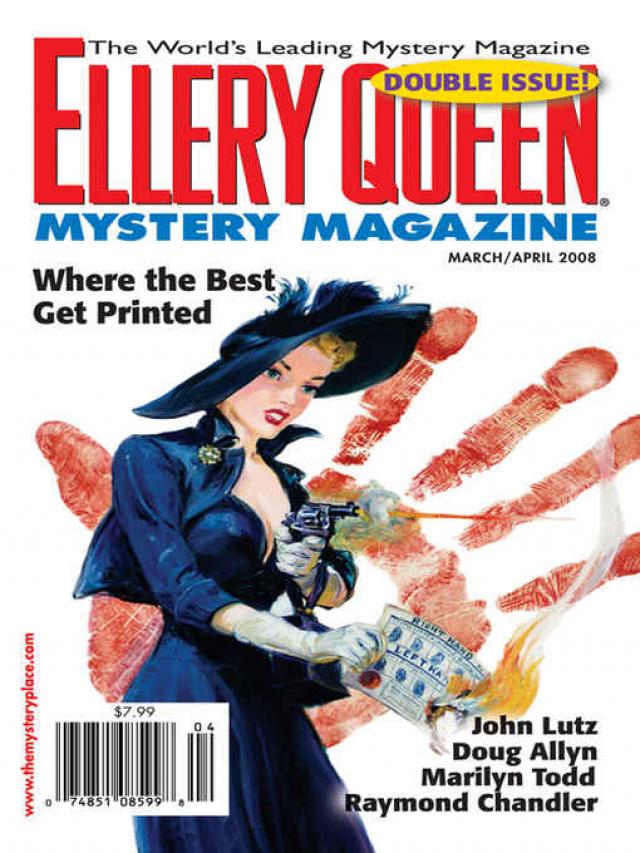
Eqmm march april 2008, p.7
EQMM, March-April 2008,
p.7


Donner put down his file and smiled. Dalmas shrugged and glanced at the Filipino, who was standing by the wall, at the end of the divan.
Dalmas said: “I don't have your organization, Donner, but I get around, I think that's a smooth story and it would have got by—with a little cooperation downtown. But it won't fit the facts as they are now."
Donner raised his eyebrows. Sutro began to swing the tip of his polished shoe up and down in front of his knee.
Dalmas said: “How does Mister Sutro fit into all this?"
Sutro stared, at him and stopped rocking. He made a swift, impatient movement. Donner smiled. “He's a friend of Walden's. Walden talked to him a little and Sutro knows Ricchio worked for me. But being a councilman, he didn't want to tell Walden everything he knew."
Dalmas said grimly: “I'll tell you what's wrong with your story, Donner. There's not enough fear in it. Walden was scared to help me even when I was working for him ... And this afternoon somebody was so scared of him that he got shot."
Donner leaned forward and his eyes got small and tight. His hands balled into fists on the desk before him.
"Walden is—dead?” he almost whispered.
Dalmas nodded. “Shot in the right temple ... with a thirty-two. It looks like suicide. It isn't."
Sutro put his hand up quickly and covered his face. The sandy-haired man got rigid on his stool in the corner.
Dalmas said: “Want to hear a good honest guess, Donner? ... We'll call it a guess ... Walden was in the dope-smuggling racket himself—and not all by his lonesome. But after Repeal he wanted to quit. The coast guards wouldn't have to spend so much time watching liquor ships, and dope-smuggling up the coast wasn't going to be gravy anymore. And Walden got sweet on a gal that had good eyes and could add up to ten. So he wanted to walk out on the dope racket."
Donner moistened his lips and said: “What dope racket?"
Dalmas eyed him, “You wouldn't know about anything like that, would you, Donner? Hell, no, that's something for the bad boys to play with. And the bad boys didn't like the idea of Walden quitting that way. He was drinking too much—and he might start to broadcast to his girlfriend. They wanted him to quit the way he did—on the receiving end of a gun."
Donner turned his head slowly and stared at the bound man on the high-backed chair. He said very softly: “Ricchio."
Then he got up and walked around his desk. Sutro took his hand down from his face and watched with his lips shaking.
Donner stood in front of Ricchio. He put his hand out against Ricchio's head and jarred it back against the chair. Ricchio moaned. Donner smiled down at him.
"I must be slowing up. You killed Walden, you bastard! You went back and croaked him. You forgot to tell us about that part, baby."
Ricchio opened his mouth and spit a stream of blood against Donner's hand and wrist. Donner's face twitched and he stepped back and away, holding the hand straight out in front of him. He took out a handkerchief and wiped it off carefully, dropped the handkerchief on the floor.
"Lend me your gun, Noddy,” he said quietly, going towards the sandy-haired man.
Sutro jerked and his mouth fell open. His eyes looked sick. The tall Filipino flicked his empty automatic into his hand as if he had forgotten it was empty. Noddy took a blunt revolver from under his right arm, held it out to Donner.
Donner took it from him and went back to Ricchio. He raised the gun.
Dalmas said: “Ricchio didn't kill Walden."
The Filipino took a quick step forward and slashed at him with his big automatic. The gun hit Dalmas on the point of the shoulder, and a wave of pain billowed down his arm. He rolled away and snapped his Colt into his hand. The Filipino swung at him again, missed.
Dalmas slid to his feet, side-stepped, and laid the barrel of the Colt along the side of the Filipino's head, with all his strength. The Filipino grunted, sat down on the floor, and the whites showed all around his eyes. He fell over slowly, clawing at the divan.
There was no expression on Donner's face and he held his blunt revolver perfectly still. His long upper lip was beaded with sweat.
Dalmas said: “Ricchio didn't kill Walden. Walden was killed with a filed gun and the gun was planted in his hand. Ricchio wouldn't go within a block of a filed gun."
Sutro's face was ghastly. The sandy-haired man had got down off his stool and stood with his right hand swinging at his side.
"Tell me more,” Donner said evenly.
"The filed gun traces to a broad named Helen Dalton or Burwand,” Dalmas said. “It was her gun. She told me that she hocked it long ago. I didn't believe her. She's a good friend of Sutro's and Sutro was so bothered by my going to see her that he pulled a gat on me himself. Why do you suppose Sutro was bothered, Donner, and how do you suppose he knew I was likely to go see the broad?"
Donner said: “Go ahead and tell me.” He looked at Sutro very quietly.
Dalmas took a step closer to Donner and held his Colt down at his side, not threateningly.
"I'll tell you how and why. I've been tailed ever since I started to work for Walden—tailed by a clumsy ox of a studio dick I could spot a mile off. He was bought, Donner. The guy that killed Walden bought him. He figured the studio dick had a chance to get next to me, and I let him do just that—to give him rope and spot his game. His boss was Sutro. Sutro killed Walden—with his own hand. It was that kind of a job. An amateur job—a smart-aleck kill. The thing that made it smart was the thing that gave it away—the suicide plant, with a filed gun that the killer thought couldn't be traced because he didn't know most guns have numbers inside."
Donner swung the blunt revolver until it pointed midway between the sandy-haired man and Sutro. He didn't say anything. His eyes were thoughtful and interested.
Dalmas shifted his weight a little, onto the balls of his feet. The Filipino on the floor put a hand along the divan and his nails scratched on the leather.
"There's more of it, Donner, but what the hell! Sutro was Walden's pal and he could get close to him, close enough to stick a gun to his head and let go. A shot wouldn't be heard on the penthouse floor of the Kilmarnock, one little shot from a thirty-two. So Sutro put the gun in Walden's hand and went on his way. But he forgot that Walden was left-handed and he didn't know the gun could be traced. When it was—and his bought man wised him up—and I tapped the girl—he hired himself a chopper squad and angled all three of us out to a house in Palms to button our mouths for good ... Only the chopper squad, like everything else in this play, didn't do its stuff so good."
Donner nodded slowly. He looked at a spot in the middle of Sutro's stomach and lined his gun on it.
"Tell us about it, Johnny,” he said softly. “Tell us how you got clever in your old age—"
The sandy-haired man moved suddenly. He dodged down behind the desk and as he went down his right hand swept for his other gun. It roared from behind the desk. The bullet came through the kneehole and pinged into the wall with a sound of striking metal behind the paneling.
Dalmas jerked his Colt and fired twice into the desk. A few splinters flew. The sandy-haired man yelled behind the desk and came up fast with his gun flaming in his hand. Donner staggered. His gun spoke twice, very quickly. The sandy-haired man yelled again, and blood jumped straight out from one of his cheeks. He went down behind the desk and stayed quiet.
Donner backed until he touched the wall. Sutro stood up and put his hands in front of his stomach and tried to scream.
Donner said: “Okay, Johnny. Your turn."
Then Donner coughed suddenly and slid down the wall with a dry rustle of cloth. He bent forward and dropped his gun and put his hands on the floor and went on coughing. His face got gray.
Sutro stood rigid, his hands in front of his stomach and bent back at the wrists, the fingers curved clawlike. There was no light behind his eyes. They were dead eyes. After a moment his knees buckled and he fell down on the floor on his back.
Donner went on coughing quietly. Dalmas crossed swiftly to the door of the room, listened at it, opened it, and looked out. He shut it again quickly.
"Soundproof—and how!” he muttered. He went back to the desk and lifted the telephone off its prongs. He put his Colt down and dialed, waited, said into the phone: “Captain Cathcart ... Got to talk to him ... Sure, it's important ... very important."
He waited, drumming on the desk, staring hard-eyed around the room. He jerked a little as a sleepy voice came over the wire.
"Dalmas, Chief. I'm at the Casa Mariposa, in Gayn Donner's private office. There's been a little trouble, but nobody hurt bad ... I've got Derek Walden's killer for you.... Johnny Sutro did it.... Yeah, the councilman.... Make it fast, Chief ... I wouldn't want to get in a fight with the help, you know...."
He hung up and picked his Colt off the top of the desk, held it on the flat of his hand and stared across at Sutro.
"Get off the floor, Johnny,” he said wearily. “Get up and tell a poor, dumb dick how to cover this one up—smart guy!"
* * * *
10.
The light above the big oak table at Headquarters was too bright. Dalmas ran a finger along the wood, looked at it, wiped it off on his sleeve. He cupped his chin in his lean hands and stared at the wall above the roll-top desk that was beyond the table. He was alone in the room.
The loudspeaker on the wall droned: “Calling Car 71W in 72's district ... at Third and Berendo ... at the drugstore ... meet a man..."
The door opened and Captain Cathcart came in, shut the door carefully behind him. He was a big, battered man with a wide, moist face, a strained moustache, gnarled hands.
He sat down between the oak table and the roll-top desk and fingered a cold pipe that lay in the ashtray.
Dalmas raised his head from between his hands. Cathcart said: “Sutro's dead."
Dalmas stared, said nothing.
"His wife did it. He wanted to stop by his house a minute. The boys watched him good but they didn't watch her. She slipped him the dose before they could move."
Cathcart opened and shut his mouth twice. He had strong, dirty teeth.
"She never said a damn word. Brought a little gun around from behind her and fed him three slugs. One, two, three. Win, place, show. Just like that. Then she turned the gun around in her hand as nice as you could think of and handed it to the boys ... What in hell she do that for?"
Dalmas said: “Get a confession?"
Cathcart stared at him and put the cold pipe in his mouth. He sucked on it noisily. “From him? Yeah—not on paper, though ... What you suppose she done that for?"
"She knew about the blonde,” Dalmas said. “She thought it was her last chance. Maybe she knew about his rackets."
The captain nodded slowly. “Sure,” he said. “That's it. She figured it was her last chance. And why shouldn't she bop the bastard? If the D.A.'s smart, he'll let her take a manslaughter plea. That'd be about fifteen months at Tehachapi. A rest cure."
Dalmas moved in his chair. He frowned.
Cathcart went on: “It's a break for all of us. No dirt your way, no dirt on the administration. If she hadn't done it, it would have been a kick in the pants all around. She ought to get a pension."
"She ought to get a contract from Eclipse Films,” Dalmas said. “When I got to Sutro I figured I was licked on the publicity angle. I might have gunned Sutro myself—if he hadn't been so yellow—and if he hadn't been a councilman."
"Nix on that, baby. Leave that stuff to the law,” Cathcart growled. “Here's how it looks. I don't figure we can get Walden on the book as a suicide. The filed gun is against it and we got to wait for the autopsy and the gun-shark's report. And a paraffin test of the hand ought to show he didn't fire the gun at all. On the other hand, the case is closed on Sutro and what has to come out ought not to hurt too bad. Am I right?"
Dalmas took out a cigarette and rolled it between his fingers. He lit it slowly and waved the match until it went out.
"Walden was no lily,” he said. “It's the dope angle that would raise hell—but that's cold. I guess we're jake, except for a few loose ends."
"Hell with the loose ends,” Cathcart grinned. “Nobody's getting away with any fix that I can see. That sidekick of yours, Denny, will fade in a hurry and if I ever get my paws on the Dalton frail, I'll send her to Mendocino for the cure. We might get something on Donner—after the hospital gets through with him. We've got to put the rap on those hoods, for the stick-up and the taxi driver, whichever of ‘em did that, but they won't talk. They still got a future to think about, and the taxi driver ain't so bad hurt. That leaves the chopper squad.” Cathcart yawned. “Those boys must be from Frisco. We don't run to choppers around here much."
Dalmas sagged in his chair. “You wouldn't have a drink, would you, Chief?” he said dully.
Cathcart stared at him. “There's just one thing,” he said grimly. “I want you to stay told about that. It was okay for you to break that gun—if you didn't spoil the prints. And I guess it was okay for you not to tell me, seein’ the jam you were in. But I'll be damned if it's okay for you to beat our time by chiselin’ on our own records."
Dalmas smiled thoughtfully at him. “You're right all the way, Chief,” he said humbly. “It was the job—and that's all a guy can say."
Cathcart rubbed his cheeks vigorously. His frown went away and he grinned. Then he bent over and pulled out a drawer and brought up a quart bottle of rye. He put it on the desk and pressed a buzzer. A very large uniformed torso came part way into the room.
"Hey, Tiny!” Cathcart boomed. “Loan me that corkscrew you swiped out of my desk.” The torso disappeared and came back.
"What'll we drink to?” the captain asked a couple of minutes later.
Dalmas said: “Let's just drink."
(c)1934 Raymond Chandler, Ltd., A Chorion Company, all rights reserved.
[Back to Table of Contents]
Reviews: THE JURY BOX by Jon L. Breen
In his great 1970 debut, A Clubbable Woman, recently reprinted with a new in-troduction (Felony & Mayhem, $14.95), Reginald Hill introduced the Mid-Yorkshire police team of Andy Dalziel (crude old-school boss) and Peter Pascoe (posh university-educated newcomer). Over the decades since, the series has proved one of the most durable, varied, and consistently outstanding in the procedural genre. The British title of the latest volume, The Death of Dalziel, was subtly changed for its American edition. Only reading the book will tell you which title is more appropriate.
**** Reginald Hill: Death Comes for the Fat Man, HarperCollins, $24.95. Dalziel is gravely injured in an explosion engineered by an antiterrorist vigilante group which may have a mole in the Central Antiterrorism Unit. Pascoe, investigating on his own, to the dismay of the spooks, finds himself taking on the abrasive personality traits of his stricken mentor. The literate prose (keep a dictionary handy), keen character insights, and devious plotting, plus the suspense over the fate of Fat Andy, mark this an excellent addition to the saga.
*** Michael Connelly: The Overlook, Little, Brown, $21.99. The reductive turf wars between local police and national anti-terrorism units get an American treatment in Los Angeles cop Harry Bosch's latest case, an expanded version of a New York TimesMagazine serial with an admirably clued puzzle plot.
*** Jennifer Lee Carrell: Interred With Their Bones, Dutton, $25.95. Kate Stanley is directing a production of Hamlet at London's new Old Globe when a theatre fire and the death of her academic mentor send her on a perilous scholarly treasure hunt with multiple stops in the U.S.A., Britain, and Spain. Elements include a lost Shakespeare play, murders in-spired by events in the Bard's works, and much pondering of who really wrote those plays. This Edgar-worthy first novel follows the formula of Dan Brown's The DaVinci Code, but is infinitely better written. A thorough and quite necessary concluding author's note separates fact from the fiction.
*** Richard Bachman: Blaze, foreword by Stephen King, Scribner, $25. King revives his Bachman pseudonym for one (last?) encore in a tragicomic crook story, written in the 1970s in acknowledged homage to Steinbeck's Of Mice and Menand published only now in revised form. Mentally impaired giant Blaze attempts to carry out the kidnapping for ransom of a baby, helped by the ghost (or the memory) of his deceased mentor and protector George. Another proof of King's incomparable storytelling gift, the novel is accompanied by an equally powerful short story, “Memory."
*** W. R. Burnett: Dr. Socrates, O'Bryan House, $14.95. In a small Midwestern town, a troubled young doctor reluctantly becomes physician of choice for a gang of robbers headed by Red Bastian, a character inspired by John Dillinger. This expertly written and suspenseful Depression-era short novel by the author of Little Caesar appeared as a Collier's magazine serial in 1935 and was filmed the same year, but has never before been published in book form.
*** Jeffrey Miller: Murder on the Rebound, ECW, $19.95 Canada, $16.95 U.S. When a controversial law professor is accused of the poisoning murder of his re-search assistant, Ontario Court of AppealJustice Ted Mariner defends, first in an unlikely but highly entertaining preliminary hearing in the Toronto law school's moot court room, then in a full-scale trial on revised charges. Neither the rather goofy plot nor the cat narrator, known as Amicus Curiae, whose graceful comic style owes an acknowledged debt to Rumpole of the Bailey, should discourage courtroom buffs from this third in a law-steeped series.
** John Mortimer: Rumpole Misbehaves, Viking, $23.95. The Old Bailey's immortal junior barrister defends a Timson youth charged with violating an Anti-Social Behavior Order, his crime chasing his football into the wrong street, and a client accused of murder who is very anxious to be defended by a QC (in polite language, Queen's Counsel; in Rumpole-speak, Queer Customer). Like other recent short novels in this series, mild fun for regular readers, but newcomers should seek out the early story collections (or TV shows) first.
** Dave Zeltserman: Bad Thoughts, Five Star, $25.95. Once a year, on the anniversary of his mother's brutal murder, Cambridge, Massachusetts cop Bill Shannon suffers nightmares and mysterious week-long blackouts. The reader is gripped immediately and held to the end, though the main surprise, revealed a little past the halfway point, both slows the impetus and challenges credibility. Violence and torture are over the top for some tastes, and the central premise may be too much to swallow, but solid prose, dialogue, and construction mark a writer worth watching.