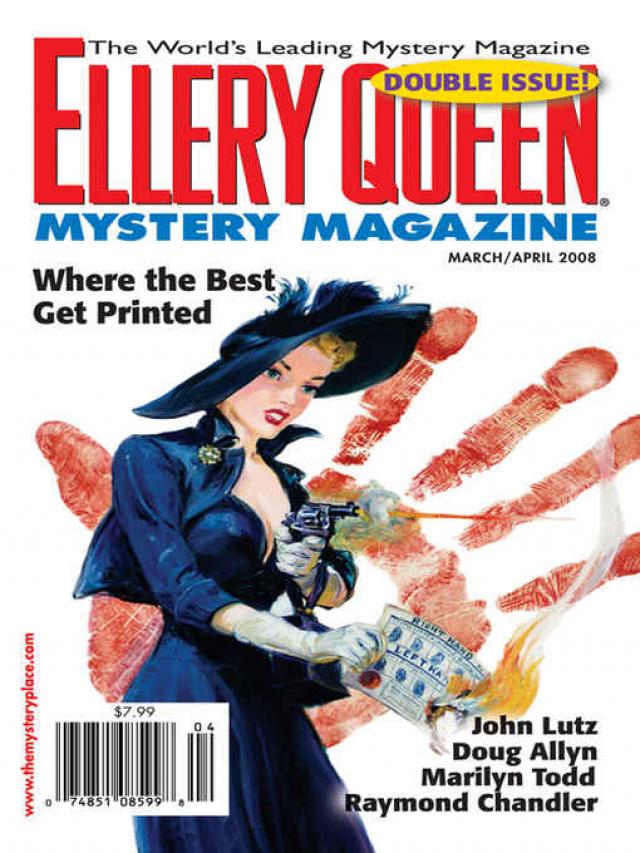
Eqmm march april 2008, p.24
EQMM, March-April 2008,
p.24


Aileen was set to stay out until a little after ten, by which time I would be seventy or so miles down the M6, so the time of death would be fixed at between nine and ten, when I had actually finished the psycho off at twenty minutes before nine. I challenge the very best pathologist in the whole wide world to pinpoint a time of death down to twenty minutes, but just to be on the safe side I'd made sure the room was warm—to slow down the rate of body cooling. Now I switched the central heating off and opened the windows.
The one thing I had absolutely no worries about was Aileen's ability to act the part of first-on-the-scene after her husband's terrible murder.
I had also got a pay-as-you-go mobile phone, because it would be nice to know how things were going for my “widow.” After I'd roughed the room up a bit I splashed a bit of petrol around just for good measure, set a match to it, and walked out of my house forever. Aileen and I would meet up when she'd sorted out the sale of the house, widow's pension, insurances. See how important it is to marry a competent woman? I'd planned to move to Bolivia.
But I was forgetting a few things. Smoke rises. Fires go out. Smoke alarms go off.
* * * *
I got the story from Aileen.
Mrs. Nosey Barnes from next-door heard the smoke alarm, got her husband to peer over the wall, and he saw the smoke and the broken glass well before time. He rang the emergency services, the police, the fire engine, and the ambulance.
An ambulance?
They dragged the body out. Only it wasn't a body. Interfering paramedics felt for a bloody carotid pulse. And know what? They found one. My murder wasn't. So they put an oxygen mask over his/"my” face and with the blue light flashing screamed their way to the hospital while the fire engine dealt with the fire.
Get it so far?
And the police were tracking down my wife to tell her someone's tried to kill her husband and burn the house down.
Same story but different backdrop.
She was supposed to be the one to find the terrible carnage. Not them. And she wasn't meant to learn about it in the Jaipur over poppadoms and chicken jalfrezi. It was, admittedly, a help that she was with Caron, who couldn't have reacted better, putting her hand over her mouth and saying, “They've got him, too.” Which was right on cue.
The kindly police took Aileen to the hospital to see her “husband.” And the psycho opened his eyes, smiled, and said, “Hello, Mrs. Arnold. I've got a bit of a headache."
At which point even my wife broke down and started screaming.
* * * *
Sometimes my colleagues can be smarter than you'd ever give them credit for. Porky bloody Flambard was the sausage-eating sergeant who'd been elected to drive my almost-widow to the hospital. He put his fat little arm around my beloved, sat her down in the chair, and said, “It isn't him, is it?"
I think by then Aileen was fast approaching a gibbering wreck.
But Porky's got a soft, greasy little voice and he persisted.
"So if it isn't ‘im, then who is it? And where is your Steve?"
When she didn't answer, he put his podgy face right by hers. “Now then, darlin',” he said. “You don't want to spend the rest of your days in a nasty, cold, dirty old prison, do you? Charged with being a) an accessory to attempted murder and b) withholding information pertaining to the theft of drugs and cash from a crime scene by a serving police officer? So let's start with the first question, shall we? Who is the geezer in the bed and how did he come to have such nasty head injuries?"
By now she was shaking all over and couldn't have spoken if she'd wanted to.
"Mind if I take a look?” he'd said and reached inside her handbag, pulled out her mobile phone, scrolled through to “Steve,” and pressed the green button.
"Hello, Steve,” he said when I answered. “Just thought I'd let you know. Your bloke isn't dead but currently sitting up in a hospital bed, a dirty great big bandage wrapped around his head, eating a marmalade sandwich. You couldn't even manage a murder, could you? Now then. Why don't you tell us where exactly you are and we'll bring you home."
All in all I only have one real regret. It's my tiger. My lovely pottery tiger. Broken forever. But I reckon I'm probably safer here, in an English jail, than out there, patrolling the streets, waiting for Juan or Pedro or Sanchez to try a bit of knife practice on my back.
Agree?
(c)2008 by Priscilla Masters
[Back to Table of Contents]
Fiction: EXPOSURE by Tim L. Williams
Memphis private eye Charlie Raines, a recurring character in a number of Tim L. Williams's short stories, including a previous tale published by EQMM, is back this month in another morally ambiguous outing. His creator is a college professor whose work has appeared in numerous literary quarterlies, as well as in crime magazines such as Plots With Guns, Murdaland, and Red Scream.
Despite my better judgment and the nagging pain in the pit of my stomach that I called indigestion but knew for a fact was guilt, I went to visit Mark McAllister in the Memphis city jail. I didn't want to be there. Early spring in Memphis is the best time of year, maybe the only good one when you consider the smoke-gray chill of winter, the rain and mud of fall, and the smothering heat of summer. As I passed through metal detectors, signed forms promising not to sue if I were unlucky enough to be killed by one of the inmates, and nodded hello to a sprinkling of deputy jailers who remembered me from my days as a Memphis homicide detective, I told myself that if I'd had the good sense to ignore McAllister's call, I would have spent the afternoon fishing on the Mississippi or taking a long walk through Riverside Park. Those were lies, of course. If I'd hung up on McAllister, I would have been at the Refugee's Lounge in Whitehaven, drinking draft beer, getting my elbows grimy on the sticky bar, and betting on the wrong teams in the first round of the NCAA tournament.
A three-hundred-pound deputy jailer with horn-rimmed glasses, acne scars, and hair the color of pipe rust grunted instructions. By the time he finished, he was wheezing, and his face had turned the color of his hair. I remembered him. Gil Brewer. A diabetic and closet alcoholic with a three-pack-a-day Marlboro habit. If it hadn't been for the fact that he was cruel and stupid, I might have felt sorry for him.
"Some deal, huh, Charlie,” he said as he unlocked a green metal door. “Kid spends a lifetime looking for his old man just so he can pop him.” His gray eyes twinkled merrily. “Hey, that's pretty frigging good. Pop his pop.” He wheezed laughter, coughed, and spat on the floor. “I hope you collected your fee up front."
Brewer led me down a walkway lined with cells to a small holding room in the back. In every prison movie I'd ever seen, inmates greeted a new arrival by catcalling, hurling insults, and hanging on the bars of their cells, but as a cop and then as a private investigator I'd visited a few dozen jails and half as many prisons, and that had never happened. Ninety percent of the inmates barely registered anyone's presence. The few who did watched quietly from their cells, their eyes either trapped and hopeless or cold and appraising. The only sounds that followed Brewer and me were a few coughs, a sneeze, Brewer's wheeze, and the echo of our footsteps on the stained concrete floor.
Inside the holding room, Mark McAllister sat at a scarred picnic table that had been bolted to the floor. He wore handcuffs, shackles, and a standard-issue orange jumpsuit. When he looked up, I noticed a half-dozen cuts and scratches on his face and an ugly bruise just below his cheekbone. He looked smaller than he had in my office, younger, defeated, terrified. He should have been. He was charged with first-degree murder in the death of his biological father, the man I'd helped him find.
"I appreciate your coming, Mr. Raines,” he said, his voice as shaky as his smile. “I wasn't sure you would."
I sat across from him at the table. “I'm not sure why I did."
Brewer snorted, dropped his bulk into a chair in the rear corner, passed gas, and scrubbed at a mustard stain on his chin. Then he reached for a National Enquirer and rattled the pages.
McAllister ignored him. “I know what they say, but I didn't do nothing like that. I couldn't do nothing like that, Mr. Raines, not to anybody, but especially not to my own father."
Pure Missouri hills and as twangy as an out-of-tune banjo, his accent grated on my nerves and brought another sharp pain to the center of my gut. I'd hit middle age and had the paunch, the crow's feet, and the receding hairline to prove it. I wasn't happy to have been duped by a nineteen-year-old punk from Carlsbad, Missouri.
"Mr. Raines, you got to help me here...."
"You can drop the mister. Anybody who hires me under false pretenses and makes me complicit in a murder has earned the right to call me Charlie."
He lowered his head, touched one of the cuts on his cheek. “I lied to you. I'm not saying I didn't, but I figured if I told you everything, you wouldn't take the job. But lying and killing are completely different things."
When McAllister had shown up in my office to hire me to find a father that he hadn't seen in seventeen years, he'd fed me a line. His mother had recently passed away. He was a welder at a factory in Missouri, took classes at a community college at night, and was just a month away from marrying his high-school sweetheart. Since he was an only child and had only a sprinkling of relatives, he'd decided to find the father who had deserted his family and fled to Memphis. The thought of the bride's side of the church being packed with family while his side was completely empty made him sick to his stomach. I'd bought it all, even cut him a discount when he said he was using part of his mother's life-insurance policy to pay me. Maybe it was because he seemed naive or maybe because my own father had left when I was ten and McAllister's story touched a nerve.
The morning after I gave Mark his father's address, Don McAllister was found dead, and I found out that most of what my client had said was fantasy. He wasn't a welder or a community-college student or engaged to his childhood sweetheart. He was on parole for assault and battery, had spent half of his teenage years in reform school, and made his living by dealing drugs in his hometown.
"You're wasting my time,” I said, angry all over again. “You lied to me, made me look like a fool at best and an accomplice in a murder at the worst. The only thing that's keeping me from whipping your ass is that I don't relish the idea of spending a week in lockup."
He breathed deep, winced as if he'd taken in a lungful of needles. “I didn't kill him, Mr.—Charlie.” He licked his lips. “I got drunk before I went to see him. Real drunk. I told myself I was just going to have one or two to calm my nerves, suck up my courage, you know? But two didn't work so I kept drinking. Then I showed up at his house. When he opened the door, it took him a little while to realize who I was, and then he called me son.” McAllister closed his eyes. “He had no right to call me that. Not as soon as he saw me, not after what he did to me and my momma."
"Listen...” I said.
"It made me want to cry,” McAllister said, his voice breaking. “And then it made me mad. I hauled off and hit him in the mouth.” He held up a scabbed and dirt-streaked right hand to show me the teeth marks. “Then I ran back to my car bawling like a baby. I remember pulling off the side of the road to throw up and stopping at a liquor store for another bottle. I guess I blacked out, because I don't remember anything else until I woke up in my hotel room covered in puke and stinking like an outhouse."
"Call a lawyer."
"I didn't kill him,” he said again. “Jesus, I just wanted to know him and know why he ditched us. That's all I wanted. Now, I reckon, I'll never know."
I felt a tremor of sympathy and warned myself not to be a sap for a second time. Still, the tremor didn't stop. What if the kid was telling the truth? What if it was just his bad fortune to find his old man on the night that somebody decided to shoot him? And hell, even if he had killed his father, who was I to judge? There'd been plenty of times I'd wanted to shoot my old man since he'd blundered back into my life.
"I know a good attorney, okay? I'll contact him, have him come see you,” I said, cursing my own stupidity as I spoke the words. “That's the best I can do."
The kid beamed. Brewer lowered his National Enquirer, gave me a look that said I was the world's biggest sucker. But that was all right. He wasn't telling me anything I didn't already know.
* * * *
Later that afternoon I walked into the Alligator, a Union Avenue dive with pretensions of being a sports bar, and found my former homicide partner hunched over a mug of draft beer at a small table near a pinball machine. The day shift had just given way to the night at the Midtown precinct. Young patrol officers with crew cuts, swollen biceps, spotless uniforms, and freshly shined shoes shot pool, flirted with dyed-blond waitresses, ordered pitchers of draft beer, and gunned shots of tequila with the good-time abandon of college frat boys. Older plainclothes cops from Robbery—Homicide and Vice sat in smaller groups, their cheap suits rumpled and smeared with ash or damp with spilled beer. They were quieter than their younger colleagues, and both their eyes and their rare smiles seemed hard and weary. Nate Randolph, who'd recently been promoted to lieutenant, sat by himself, his dark brown forehead beaded with sweat, his eyes bloodshot, his posture that of a hungry bear protecting a fresh kill from scavengers.
I crossed the room, elbowing my way through the crowd, ignoring the stares. For most of the cops in the Alligator, their hostility wasn't personal. I was just an outsider who'd blundered into their world. But there were a few who remembered me, and their expressions were a mixture of contempt, pity, and barely restrained anger. In a lot of ways, quitting the police force is like leaving a cult. Your walking away isn't just a personal decision, it's a repudiation of everything your former brothers are willing to die for.
I took a chair at Nate's table without waiting for an invitation. “Let me buy you a drink."
"Leave a five-dollar bill and I'll send you a thank-you note tomorrow."
"It's good to see you've developed a sense of humor. It isn't much of one, but at least it's a start."
He tried glaring and then glowering, finally gave up and settled for looking morose. I flagged a waitress, ordered a round of beers, asked how his wife was doing. Mistake. They'd divorced a year and a half ago. I apologized; he grunted.
"What do you want, Raines?” he asked after he downed a quarter of his beer in a single swallow. “Spit it out and then get out of here."
"You're grumpier than usual."
He shrugged his massive shoulders. “I've pulled two double shifts in the last three days. The one damn chance I get to have a drink in peace, you show up like a mangy dog begging for scraps."
"Mark McAllister."
He raised his head a little, smiled. “The kid who killed his long-lost father. You got egg on your face on that one."
"What do you know about his case?"
He belched, winced, washed down his indigestion with another drink of beer. “You lose your ability to read people or are you so hard up for cash you don't bother to check out your clients anymore?"
"I bought his line."
He emptied his mug, slapped it hard on the table, and raised his eyebrow. I took the hint, waved at the waitress, and held up two fingers for another round.
"Your boy went to his father's house, punched him around a little, stormed off. Sometime later, he came back with a .22 automatic, shot dear old dad four times at close range, and took off again. Neighbor heard the original commotion, got your boy's license-plate number, phoned it in. Next morning he was found in a whore's motel off the I-40 loop, still half drunk, beat up, with blood and puke on his clothes. When officers searched his Firebird, they found a half-dozen .22 shells scattered in the floorboard under empty beer cans and cigarette packs. End of story."
"I read the police report."
He accepted another beer from the waitress and brought it to his lips without letting it touch the table. “Then why bother me?” He stifled a belch. “What do you care?"
"I'm curious by nature."
"You want the God's honest truth? I don't give a damn about your curiosity or McAllister or his old man. Last week and a half, four of Little Vinnie Montesi's bagmen have been robbed and killed, one of them at three in the afternoon in a public park."
I mumbled a wow because that was all that I could think to say. Little Vinnie Montesi ran the mob in Memphis. He'd replaced his uncle, Fat Tony, a couple of years ago. Fat Tony had been tough, ruthless, as dangerous as a Bengal tiger when someone infringed on his territory, but essentially a rational and loyal man. I'd had an occasion to work with him once and owed him my life. But he and his nephew had little in common other than their last names. A coke-head with the facial tick and the megalomania that plagued long-time addicts, Little Vinnie was known for being smart, high-strung, and relentlessly vicious.
"Last thing we need in this town is a gang war with a bunch of Elvis-loving tourists caught in the middle. That happens, the chamber of commerce, the mayor, and the police chief are going to be as unpleasant as wasps on crank."
"Wasps use speed?"
He glared at me. “A figure of speech. What I'm saying is, I got my own problems to worry about. You want to know anything about your boy, ask the guys working his case."
He turned his chair, bellowed for Elswick and Johnson to join us. They were a little younger than Nate and I, but I remembered Elswick as a rookie uniform. He was tall, blond, broad-shouldered, and sunburned. His partner, Johnson, was a whip-thin black man with a thick moustache and razor bumps on his jaws.
"You guys know Charlie Raines?"
Johnson stroked his moustache like a guy who hadn't had it long. “By reputation."
"We know one of your clients.” Elswick smirked, took a sip from a glass of what looked like bourbon and water. “We had a few questions for you."
"Ask away."
"No need now,” Johnson said. “We figured out the answers."
"And?"
"We've got his prints, a witness who put him at the scene, blood on his clothes, shells in his car, a motive for murder. We also got him on record as telling one of his buddies up in Missouri that he was going to find his father in Memphis and might have to stick around long enough to help put him in the ground."