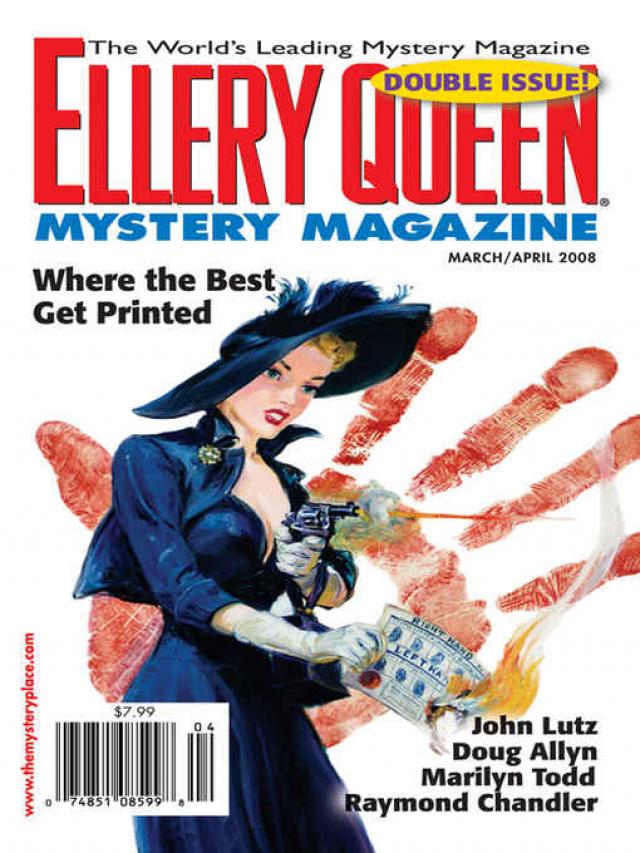
Eqmm march april 2008, p.26
EQMM, March-April 2008,
p.26


"What did you say to Mark McAllister when you went to see him,” he said instead of hello. “The kid hung himself in his cell. You know how that looks? It looks like a confession."
"McAllister's dead?"
"He might as well be. He's at Baptist Memorial, ICU, and if the little jerk survives, a jury's going to hang him.” He coughed into the phone and then the coughs gave way to curses. “So far the only thing he's been able to say is ‘I want Charlie Raines.’ Go down there if you have to, but for God's sake, try hard not to make things worse than they are."
After he hung up, I called a cab. But I didn't go home.
* * * *
Gil Brewer, rumpled, red-eyed, and coffee-stained, and a young patrol officer stood guard outside the ICU door. The patrol officer's presence wasn't a surprise, but Brewer's was, and I didn't like it.
"New jail policy,” Brewer said, scratching a red smear on his chin that might have come from a jelly doughnut. “One of ours leaves the jail, one of us has to go with him."
"I thought you worked the day shift."
"Rodriguez called in sick, menstrual cramps or some such nonsense, so I had to pull a double shift.” He hooked his head toward the ICU. “Then this asshole decides to hang himself on my watch, so guess who gets to stand on his feet all night?"
"Tough world,” I said, stepping past him.
He followed me into the ICU ward and parked himself beside Mark McAllister's door. The kid looked as small as a ventriloquist's dummy in the hospital bed. A half-dozen tubes and wires were connected to his nose, his mouth, and his arms, but he was awake.
"Charlie,” he said, his voice a ragged hiss coming from his damaged vocal cords. “Didn't do it. Not my old man.” He hissed and coughed, and the machines beeped crazily. Still, he managed to lift a hand and touch his swollen throat. “Not this, either."
"Okay,” I said.
"Not this."
"Take it easy."
I didn't have to tell him twice. He shut his eyes and went to sleep.
* * * *
The next morning I woke on my living-room floor, hung over, stiff, stinking like a skid-row bum. By the time I'd left the hospital, taken a cab back to the Refugee for my car, and driven home, I was sober, a condition I'd remedied by finishing the last eight beers in my refrigerator and then breaking into a bottle of Ten High bourbon. I'd sat at my kitchen table, drinking, chain-smoking Kools, my brain chasing itself in circles. Something about the day had stuck and was grating at my consciousness but I couldn't quite grasp it. Like most people who drink too much, I told myself that booze helped clarify my thinking, but I'd worked so hard at achieving clarity that I'd passed out.
Now, I smoked my first cigarette of the day while I waited for coffee to brew. When it did, I took a cautious sip, gagged, sipped again. I closed my eyes, letting everything run through my brain—the missing camera equipment, Blake Roberts's passionate defense of his friend, the photographs I'd seen in Don McAllister's portfolio, Mark McAllister's insistence that he hadn't tried to commit suicide. Then I squeezed my eyes tighter. It was the last photograph in Don McAllister's portfolio that was still bothering me. Kids on the playground. A family having a picnic. The towheaded boy, a figure of longing and desperation. But it was the faces in the background that came back to me. They were unimportant to Don McAllister. His focus and the composition made that clear. They were just faces, men and women in the park, irrelevant to him in his obsession. He was a good photographer, and his picture demanded that you follow his eye, his focus. Now, I shut my eyes, tried to pry my mind free of what McAllister had wanted the picture to capture. I focused on the background, saw a heavyset black woman in a bright orange blouse, an elderly man walking a terrier, a man staring at the camera with a look that was either fear or surprise. I opened my eyes. I hadn't recognized the figures in the background because I'd been too quick to latch on to the subject matter. The belief that McAllister was a pedophile had blotted everything else out. I made a phone call to an old friend who worked as a fact checker for the Commercial Appeal and when I hung up, I knew I'd made a mistake.
* * * *
Blake Roberts had stopped crying, but it looked as if he might start again. He was sitting behind his desk with a USA Today open in front of him. His glasses had slipped down his nose, and his eyes were bloodshot and watery.
"You're not welcome here,” he said, his voice raw but his words precise. “I made that clear yesterday."
I held up a hand to stop him. “I've come to apologize,” I said, which was at least partially true. “I jumped to a conclusion I shouldn't have."
He wasn't a man accustomed to being angry and didn't seem very good at it. Still, he tried to hold on to his hostility for a little while before he gave up and slumped back against his chair.
"I can see why you thought what you did, Mr. Raines. But I can guarantee you that it was wrong."
"You cared a lot about him."
His expression grew wary. “We were friends."
"You were lovers."
He lowered his eyes. “I'm married. I have children."
"And you were in love with Don McAllister."
"No.” He sagged a little further into the chair and then waved his hand dismissively. “He was a good man, courageous.” He took a gulp of air. “More courageous than I could ever be. He loved his family, loved his son, but he left them because he couldn't live as someone else. I've never lived anything but a lie. You want to know how much of a coward I am?"
"It's not necessary."
He wasn't listening. “I didn't even go to his funeral. I loved the man for ten years, and I was afraid to attend his funeral because my wife might suspect that there was something between us.” He wiped his mouth on the back of his hands. “He was dying. Did you know that?"
"He wrote his son."
"Don missed his family like a part of him that had been amputated. That's why he took the pictures. He was trying to capture what he'd lost when he left his son.” He lifted his glasses, rubbed at his eyes. “Don was an artist, and if the world had been different, he would have been a great father. I knew he didn't want to die without reconciling with his son. That's why I encouraged him to write the letter.” His shoulders completely crumbled and his chin bobbed to his chest. “And I got him killed, didn't I?"
"I don't think so."
He lifted his head, wiped his eyes on the back of his hand. “You don't believe his son did it?"
"I did, but now I don't think so."
"I hope that's true. You have no idea how I've blamed myself, how guilty I've felt."
"The photographs. Did he date them?"
"Most photographers do."
"Did he?"
He puffed his cheeks as if he were trying to figure out a complex equation and then nodded. “Yes, I'm certain he did."
"Bring me the portfolio."
* * * *
Three hours later, I found Elswick and Johnson at the Alligator, drinking their way through their lunch hour. Elswick glared; Johnson wiped his mouth on a paper napkin, balled it up, and dropped it on a plate smeared with barbecue sauce and ketchup.
"You guys are going to have to find a new patsy,” I said.
Elswick glanced at Johnson and then back at me. “Are you drunk or just stupid, Raines?"
I sat at their table, reached into the pocket of my windbreaker, clicked on a microcassette recorder, and then pulled out my pack of Kools. “Mark McAllister is going to walk for his father's murder."
"Both,” Johnson said. “He's drunk and he's stupid."
"I found the kid an alibi. As it turns out, while his old man was being murdered, Mark McAllister was in the process of being robbed by a Whitehaven hooker and her pimp."
"That's a good one, Raines. You keep saying it enough times, someone might believe you."
"But not us,” Elswick added.
I lit a cigarette, ignored their frowns. “Her conscience was bothering her. Hooker or not, she didn't want to see an innocent kid go down for a murder he didn't commit. She's already given her statement to Nate Randolph. Now, her pimp's a different story, a hard case who drifted into town a few weeks ago, drifted out right after the murder."
"This is crap, Raines,” Elswick said.
I blew a lungful of smoke in his face. “You guys didn't find what you were looking for. You killed Don McAllister for nothing. He didn't have the photographs and had no idea what they meant anyway.” I smiled. “A friend of mine blew up the picture. I could even see the latex gloves you guys wore to cover the gunpowder residue when you knocked off Little Vinnie's bagman at Riverside Park."
"Man, you've lost your mind,” Johnson said, but neither of them made a move to walk away.
"My friend found the film, went back, developed a couple more pictures. You guys are never the stars but you're there in three of them."
"Waste of time,” Elswick said. “Let's get out of here."
I snubbed my cigarette, went on as if he hadn't spoken. “With computer enhancement, I bet you could read the serial numbers on the .22 that Johnson dropped in that trash can next to the tulip bed. You seemed surprised. That's when you realized you'd been photographed, right?"
"To hell with you, Raines,” Elswick said.
"Something needs to be done about corruption in the police force. You have any idea how many desk-sitters were willing to let me look at your logs when I waved around a hundred dollars?” I lit another cigarette, changed my mind, and dropped it into Elswick's glass. “You two were unaccounted for every time one of Montesi's men got robbed and killed, and you caught the McAllister case because you were the first to arrive at the scene. Just happened to be in the neighborhood, huh?” I leaned forward. “Your witness put Mark McAllister on the scene earlier. When you found him, everything fell into place.” I met Elswick's clear blue eyes. “But now it's unraveling. It's not going to take a lot of leaning on Gil Brewer before he rolls over on you two for hiring him to hang Mark McAllister in his cell."
Something passed between them. I had a good idea that something was an unspoken agreement to rid the world of Gil Brewer at their first opportunity. But that was all right with me. I didn't see that the world would be any worse off with his passing.
"You think you can prove any of it, take it to Internal Affairs,” Elswick said. “After they clear us, maybe we'll have a long talk with you about slander."
"Or maybe we won't bother to talk,” Johnson said.
"Just stay away from Mark McAllister. The kid's a jerk, but he doesn't deserve to be framed for murder. When he gets better, let him walk away. If you do, you'll save yourselves the grief of an I.A. investigation."
"Let's pretend this crap is true, and let's say that the kid walks, you wouldn't go whispering a bunch of nonsense in Lieutenant Randolph's ear?"
"Right."
"And this photograph that doesn't exist...” Elswick said.
"Would stay in my lawyer's safe. We'll call it protection against any bad decision you might make."
"That's pretty good,” Johnson said. “You ought to write for television."
They stood in unison. “Thanks for your help with everything, Charlie,” Elswick said. “I hate to see a case come to a dead end, but better it go Cold Case than an innocent kid spend the rest of his life in prison."
"We'll see you around,” Johnson said. “Give your client our best wishes and tell him that we're sorry for the misunderstanding."
* * * *
A week and a half later, I sat on a bench at the Riverside Park, smoking a cigarette and waiting. In the last couple of days, the weather had warmed and the air had gotten muggy, a reminder that summer heat was hunkering on the horizon. Still, I wore a windbreaker and sweated as I watched kids run helter-skelter through the playground. It was the kind of day that Don McAllister would have loved.
When Mark McAllister was released, Blake Roberts went with me to pick him up and drop him at the bus station. It was awkward. Roberts kept looking at the kid as if he wanted to grab him, kiss him, and remind him to eat his vegetables. McAllister didn't have a lot to say, but the sneer on his lips and the hardness in his eyes said he knew exactly what kind of relationship Roberts had had with his father. Still, when Roberts told Mark that his father had loved him, truly loved him, the kid managed to smile and shed a quick tear that I hope was genuine.
Later that evening, I finished my last two obligations to the McAllister case. The first was easy. I found Loretta Hampton trolling for tricks outside a Whitehaven nightclub, slipped her an envelope with five one-hundred-dollar bills, her price for providing Mark McAllister with an alibi. The second was harder. I spent an hour and a half sitting in my car, nipping from a half-pint of bourbon and telling myself that I wasn't going to do what I had in mind. Then I picked up an oversized envelope with Don McAllister's photographs, copies I'd made of the police logs, and the microcassette tape that I'd recorded at the Alligator. None of it was solid evidence or had a chance of holding up in court, but I was parked outside of a strip club on Brooks Road, not the hall of justice.
Now I finished my smoke, ignored frowns from a couple of health freaks who were jogging the River Walk, and then spotted the man I'd been waiting for. He looked as out of place in a park filled with toddlers and their adoring parents as the Pope would have looked in one of the strip clubs or massage parlors that the man operated. He was tall, muscled, in his early sixties. He wore jeans, a black leather jacket with studs, dark glasses, and lots of rings—a habit that had earned him his street name. Johnny Rings. I'd known him off and on for fifteen years. In that time he'd risen from a part-time bookie to captain of one of the Montesi crews.
"Nice day, huh?” he said, sitting beside me on the bench and slicking back his hairspray-stiff hair. “I need to get out of the office more, enjoy the weather."
He unzipped his jacket, glanced around to make sure no one was watching, and then pulled out a thick envelope and stuck it in my hand. I stuffed the envelope in my windbreaker without bothering to open it.
"Five G's,” Johnny Rings said. “And Vinnie says to pass on his thanks."
"Right,” I said. “I'll see you around, Johnny."
"The last guy those two jerks popped was my sister's stepson. I took it personally.” He smiled a vacant smile that would have made a polar bear shiver. “And then I took care of it myself. When we got finished with Elswick and Johnson..."
"I don't want to know, Johnny."
He seemed offended but then relaxed. “Oh sure. Loose lips, right?” He slapped my shoulder. “You take care, Charlie. You ever need a favor, call."
Then he strutted away, his hands stuffed into the pockets of his jeans. I touched the envelope in my pocket. I hadn't tipped Montesi for the money. And as much as I would have liked to pretend that it was true, I hadn't gone to him out of a relentless desire for justice. It was a matter of survival. I'd rattled Johnson and Elswick, and sooner or later, they'd have made a move on me. I'd told Vinnie Montesi that I didn't expect money, but he'd insisted that I take a finder's fee and Little Vinnie was a man who didn't like to be told no.
Now, I patted the envelope. Just because I'd taken it, didn't mean I had to keep it. I sat on the bench for a few minutes, watching kids play and thinking what I could do with the cash to make myself feel better. I could give it to charity, drop it in a donation box at Saint Michael's or make a gift in Don McAllister's name to my friend the AIDS activist. But none of that was going to happen. I had bills to pay. In the end, Vinnie Montesi's money would spend as easily and cleanly as anyone else's.
I lit a cigarette, zipped my jacket, and headed out of the park, doing my best to ignore the wary expressions of the clean-scrubbed and bright-eyed parents I passed on my way to the car. My jacket, my bloodshot eyes, the stale whiskey sweat that seeped from my pores made me suspect, and I knew that despite the lies I told myself, I was as out of place in this bright world as Johnny Rings or Little Vinnie or Elswick and Johnson had ever been. It struck me then, no matter what the reason, if you get dirty enough, it's damn near impossible to ever get clean. Still, on my way to the car, I slapped a twenty into a panhandling bum's palm. Then I headed for the Refugee Lounge, where a tired waitress could use a tip large enough to pay an electric bill and the lights were dim enough that no one would notice a few stains that might fade with time.
(c)2008 by Tim L. Williams
[Back to Table of Contents]
Fiction: TOM WASP AND THE DOLLYSHOP by Amy Myers
* * * *
Art by Allen Davis
* * * *
The appearance of this new Tom Wasp story is timely, for the first novel in the series saw print just a few months ago. See Tom Wasp and the Murdered Stunner (Five Star Press). Before she became a full-time writer, Ms. Myers worked as a director of a London publishing firm where she edited memoirs and fiction titles that included ghost stories and romances. Look for an Auguste Didier story by this author next month!
* * * *
Ned would take it into his head that he must have a book.
Now this I approved of, knowing the value of such things, especially for a chimney sweeper's lad. Even Queen Victoria has a book or two, I'm sure of that. What's more, this book that he took a fancy to was the Good Book, which I have myself, although my Bible is not such a fine volume as this. When I asked Ned why he liked it, he looked anxious.
"It looks nice, Gov."
It did. Leather-bound, held together with what looked like a gold clasp, and not even the sign of a nibbling mouse. It was not the sort of thing that you'd normally find in Mrs. Guggins's dollyshop. We'd only gone there last evening because Ned's trousers had worn through, and she sells the cheapest rags in Rag Fair. To call it by its proper name, that's the Rosemary Lane area in London's East End, but its stink has nothing sweet or fragrant about it. We came across a brown knickerbocker suit, which looked about the right size. Ned was doubtful about it, but I told him it would go with his old stockinette brewer's cap he's so fond of. The rules about young chimney sweeps are being tightened up in this year of 1864, so he needs to look smartish. It was a penny the lot, Mrs. Guggins told us, eyes gleaming at the prospect of a sale.