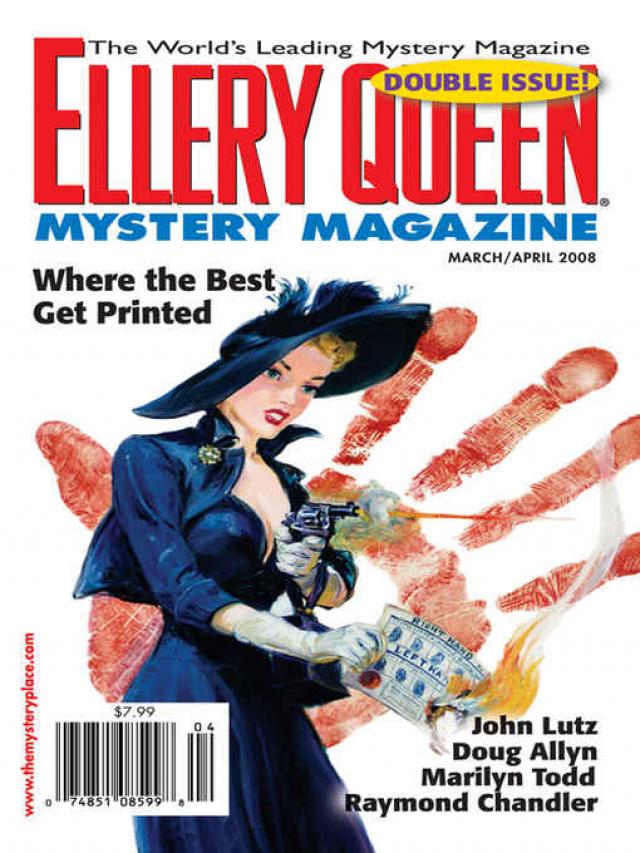
Eqmm march april 2008, p.32
EQMM, March-April 2008,
p.32


An older woman in a pink waitress uniform sauntered over, keeping up her end of the conversation with a bearded man sitting at one of the stools “—so I told her, I don't care how friggin’ old she is, she's still under my roof, still my rules—” and she slapped a white mug of coffee before Elaine without asking.
Elaine wasn't much of a coffee drinker and would have preferred tea, but this was the kind of place the Have a Seat diner looked to be. You got what they served you and didn't make a fuss.
The waitress looked down at her, little order pad in her chubby hands. “Well, hon, what's it going to be?"
There was a menu at her elbow, but she felt a bit intimidated by the waitress and didn't want to send her away while she looked at the menu, so she said, “Two scrambled eggs, please. And toast."
"Wheat, white, or rye?"
"Wheat, please."
The waitress looked down, quizzical, and then Elaine said, “That's all, thanks."
The other woman nodded, turned, and went back to the grill, and then picked up her conversation as she passed the order over, “—and then she had the nerve to tell me, well, what you feed me—"
Sure. Feed. Elaine looked about the noisy diner, the grease smells assaulting her nose, the taste of it in her mouth. What a place. And she remembered how she had ended up here.
* * * *
At times eating quick, eating fast, but the types of food available at all hours in Manhattan and its neighboring boroughs, well, it was enough to make a food critic surrender and not even bother to keep track anymore. Two-star, three-star, four-star meals, and best of all, of course, was when they were expense-accounted, and you never really saw the bill, except when it was stapled to your monthly report. Every type of ethnic and sub-ethnic grouping, wines from France, Australia, South Africa, Spain, and Chile, and the conversations that went on and on during those meals, solving the problems of the newspaper, solving the problems of New York, and—in one's spare time—solving the problems of the world.
To be a journalist on your own and with your own career seemed the finest thing possible, and then one night—or early morning, depending on your point of view—it had all changed, with a smile and an offer of a free drink, when Casey Riley had entered her life.
* * * *
She listened as she waited for her breakfast as voices were raised, points were made, even a few arguments conducted at various places across the room. In a space of a few minutes she had heard about the dating habits of one of the local selectmen, two sons who were about to go to county lock-up for burglaries, a messy divorce, and a contractor from across the river in Vermont who liked to help lonely housewives with more than just leaky roofs.
There were lots of loud voices and laughs, and she felt so out of place. She stirred two spoonfuls of sugar into her coffee, took a sip, and, surprised, took another. Not bad ... actually, pretty damn good for diner coffee. She had read once that making good diner coffee meant being a bear in cleaning out the urns and associated plumbing on a daily basis. So someone here was paying attention, and she knew who it was: the large man by the grill, shaved head and black goatee, wearing a tight black T-shirt, white apron tied snug about his jeans-enclosed waist. He looked to be about fifty or sixty, depending on the light, and in the midst of frying up bacon or sausage, or stirring up eggs, or cracking eggs over the grill, he worked hard to get the food out as quickly as possible.
But even with the flurry of motions in his arms and hands, he kept up a constant patter with the rest of the customers, and kept his eyes on the grill.
Sausage patties flipped over.
"That's what you get from inviting out-of-town talent, I'll tell ya."
Two eggs cracked open, the whites and yokes sizzling on the grill.
"I don't care if he sleeps with his cousin or his wife, so long as the tax rate doesn't go up next year."
Large hands, whisking a couple of eggs in a metal bowl.
"Mark my words, you start paying the state reps more, you'll get more laws and regulations, that's what you'll get, and that's what we don't need."
She watched him for a bit. Jason Lovell. Owner and chief cook and dishwasher of the Have a Seat grill.
Her potential interview subject.
And then, as the waitress approached her, plate of scrambled eggs in her hand, she thought of something else.
If she was lucky, very lucky, perhaps her savior.
* * * *
There are whirlwind romances, and there are romances that move at the speed of hurricanes. And such had been the case with her and Casey Riley. That night—or early morning—he had brought her a drink and had cornered her in a relatively quiet area of the bar, a nice place north of the Financial District, and after the usual give and take of who are you, and what are you doing (she: BU and then Columbia Journalism School, lucky-break internship that led to the Wall Street Journal; he: CCNY and then a variety of jobs at various trading firms on Wall Street), he smiled at her with soft brown eyes that had an adorable crinkle about them in the corner, and he said, “Look. I don't want to be too forward here, but how about breakfast?"
And though she had thought him pretty good-looking in a rugged kind of way, she thought he was moving way too fast, and he had laughed and said, “Just breakfast, that's all. I know a nice little place. You'll love it."
Elaine had checked her watch. “Where? It's only one a.m. I'm not really that hungry."
He grabbed her purse, gently too her forearm. “This place is great. It's in Victoria."
Head spinning, not sure why she was letting him lead her on, she had said, “Victoria? Where's that? In Connecticut?"
"Nope,” he had said, leading her to the door. “British Columbia."
God, how she had laughed, right through him bundling her into a cab, and then a quick run out to LaGuardia, and in a matter of just a few more minutes she had been put into a private jet, some sort of Gulfstream model, and a few hours later, she had seen the sun rise above the Rocky Mountains and decided she liked very much being with Mr. Casey Riley, and wanted to see much more of him in the future.
* * * *
The waitress dropped off the plate and scurried off and Elaine sprinkled some salt and pepper and took a bite. Though her jaw ached a bit, she was amazed at the taste and consistency of the eggs. In diner visits past—and not too many, she had to confess—eggs were either cold or overcooked or lumped to one side and so stiff they had to be cut with a knife. But not these; they were light and fluffy, had a wonderful consistency that almost seemed to melt in her mouth, and she ate them so quickly she was disappointed when she had finished.
The noise in the diner seemed to move in cycles, louder and softer, and then louder again, and when the waitress came back and said, “Anything else, hon?” Elaine looked at her and said, “No, just the check. please."
” ‘Kay,” and with that, a slip of paper was put on the table, but before she went away, Elaine said, “Excuse me, one more thing."
"Yeah?"
"Could ... could I see Jason Lovell, the owner? Could I see him for a moment?"
The waitress's eyes narrowed, like that of a mama bear seeing someone getting too close to one of her cubs. “Is there a problem? You didn't like your breakfast?"
Elaine said, “No, no, there's no problem. The eggs were delicious. I ... I just need to talk to him."
The waitress glanced over at the grill. “He's pretty busy."
"I know. It'll take just a minute. That's all."
She shrugged and walked away, and Elaine glanced at the check—three dollars and fifty cents, can you believe it!—and when she looked up again, Jason Lovell was striding towards her, wiping his big hands in a towel.
Oh yeah. She had interviewed bankers and senators, congressmen and unindicted co-conspirators in various business shenanigans, but never had she been so nervous, feeling her heart thump away like that, as Jason came closer.
* * * *
The day of her marriage she had been talking about something to her cousin Tracy when Mother came and gently tugged at her elbow. “Just a minute, that's all I need,” she had said as Mother brought her to a corner of the function room that was used to store additional chairs. She tried to stifle a sigh as Mother looked her over. Father had left her years ago, and much to the surprise of friends and relatives, Elaine had taken Father's side in the whole mess. Mother had a sharp eye and sharper tongue, had grown up protesting in the streets during the ‘sixties, and from Elaine's point of view, Mother saw everything in life as just one more assault against one more barricade, no matter who or what the barricade was.
And then, surprise of surprises, Mother kissed her on the cheek, and when she drew back, there were tears in her eyes.
"Mother ... what's up?” Elaine said.
Dressed in a light-blue gown that was no doubt going to be donated next day to some charitable outfit, Mother said, “I can't believe this day has come ... and that you're married."
That had brought a smile to her face. “Can't believe your little girl has gone out on her own?"
Mother had shaken her head. “No ... I can't believe you chose him, that's all."
Something cold formed in her chest. “Mother, please, not now. Not today."
Another quick shake of the head. “All right. Just remember I said this. I don't like him, I don't trust him, and I never will."
"Why? What has he ever done?"
Mother wiped at her cheeks, drawing away the tears. “Nothing. That's the problem. It's what he's going to do that scares me."
"How's that?"
"His eyes."
Elaine couldn't believe what she had just heard. “His eyes? That's it? His eyes?” And thinking at the same time that it was Casey's eyes that had first attracted her to him.
A firm nod from her mother. “His eyes. They're lizard eyes. They change color depending on his moods ... and I can tell he has very dark moods in him, Elaine. Very dark moods."
And that had been too much, and Elaine had said something like, oh, did you see that in your crystal readings or something? And with that, she had gone back to the celebration, back to the man of her life, the man with the laughing brown eyes.
* * * *
Before her, Jason Lovell sat down, face open and friendly, a bit curious. “Help you with something?"
She found her lips were quite dry. “My ... my name is Elaine Fletcher."
A huge hand held out, which she promptly shook. “Nice to meet you, Elaine. What's up? And do you mind making it quick? Don't want to let the orders back up."
From her purse she pulled out a business card, slid it across the tabletop. “I'm a freelance writer. Used to be on staff at the Wall Street Journal—” and how that phrase tasted like cold ashes in her mouth—"and I was wondering if I could interview you."
He examined the card, then looked at her with a bemused look. “Me? You want to interview me?"
"Yes, I would."
"What for?"
"A human-interest story. About you and the diner."
He looked about the diner. “Why? Must be dozens of these kinds of diners in this county alone. Why me, and why this one?"
She raised a hand. “Look at the place. It's full. It's always full. And the mix of your customers ... I just think it'd be a fascinating look at a small-town diner, its owner, and its customers."
For a moment Elaine wondered if she had gone too far, had laid it on too thick, for there was something wary about Jason's expression, and she wondered just how smart he was. Pretty smart, from what she had been able to find out earlier, but still...
Then he leaned back and laughed. “Sure. You got it. Why the hell not? Come back at ten-thirty ... it slows down pretty much then ... breakfast traffic leaves me alone and it's a bit early for the lunch traffic."
"Thanks, that's very kind of you,” she said, feeling just a bit light-headed. The first step, the very first step, but it was progress.
He stood up and wiped his hands on his apron. “But I can only give you a half-hour or so. Okay? Some people love an early lunch, and I hate to disappoint my customers."
"I'm sure,” she replied, and when Jason got back to the grill—accompanied by some catcalls and shouts for goofing off on the job—she reached into her purse, took out a five-dollar bill, left it on the counter, and then walked out.
* * * *
Home.
She paused in the driveway, in her Volvo, still listening to the radio gallantly try to pull in that elusive NPR station. She had nearly four hours to kill before returning to the Have a Seat diner. Up ahead was the house, a small one-story ranch on a nice sloping lawn that had a view of the Connecticut River Valley. It had about an acre of woods in the rear, and a few times, early in the morning, standing by herself in the living room, she had seen deer grazing on the shrubbery down by the mailbox. She had grown up in apartments and condos. It was the first house she had ever lived in, and the first day she had seen it had also been the day she and Casey had moved in.
She got out and walked up to the door.
It was a house.
It wasn't home.
And the damn thing was, it had seemed so ... well, if not logical, then it had some sort of crazy sense to it, and only later did she think that Casey had this all planned out, years and years earlier. After marriage and a honeymoon filled with love, laughs, and lots of fun, they had settled into their lives, a routine that she had loved, he off to his high-powered trading firm, she off to the Journal and occasional assignments out of town. Nights at restaurants or pubs, circles of friends from the business world, weekends at the Hamptons or up the Hudson River Valley, lots of laughs, but ... there had been some edgy times. Just little spats here and there, and one day, well, one day, he had come out and said it.
"Look, we've got to leave,” Casey had said.
"Leave what?” she had said, grinding coffee beans in a German-made coffee grinder that offered twelve different levels of coarseness. “The apartment? The neighborhood?"
"Nope,” he had said, “Manhattan. The whole package."
She knew she looked ridiculous, standing there in her Bloomie off-the-rack bathrobe, container of ground coffee in her hand, but still ... “I'm sorry, what did you just say?"
His somewhat friendly expression suddenly chilled. “You heard me. I'm not kidding, Elaine. Look, we're not getting any younger. We're getting shackled in what we're doing, me with the firm, you with the newspaper."
"I don't think I'm shackled."
"You don't?” he shot back. “How many times have you complained about your editors, about your travel, about your assignments? How many times have you told me you'd really like to dump it all and start writing a novel? Am I right? Don't you want to write that novel you've talked about so many times?"
And with each sentence, each phrase, his voice got tighter and sharper, a type of assault she had never experienced before. “Sure, Casey, one of these days, I mean—"
He made a chopping motion with his hand, smacking it into the other hand. “That's what I mean! One of these days! One of these days, I want to have my own firm, and one of these days, you want to write your novel. And I'm telling you, Elaine, I'm tired of waiting. We've got to do it now. Dump everything, cash out, and get out of the city. Go someplace remote where we'll have an edge. Do it now before we're stuck."
So she had stood there, dumbfounded, coffee grounds in her hand, wanting to tell him that she didn't feel stuck, that despite her complaints, she felt pretty good about herself, but there was something in what he had said, those little worms of worry ... Was she ever going to do that, write that novel? Fulfill that college-age dream? Sure, one of these days ... and before you know it, the days have all passed by.
But she kept her mouth shut. For she had looked into his eyes, and for the first time—and, alas, not the last—she had been frightened at what she had seen.
* * * *
Inside her New Hampshire house, she heard her footsteps echo loudly. Casey was gone on yet another business trip, stirring up potential clients, trying to get his business up and running, at least making it self-supporting; for right now, it was sucking away at their combined savings every bloody month, and lately Casey had been making sounds about having to tap into their IRAs, which scared her to death. That was retirement money, money to live a good life when you were older, for if you believed Social Security was going to do it for you, there were many Manhattan bridges that Elaine could name that she would try to sell you.
She went to the doorway of the spare bedroom that she had turned into an office. Quiet. Silent computer. Filing cabinet empty save for some unfilled folders. Notebooks, pens, pencils. Credenza with a little library of books on top of the polished surface. A nice little office in which to write a nice little novel, a nice little novel that she had yet to get beyond Chapter Two. My God, she could write stories about complicated SEC filings and business mergers with a fifteen-minute deadline, but facing that blank screen every morning to try to create something that would grab at people and make them read, to make a fictional universe come alive with characters that seemed to breathe and live and laugh ... It got so that she hated her office, hated that mocking computer, could barely function when she sat in her expensive chair and stared at the blank screen.
She looked about the house some more—at how clean and tidy it was, and she felt that sick little ache in her, knowing if Mother was here, oh lord, what Mother would say. She would say, what do you expect, having dumped your dreams and desires in somebody else's lap? That now everything was merged so that the household budget was examined every other week to make sure she wasn't spending too much on groceries or newspapers or whatever, so that the funds were there to keep the Riley Financial Advisory Group up and running.