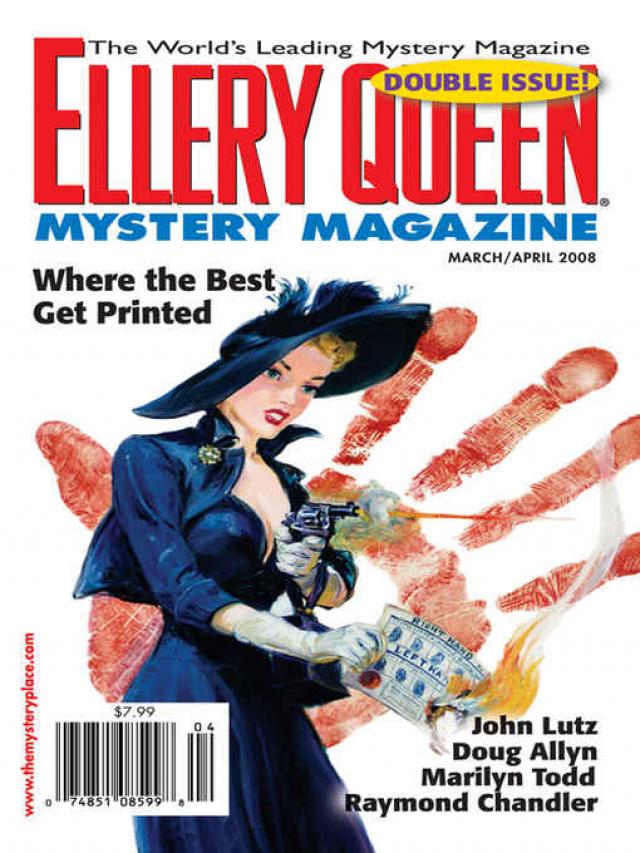
Eqmm march april 2008, p.27
EQMM, March-April 2008,
p.27


"Throw the book in,” I said grandly, “and we'll take it.” She didn't mind. It's not often she can shift a book, even the Good One.
All the same, I felt there was something strange about this one, and sure as my name's Tom Wasp, there was. When we got back to our room, and I'd found a lucifer match to light the candle, I opened it. There, taking precedence over Genesis, was the Duke of Wessex's crest. I knew it well owing to the fact that I have the pleasure of cleaning His Grace's chimneys in Piccadilly, where that nasty-looking lion on his coat of arms watches you every step you tread, as if he'd gobble you up for a speck of soot. I knew the duke isn't one for giving away anything (even the tuppence I was rightfully due for the extra chimneys he makes me clean) so I would have known this book was stolen even if I hadn't heard the patterer on the Ratcliffe Highway shouting out the news of a big robbery in Wessex House a few days ago.
What puzzled me was that the book was just lying there, the crest visible to anyone who opened it. Usually stolen goods are christened first, meaning that all identifying marks are removed. Mrs. Guggins's dollyshop might look at first like an honest pawnbroker's, but there are no three balls hanging outside to indicate that. It does its best to hide its face, for it has no licence. Dollyshops cater for the very poorest of folks, often defrauding those who pawn their vital possessions in the hope of finding the dosh to buy them back in due course. Dollyshops all too often have another role, too. They deal in stolen goods, but usually Mrs. Guggins's showed no signs of that, stinking hole though it is.
Mostly the Fair consists of honest street sellers, trading in all manner of things but chiefly secondhand clothes, some on barrows, some without. The Fair spreads into the side streets off Rosemary Lane, too, where those who aren't so bothered about the honest bit tend to trade. Mrs. Guggins is one of them; her dollyshop is hidden in Blue Anchor Yard, where she trades from the ground floor of her house.
Mr. Guggins was only in evidence as a familiar figure weaving his way back to the dollyshop after a good session at the Paddy Goose or some other hostelry in London's dockland. He was an evil-looking man, hunched and bent, with a way of studying the ground until you passed by. Then his head would shoot up, glaring malevolently, as though he'd like to meet you by night down by the docks with a knife in his hand and no questions asked.
"Tomorrow we take that book back, Ned,” I said firmly. “No use having a Good Book if it's got by evil means. You'd be foolish to keep it."
Ned looked torn. He knows from his Sunday school that Our Lord has his eye on those that steal, but on the other hand he always hopes it's temporarily shut.
Next morning we set off for the Fair on our way to our first job. It was early yet and only the oyster and hot chestnut sellers were plying their trade in Rag Fair. Another few hours and you wouldn't be able to move for old petticoats, shawls, and broken-down boots. Mind you, chimney sweeps such as I, Tom Wasp, can always move onwards owing to our smell. The folks we pass are only too anxious for us to be on our way, and the Red Sea parts like it did for Moses.
Even Moses would have been taken aback at what we found today, though. Two solid policemen were guarding the door into Mrs. Guggins's dollyshop, which was strange since they usually give this place a wide berth. Our eyes were fixed not on them, however, but on Mrs. Guggins. It would be hard not to, because of her howl. It filled the street, it chilled our bones with its stridency. We could see her standing in the doorway. Her sturdy body rocked and the greasy curls under the dirty white bonnet she always wore shook as she wailed. Time and time again came the cry:
"Guggins ‘as gawn."
Mrs. Guggins could never have been a pretty woman, nor a dainty one, but I respect grief, so I wondered what was amiss. Then out of the shop came another policeman, one I recognised. It was Sergeant Peters, who owes me a favour or two, as I've obliged him in the past when he needed help with villains.
"Where's Guggins gone?” I asked him with interest.
"Hell, most like,” answered Peters soberly. “There he is. Dead for an hour or two."
He pointed to the dim interior of the shop, made all the darker by the mass of clothing stacked from floor to ceiling. No more Paddy Goose for Mr. Guggins. There lay his dead body, hunched on the floor. I took off my stove hat in respect, as we went in, though the look the sergeant gave me suggested there was no need.
He'd been knifed, had Mr. Guggins. I could see the congealed blood on his clothes, and particularly round the wound in his chest. I sent Ned outside, not because he's squeamish over dead bodies, but because I needed a quiet word without flapping ears.
"Knife left in the wound, was it?” I asked the sergeant.
"No."
"Body like that when it was found, was it?"
"So she says.” Sergeant Peters indicated Mrs. Guggins, now weeping noisily onto a constable's shoulder. I might seem unsympathetic when I mention Mrs. Guggins, but she shows no milk of human kindness to the poor folk who can't afford to redeem their possessions. Not a penny less, not a penny late, is her motto. All the same, Our Lord reminded me, Mr. Guggins was her husband, and two villains can love as truly as two angels.
"That's a puzzle,” I remarked, lowering my voice in case Mrs. Guggins heard. “When the knife was pulled out, there would have been blood everywhere, yet there's precious little to be seen on the floor here.” I'd seen a matelot stabbed before my eyes down by the docks and knew what I was talking about.
We both stared at the filthy floor and I noticed an interesting fact, just as the van arrived to take the body to the police mortuary and we had to break off. After it left, I could hear Mrs. Guggins's mournful voice outside, relating her sad tale yet again.
"Not killed in this spot then?” I said casually to the sergeant, looking pointedly at the blobs of dried blood at intervals on the floor.
I knew he wasn't, but it gave the sergeant a chance to shine.
"It's my belief, Mr. Wasp,” he said loudly, “that he was killed elsewhere and his body dragged here. But where from?"
We followed the blobs of dried blood just discernible in the general grime, but then we had to stop. We and the blobs had ended at a stack of clothes piled almost to ceiling height and stacked against a wall.
"I wonder,” said I, “what's behind that wall?” I made it sound innocent, but I knew for sure then why no one had ever seen much of Mr. Guggins, save at public houses. Sergeant Peters took my meaning at once.
"Here,” he roared to Mrs. Guggins, whose hand flew to her breast as if she was Cleopatra. “What's behind this wall?"
Mrs. Guggins seemed fully restored to health as she threw herself towards us, having seen the sergeant rummaging in the pile of clothes. He pulled a covering curtain back triumphantly to reveal a trolley under the heap, so that the whole pile could be wheeled aside. I put myself between her and Sergeant Peters, who had now heaved the trolley aside to reveal a door.
"Get out,” she howled. “It ain't respectful. That's Guggins's room and Guggins ‘as gawn."
Even as she spoke, however, the door was thrust open in our faces from the far side and we had to leap back. Mr. Guggins's room had a guard, it seemed, for we were face to face with Big George, who seemed equally horrified to see us. Everyone round here knows about Big George. The biggest villain and biggest man in London (over six foot five inches high and several solid feet wide). One look at a lock from him and it springs open.
"What are you doing here, George?” asked the sergeant, squaring up to him, despite the fist produced in his face. He is, of course, most familiar with the gentleman, as I am myself, though I keep my distance.
"Only after what's mine by right,” he snarled.
Big George, having removed the fist once he realised it was the law he was addressing, then tried to make a run for it through the rear door. With the help of Mrs. Guggins he was first floored, then struggled up again to have the cuffs put on him. I hobbled over to have a look at this door—I've hobbled since childhood owing to my trade. It opened into a tiny yard with the usual stinking privy and pile of coal, but interestingly there was a gate. The dollyshop is on the corner where Blue Anchor Yard leads through to Glasshouse Street, thus providing a most useful second entrance for the Gugginses.
"I want what's mine by right,” Big George growled sadly from his lofty heights, as I went back inside.
"It's only wrong I see here,” Sergeant Peters replied wittily.
What I then saw made me speechless. So this was where Guggins had worked. He'd been a fence, receiving stolen goods, and that was the real trade of the dollyshop, although Mrs. Guggins sold a few bits and bobs outside to look respectable. Here Mr. Guggins, in-between trips to the Paddy Goose (where he could meet customers and do business without suspicion), had reigned over a palace. Fancy silks, posh china, silver, snuffboxes, jewellery everywhere we looked. Her Majesty herself would be proud to entertain here. The only thing she would not have liked was the dried blood on the desk and floor.
"What made you suspect this, Mr. Wasp?” asked the sergeant, who is young enough to be respectful to me.
"A book,” I told him, “with the Duke of Wessex's crest, had not been christened, so it struck me there must be other swag and the book got dropped by mistake.” I began to look at some of the articles in the late Mr. Guggins's possession, but to my surprise could see none with the crest of the Duke of Wessex. Christening fine ware takes time, and in this case, I supposed, it was so hot that Guggins would have been anxious to be rid of it.
"What have you done with it, George?” I asked, having pointed out the problem to the sergeant. I was feeling brave with all these police around, and hoping that George wouldn't recognise me by the time he was out of jug (one sooty face being much like another).
Big George's face went an interesting shade of red.
"Wessex House,” the sergeant added, as if he didn't know. “A burglary there a week ago. You got a good haul, didn't you?"
"Nothing to do with me,” Big George said complacently, secure in the knowledge that there was nothing in this room that could be traced back to him.
"Then what are you doing in Guggins's room?” asked the sergeant.
The complexities of puzzling out this trap were too much for Big George. “Business,” was all he could growl.
"When did you get here?"
"What's the time now?” We looked at a rather fine clock that might one day be restored to its rightful owner. It was a quarter to eight.
"Just got here. Came in the back like he always said. Don't know nothing."
"Turn your pockets out, George,” instructed Sergeant Peters.
This was a difficult task with his hands cuffed so I had to assist, much to his fury. Out came three elegant snuffboxes.
"Mine,” he growled. “I've a fancy for snuff."
"Tell that to the judge,” said the sergeant smartly.
Big George paled. “Look, it ain't fair. I come here at five for me money, like old Guggins told me. I'd sold him some—well, some old clothes, and he said he'd have it ready by then, but he only gave me five quid. No honesty around nowadays. Mean old skinflint. Said it was fake. A man can't make an honest living nowadays. I've got a wife and children to keep."
I wondered how secondhand clothes could be fake, but decided to keep silent.
"Mr. Guggins wouldn't cheat no one,” said his wife faintly.
"Done what by five?” Sergeant Peters enquired.
"Guggins had customers coming.” Big George was getting sullen now, obviously resenting being cuffed. “When I gets there, I said that five quid weren't enough, and he says the deal's not finished yet, so come back in an hour or so for the rest. So back I comes at sixish, but no one around, so I comes back yet again—and look what I gets from you. Cuffed.” He displayed his hands on high, in appeal to a Higher Justice.
"And who might these customers have been, Mrs. Guggins?"
"How should I know?” Most indignant she looked. “I don't know nothing about what went on in here. You coulda knocked me down with a feather when you opened this door.” (Unlikely, I felt.) “I was asleep all night,” she continued. “Had a nice glass of hot milk and slept like a baby."
Her colouring suggested several glasses of neat gin were her usual tipple.
"Guggins, poor love,” she blew her nose delicately on her sleeve, “he worked all night sometimes, so I never saw him, not till I saw his body when I opened up this morning. Fancy all this stuff being back here—” She did an impressive job of looking amazed at the splendour around her—"Well I never, he must have been saving it for my birthday present."
"Who'd he sell to, Mrs. Guggins?” Sergeant Peters went on relentlessly.
I was getting most interested in the late Mr. Guggins's trade, and even Ned had crept back in through the open door. I don't blame him. By now I could hear stalls being set up outside. The oyster sellers would be going on their way a-whistling, and the clothes dealers were taking their places. You could live your whole life in Rosemary Lane without going anywhere else. Goods and food—you can find everything you could ever want here. You could pay your way for it by honest toil on the stalls, or by dishonest dipping in the pockets of the strangers who come here in the hope of picking up a bargain.
Strangers, now that was a thought.
"Mrs. Guggins,” said I, “these customers Mr. Guggins was expecting. They can't be from round here. They couldn't sell the duke's stuff in the Fair, they'd need to sell it to gentry, and not the gentlemen of Piccadilly either, for they'd know the duke's crest by sight. So who were they? Must have been special to come in the night and not deal in the Paddy Goose. No risk to you in telling us."
"Only in not telling us,” Sergeant Peters added, getting the idea nicely.
Even so, Mrs. Guggins decided to bewail her loss again, in order to avoid answering this question of mine. “Guggins was a good—” she began, but the sergeant has a way of getting his message through. He rattles the cuffs, which is a most powerful persuader in these parts. Mrs. Guggins breathed heavily. “They come here by night,” she told us. “I don't see them."
"Seems to me you don't see anything unless you choose to,” observed Sergeant Peters, with another rattle. “See these?"
"John Clode,” she says quickly. “John Clode and Flirty Fan."
"And who might they be?"
That surprised me. I thought everyone knew Flirty Fan at least, for all she lives across the water Rotherhithe way. She has a business in the better parts of Blackheath and Lewisham. She's far too choosy to flirt with a chimney sweep, but she's a sight for sore eyes when she flounces by. Makes a day of it, she does, when she comes through the tunnel over this way, and by nights she does her illegal business, so I'm told. She's as thin as a stewed eel and just about as slippery. She does herself up grand, with bonnets covered in plumes and feathers, jangling her bracelets and necklaces, flaunting her silks and satins and wriggling along, all bustles and mincing little bootees. She puts on every bit of gaudiness she can find to attract custom—which is both in goods and in men. So eager she is, I've seen her work her way round Billingsgate fish market to find a man. She's a shrewd barterer, though, and if Guggins tried to cheat her last night, she could have turned nasty.
Mrs. Guggins was much briefer in her description of Flirty Fan to Sergeant Peters. “A whoring bitch,” she snarled.
"And Mr. John Clode?” asks the sergeant.
A simper now. “He's a Frenchie. Most polite, though. Naturally, I don't know what business he could have had with Mr. Guggins."
"I do,” growled Big George.
"But so polite,” Mrs. Guggins persisted desperately. “'Oh, Mrs. Guggins,’ says he, ‘would that I could sail on the evening tide to the belle France with the belle Mrs. Guggins.’”
"Would that be,” Sergeant Peters asked quietly, “Mr. Jean-Claude Lepin, the well-known receiver of stolen goods in Paris?"
"Could be,” said the belle Mrs. Guggins guardedly.
"Seen by the river police entering the country in a small craft up the Thames last evening?"
"Might be."
"And no doubt trying to leave again at this very moment with a boatload of stolen goods?"
* * * *
"Can I come, Gov?” pleaded Ned.
A day had gone by, and I was most surprised when a police van called for me early the next morning. I could tell it was the police by the way everyone had scattered in our court, which is well shielded from the road by a narrow entrance between the lodging houses down which this policeman must have made his way very cautiously. Usually there were folks around at the pump, but now the yard was empty. Who was scared of who? I wondered. The policeman looked at me warily as I answered the thump on my door.
"You chimney sweep Wasp?"
It must have been obvious, but I agreed that I was.
"Orders to take you to the sergeant."
I had no objection, as my interest in the means by which Mr. Guggins had gone was growing, and if Ned wished to come too, why not?
"Is he under sixteen?” asked the policeman suspiciously.
I sighed. Ned is about thirteen or fourteen, not sure which, since he never knew his age, but the new law says if he's under sixteen he has to wait outside the house while I do the hard work cleaning the chimneys inside. As if any young lad wouldn't choose waiting outside given the chance. Sometimes the good men who reform the law put one thing right only to cause another injustice. I have a hard time lugging my machine up all those stairs without help, and Ned longs to help, but we daren't risk it.
"Yes, I am,” Ned pipes up. “But it was my Good Book, so I'm a witness."
"That's true, Ned. You come along then,” I told him, and the constable said no more. After all, we weren't off to sweep a chimney. Not a real one, anyway.