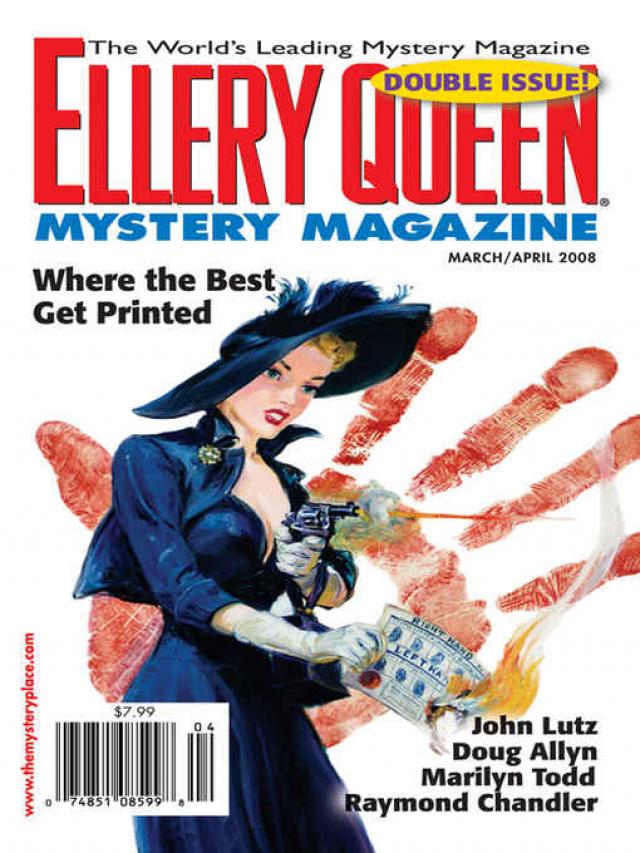
Eqmm march april 2008, p.5
EQMM, March-April 2008,
p.5


Dalmas said slowly: “How well do you know Derek Walden, Denny?"
Denny looked out of the window. There was a sort of haze in the sky and the reflection of a red neon sign behind a nearby building looked like a fire.
He said: “I don't what you call know him. I've seen him around. I know he's one of the big money guys on the lot."
"Then you won't fall over if I tell you he's dead,” Dalmas said evenly.
Denny turned around slowly. The cigar, still unlighted, moved up and down in his wide mouth. He looked mildly interested.
Dalmas went on: “It's a funny one. A blackmail gang has been working on him, Denny. Looks like it got his goat. He's dead—with a hole in his head and a gun in his hand. It happened this afternoon."
Denny opened his small eyes a little wider. Dalmas sipped his drink and rested the glass on his thigh.
"His girlfriend found him. She had a key to the apartment in the Kilmarnock. The Jap boy was away and that's all the help he kept. The gal didn't tell anyone. She beat it and called me up. I went over ... I didn't tell anybody either."
The big man said very slowly: “For Pete's sake! The cops'll stick it into you and break it off, brother. You can't get away with that stuff."
Dalmas stared at him, then turned his head away and stared at a picture on the wall. He said coldly: “I'm doing it—and you're helping me. We've got a job, and a damn powerful organization behind us. There's a lot of sugar at stake."
"How do you figure?” Denny asked grimly. He didn't look pleased.
"The girlfriend doesn't think Walden suicided, Denny. I don't either, and I've got a sort of lead. But it has to be worked fast, because it's as good a lead for the law as us. I didn't expect to be able to check it right away, but I got a break."
Denny said: “Uh-huh. Don't make it too clever. I'm a slow thinker."
He struck a match and lit his cigar. His hand shook just a little.
Dalmas said: “It's not clever. It's kind of dumb. The gun that killed Walden is a filed gun. But I broke it and the inside number wasn't filed. And Headquarters has the number, in the special permits."
"And you just went in and asked for it and they gave it to you,” Denny said grimly. “And when they pick Walden up and trace the gun themselves, they'll just think it was swell of you to beat them to it.” He made a harsh noise in his throat.
Dalmas said: “Take it easy, boy. The guy that did the checking rates. I don't have to worry about that."
"Like hell you don't! And what would a guy like Walden be doin’ with a filed gun? That's a felony rap."
Dalmas finished his drink and carried his empty glass over to the bureau. He held the whiskey bottle out. Denny shook his head. He looked very disgusted.
"If he had the gun, he might not have known about that, Denny. And it could be that it wasn't his gun at all. If it was a killer's gun, then the killer was an amateur. A professional wouldn't have that kind of artillery."
The big man said slowly: “Okay, what you get on the rod?"
Dalmas sat down on the bed again. He dug a package of cigarettes out of his pocket, lit one, and leaned forward to toss the match through the open window. He said: “The permit was issued about a year ago to a newshawk on the Press-Chronicle, name of Dart Burwand. This Burwand was bumped off last April on the ramp of the Arcade Depot. He was all set to leave town, but he didn't make it. They never cracked the case, but the hunch is that this Burwand was tied to some racket—like the Lingle killing in Chi—and that he tried to shake one of the big boys. The big boy backfired on the idea. Exit Burwand."
The big man was breathing deeply. He had let his cigar go out. Dalmas watched him gravely while he talked.
"I got that from Westfalls, on the Press-Chronicle,” Dalmas said. “He's a friend of mine. There's more of it. This gun was given back to Burwand's wife—probably. She still lives here—out on North Kenmore. She might tell me what she did with the gun ... and she might be tied to some racket herself, Denny. In that case she wouldn't tell me, but after I talk to her she might make some contacts we ought to know about. Get the idea?"
Denny struck another match and held it on the end of his cigar. His voice said thickly: “What do I do—tail the broad after you put the idea to her, about the gun?"
"Right."
The big man stood up, pretended to yawn. “Can do,” he grunted. “But why all the hush-hush about Walden? Why not let the cops work it out? We're just going to get ourselves a lot of bad marks at Headquarters."
Dalmas said slowly: “It's got to be risked. We don't know what the blackmail crowd had on Walden, and the studio stands to lose too much money if it comes out in the investigation and gets a front-page spread all over the country."
Denny said: “You talk like Walden was spelled Valentino. Hell, the guy's only a director. All they got to do is take his name off a couple of unreleased pictures."
"They figure different,” Dalmas said. “But maybe that's because they haven't talked to you."
Denny said roughly: “Okay. But me, I'd let the girlfriend take the damn rap! All the law ever wants is a fall guy.” He went around the bed to get his hat, crammed it on his head. “Swell,” he said sourly. “We gotta find out all about it before the cops even know Walden is dead.” He gestured with one hand and laughed mirthlessly. “Like they do in the movies."
Dalmas put the whiskey bottle away in the bureau drawer and put his hat on. He opened the door and stood aside for Denny to go out. He switched off the lights. It was ten minutes to nine.
* * * *
6.
The tall blonde looked at Dalmas out of greenish eyes with very small pupils. He went in past her quietly, without seeming to move quickly. He pushed the door shut with his elbow.
He said: “I'm a dick—private—Mrs. Burwand. Trying to dig up a little dope you might know about."
The blonde said: “The name is Dalton, Helen Dalton. Forget the Burwand stuff."
Dalmas smiled and said: “I'm sorry. I should have known."
The blonde shrugged her shoulders and drifted away from the door. She sat down on the edge of a chair that had a cigarette burn on the arm. The room was a furnished-apartment living room with a lot of department store bric-a-brac spread around. Two floor lamps burned. There were flounced pillows on the floor, a French doll sprawled against the base of one lamp, and a row of gaudy novels went across the mantel, above the gas fire.
Dalmas said politely, swinging his hat: “It's about a gun Dart Burwand used to own. It's showed up on a case I'm working. I'm trying to trace it—from the time you had it."
Helen Dalton scratched the upper part of her arm. She had half-inch-long fingernails. She said curtly: “I don't have an idea what you're talking about."
Dalmas stared at her and leaned against the wall. His voice got on edge.
"Maybe you remember that you used to be married to Dart Burwand and that he got bumped off last April ... Or is that too far back?"
The blonde bit one of her knuckles and said: “Smart guy, huh?"
"Not unless I have to be. But don't fall asleep from that last shot in the arm."
Helen Dalton sat up very straight, suddenly. All the vagueness went out of her expression. She spoke between tight lips.
"What's the howl about the gun?"
"It killed a guy, that's all,” Dalmas said carelessly.
She stared at him. After a moment she said: “I was broke. I hocked it. I never got it out. I had a husband that made sixty bucks a week but didn't spend any of it on me. I never had a dime."
Dalmas nodded. “Remember the pawnshop where you left it?” he asked. “Or maybe you still have the ticket."
"No. It was on Main. The street's lined with them. And I don't have the ticket."
Dalmas said: “I was afraid of that."
He walked slowly across the room, looked at the titles of some of the books on the mantel. He went on and stood in front of a small folding desk. There was a photo in a silver frame on the desk. Dalmas stared at it for some time. He turned slowly.
"It's too bad about the gun, Helen. A pretty important name was rubbed out with it this afternoon. The number was filed off the outside. If you hocked it, I'd figure some hood bought it from the hockshop guy, except that a hood wouldn't file a gun that way. He'd know there was another number inside. So it wasn't a hood—and the man it was found with wouldn't be likely to get a gun in a hock shop."
The blonde stood up slowly. Red spots burned in her cheeks. Her arms were rigid at her sides and her breath whispered. She said slowly, strainedly: “You can't maul me around, dick. I don't want any part of any police business—and I've got some good friends to take care of me. Better scram."
Dalmas looked back towards the frame on the desk. “Johnny Sutro oughtn't to leave his mug around in a broad's apartment that way. Somebody might think he was cheating."
The blonde walked stiff-legged across the room and slammed the photo into the drawer of the desk. She slammed the drawer shut, and leaned her hips against the desk.
"You're all wet, shamus. That's not anybody called Sutro. Get on out, will you, for gawd's sake?"
Dalmas laughed unpleasantly. “I saw you at Sutro's house this afternoon. You were so drunk you don't remember."
The blonde made a movement as though she were going to jump at him. Then she stopped, rigid. A key turned in the room door. It opened and a man came in. He stood just inside the door and pushed it shut very slowly. His right hand was in the pocket of a light tweed overcoat. He was dark-skinned, high-shouldered, angular, with a sharp nose and chin.
Dalmas looked at him quietly and said: “Good evening, Councilman Sutro."
The man looked past Dalmas at the girl. He took no notice of Dalmas. The girl said shakily: “This guy says he's a dick. He's giving me a third about some gun he says I had. Throw him out, will you?"
Sutro said: “A dick, eh?"
He walked past Dalmas without looking at him. The blonde backed away from him and fell into a chair. Her face got a pasty look and her eyes were scared. Sutro looked down at her for a moment, then turned around and took a small automatic out of his pocket. He held it loosely, pointed down at the floor.
He said: “I haven't a lot of time."
Dalmas said: “I was just going.” He moved near the door. Sutro said sharply: “Let's have the story first."
Dalmas said: “Sure."
He moved lithely, without haste, and threw the door wide open. The gun jerked up in Sutro's hand. Dalmas said: “Don't be a sap. You're not starting anything here and you know it."
The two men stared at each other. After a moment or two Sutro put the gun back into his pocket and licked his thin lips. Dalmas said: “Miss Dalton had a gun once that killed a man—recently. But she hasn't had it for a long time. That's all I wanted to know."
Sutro nodded slowly. There was a peculiar expression in his eyes.
"Miss Dalton is a friend of my wife's. I wouldn't want her to be bothered,” he said coldly.
"That's right. You wouldn't,” Dalmas said. “But a legitimate dick has a right to ask legitimate questions. I didn't break in here."
Sutro eyed him slowly. “Okay, but take it easy on my friends. I draw water in this town and I could hang a sign on you."
Dalmas nodded. He went quietly out of the door and shut it. He listened a moment. There was no sound inside that he could hear. He shrugged and went on down the hall, down three steps, and across a small lobby that had no switchboard. Outside the apartment house he looked along the street. It was an apartment-house district and there were cars parked up and down the street. He went towards the lights of the taxi that was waiting for him.
Joey, the red-haired driver, was standing on the edge of the curb in front of his hack. He was smoking a cigarette, staring across the stret, apparently at a big, dark coupe that was parked with its left side to the curb. As Dalmas came up to him he threw his cigarette away and came to meet him.
He spoke quickly: “Listen, boss. I got a look at the guy in that Cad—"
Pale flame broke in bitter streaks from above the door of the coupe. A gun racketed between the buildings that faced each other across the street. Joey fell against Dalmas. The coupe jerked into sudden motion. Dalmas went down sidewise, onto one knee, with the driver clinging to him. He tried to reach his gun, couldn't make it. The coupe went around the corner with a squeal of rubber, and Joey fell down Dalmas's side and rolled over on his back on the sidewalk. He beat his hands up and down on the cement and a hoarse, anguished sound came from deep inside him.
Tires screeched again and Dalmas flung up to his feet, swept his hand to his left armpit. He relaxed as a small car skidded to a stop and Denny fell out of it, charged across the intervening space towards him.
Dalmas bent over the driver. Light from the lanterns beside the entrance to the apartment house showed blood on the front of Joey's whipcord jacket, blood that was seeping out through the material. Joey's eyes opened and shut like the eyes of a dying bird.
Denny said: “No use to follow that bus. Too fast."
"Get on a phone and call an ambulance,” Dalmas said quickly. “The kid's got a bellyful ... Then take a plant on the blonde."
The big man hurried back to his car, jumped into it, and tore off around the corner. A window went open somewhere and a man yelled down. Some cars stopped. Dalmas bend down over Joey and muttered: “Take it easy, oldtimer ... Easy, boy ... easy."
* * * *
7.
The homicide lieutenant's name was Weinkassel. He had thin, blond hair, icy blue eyes, and a lot of pockmarks. He sat in a swivel chair with his feet on the edge of a pulled-out drawer and a telephone scooped close to his elbow. The room smelled of dust and cigar butts.
A man named Lonergan, a bulky dick with gray hair and a gray moustache, stood near an open window, looking out of it morosely.
Weinkassel chewed on a match, stared at Dalmas, who was across the desk from him. He said: “Better talk a bit. The hack driver can't. You've had luck in this town and you wouldn't want to run it into the ground."
Lonergan said: “He's hard. He won't talk.” He didn't turn around when he said it.
"A little less of your crap would go farther, Lonnie,” Weinkassel said in a dead voice.
Dalmas smiled faintly and rubbed the palm of his hand against the side of the desk. It made a squeaking sound.
"What would I talk about?” he asked. “It was dark and I didn't get a flash of the man behind the gun. The car was a Cadillac coupe, without lights. I've told you this already, Lieutenant."
"It don't listen,” Weinkassel grumbled. “There's something screwy about it. You gotta have some kind of a hunch who it could be. It's a cinch the gun was for you."
Dalmas said: “Why? The hack driver was hit and I wasn't. Those lads get around a lot. One of them might be in wrong with some tough boys."
"Like you,” Lonergan said. He went on staring out of the window.
Weinkassel frowned at Lonergan's back and said patiently: “The car was outside while you was still inside. The hack driver was outside. If the guy with the gun had wanted him, he didn't have to wait for you to come out."
Dalmas spread his hands and shrugged. “You boys think I know who it was?"
"Not exactly. We think you could give us some names to check on, though. Who'd you go to see in them apartments?"
Dalmas didn't say anything for a moment. Lonergan turned away from the window, sat on the end of the desk and swung his legs. There was a cynical grin on his flat face.
"Come through, baby,” he said cheerfully.
Dalmas tilted his chair back and put his hands into his pockets. He stared at Weinkassel speculatively, ignored the gray-haired dick as though he didn't exist.
He said slowly: “I was there on business for a client. You can't make me talk about that."
Weinkassel shrugged and stared at him coldly. Then he took the chewed match out of his mouth, looked at the flattened end of it, tossed it away. “I might have a hunch your business had something to do with the shootin',” he said grimly. “That way the hush-hush would be out. Wouldn't it?"
"Maybe,” Dalmas said. “If that's the way it's going to work out. But I ought to have a chance to talk to my client."
Weinkassel said: “Okay. You can have till the morning. Then you put your papers on the desk, see."
Dalmas nodded and stood up. “Fair enough, Lieutenant."
"Hush-hush is all a shamus knows,” Lonergan said roughly.
Dalmas nodded to Weinkassel and went out of the office. He walked down a bleak corridor and up steps to the lobby floor. Outside the City Hall he went down a long flight of concrete steps and across Spring Street to where a blue Packard roadster, not very new, was parked. He got into it and drove around the corner, then through the Second Street tunnel, dropped over a block, and drove out west. He watched in the mirror as he drove.
At Alvarado he went into a drugstore and called his hotel. The clerk gave him a number to call. He called it and heard Denny's heavy voice at the other end of the line. Denny said urgently: “Where you been? I've got that broad out here at my place. She's drunk. Come on out and we'll get her to tell us what you want to know."
Dalmas stared out through the glass of the phone booth without seeing anything. After a pause he said slowly: “The blonde? How come?"
"It's a story, boy. Come on out and I'll give it to you. Fifteen-fifty-four South Livesay. Know where that is?"
"I've got a map. I'll find it,” Dalmas said in the same tone.
Denny told him just how to find it, at some length. At the end of the explanation he said: “Make it fast. She's asleep now, but she might wake up and start yellin’ murder."
Dalmas said: “Where you live, it probably wouldn't matter much ... I'll be right out, Denny."
He hung up and went out to his car. He got a pint bottle of bourbon out of the car pocket and took a long drink. Then he started up and drove towards Fox Hills. Twice on the way he stopped and sat still in the car, thinking. But each time he went on again.
* * * *
8.
The road turned off Pico into a scattered subdivision that spread itself out over rolling hills between two golf courses. It followed the edge of one of the golf courses, separated from it by a high wire fence. There were bungalows here and there dotted about the slopes. After a while the road dipped into a hollow and there was a single bungalow in the hollow, right across the street from the golf course.