

The case of the perjured.., p.1
The Case of the Perjured Parrot,
p.1
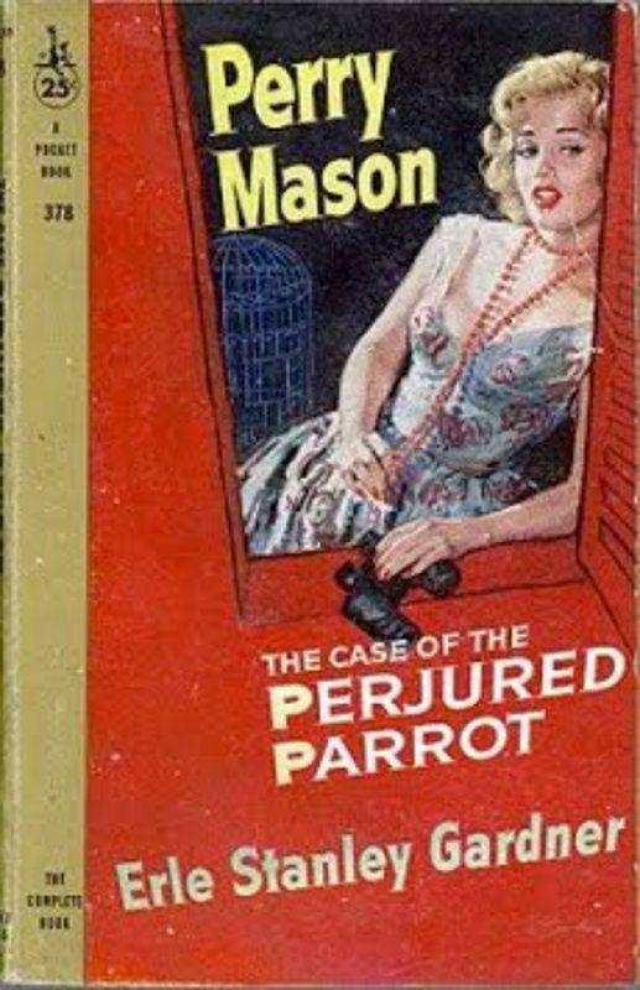


The Case of the
Perjured Parrot
Erle Stanley Gardner
© 1939, 2011 Erle Stanley Gardner. All rights reserved.
CAST OF CHARACTERS
PERRY MASON—Noted criminal lawyer—intrepid, dramatic, elusive fighter, whose cause is never lost
DELLA STREET—His secretary, whose horizon is bounded by that of her chief, and whose only fear is that some day he may overstep the charmed circle of his daring
CHARLES SABIN—Son of Fremont C. Sabin, a substantial citizen, quiet, determined, ready to pay anything to bring his father’s murderer to justice
PAUL DRAKE—Detective, long, laconic, and loyal, willing to toss his natural caution to the winds in the service of Perry Mason
SERGEANT HOLCOMB—One-track representative of the long arm of the law, with a wistful, pugnacious hope of catching Perry Mason off his guard
SHERIFF BARNES—Efficient, tolerant, slow, who would rather be sure of his man
RICHARD WAID—Erstwhile secretary to Fremont C. Sabin, whose conscience is his guide, when convenient
ARTHUR GIBBS—Calmly observant trainer of parrots to suit the public taste
MRS. WINTERS—Neighbor of Helen Monteith, whose friendship isn’t quite deep enough to drown her curiosity
HELEN MONTEITH—Buffeted by the winds of circumstance, whose ship finally reaches port
MRS. HELEN WATKINS SABIN—Widow of the murdered man—a juggernaut with a purpose
STEVE WATKINS—Suave son of Mrs. Watkins by a former marriage, and her able disciple
DISTRICT ATTORNEY RAYMOND SPRAGUE—Explosive, frustrated exponent of the high-pressure technique
RANDOLPH BOLDING—Handwriting expert, who found to his surprise that professional pride had better be denied
ANDY TEMPLET—Practical, non-partisan coroner, determined that justice shall be done
GEORGE WALLMAN—Innocent bystander, whose simple philosophy is the cause of much confusion
Contents
Cast of Characters
CHAPTER ONE
CHAPTER TWO
CHAPTER THREE
CHAPTER FOUR
CHAPTER FIVE
CHAPTER SIX
CHAPTER SEVEN
CHAPTER EIGHT
CHAPTER NINE
CHAPTER TEN
CHAPTER ELEVEN
CHAPTER TWELVE
CHAPTER THIRTEEN
CHAPTER FOURTEEN
About the Author
CHAPTER ONE
PERRY MASON regarded the pasteboard jacket, labeled “IMPORTANT UNANSWERED CORRESPONDENCE,” with uncordial eyes.
Della Street, his secretary, looking as crisply efficient as a nurse in a freshly starched uniform, said with her best Monday-morning air, “I’ve gone over it carefully, Chief. The letters on top are the ones you simply have to answer. I’ve cleaned out a whole bunch of the correspondence from the bottom.”
“From the bottom?” Mason asked. “How did you do that?”
“Well,” she confessed, “it’s stuff that’s been in there too long.”
Mason tilted back in his swivel chair, crossed his long legs, assumed his best lawyer manner and said, in mock cross-examination, “Now, let’s get this straight, Miss Street. Those were letters which had originally been put in the ‘IMPORTANT UNANSWERED’ file?”
“Yes.”
“And you’ve gone over that file from time to time, carefully?”
“Yes.”
“And eliminated everything which didn’t require my personal attention?”
“Yes.”
“And yet this morning of Monday, September twelfth, you take out a large number of letters from the bottom of the file?”
“That’s right,” she admitted, her eyes twinkling.
“How many letters, may I ask?”
“Oh, fifteen or twenty.”
“And did you answer those yourself?”
She shook her head, smiling.
“What did you do with them?” Mason asked.
“Transferred them to another file.”
“What file?”
“The ‘LAPSED’ file.”
Mason chuckled delightedly. “Now there’s an idea, Della. We simply hold things in the ‘IMPORTANT UNANSWERED’ file until a lapse of time robs them of their importance, and then we transfer them to the ‘LAPSED’ file. It eliminates correspondence, saves worry, and gets me away from office routine, which I detest…. Incidentally, Della, things which seem frightfully important at the time have a habit of fading into insignificance. Events are like telephone poles, streaming back past the observation platform of a speeding train. They loom large at first, then melt into the distance, becoming so tiny they finally disappear altogether…. That’s the way with nearly all of the things we think are so vital.”
Her eyes were wide and innocent. “Do the telephone poles really get smaller, Chief, or do they just appear smaller?”
“Of course, they don’t get smaller,” he said; “it’s simply that you’re farther away from them. Other telephone poles come in and fill up the foreground. The telephone poles are all the same size. However, as you get farther distant from them they appear to be smaller, and …” He broke off abruptly and said, “Wait a minute. You aren’t gently trying to point out a fallacy in my argument, are you?”
At her triumphant grin, he made a mock grimace. “I should have known better than to argue with a woman. All right, Simon Legree, get your notebook ready, and we’ll write those confounded letters.”
He opened the filing jacket, scanned a letter from a prominent firm of lawyers, tossed it across the desk to her, and said, “Write these people that I’m not interested in handling the case, even at twice the fee named. It’s just a plain, ordinary murder case. A woman gets tired of her husband, plugs him with a six-gun, and then weeps and wails that he was drunk and trying to beat her up. She lived with him for six years, and seeing him drunk was no novelty. The business about being afraid he was going to kill her doesn’t check with the story of the other witnesses.”
“How much of that,” Della Street asked with calm efficiency, “do you want me to put in the letter?”
“Just the part about not wanting to handle the case…. Oh, Lord, here’s another one. A man, who’s swindled a bunch of people into buying worthless stock, wants me to prove that he was within the letter of the law.”
Mason slammed the file shut and said, “You know, Della, I wish people would learn to differentiate between the reputable lawyer who represents persons accused of crime, and the criminal lawyer who becomes a silent partner in the profits of crime.”
“Just how would you explain the difference?” she asked.
Mason said, “Crime is personal. Evidence of crime is impersonal. I never take a case unless I’m convinced my client was incapable of committing the crime charged. Once I’ve reached that conclusion, I figure there must be some discrepancy between the evidence and the conclusions the police have drawn from that evidence. I set out to find them.”
She laughed. “You sound as though you were more of a detective than a lawyer.”
“No,” Mason said, “they are two different professions. A detective gathers evidence. He becomes skilled in knowing what to look for, where to find it, and how to get it. A lawyer interprets the evidence after it’s been collected. He gradually learns …”
He was interrupted by the ringing of the telephone at Della’s desk. She answered it, saying, “Hold the line a moment, please,” and then, cupping her hand over the mouthpiece, turned to Perry Mason. “Would you be interested in seeing a Mr. Charles Sabin on a matter of the greatest importance? Mr. Sabin says he’s willing to pay any consultation fee.”
Mason said, “Depends on what he wants. If he has a murder case, I’ll listen to him. If he wants me to draw up a chattel mortgage, the answer is ‘no.’ There isn’t enough money in the mint to tempt me to … Wait a minute, Della. What’s his name?”
“Sabin,” she said, “Charles W. Sabin.”
“Where is he?”
“In the outer office.”
Mason said, “Tell him to wait a few minutes. No, wait a minute. Find out if he’s related to Fremont C. Sabin.”
Della asked the question over the telephone, and waited for the girl at the information desk in the outer office to relay the inquiry to the visitor. She turned once more to Mason and said, “Yes, he’s the son of Mr. Fremont C. Sabin.”
“Tell him I’ll see him,” Mason said. “Tell him he’ll have to wait about ten minutes. Go out and meet him, Della. Size him up. Take him into the law library, let him wait there. Bring me the morning newspapers. This, young lady, in case you don’t know it, is a Break with a capital ‘B.’ Okay, get busy … Wait a minute, I have one of the newspapers here.”
Mason made a dive for the newspaper, sweeping the file of important correspondence over to the far end of the desk, as he hurriedly cleared a space in front of him.
The account of the murder of Fremont C. Sabin occupied much of the front page. There were photographs on the second and third pages. There was a human interest story about his character and personality.
That which was known of the murder was well calculated to stir the imagination. Fremont C. Sabin, eccentric multimillionaire, had virtually retired from the many businesses which bore his name. His son, Charles Sabin, carried on for him. During the past two years the wealthy man had become almost a recluse. At times he would travel in a tr
ailer, stopping in at auto camps, fraternizing with other trailerites, talking politics, exchanging views. None of those with whom he talked had the least inkling that this man, with his shiny business suit, his diffident manner, and his quiet gray eyes, was rated at more than two million dollars.
Or he would disappear for a week or two at a time, prowling around through bookstores, dropping in at libraries, living in a realm of studious abstraction, while he browsed through books.
Librarians invariably classified him as a clerk out of work.
Of late he had been spending much of his time in a mountain cabin, on the pine-clad slope of a rugged range near a brawling stream. Here he would sit on the porch by the hour with a pair of powerful binoculars in his hand, watching the birds, making friends with the chipmunks and squirrels, reading books—asking only to be let alone.
Just touching sixty, he represented a strange figure of a man; one who had wrung from life all that it offered in the way of material success; a man who literally had more money than he knew what to do with. Some of this money he had established in trust funds, but for the most part he did not believe in philanthropy, thinking that the ultimate purpose of life was to develop character; that the more a person came to depend on outside assistance, the more his character was weakened.
The newspaper published an interview with Charles Sabin, the son of the murdered man, giving an insight into his father’s character. Mason read it with interest. Sabin had believed that life was a struggle and had purposely been made a struggle; that competition developed character; that victory was of value only as it marked the goal of achievement; that to help someone else toward victory was doing that person an injustice, since victories were progressive.
The elder Sabin had placed something over a million dollars in trust funds for charitable uses, but he had stipulated that the money was to go only to those who had been incapacitated in life’s battles: the crippled, the aged, the infirm. To those who could still struggle on, Sabin offered nothing. The privilege of struggling for achievement was the privilege of living, and to take away that right to struggle was equivalent to taking away life itself.
Della Street entered Mason’s office as he finished reading that portion of the article.
“Well?” Mason asked.
“He’s interesting,” she said. “Of course he’s taking it pretty hard. It’s something of a shock, but there’s nothing hysterical about him, and nothing affected about his grief. He’s quiet, determined, and very self-controlled.”
“How old?” Mason asked.
“About thirty-two or thirty-three. Quietly dressed … In fact, that’s the impression he gives you, of being quiet. His voice is low and well-modulated. His eyes are a very cold blue, and very, very steady, if you get what I mean.”
“I think I do,” Mason told her. “Rather spare and austere in his appearance?”
“Yes, with high cheekbones and a firm mouth. I think you’ll find he does a lot of thinking. He’s that type.”
Mason said, “All right, let’s get some more facts on this murder.”
He once more devoted his attention to reading the newspaper, then abruptly said, “There’s too much hooey mixed in with this, Della, to give us very much information. I suppose I should get the highlights, because he probably won’t want to talk about it.”
He returned to the newspaper, skimming salient facts from the account of the murder.
Fishing season in the Grizzly Creek had opened on Tuesday, September sixth. It had been closed until that date by order of the Fish and Game Commission to protect the late season fishing. Fremont C. Sabin had gone to his mountain cabin, ready to take advantage of the first day. Police reconstructed what had happened at that cabin from the circumstantial evidence which remained. He had evidently retired early, setting the alarm for five-thirty in the morning. He had arisen, cooked breakfast, donned his fishing things, and had returned about noon, evidently with a limit of fish. Sometime after that—and the police, from the evidence which had been so far made available, were unable to tell just when—Fremont Sabin had been murdered. Robbery had evidently not been the motive, since a well-filled wallet was found in his pocket. He was still wearing a diamond ring, and a valuable emerald stickpin was found in the drawer of the dresser, near the bed. He had been shot through the heart and at close range by a short-barreled derringer, obsolete in design but deadly in its efficiency.
Sabin’s pet parrot, who had of late years accompanied him on nearly all his trips to the mountain cabin, had been left in the room with the body. The murderer had fled.
The mountain cabin was isolated, nearly a hundred yards back from the automobile road which wound its tortuous way up to the pine-timbered cabin. There was not a great deal of traffic on this road, and those people who lived in the neighborhood had learned to leave the wealthy recluse alone.
Day after day such traffic as used the highway passed heedlessly by, while in the cabin back under the trees a screaming parrot kept vigil over the lifeless corpse of his master.
Not until several days after the murder, on Sunday, September eleventh, when fishermen came in large numbers to line the stream, did anyone suspect anything was wrong.
By that time the parrot’s shrill, raucous cries, interspersed with harsh profanity, attracted attention.
“Polly wants something to eat. Dammit, Polly wants something to eat. Don’t you damn fools know Polly’s hungry?”
A neighbor, who owned a nearby cabin, had investigated. Peering through the windows he had seen the parrot, and then had seen something else which made him telephone for the police.
The murderer had evidently had compassion for the bird, but none for the master. The cage door had been left propped open. Someone, apparently the murderer, had left a dish of water on the floor, an abundance of food near the cage. Food remained, but the water dish was dry.
Mason looked up from the newspaper and said to Della Street, “All right, Della, let’s have him in.”
Charles Sabin shook hands with Perry Mason, glanced at the newspaper on the table, and said, “I hope you are familiar with the facts surrounding my father’s death.”
Mason nodded, waited until his visitor had seated himself in the overstuffed, black leather chair, and then inquired, “Just what do you want me to do?”
“Quite a few things,” Sabin said. “Among others, I want you to see that my father’s widow, Helen Watkins Sabin, doesn’t ruin the business. I have reason to believe there’s a will leaving the bulk of the estate to me, and, in particular, making me the executor. I can’t find that will in searching among his papers. I’m afraid it may be in her possession. She’s fully capable of destroying it. I don’t want her to act as administratrix of the estate.”
“You dislike her?”
“Very much.”
“Your father was a widower?”
“Yes.”
“When did he marry his present wife?”
“About two years ago.”
“Are there any other children?”
“No. His widow has a grown son, however.”
“Was this last marriage a success? Was your father happy?”
“No. He was very unhappy. He realized he’d been victimized. He would have asked for an annulment, or a divorce, if it hadn’t been for his dread of publicity.”
“Go on,” Mason said. “Tell me just what you want me to do.”
“I’m going to put my cards on the table,” Charles Sabin told him. “My legal affairs are handled by Cutter, Grayson & Bright. I want you to co-operate with them.”
“You mean in the probate of the estate?” Mason asked.
Sabin shook his head. “My father was murdered. I want you to co-operate with the police in bringing that murderer to justice.
“My father’s widow is going to require quite a bit of handling. I think it’s a job that’s beyond the abilities of Cutter, Grayson & Bright. I want you to handle it.
“I am, of course, deeply shocked by what has happened. I was notified yesterday afternoon by the police. It’s been very much of an ordeal. I can assure you that no ordinary business matter would have brought me out today.”
Mason looked at the lines of suffering etched on the man’s face, and said, “I can readily understand that.”















