

The case of the lucky lo.., p.1
The Case of the Lucky Loser,
p.1
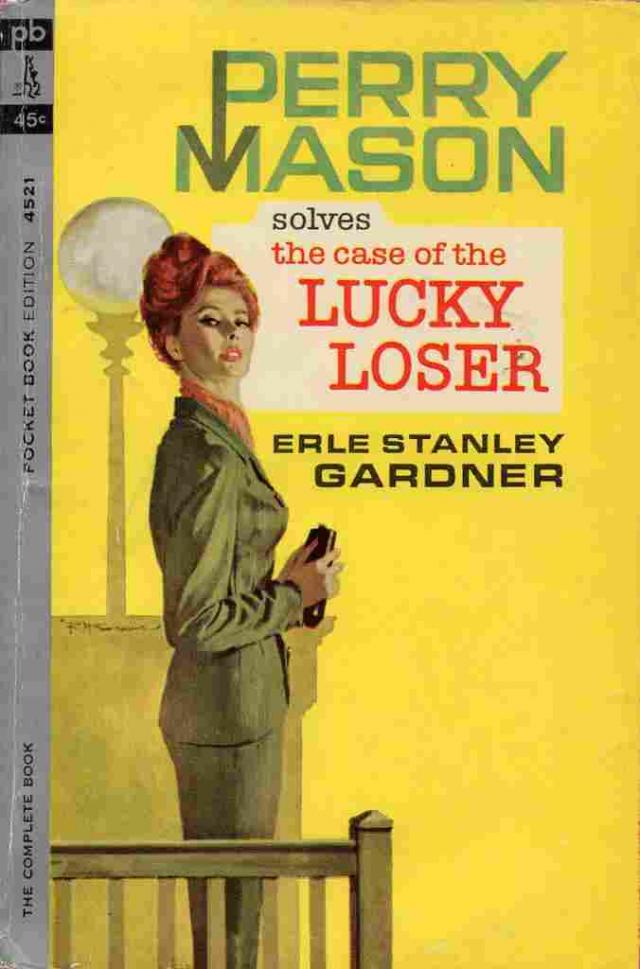


The Case of the
Lucky Loser
by
Erle Stanley Gardner
Copyright © 1957 by Erle Stanley Gardner. Renewed 1985 by Jean Bethel Gardner and Grace Naso.
Electronic Book: Copyright © 2012 by The Erle Stanley Gardner Literary Trust.
All rights reserved.
Contents
Copyright
Foreword
Cast of Characters
Chapter 1
Chapter 2
Chapter 3
Chapter 4
Chapter 5
Chapter 6
Chapter 7
Chapter 8
Chapter 9
Chapter 10
Chapter 11
Chapter 12
Chapter 13
Chapter 14
Chapter 15
Chapter 16
Chapter 17
Chapter 18
Chapter 19
Chapter 20
Chapter 21
About the Author
FOREWORD
Nearly a year ago my good friend John Ben Shepperd, the Attorney General of the State of Texas, told me, “The next big development in law enforcement must come from the people rather than from the police.”
General Shepperd wasn’t content with merely predicting such a development. He discussed it with several influential businessmen in Texas, and soon these businessmen began to take action.
J. Marion West of Houston, Texas, affectionately known as “Silver Dollar” West, is an attorney at law, a cattleman, an oil operator, and is widely respected for his knowledge of police science. He spends a large portion of his time assisting local police officers in the Houston area.
I have for some years been associated with Park Street, who is a member of “The Court of Last Resort,” a San Antonio attorney with driving energy, and a boundless enthusiasm for his work. Park Street has as his lifetime ambition a desire to improve the administration of justice.
Jackson B. Love, of Llano, Texas, is an ex-Texas Ranger who has had considerable experience as a peace officer. He owns and operates a large ranch, has exceptionally sound business judgment, is quite an historian, and collects books dealing with the frontier period of the West.
W. R. (Billy Bob) Crim, of Kilgore, Texas, a man with extensive oil interests in Kilgore, Longview and Dallas, is vitally interested in state police work and is an authority on weapons.
Frederick O. Detweiler, president of Chance Vought Aircraft, Incorporated, Dallas, Texas, is representative of the modern executive, with broad interests, a razor-keen mind and a background of knowledge ranging from economics to public relations. He is one of the prominent businessmen of Texas and is known and loved all over the state for his intense interest in better law enforcement.
Dr. Merton M. Minter is a prominent physician of San Antonio, a man loved and respected by those who know him. Recently he began to take an active interest in law enforcement. A member of the Board of Regents of the University of Texas, he is particularly interested in the educational aspects of crime prevention and law enforcement.
These people got together with Attorney General John Ben Shepperd and decided to organize the Texas Law Enforcement Foundation, of which my good friend Park Street is Chairman and J. Marion (Jim) West is Vice-chairman.
When Texas does anything, it does it in a big way, and this Law Enforcement Foundation is no exception.
Col. Homer Garrison, Jr., Director of the Texas Department of Public Safety, and as such, head of the famed Texas Rangers, a man who is acclaimed everywhere as one of the outstanding figures in the field of executive law enforcement, is Chairman of the Advisory Council of the Foundation.
I consider myself greatly honored in that I have been appointed a special adviser of this Foundation.
The Texas Law Enforcement Foundation isn’t a “Crime Commission.” Its primary purpose is to acquaint citizens everywhere with their civic responsibilities in the field of law enforcement. The Foundation wants the average citizen to have a better understanding of the causes of crime, of how crime can be prevented, of the responsibilities of the police officer, the latent dangers of juvenile delinquency, the purpose and problems of penology, and the responsibilities of the organized bar and of lawyers generally.
If the average citizen can’t learn more about the problems with which the various law enforcement agencies have to contend, the citizen can’t play his part in the job of curtailing crime.
As of this writing, organized crime is making an alarming bid for power. Juvenile delinquency is but little understood and is on the increase.
On many fronts we are trying to combat atomic age crime methods with horse-and-buggy thinking.
Efficient law enforcement can’t function in a civic vacuum. The police force depends on the training, integrity and loyalty of its members for efficiency, and on public understanding and cooperation for its very life.
It is well known that if the average community had half as much loyalty to its police as the police have to the community we would have far less crime.
Because I consider the work of this law enforcement foundation so important, I have departed from my usual custom of dedicating books to outstanding figures in the field of legal medicine, and I dedicate this book to those citizens of Texas who, at great personal and financial sacrifice, have been responsible for bringing into existence a new concept of law enforcement.
—ERLE STANLEY GARDNER
Since this Foreword was written in 1956, J. Marion West has died. His contributions are greatly missed. John Ben Shepperd is no longer Attorney General of the State of Texas but remains actively interested in the program.
Temecula, 1958
CAST OF CHARACTERS
Perry Mason—Just as a favor, the top-flight criminal lawyer dropped into court. But he found himself in one of the most cleverly masterminded frame ups of his career.
Della Street—Mason’s ever-faithful gal Friday could tell from the look in Perry’s eyes that this case produced more surprises than he had bargained for.
Judge Mervin Spencer Cadwell—“Unprofessional! Unethical!” he boomed when confronted with Perry Mason’s quick-witted tactics to stall for time—and a man’s life.
Mortimer Dean Howland—The bombastic counsel for the defense was only too glad to saddle Perry with a case he had good reason to believe would end in conviction.
Myrtle Anne Haley—The key witness for the prosecution had her testimony down so pat that Perry got suspicious.
Guthrie Balfour—Excavations in Mexico seemed to interest him more than his multimillion-dollar empire, his wife’s meanderings or his nephew’s misfortunes.
Marilyn Keith—This shy, earnest young girl, who had retained Perry under baffling circumstances, touched the soft spot in his level-headed, legalistic mind
Dorla Balfour—Guthrie Balfour’s second wife was a luscious specimen of what the amateur anthropologist’s money could buy—but not necessarily keep.
Paul Drake—Head of the Drake Detective Agency and Perry’s right-hand man, he turned up evidence that was more bewildering than enlightening.
Addison Balfour—Indomitable, even on his deathbed, the crusty old patriarch of Balfour Allied Associates fought the threat of a family scandal with every weapon he had—and he had quite a few.
Ted Balfour—The young scion of the Balfour clan reaped a conviction of manslaughter and the wrath of his uncle Addison while out sowing his wild oats.
Florence Ingle—Her devotion to Guthrie Balfour was well known. Her jealousy of his svelte young wife was equally well known. But her whereabouts at a crucial moment in the case was a puzzle—until Perry Mason got on the trail.
Banner Boles—Tall, dark and dangerous trouble shooter for Addison Balfour, nothing was too indelicate for this master of diplomacy to smooth over—not even perjury.
Hamilton Burger—The big grizzly bear of a D.A. forsook his usual courtroom battle post opposite his ancient rival Perry Mason, but he came in at the last moment as a spectator of what he thought would be the kill.
CHAPTER 1
Della Street, Perry Mason’s confidential secretary, picked up the telephone and said, “Hello.”
The well-modulated youthful voice of a woman asked, “How much does Mr. Mason charge for a day in court?”
Della Street’s voice reflected cautious appraisal of the situation. “That would depend very much on the type of case, what he was supposed to do and—”
“He won’t be supposed to do anything except listen.”
“You mean you wouldn’t want him to take part in the trial?”
“No. Just listen to what goes on in the courtroom and draw conclusions.”
“Who is this talking, please?”
“Would you like the name that will appear on your books?”
“Certainly.”
“Cash.”
“What?”
“Cash.”
“I think you’d better talk to Mr. Mason,” Della Street said. “I’ll try to arrange an appointment.”
“There isn’t time for that. The case in which I am interested starts at ten o’clock this morning.”
“Just a moment, please. Hold the wire,” Della Street said.
She entered Mason’s private office.
Perry Mason looked up from the mail he was reading.
Della Street said, “Chief, you’ll have to handle this personally. A youthful-sounding woman wants to retai
n you to sit in court today just to listen to a case. She’s on the phone now.”
“What’s her name?”
“She says it’s Cash.”
Mason grinned, picked up his telephone. Della Street got on the other line, put through the connection.
“Yes?” Mason said crisply. “This is Perry Mason.”
The woman’s voice was silky. “There’s a criminal case on trial in Department Twenty-three of the Superior Court entitled People versus Balfour. I would like to know how much it’s going to cost me to have you attend court during the day, listen to the proceedings, and then give me your conclusions.”
“And your name?” Mason asked.
“As I told your secretary, the name is Cash—just the way the entry will appear on your books.”
Mason looked at his watch. “It is now nine twenty-five. I have two appointments this morning and one this afternoon. I would have to cancel those appointments, and I would only do that to handle a matter of the greatest importance.”
“This is a matter of the greatest importance.”
“My charges would be predicated upon that fact, upon the necessity of breaking three appointments and—”
“Just what would your charges be?” she asked.
“Five hundred dollars,” Mason snapped.
The voice suddenly lost its silky assurance. “Oh!… I’m sorry. I had no idea.… We’ll just have to forget it, I guess. I’m sorry.”
Mason, moved by the consternation in the young woman’s voice, said, “More than you expected?”
“Y…y…yes.”
“How much more?”
“I… I… I work on a salary and … well, I—”
“You see,” Mason explained, “I have to pay salaries, taxes, office rental, and I have a law library to keep up. And a day of my time—What sort of work do you do?”
“I’m a secretary.”
“And you want me just to listen to this case?”
“I did … I guess I … I mean, my ideas were all out of line.”
“What had you expected to pay?”
“I had hoped you’d say a hundred dollars. I could have gone for a hundred and fifty … Well, I’m sorry.”
“Why did you want me to listen? Are you interested in the case?”
“Not directly, no.”
“Do you have a car?”
“No.”
“Any money in the bank?”
“Yes.”
“How much?”
“A little over six hundred.”
“All right,” Mason said. “You’ve aroused my curiosity. If you’ll pay me a hundred dollars I’ll go up and listen.”
“Oh, Mr. Mason!.., Oh … thanks! I’ll send a messenger right up. You see, you mustn’t ever know who I am.… I can’t explain. The money will be delivered at once.”
“Exactly what is it you want me to do?” Mason asked.
“Please don’t let anyone know that you have been retained in this case. I would prefer that you go as a spectator and that you do not sit in the bar reserved for attorneys.”
“Suppose I can’t find a seat?” Mason asked.
“I’ve thought of that,” she said. “When you enter the courtroom, pause to look around. A woman will be seated in the left-hand aisle seat, fourth row back. She is a redhaired woman about… well, she’s in her forties. Next to her will be a younger woman with dark chestnut hair, and next to her will be a seat on which will be piled a couple of coats. The younger woman will pick up the coats and you may occupy that seat. Let’s hope you aren’t recognized. Please don’t carry a brief case.”
There was a very decisive click at the other end of the line.
Mason turned to Della Street
“When that messenger comes in with the hundred dollars, Della, be sure that he takes a receipt, and tell him to deliver that receipt to the person who gave him the money. I’m on my way to court.”
CHAPTER 2
Perry Mason reached the courtroom of Department Twenty-three just as Judge Mervin Spencer Cadwell was entering from his chambers.
The bailiff pounded his gavel. “Everybody rise,” he shouted.
Mason took advantage of the momentary confusion to slip down the center aisle to the fourth row of seats.
The bailiff called court to order. Judge Cadwell seated himself. The bailiff banged the gavel. The spectators dropped back to their seats, and Mason unostentatiously stepped across in front of the two women.
The younger woman deftly picked up two coats which were on the adjoining seat. Mason sat down, glancing surreptitiously at the women as he did so.
The women were both looking straight ahead, apparently paying not the slightest attention to him.
Judge Cadwell said, “People of the State of California versus Theodore Balfour. Is it stipulated by counsel that the jurors are all present and the defendant is in court?”
“So stipulated. Your Honor.”
“Proceed.”
“I believe the witness George Dempster was on the stand,” the prosecutor said.
“That’s right,” Judge Cadwell said. “Mr. Dempster, will you please return to the stand.”
George Dempster, a big-boned, slow-moving man in his thirties, took the witness stand.
“Now, you testified yesterday that you found certain pieces of glass near the body on the highway?” the prosecutor asked.
“That is right, yes, sir.”
“And did you have occasion to examine the headlights on the automobile which you located in the Balfour garage?”
“I did, yes, sir.”
“What was the condition of those headlights?”
“The right headlight was broken.”
“When did you make your examination?”
“About seven-fifteen on the morning of the twentieth.”
“Did you ask permission from anyone to make this examination?”
“No, sir, not to examine the car itself.”
“Why not?”
“Well, we wanted to check before we committed ourselves.”
“So what did you do?”
“We went out to the Balfour residence. There was a four-car garage in back. There was no sign of life in the house, but someone was moving around in an apartment over the garage. As we drove in, this person looked out of the window and then came down the stairs. He identified himself as a servant who had one of the apartments over the garage. I told him that we were officers and we wanted to look around in the garage, that we were looking for some evidence of a crime. I asked him if he had any objection. He said certainly not, so we opened the garage door and went in.”
“Now, directing your attention to a certain automobile bearing license number GMB 665, I will ask you if you found anything unusual about that car?”
“Yes, sir, I did.”
“What did you find?”
“I found a broken right front headlight, a very slight dent on the right side of the front of the car, and I found a few spatters of blood on the bumper.”
“What did you do next?”
“I told the servant we would have to impound the car and that we wanted to question the person who’d been driving it. I asked him who owned it, and he said Mr. Guthrie Balfour owned it, but that his nephew, Ted Balfour, had been driving—”
“Move to strike,” the defense attorney snapped. “Hearsay, incompetent, irrelevant, immaterial. They can’t prove who drove the car by hearsay.”
“Motion granted,” Judge Cadwell said. “The prosecution knows it can’t use evidence of that sort.”
“I’m sorry, Your Honor,” the prosecutor said. “I was about to stipulate that part of the answer could go out. We had not intended to prove who was driving in this way. The witness should understand that.
“Now just tell the Court and the jury what you did after that, Mr. Dempster.”
“We got young Mr. Balfour up out of bed.”
“Now, when you refer to young Mr. Balfour, you are referring to the defendant in this case?”
“That’s right. Yes, sir.”
“Did you have a conversation with him?”
“Yes, sir.”
“At what time?”
“Well, by the time we had this conversation it was right around eight o’clock.”
“You got him up out of bed?”
“Somebody awakened him, he put on a bathrobe and came out. We told him who we were and what we wanted, and he said he wouldn’t talk with us until he was dressed and had had his coffee.”















