

The case of the lame can.., p.11
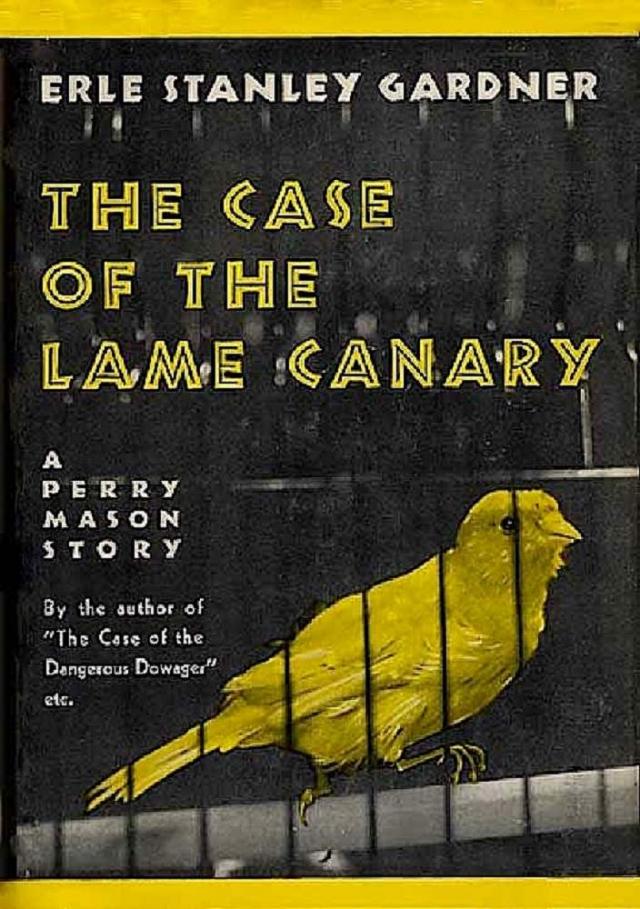
The Case of the Lame Canary (Perry Mason Series Book 11),
p.11


Cuff drew himself up and said, “Please don’t think I’m completely inexperienced, Mr. Mason. I did quite a bit of trial work in one of the outlying counties. My father wanted me to get started in the city, and Mr. Dimmick promised to take me on. I think you’ll find I know my way around in a courtroom.”
“Glad to hear it,” Mason said. “Glad to have met you both.”
Dimmick started stamping toward the doorway, paused to wait for Rodney Cuff to open the door. “Well,” he said, “I don’t like it. What’s more, the doctor tells me I mustn’t get excited. Keep calm. Take it easy. Don’t get angry. Don’t get excited. That’s what they tell me. Bah! Here I am, seventy-one, thrown into a criminal case, and if I get excited, it may kill me. Come on, Rodney. No need to take up more of Mason’s time. Glad I met you, Mr. Mason. Good-by!”
He stormed out of the door, and the sound of his cane banging down the corridor was distinctly audible until he reached the elevator. Della Street looked at Perry Mason and burst out laughing. “Now that,” she said, “is a situation.”
“I’ll tell the world it’s a situation,” Mason said, grinning, “and one not very much to my liking.”
“Why didn’t you agree to play ball with them?”
“Because I’m not going to tie myself up to Jimmy Driscoll—not until I know a lot more about where he fits into the picture. He shows too much natural aptitude to hide behind a woman’s skirts to suit me.”
“Emil Scanlon, the coroner, telephoned and left a message,” she said. “The inquest is going to be held tonight at eight o’clock and Scanlon says he’ll give you an opportunity to ask an occasional question if you want. He says as far as he’s concerned, he’s going to throw the whole case wide open.”
Mason nodded thoughtfully.
“Won’t that irritate the district attorney’s office?” Della Street asked.
“Ordinarily it would,” Mason told her, “but I have an idea the district attorney may be back of the move this time. He’s in something of a spot. He must smell a rat, or he wouldn’t have grabbed the canary as evidence. If Rosalind took the gun instead of Rita, he’d hate to charge Rita with murder. If the evidence gets mixed up, and he prosecutes the wrong person, he’s going to have a hard time backing up and going after the right one. It would suit him just as well if we all started fighting.”
“Then you’re playing right into his hands?” she asked.
“Doing what?”
“Refusing to co-operate with Driscoll’s attorneys?”
“That,” he told her, “remains to be seen. I’m not going to let anyone tie my hands.”
“Well,” she said, “right now you have an appointment to go down and have your passport pictures taken. There’s a Mr. Smith over in the Federal Building who was on one of your juries once. He’ll rush through the application.”
Mason nodded, grinned, and said, “Okay, Della, I’m going down to have my picture taken and get my passport.”
“I’ll let you see my passport picture if you’ll let me see yours,” she promised.
“Maybe we should get enlargements and hang ’em side by side in the office so the clients could have a treat,” Mason suggested.
She shook her head. “You know how passport pictures are. We’d look like a couple of crooks.”
Mason paused with his hand on the knob of the door and grinned across at her. “Well,” he asked, “aren’t we?”
CHAPTER TEN
THE RESPONSIBILITIES of his office rested lightly on the shoulders of Emil Scanlon, the coroner. Tall, middle-aged, good-natured, he regarded the gruesome aftermaths of tragedies which flowed through his office with the detached interest of a scientist viewing guinea pigs. He was a sympathetic man, but he reserved his sympathies for the living, where they could do some good, rather than for the mangled remains upon which he was so frequently called to hold inquest.
He called the inquest to order in a good-natured, matter-of-fact voice, his keen eyes flitting over the crowded room.
“The jury has now viewed the remains,” he said, “and we’re ready to take testimony. The proceedings here are going to be informal. In other words, I’m not going to stand on a lot of technicalities. Apparently this man didn’t commit suicide. Three people are being held by the authorities. They’re Rosalind Prescott, the widow, Rita Swaine, the decedent’s sister-in-law, and James Driscoll. Driscoll waived extradition and is here. Miss Swaine and the widow refused to waive extradition and are not here, so we can’t call them as witnesses. Oscar Overmeyer, the deputy district attorney, is representing the interests of The People. Perry Mason is representing Miss Swaine and Mrs. Prescott, and Rodney Cuff is representing Mr. Driscoll. Now, obviously, if these attorneys start getting technical and are allowed to get away with it, we’ll be here all night. The idea of this inquest isn’t to prove anybody guilty beyond all reasonable doubt, it’s simply to ascertain how the decedent met his death. In other words, we want to know just what caused Walter Prescott to die. And if the probabilities are someone killed him, we want to know who that someone was.
“Now, I’m to go ahead with this inquest, and if any of the interested parties want to co-operate with me, I’ll be glad to have them. But I’m not going to have this inquest used as an excuse to mix things up. Do you gentlemen understand me?”
The three attorneys nodded.
“The first witness,” Scanlon said, “will be George Wray.”
Wray held up his hand and was sworn.
“You’ve seen the remains of the decedent?” Scanlon asked.
“Yes.”
“Can you identify them?”
“Absolutely. Those are the remains of Walter Prescott, who was my partner in the firm of Prescott & Wray.”
“What sort of business?” Scanlon asked.
“Insurance adjusting.”
“When did you last see him alive?”
“The day before yesterday.”
“Did you talk with him yesterday?”
“Yes”
“Over the telephone?”
“That’s right.”
“At what time?”
“At approximately five minutes to twelve. I happened to look at the clock at the time.”
“Did he say where he was?”
“No, he didn’t. He said he expected to arrive at the office during the first part of the afternoon, and I happened to notice the time when he was telephoning because I’d had rather a busy morning and had more or less lost track of time.”
“What time was it?”
“Almost exactly five minutes of twelve. I think it was about five and one-half minutes.”
“By an office clock?”
“Yes.”
“You’ve checked that office clock since?”
“Yes, it’s an electric clock. It’s absolutely right to the second.”
“That’s all,” the coroner said.
“May I ask one question?” Perry Mason inquired.
The coroner nodded his permission, and Mason said, “Did you go out to lunch shortly after that telephone conversation, Mr. Wray?”
“Immediately afterwards,” Wray said.
“That’s all, thank you.”
Dr. Hubert, an autopsy surgeon, was called, identified three bullets, one of which had been taken from the body of the deceased, the remaining pair having been found in the room after having evidently passed entirely through the decedent’s body.
The physician described the course of the bullets. One of them had inflicted a wound which would not necessarily have been fatal. The other two inflicted wounds which were instantaneously fatal. Powder marks indicated the shots had been fired at close range. He described how the body had been found, and testified that death had been instantaneous. He fixed the time of death as between noon and two-thirty in the afternoon. The body had been discovered shortly before five o’clock in the evening.
E. Q. James, a criminologist attached to the district attorney’s office, identified a gun, together with micro-photographs of test bullets which had been fired from that gun which showed that they were identical with the three bullets which had been placed in evidence by the autopsy surgeon.
The coroner called Stella Anderson. She strode up to the witness stand, back rigid, chin up, eyes flashing, her flushed face showing her enjoyment at finding herself in the limelight. While she testified as to her name and residence, newspaper photographers snapped flashlight photographs of her on the witness stand.
Under questioning by the coroner, she repeated what she had seen in the Prescott house the previous day.
“And you saw this young man give the young woman a gun?” Scanlon asked.
“Yes, sir, I saw him hand her a gun. She opened the drawer in the desk and pushed it down in behind the drawer, then closed the drawer.”
“Who was this man?”
“That man sitting right there. The one in the blue suit.”
“You mean James Driscoll? . . . Stand up, Mr. James Driscoll. . . . Is that the man, Mrs. Anderson?”
“Yes—that is, he’s the man I saw running out of the Prescott house right after the accident, and he looks just like the man I saw with the gun. You see, those windows have very thin lace curtains behind them, and you can’t see quite as clearly as if they weren’t there. Not quite, but pretty near. I’m pretty positive that man I saw with the gun was this young man, James Driscoll.”
“Now, who was this woman?”
She faced him frankly and said, “I don’t know. I thought it was Rosalind Prescott. But later on, Rita Swaine appeared at the window wearing exactly that same dress, and trying to make me think—”
“Never mind what she tried to make you think,” the coroner said. “Just tell what you saw.”
Mrs. Anderson pressed her lips tightly together and said, “Well, I have my own opinion.”
There was a titter in the room, which was silenced by the coroner’s gavel. “Just what did you see, Mrs. Anderson?” he asked.
“I saw Rita Swaine standing at the window and clipping the canary’s claws.”
“Which foot, the right or the left?”
“The right.”
The coroner thanked her, excused her from the stand, and nodded toward Driscoll, who sat between a deputy sheriff on one side and Rodney Cuff on the other.
“Mr. Driscoll,” the coroner said, “as a matter of form, I’m going to ask you to take the stand and answer some questions. I realize, of course, that your attorney won’t allow you to answer them, but, just for the sake of keeping the record clear, I want your refusal to answer my questions to appear in the record of this inquest.”
Rodney Cuff, on his feet, was smiling and urbane. His voice, seemingly elevated hardly above a conversational tone, filled the crowded room with a vibrant resonance. “I think,” he said, “your Honor misunderstands our position. It is only the guilty who need to take refuge in technicalities. So far as James Driscoll is concerned, he will unhesitatingly answer any question put to him by the coroner or the deputy district attorney.”
There was a ripple of audible surprise in the room. Emil Scanlon exchanged puzzled glances with the deputy district attorney, then swore Driscoll as a witness.
“You’re acquainted with the decedent, Mr. Driscoll?” the coroner asked.
“Yes, I’d seen him once or twice.”
“You were acquainted with Mrs. Prescott?”
“Yes.”
“How long had you known her?”
“Something over eighteen months.”
“Had you at one time been engaged to her?”
“Yes.”
“What happened to that engagement?”
Driscoll moistened his lips with his tongue and said, “It was broken because of a quarrel.”
“How soon after that did she marry the decedent?”
“Within a month.”
“Now then, Mr. Driscoll, I’ll ask you if a letter was written by you and sent to Mrs. Prescott in which you suggested she leave her husband and get a divorce.”
“The letter itself is the best evidence,” Mason objected.
Cuff smiled. “I understand Mr. Mason’s objection perfectly,” he said. “But questions and answers will never incriminate this witness because he’s completely innocent. Go right ahead and answer the question, Jimmy.”
Driscoll said, “I wrote such a letter, signed it, put it in a stamped, addressed envelope, and mailed it to Mrs. Prescott. That was, I believe, four or five days ago.”
“In this letter you advised Mrs. Prescott to leave her husband?” the coroner asked.
“Yes.”
“You didn’t feel friendly toward him?”
“I did not. I thought he was a crook and a cheat.”
“You were jealous of him?”
“In a way, yes.”
“You had reason to hate him?”
“Frankly, I did.”
The coroner glanced appealingly at Cuff, then over to the deputy district attorney, and said, “I’ve never heard anything quite like this.”
Overmeyer nodded. Rodney Cuff said cordially, “Go right ahead, your Honor. You’re doing fine. Or would you prefer to have me ask the questions?”
“No,” the coroner said, “I’ll ask them. Now, you were in Walter Prescott’s house yesterday morning, Mr. Driscoll?”
“Yes.”
“At about what time?”
“At about the time mentioned by Mrs. Anderson. I didn’t look at my watch, but it was just a few minutes after eleven when I arrived.”
“Did Walter Prescott know you were coming?”
“No.”
“Had he invited you to visit his house?”
“No.”
“You went there for the purpose of seeing his wife?”
“Yes.”
“You saw her?”
“Yes.”
“And you armed yourself before going to the house?”
“I did. Walter Prescott had threatened to kill her. I considered him fully capable of doing just that. I intended to protect her from him.”
“By using that weapon?”
“I didn’t think I’d need to use it, but I wanted her to have it so she could use it if she had to in order to defend herself.”
“Did you make any protestations of love or affection to Mrs. Prescott?”
“I did,” Driscoll said, with some feeling. “I couldn’t bear the thought of her being unhappy. My emotions got the best of me. I took her in my arms and told her I still loved her; that I had always loved her.”
He was leaning slightly forward in the chair now, breathing rapidly. Press photographers pushed forward. Cameras clicked audibly.
The coroner said, “Let’s not have any misunderstanding about this, Mr. Driscoll. Did you kill Walter Prescott?”
“I did not.”
“Did you know he was dead?”
“Not until long after I had left the house.”
“Will you describe just what you did in the house after, let us say, eleven-thirty?”
“I was talking with Mrs. Prescott about her financial aflairs and the embezzlement of some twelve thousand dollars of her money by her husband. He had deliberately manipulated her affairs so he could steal this money.”
“Do I understand you communicated these sentiments to Walter Prescott’s wife?”
“Exactly,” Driscoll said with feeling. “He’d swindled her, lied to her and cheated her. He only married her for her money. I felt that he’d forfeited any rights he might have had as a husband.”
“But you knew the law regarded him as her legal husband and still clothed him with the rights of a husband?”
“Yes.”
“You knew there’d been no suit for divorce filed?”
“Yes.”
“And yet, before you left that house, you were planning to run away with this woman?”
“I was planning to take her to Reno, where she could institute a divorce action. At first I intended to let her go by herself. Later on I decided to join her on her trip.”
“And you did so?”
“I did.”
“Did you know Walter Prescott was dead when you left the house?”
“I did not.”
“Let’s get back now to what you were doing after eleven-thirty.”
“I lost my self-control and took Mrs. Prescott in my arms and told her that I loved her. Mrs. Anderson, watching from the adjoining house, can bear witness to that.”
Stella Anderson nodded vigorously.
The coroner said, “Never mind, Mrs. Anderson. You’re not on the witness stand now. You’ve already given your testimony. Go ahead, Mr. Driscoll. Tell us what happened after that.”
“After that I stepped into the other room to telephone the airport to get a reservation on the plane for Mrs. Prescott. I had just about finished telephoning when an automobile accident occurred in front of the place. I ran out to render what assistance I could, and then returned. Knowing that, because of the accident, I might be subpoenaed at any moment as a witness to that accident, and not wishing to leave Rosalind Prescott unprotected, I took the revolver from my pocket and gave it to her. That’s the Smith & Wesson .38 caliber revolver which has been introduced in evidence here. It was my revolver, but at the time I gave it to Mrs. Prescott it had not been fired. She told me that her husband had threatened to take her life, and I wanted her to have some means of protecting herself.”
“Then what did you do?”
“Then I left the house and ran into a couple of radio officers. They took my name, license number, and address, and told me I might be a witness. I told them I’d been telephoning at the time and hadn’t seen anything of what had occurred, but that didn’t seem to make any difference with them. Then I returned to Prescott’s house, told Rosalind Prescott that my identity had been discovered and I was afraid Walter would make some trouble, so I suggested we both leave at once for Reno.”
“What did she say?”
“She agreed.”
“Did she pack a bag?”
“Just a little overnight bag, some creams and things. She changed her dress, and we left at once by the side entrance.”
“Was there any conversation about what Mrs. Anderson might have seen?”















