

The case of the lame can.., p.19
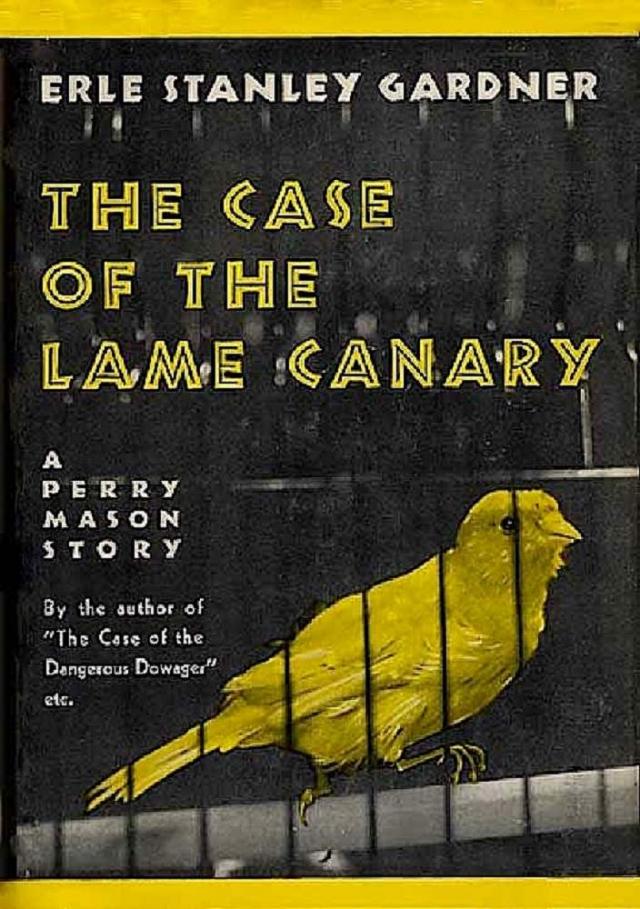
The Case of the Lame Canary (Perry Mason Series Book 11),
p.19


“Well,” she reported, “Sergeant Holcomb went tearing down to the Trader’s Transfer Company, hot on the trail of some baggage with the initials ‘D.M.’ on it. He found the baggage all right, and the more Trader tried to tell him it wasn’t mine, the more he thought Trader was in league with you. So he became pretty hostile and smashed open the baggage. He found a lot of property which had been surreptitiously moved from some of the buildings which had been fired by this gang of incendiaries. Of course, he didn’t know what it was at the time, but all of the fur coats and things made him suspicious. So he got in touch with the detective division and they identified the property in short order. So naturally, Sergeant Holcomb arrested me, and Judge Summerwaite signed the writ of habeas corpus and I got out just about the time Trader made some incriminating admissions.”
“Did Trader implicate Weyman?”
“Not by the time I’d left. He did implicate Prescott and this Diana Morgan. Now, suppose you be nice to a poor working girl and satisfy my curiosity as to what happened, and then give your undivided attention to your driving. Personally, I want to catch that ship.”
“Well,” Mason said, “it all started when I got to figuring the thing from the standpoint of psychology. I figured that Walter Prescott had the psychology of a murderer rather than that of a victim, so starting my reasoning in that goofy way, I got to wondering who his victim could possibly have been. And I began to think of Carl Packard’s disappearance. Then, suddenly, I saw a great light. Suppose Walter Prescott, as an insurance adjuster, had been standing in, either with or without Wray’s knowledge, with a gang of incendiaries. It would make a perfect set-up, and it wouldn’t have been the first time such a thing had happened. And if Packard had suspected Prescott, and was getting hot on the trail, Prescott would have been just the type to bump him off.
“But Carl Packard, who was a logical victim, couldn't have been a victim because he’d shown up at the hospital and made a voluntary statement that the accident had been his fault; that he’d been looking at something he saw in the window—and then the whole thing clicked in my mind.
“Packard was getting close on the trail of the real firebugs. They decided to murder him in such a way it would be virtually impossible to bring home the murder to them. You can see what happened: Weyman, one of the conspirators, let the gang beat him up enough so that he looked as though he’d sustained minor injuries in an automobile accident. Then, when Packard started out for Walter Prescott’s house, Harry Trader, with his big van, followed along behind, and, at the proper moment, smashed Packard into the curb. He promptly unloaded Packard, put him in the covered van—and note that the covered van was an important factor in the conspiracy—and hustled off toward a hospital. The next time we contact the injured man is when he appears in the hospital. But, just as a stage magician frequently substitutes watches when he’s walking from the audience up to the stage, so the victims were substituted during that journey in the covered van.
“The more I thought of it, the more I realized how perfectly plausible such a murder would be. Jason Braun, alias Carl Packard, was put into the van in an unconscious condition. He may have been dying then. For all we know, he was immediately the victim of the brutal assault which smashed in his head in such a way that identification became virtually impossible.
“When the covered van arrived at the hospital, Weyman, feigning unconsciousness, took Jason Braun’s place and was carried out on the stretcher.
“Now then comes the masterly touch. Jason Braun was to disappear permanently. The conspirators wanted to make it seem that there was nothing suspicious about his disappearance. Therefore, they pulled that traumatic amnesia business, and Dr. Wallace fell for it, hook, line and sinker. He patched up Weyman’s face, and Weyman came back to his house, having poured a little whiskey on his garments, taken a few drinks, and put on the act of having been drunk and fighting again.
“Now, when he arrived at the house, his wife told him of the latest gossip of the neighborhood; of what Mrs. Snoops had seen in Walter Prescott’s house.
“Weyman immediately realized what a wonderful opportunity it would be to murder Prescott and get away with it. And Prescott was a thorn in the flesh of the incendiaries. For the one person who we absolutely know Jason Braun suspected in connection with this gang of firegugs was Walter Prescott. The conspirators were afraid that if Braun knew Walter was tied up with them, other people might know it. And they also knew that if Walter were arrested, he’d implicate them.
“As a sheer coincidence, and part of the act which the conspirators had put on at the hospital, Weyman, posing as Packard, had stated that the accident was his fault because his attention had been distracted by something he saw in the window of the house.
“So Weyman dropped over to call on Walter Prescott,who had gone to his house following the accident, after the departure of his wife, and prior to the arrival of Rita Swaine. Weyman put on gloves, took the gun from its hiding place, approached Walter Prescott casually, under the guise of friendship, and fired three shots into him before Prescott knew what was happening, then returned the gun to its hiding place, and left the house.
“You see, the crime must have been committed after Jimmy Driscoll gave that gun to Rosalind Prescott. That is, if we’re to believe Wray’s testimony. And there’s no reason why we shouldn’t. In other words, Prescott was alive at eleven fifty-five. Virtually every minute of Driscoll’s time is accounted for after that. Of course, he might have left the telephone and killed Prescott. But I couldn’t figure him as Prescott’s murderer because of things entirely foreign to the time element.
“Notice the manner in which Prescott was killed: He was killed in his bedroom. He was killed with no evidence of struggle. He was killed by someone, who, under the guise of friendship, was able to walk quite close to him, produce a gun and fire three times before Prescott realized he was in any danger.
“Prescott had previously mentioned to the police that someone had been prowling around the house, and, he thought, intended to kill him. It’s quite possible that he had seen Braun while that individual was making some preliminary investigations. In any event, Driscoll, who was his sworn enemy, could not have approached him in the limited time which Driscoll had within which to act, and fired the fatal shot—not in the bedroom of his own house. Prescott would have been too much on his guard, too hostile. No, Prescott was killed by a friend, someone he trusted.
“Rita Swaine could have done it. Stella Anderson might have done it. Mrs. Weyman could have done it. None of those three really would have done it. Rita wouldn’t have taken the gun from its hiding place after she had gone to so many pains to let Mrs. Snoops see her in the solarium. Mrs. Snoops and Mrs. Weyman could have had no possible motive for the murder. None of the three could have approached Walter in his bedroom without arousing Walter’s suspicions.
“There was only one other person who knew that the gun was hidden in that place, and that was Weyman. His wife must have told him, and asked him what to do, whether to call the police, and so forth. Thinking the thing over, it all became perfectly clear.
“Having reasoned that far, and assuming that Prescott was in a conspiracy to get places of business heavily insured, remove the most valuable goods from the buildings fire them, and subsequently, as an adjuster, hold up the insurance company for a splendid settlement, I realized that the gang must have some way of disposing of the goods.
“The redhead in Prescott’s office looked like a phony to me. In other words, she didn’t look the part of a legitimate stenographer, secretary and receptionist. As soon as an investigation disclosed that she was leading a double life, I knew I was right. As Diana Morgan, a rich divorcee who traveled about the country, she was in a position to have boxes and bags brought to her apartment, taken out by Trader, and eventually dispose of the merchandise. Her apartment in the Bellefontaine made an excellent place in which to hide and sort over the loot. Later on, when the conspirators were ready to dispose of it, they could move it out, all packed in trunks, bags and boxes.”
“How about .Jimmy Driscoll?” Della asked.
“Driscoll,” he said, “or Rodney Cuff, his lawyer, or both, evidently had some inkling of what was going on. I think Jimmy tried to implicate Rita in order to free himself and Rosalind, so the two of them could work to bring about a solution of the case. Unfortunately, I won’t have time to conduct any post-mortems on the clues with Rodney Cuff. However, that young man apparently has considerable on the ball. He figured out just about what had happened all the way along the line.”
“Then,” Della said, “Weyman and Trader must have stolen a car, taken Jason Braun’s body out into the Santa Monica Mountains, wrecked the car, and left the body in such a manner that the features were practically unrecognizable. Is that right?”
“That’s right,” he said, “only I think what happened to Braun’s features took place in the covered van on the road to the hospital. It isn’t a nice thing to think about.”
They drove in silence for a couple of miles. Then Della Street said, “Why did you want Sergeant Holcomb to get into that baggage?”
“Because,” he said, “I figured we needed proof. I didn’t want to start exposing Weyman until I had something definite. Weyman was so clever he acted the part of a surly ox and fooled me. When I realized the truth, I thought he’d dodge the subpoena and it would be necessary for me to make some accusations in open court. You see, Weyman had absolutely nothing to fear from any person in the world except one man. That man was Dr. James Wallace. Knowing that Dr. Wallace would probably be a witness at the inquest on Jason Braun’s body, I couldn’t believe that Weyman would have the audacity to show up. But that’s where Weyman was more clever than I gave him credit for. You see, if he’d refused to obey the subpoena, that would have been an incriminating circumstance in itself. So Weyman outsmarted everyone by claiming that his face had become infected, and bandaging it in such a way that no one could recognize him.
“I thought, of course, that after Holcomb had once got on the trail, he’d shake down Trader and Rosa Hendrix until he got all the dope. But, by that time, our ship would’ve sailed. If Weyman showed up at the autopsy, I wanted to make a spectacular, whirlwind finish. I explained to Scanlon generally what I was working on, and Scanlon agreed to give me a free hand, within reasonable limits.”
“Why didn’t you go to Holcomb and tell him?” she asked.
Mason chuckled and said, “In the first place, Holcomb would have tried to grab all the credit, and, in the second place, he wouldn’t have co-operated. I could never have got Mm to search the luggage of Diana Morgan if it hadn’t been for making him think that baggage contained stuff which would implicate you and me.”
“How did you happen to suspect Weyman as the guilty party, Chief?”
“To begin with, he and Prescott both moved into the neighborhood at the same time—six months ago. Knowing that if a switch of victims had been made in that van, the man who went to the hospital must have had medical treatment, and remembering what Dr. Wallace had said about the injuries being facial and superficial, the wonder of it is that I didn’t suspect Weyman before.”
“Was Trader in on Prescott’s murder?” she asked.
“No. He knew nothing about it until later, because he went right ahead and delivered the stuff to Prescott’s garage. Then, learning of the murder, and knowing the police would search the garage, he sneaked the stuff up to Diana Morgan’s apartment, to take it out last night concealed in inexpensive trunks and suitcases which would enable it to be shipped.”
She frowned thoughtfully, then asked, “Why did Weyman support Driscoll by swearing he’d seen him at the telephone?”
Mason laughed. “Because he was clever as hell. He didn’t care about Driscoll, but by swearing, apparently unwillingly, that he’d been standing where he could see Driscoll, he gave himself an alibi for the time of the auto accident, just in case anyone should get to wondering. It was a clever move. You see, he told his wife all about it, knowing she’d tell Mrs. Snoops, and knowing Driscoll’s lawyer would interview Mrs. Snoops. The way he staged it fooled everyone. I might have doubted whether it was Jimmy Driscoll he saw at the phone, but he planted his build-up so smoothly that until I went back to first principles I never doubted that Weyman was there on the street, instead of in the van.”
“All right,” she told him. “I know enough now to figure it all out. If there are any loose ends I can tie them up myself. You pay attention to your driving.”
Mason stole a glance at his wrist watch, frowned, and pushed the accelerator down close to the floorboards. “And how!” he said.
CHAPTER SEVENTEEN
THE President Monroe had blown its fifteen-minute whistle. One minute to go. All visitors had been ordered ashore. Dock-hands were standing at the gangplank, ready to take it up. The band was playing.
Clouds which had blanketed the bay earlier in the morning were lightening somewhat, with patches of blue sky showing through. Streamers of colored paper furnished ribbons of color which stretched from passengers on the upper decks to friends who had gathered on the dock to say farewell. The edge of the wharf was lined with people calling out good-natured banter to those who were standing at the ship’s rail.
The uniformed officer who was importantly directing the parking of cars stifled a yawn. Half an hour before, cars had been arriving by the score. Five minutes later, they would be leaving in droves. Right now he had nothing to do, save push his chest against his uniform and strut importantly up and down the pavement.
He looked up as he heard the sound of screaming tires, the roar of an automobile. He raised his whistle to his lips, then jumped to one side to avoid being struck as a car skidded sideways, swung half around, and lurched to a stop.
Mason jumped out, yelled at him, “Park that car somewhere,” grabbed Della Street, and, together, they raced up the gangplank just as the hoarse bellow of the ship’s whistle aroused echoes along the waterfront.
The gangplank was pulled away. Lines were cast off. The lawyer and his secretary, breathless from their mad scramble, stood by the rail, laughing, panting, and looking down across the widening strip of oily water at the sea of upturned faces.
Suddenly Mason said, “Look down there, Della, over against post number seven.”
Della Street followed the direction of his eyes. Rodney Cuff, Jimmy Driscoll, Rosalind Prescott, and Paul Drake were gathered together in a compact group. Drake spotted them just as Della Street looked. He said something to his companions, then raised his voice and yelled, “Perry! We burnt up the road to get here. A client of mine has a case he wants you to take. This is right down your alley. He has plenty of money and—”
“Not interested,” Mason called back.
“You can come back with the pilot,” Drake shouted, “and—”
“Not interested,” Mason interrupted, waving his hand. “I have a date in Singapore with a lady.”
Cuff shouted, “I wanted to congratulate you. You got out of the courtroom before I knew you were going. Wonderful work, Counselor.”
“Thanks,” Mason called. “Hey, Paul, tell your man to take Ms case to Rodney Cuff. Good-by! I’ll send you a card from Waikiki!”
The big engines throbbed into vibrations as the ship gathered speed. Drake yelled something which was unintelligible. The dock with its human fringe of waving figures slipped astern.
Mason turned to Della Street. “How’s that,” he asked, “for keeping a promise?”
Her face flushed, her eyes starry, she looked up at him, the fresh wind from the harbor blowing her hair about her flushed cheeks.
“Swell,” she admitted.
“Now,” he said, “we are confronted with the problem that all your baggage is initialed ‘D.M’ What are we going to do about that?”
“Can’t we have the initials erased?” she asked.
“Not very well,” Mason said, his eyes twinkling. “They’re stamped into the leather. I’ll tell you what you could do, though.”
“What?” she asked.
“If,” he said, “you became Mrs. Mason, the initials would be perfectly all right. They would then stand for ‘Della Mason’ instead of ‘Diana Morgan.’ ”
“Are you,” she asked, “proposing to me?”
He nodded.
She looked thoughtfully down into the water, then raised her eyes to face him frankly.
“As your wife,” she asked, “would I continue to be your secretary?”
“Hardly. I couldn’t give you orders. It wouldn’t set well with the clients. But you wouldn’t need to work. You could have a car of your own and—”
“That’s what I thought,” she interrupted. “We’re getting along swell the way it is. You’d establish me in a home somewhere as your wife. Then you’d get a secretary to help you with your work. The first thing you knew, you’d be sharing excitement and experiences with the secretary and I’d be entirely out of your life. No, Mr. Perry Mason, you aren’t the marrying kind. You live at too high speed. You’re too wrapped up in mysteries. I’d rather share in your life than in your bank roll.”
“But think of all that baggage,” he told her, sliding his arms around her waist. “It has those perfectly good initials, ‘D.M.,’ which we can’t let go to waste.”
She snuggled close to him. “No,” she said, “I think my hunch is right, Chief. I think it would be better for me to remain Della Street and have the baggage wrong than to become Della Mason and have everything else wrong. But—well, I’ll tell you what I’ll do—ask me again in Singapore.”
“It’s a long ways between here and Singapore,” he told her. “How about Waikiki?”
She laughed, flung back her head to catch the wind on her cheeks and forehead. “Always impatient,” she said. “Come on. Let’s walk the deck. I don’t think you need a wife. But I know damn well you need a secretary who’s willing to go to jail occasionally to back your play.”















