

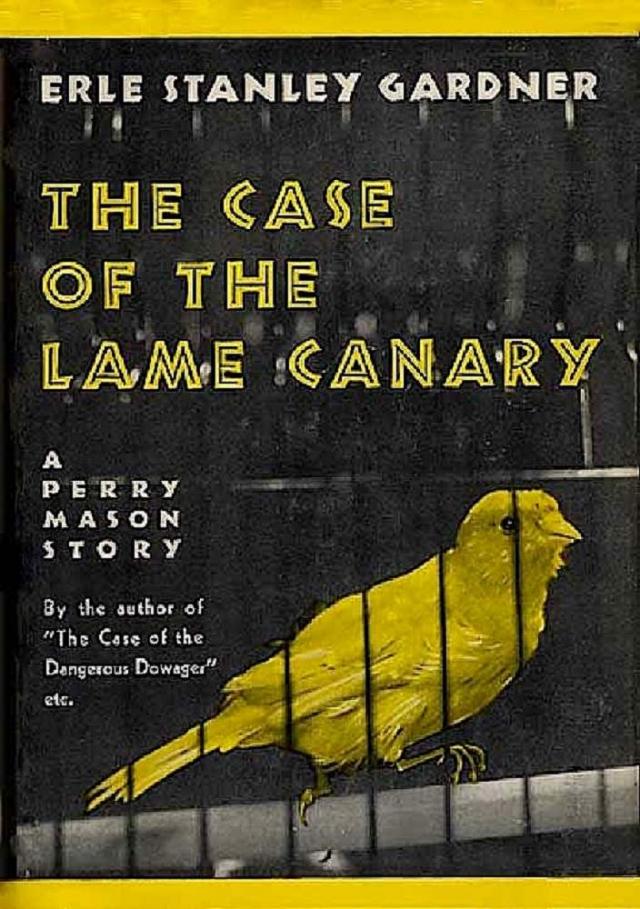
The case of the lame can.., p.8
The Case of the Lame Canary (Perry Mason Series Book 11),
p.8


Mason raised his eyes to Driscoll. “How about you, Driscoll, are you going to keep quiet about my having been here?”
Driscoll said, “You don’t seem to have any confidence in me, and I don’t see why I should have any in you. I’ll give you no promises.”
“Jimmy!” Rosalind Prescott exclaimed. “Can’t you see Mr. Mason is taking a big risk just in order to protect us? Can’t you—”
The telephone rang. Mason pushed past Driscoll to jerk the receiver from its hook and say, “Hello!”
Della Street’s excited voice said, “Sergeant Holcomb and two local deputies, with big sombreros and tanned faces, are just getting in the elevator, Chief.”
“Grab a cab,” he told her. “Beat it to the airport. Meet me there. If I don’t show up in an hour, head back for the office. Hang up your phone, quick!”
Mason jiggled the hook up and down with his finger until the hotel operator said impatiently, “Yes, what is it? No need to have a fit! That hurts my ear.”
Mason said, “I’m in a hurry. This is Perry Mason, a lawyer. I want to report that there are three persons in room three thirty-one who are wanted by the Los Angeles police. There’s Rosalind Prescott, registered under the name of Mildred Owens, Jimmy—”
Jimmy Driscoll lunged for him. Mason, holding the receiver to his ear with his left hand, lashed out with his right, catching Driscoll on the point of the chin. As the young man staggered back, Mason went on evenly into the telephone, as though there had been no interruption, “Driscoll, both of whom are wanted for the murder of Walter Prescott in Los Angeles. There’s also Rita Swaine, Rosalind Prescott’s sister, who is wanted for questioning in connection with the same murder.”
Driscoll, recovering his balance, came charging forward. Mason slammed the receiver back on its hook and said, “Stop it, you fool! The jig’s up. Now listen, Rosalind, you and Rita are going to be questioned. Don’t answer questions. Don’t waive extradition. Stand on your constitutional rights. Don’t do anything unless I’m—”
A peremptory pounding on the door interrupted him. A man’s voice said, “Open up in there!”
Driscoll stood glowering at Mason. Rosalind Prescott was watching him with a puzzled question in her eyes. Mason pushed past Rita Swaine, and unlocked the door.
Sergeant Holcomb, accompanied by two bronzed men in Stetsons, pushed forward, then came to a surprised halt as he saw Perry Mason.
“You!” he said.
“In person,” Mason assured him.
A grin suffused Holcomb’s features as he said, “Well, isn’t that nice. You knew that these people were wanted by the police. You smuggled them across the state line and—”
“Wait a minute,” Mason interrupted. “I had nothing to do with their crossing the state line.”
“That’s what you say,” Holcomb sneered.
“It’s what I say,” Mason said, “and it’s what I can make stick.”
“Okay. Anyway, we catch you here, plotting with them, avoiding the police.”
“That wasn’t what I was doing at all.”
“Oh, yeah? Well, try and tell that to the Grievance Committee of the Bar Association.”
Mason said, “As it happens I don’t have to tell anything to the Grievance Committee of the Bar Association. I came here because I had reason to believe a person registered in this hotel as Mildred Owens was, in fact, Rosalind Prescott, who I happened to know is wanted by the police for murder. The fact that she happens to be my client in connection with another matter has nothing to do with it.”
Holcomb said, “Try and make that stick.”
“And,” Mason went on, “as soon as I found out the true facts, I determined to surrender her to the police.”
Holcomb said, “Don’t make me laugh. My side hurts. I’ve heard some wild stories in my time, but that’s the wildest.”
Mason nodded toward the telephone. “If you’ll kindly call the operator you’ll find that I asked her to notify the police several minutes before you arrived.”
Holcomb stared at Mason, said, “I’ll just nail you to the cross on that one before you have a chance to bribe the telephone operator to commit perjury,” picked up the telephone receiver and said, “Did anyone from this room try to call police headquarters?”
The receiver made squawking noises. Holcomb’s face showed chagrin as he listened. He said, “All right, forget it! The police are here,” and slammed the receiver into place. He glowered at Mason. “There’s something fishy about this. We’ll pass it for the moment, but I’m not done with it—not by a long ways. You’re representing Rosalind Prescott, Mason?”
“Yes.”
“Representing Driscoll here?”
“No.”
“Representing Rita Swaine?”
“Yes.”
“All right. How about waiving extradition?”
“You’re arresting them?”
“Yes. On suspicion of murder. Will you waive extradition?”
Mason smiled at him and said, “I’ll wave my hands, and that’s all.”
“Get out!” Holcomb ordered.
Mason picked up his hat and said, “Remember, you two, don’t say a word in answer to any question unless I’m there and advise you to answer that question. They can’t make you talk if you don’t want to. Don’t want to. I’ll do the talking. Don’t waive extradition. Don’t sign anything. Don’t volunteer any information and remember that they’ll pull the old police gag of telling each one of you the other has confessed and—”
The three converged on him, ominous purpose in their eyes. Mason slipped adroitly into the corridor, said, “Good night, gentlemen,” and slammed the door shut behind him.
There was no sign of Della Street in the lobby. He went by cab to the airport, found the pilot and said “Have you seen anything of the young woman you brought up here?”
“Why, no,” the aviator said. “I thought she was with you.”
Mason said, “Get your plane out and warm it up. Hold it in readiness.”
It wasn’t until the motors had been turning for several minutes that a shadowy figure emerged from the darkness to touch Mason lightly on the arm. “Everything okay, Chief?” she asked in a low voice.
“Lord, you gave me a fright!” he said. “I thought they’d nabbed you.”
“No,” she told him, “but I figured it would be a good move for me to keep out of sight in case they came out here prowling around. What did you do?”
“Covered myself with whitewash,” he told her, “by telephoning for the police. Thanks to your tip, I had an opportunity to get the thing all planted before Holcomb pounded on the door. Holcomb’s suspicious, but he can’t prove anything.”
The aviator said, “I’m ready. How about it?”
Mason nodded. “Let’s go,” he said.
CHAPTER EIGHT
MORNING SUN was streaming through the windows of Mason’s private office, as he opened the door from the corridor and stood regarding Della Street with a whimsical smile.
She was standing by his desk, putting the finishing touches to an arrangement of maps and circulars which completely covered the top.
“Ship ahoy!” Mason called. “Where are we—Java, Singapore, or Japan? Lower the gangplank so I can come aboard.”
She made motions of turning a windlass. “Okay, Chief,”she said, “watch your step. Those sampans are tricky things to step out of. Here you are. Now climb this ladder. Okay. Here, give me a hand.”
She stretched forth her right hand, clinging to the desk with her left. Mason gripped her hand, gave a long jump to reach her side and said, “How’s this?”
“That’s fine. Now you’re aboard. What do you think of it?”
“Wonderful! Is this my steamer chair?” he asked, indicating the office chair.
“Yes,” she said. “Just settle back and relax and look at the scenery. Over here’s Honolulu. That’s Diamond Head just beyond the beach at Waikiki. See the natives riding the surf with outrigger canoes? The circular says you get a speed of thirty or forty miles an hour, coming in for almost a mile, riding the crests of the huge breakers. Look at the way the water hissed up from the bow.”
“Too tame,” Mason told her, “I want to be the chap riding the surf board.”
“They say that takes lots of practice.”
“Well,” he told her, “it’d be fun learning. Where do we go from here?”
She indicated the next circular. “Tokio,” she said. “That is, the boat docks at Yokohama. We can see Yokohama and then take a run up to Tokio. And after that, here’s Kobe,” indicating another circular, “and then we cross the Yellow Sea and go up the river to Shanghai.”
“How about side trips?” Mason asked. “Do we stop off in between boats?”
“We can if you want, but what you need is a rest. So I thought it would be better to get on a ship, pack our stuff in staterooms. Take all we want, and not have to bother with loading and unloading it, getting it through customs, and into hotels. In case you don’t know it, you have a de luxe suite, all the way around the world. Starting Saturday afternoon you can unpack your trunks, put on your bathrobe and slippers, be where there are no telephones, hysterical women, or lame canaries.”
“That’s swell,” Mason said, grinning. “Speaking of lame canaries, do you suppose we could send a cablegram to Paul Drake and find out what’s happening in the present case? After all, you know, we have to make a living in order to pay for de luxe suites on the Dollar Steamship Lines.”
“Yes,” she said, “I presume we could reach him by cable, although I hope you won’t try to carry your business along with you.”
“Oh, not in the least,” he said, grinning. “Where are we now, in Kobe?”
“No. We were in Shanghai, the last stop. But, why bother with cablegrams? Why not use International Long Distance?”
“Now there's a thought,” he said. “Let’s get him on the line.”
Della Street put through the call, said to Perry Mason, “Remember, you’re only as far as Shanghai, then you go down to Hong Kong, Manila, Singapore—Oh, yes, that’s one optional side trip. We can stop over at Singapore and run down to Bali, Java and Sumatra. I’ve arranged for that trip at your option.”
“Okay,” he told her, “let’s take that trip. We may as well see it all while we’re doing it. Besides, if we stay on one ship too long the captain might commit a murder and I’d have to represent him. Say, Della, how about stopping over in Honolulu, running down to Australia with Captain Johansen on the Monterey, and—”
She said into the telephone, “Hello, Mabel, this is Della. The boss is in and wants to talk with Paul. . . . Okay, put him on. . . . That folder up in the upper right-hand comer of the desk is the one on Bali, Chief. Better look at it. . . . Hello. . . . Just a minute, Paul. The boss wants to talk with you.”
Mason whistled and said, “Wait a minute. Is this Bali?”
“That,” she told him, “is Bali.”
“All right,” he told her, “we stop off at Bali. . . . Hello, Paul. What’s new under the sun?”
“Read the papers?” Drake asked.
“Yes. I see that the police have taken a tumble to Packard, and are giving plenty of publicity to his disappearance.”
“Not only that,” Drake said, “but they aren’t getting anywhere. It’s no wonder I couldn’t locate him, with the limited resources which are available to a private detective agency. The police have been moving heaven and earth to find him and can’t even get a trace of him.”
“But surely,” Mason said, “they must have been able to uncover something about him in Altaville.”
“Not a trace,” Drake said. “At any rate, nothing they can work on. Packard is the most important witness in this case, and he’s wandering around the city somewhere, in a daze. The probabilities are his amnesia came back on him and he doesn’t know who he is.”
“You’ve been running down all the leads?”
“I’ll say so. I’ve covered the hospitals, jails and every other lead I can think of. The police have been doing the same. They’ve combed the city, looking for an amnesia victim. They’ve uncovered drunks, idiots, crooks and bums, but not a trace of Packard.”
“How about his coupe?”
“The police figure he might have contacted some garage to come and move the car, and perhaps given an incorrect address. I understand they’ve covered every garage which has a tow car and still haven’t learned a thing.”
“Have they moved the wreck?”
“No. They’re leaving it there, hoping Packard may come back to it or send after it. If he shows up, they’ll grab him.”
Mason frowned thoughtfully at the telephone for several seconds, then said, “Come on in here, Paul. I have an idea I want to talk over with you.”
He hung up the receiver and indicated his desk with a sweeping gesture. “I’m sorry, Della, vacation’s over.”
“You aren’t going to stay in Shanghai?”
“No,” he told her. “We’ll have to let the boat sail without us, and come back on the clipper.”
“That’s what I was afraid of,” she said, picking up the folders one at a time. “Listen, Chief, you aren’t going to back out on this vacation, are you?”
“No,” he told her with a grin, “we sail, as per schedule, if I can clean up this case of the lame canary. And that case begins to look more and more complicated, and our sailing that much more uncertain.”
Paul Drake tapped lightly on the panels of the corridor door, and Della Street let him in. Drake crossed over to slide into the big overstuffed leather chair, and said, “What’s on your mind, Perry?”
“Simply this,” Mason said. “That doctor out at the hospital was a little too self-satisfied, a little too positive, a little too definite in his diagnosis.”
“What do you mean?”
“That traumatic amnesia business,” Mason said. “The man had been in an accident. He had amnesia. Immediately the doctor decided it was traumatic amnesia. Nine hundred and ninety-nine times out of a thousand, it would have been. But then the patient wouldn’t have left the hospital and had a return attack. Now then, Paul, suppose that it wasn’t traumatic amnesia, but was a case of chronic amnesia? Suppose it was amnesia which leaves a man on the border-line of normalcy?”
“Is there an amnesia like that?”
“I don’t know. I’m not trying to study medicine, I’m trying to list causes and get results. I want to add figures and get the answer.
“Now I’ve never had amnesia myself, but I’ve forgotten names that I wanted to remember lots of times, and I suppose a man who forgets his own identity has just about the same symptoms as someone who forgets the identity of another person. In other words, he has spells during which he can almost get it. The name does everything but pop into his mind, but vanishes again just as soon as he tries to concentrate on it.”
“I know what you mean,” Drake said. “Go on from there.”
“If that’s the case,” Mason said, “this man Packard leads sort of an intermittent life. He wakes up in the morning, or has a shock of some sort, and can’t remember who he is. He starts groping with the problem. He can almost remember, but not quite. He thinks he’s Carl Packard of Altaville. He goes under that name for a while. Then something happens and he forgets it. A man gently reminds him of Altaville, and the association of ideas brings the name Packard back to his mind. For a moment he thinks he’s Packard, but just as soon as the effect of suggestion is withdrawn, he can’t remember who he is.”
Drake said, “What you mean is that the man’s name may be something like Packard, and he probably does come from Altaville.”
“That’s it,” Mason said. “Now, there aren’t many names which sound like Packard. But Packard is the name of an automobile. Now, suppose you start men at work in Altaville, looking up every person who has disappeared, and particularly seeing if you can’t locate someone by the name of Ford or Lincoln, or Auburn, who is taking an automobile trip somewhere and hasn’t written to any of his friends for several weeks.”
Drake nodded and said, “It’s a good hunch, anyway.”
“Now here’s another one,” Mason said. “Let’s suppose this man has one of these spells, and there isn’t some doctor available to adroitly suggest to him that he really is Carl Packard of Altaville. Then he’d be apt to take some other name. Now, we don’t know how long he’s been here in the city. So, in addition to the Altaville angle, start men working on every disappearance which has been reported within the last two months. In other words, if a man walks out of a hotel or apartment and doesn’t come back, but leaves his things, under circumstances which make it look as though he wasn’t trying to beat a hotel bill, we may have a live lead. I don’t think it’s going to be very difficult to find those cases because the police will have records of all of them. Get in touch with the Missing Persons Bureau at headquarters, and sift through their records. Do it in a rush, because the police may have the same hunch, and I’d like to talk with Packard before the district attorney sews him up. And don’t forget Doctor Wallace said he was headed for San Diego. So do some work on that angle, too.”
Drake nodded and said, “I’ll get at that right away. Now here’s something else, Perry: I’m uncovering a lot of stuff about Prescott. Most of it doesn’t have any particular significance and won’t mean anything until I’ve got enough stuff to be able to put it all together in a complete report. But here’s something you can get a lot easier than I can: Prescott had an account over at the Second Fidelity Savings & Loan. Naturally, they aren’t passing out information to strangers about the accounts of their customers, but I did find this out: There’s something fishy about it. Large deposits were made in the form of cash. And, unless Prescott’s business was a gold mine, he was getting some cash from outside sources.”
“Sure he was,” Mason said grimly. “He got twelve thousand bucks out of his wife, and I only hope his account shows where he deposited that much in cash.”
Drake said significantly, “If my information’s correct, Perry, twelve thousand dollars isn’t a drop in the bucket. He deposited over seventy-five thousand dollars since the first of the year.”















