The case of the lame can.., p.2
The Case of the Lame Canary (Perry Mason Series Book 11),
p.2


“How seriously was the man injured?” Mason asked.
“I don’t know. He was unconscious when Jimmy helped load him in the van.”
“Do you know who owned the van?”
“Yes, there was a sign. It’s ‘Trader’s Transfer Company.’ ”
“How about the coupe?”
“It’s still out in front,” she said, “pretty badly smashed. The license number is 6T2993, and the registration certificate wrapped around the steering post shows that it’s registered in the name of Carl Packard, who lives at 1836 Robinson Avenue, Altaville, California.”
Mason nodded, turned to Della Street and said, “Ring the Drake Detective Agency, Della. Ask Paul Drake to step in here.” Then to Rita Swaine, “I’ll get busy right away and see what can be done about that automobile accident. In the meantime, you tell your sister to come in and see me.”
“I don’t know just where Rossy is right now,” she said, “but as soon as I hear from her I’ll tell her to come in.”
“Where can I reach you?” Mason asked.
“I’ll be at my apartment.”
The lawyer glanced across at his secretary. “You have the address, Della?”
“Yes,” Della Street said. “What’s your telephone number, Miss Swaine?”
“Ordway six-naught-nine-two-two.”
Mason arose, crossed the office, and opened the corridor door.
“Isn’t there a retainer to be paid now?” Rita Swaine asked, opening her purse and pulling out a sheaf of currency.
“Now now,” Mason told her. “After all, you know, I asked for this. . . . And you’d better put that money in the bank, young lady. Good Lord! You don’t carry sums like that around in your purse, do you?”
“Of course not. I thought you’d want some money before you went ahead with the case, so I stopped at the bank and got two thousand dollars.”
Mason started to say something, then smiled, held the door open for her and said, “Well, you’d better put it back in the bank, Miss Swaine. I’ll fix a fee later on when I feel more generous. Right now I can only think of you as a young woman who spoiled a mystery. Good afternoon.”
“Good afternoon, Mr. Mason,” she said. She put the money back in her purse, picked up the canary cage and walked rapidly from the office. In the corridor she paused to inquire, “Do you know anything about the pet store that’s in this block?”
“The man who runs it,” Mason said, “was once a client of mine. He’s an old German, quite a character. Karl Helmold’s the name. Why did you ask?”
“I thought I’d leave Dickey there for a while.”
“That’s the canary?”
“Yes. Then, when Rossy gets settled she can send for him. But I’d want to be certain that Walter wouldn’t know where I’d left him.”
“I’m quite sure,” Mason said, “you can trust the discretion of Karl Helmold. Tell him I sent you.”
She nodded, and her clacking heels echoed rapid steps as she walked toward the elevator.
Mason closed the door and turned to Della Street.
“That,” he said, making a wry grimace, “is what comes of trying murder cases. I’m constantly translating everyday occurrences into terms of the bizarre. That girl came in here carrying a caged canary. She was excited, nervous and upset, and I, like a fool, began to clothe her with all sorts of mysterious backgrounds.”
“Why didn’t you refuse to take her case, Chief?” Della Street asked.
“Not after I’d pried into her private affairs, Della. Remember, this is just a business with us. It’s something else to the client. The sister’s divorce case is a chore to me, but right now it’s the most important thing in that young woman’s life—except her love affair with Jimmy Driscoll.”
Della Street surveyed the lawyer with thoughtfully speculative eyes. “Chief,” she said, “speaking to you as a woman who is under no illusions as to her sex, and is, therefore, immune to feminine wiles and tearful entreaties, did it occur to you there’s something strange about the way she reacted to that love affair? She wouldn’t look you in the eyes when she talked about it. She acted as though it were something furtive, something to be concealed, something of which she was ashamed. Don’t you think that she may have doublecrossed her sister more than she admits—in order to get Jimmy, I mean?”
Mason chuckled delightedly and said, “There you go, Della. I tell you, it’s too many murder cases. First it’s a caged canary which throws me for a loss, then this love affair gets you. What we need’s a vacation. What do you say we chuck the whole business and take a trip around the world? I’ll look into the jurisprudence of the different countries we visit, and you can take notes on what I find.”
Her eyes widened. “You mean it, Chief?”
“Yes.”
“How about the law business?”
“We’ll leave it. Jackson can handle routine matters while I’m gone, and there’ll be plenty of big things when we get back.”
“And how about this case?”
“Oh,” Mason said casually, “we’ll get Rossy out of her difficulties. That won’t take long.”
Della Street picked up the telephone and said to the exchange operator in the outer office, “Get me the Dollar Steamship Company on the line. Right away, please, before the boss changes his mind.”
CHAPTER TWO
PAUL DRAKE, head of the Drake Detective Agency, braced his tall, thin form languidly against the door jamb. The film which covered his slightly protruding eyes seemed like a veil drawn between his thoughts and the outer world. During moments of repose, his fish-like mouth hung partially open, giving his face an expression of droll humor. Even an acute observer would have admitted he looked more like a drunken undertaker than a detective.
“My God, Perry,” he said, in drawling protest, “don’t tell me you’re starting on another case.”
Mason nodded.
“I wish,” Drake went on in the same good-natured, drawling voice, “that you’d take a vacation for my health.”
“What’s the matter, Paul? Can’t you take it any more?”
Drake sauntered over to the big leather chair, sat down in it cross-wise, one of the chair’s arms supporting his back, the other catching his legs just back of the knees. “I’ve known you now for five years,” he said reproachfully, “and I never saw you yet when you weren’t in a hurry.”
“Well,” Mason told him crisply, “I’m not going to break the record now, Paul. Some time around noon, out near the corner of Fourteenth Street and Alsace Avenue, a truck owned by the Trader’s Transfer Company smashed a coupe driven by Carl Packard of Altaville, California. It should be a cinch to chase down. Packard was injured, and the truck driver put him in the van and rushed him to a hospital. Find out which hospital, how seriously Packard was hurt, whether he’s insured, whether the truck’s insured, how the truck driver reported the accident, whether the trucking company will admit liability, and how much the case can be settled for by whichever party was in the wrong.”
Drake said, “And you want all of this in a hurry?”
“Yes. I’d like to have the information in an hour.”
“And that’s all you want?”
“No. Here’s another one. Walter Prescott, 1396 Alsace Avenue, suing his wife for divorce. Find out who his girl-friend is.”
“What makes you think he has one?”
“He short-changed his wife out of twelve thousand bucks. He didn’t put it in his business.”
“Any leads?” Drake asked.
“Nothing in particular. He’s an insurance adjuster. The firm name is Prescott & Wray, and they have offices in the Doran Building. Find out where he buys his flowers. Get a look at the delivery addresses at the florist’s. Have an operative bust into Prescott’s office and claim that a young woman driving Prescott’s automobile smashed into him and ripped off a fender and hasn’t settled. Watch what number he calls up when he refutes the story. Put a couple of shadows on him and find where he goes when he isn’t at the office.”
“Suppose he’s wise and doesn’t go?”
“Write him an anonymous letter that his sweetie has another boy-friend who calls on her every afternoon. Start him moving around, then see where he moves to.” Drake pulled a leather-covered notebook from his pocket and wrote names and addresses.
“Here’s something else,” Mason said. “A Stella Anderson has the house next door to the Prescott place. Apparently she’s the neighborhood gossip. Drop in and kid her along. See if she can’t give you a line on Prescott. Find out whether he spends his evenings home or is out a good part of the time and see if she dishes out any dirt on Prescott’s wife.”
“In other words,” Drake said mournfully, “you want everything.”
“That’s it,” Mason told him. “Put some operatives out doing the leg work. You’d better talk with Mrs. Snoops first, and then pull the rough stuff to make Prescott contact his girl-friend. You can write him an anonymous letter and send it special delivery. Put a couple of shadows on him—”
“Who’s the Snoops dame?” Drake asked.
Mason grinned. “I forgot about that. That’s a pet name for the Anderson woman.”
“Anything else?”
“Yes. While you’re getting the low-down on the neighborhood gossip from Mrs. Anderson, find out about a necking party which she looked in on next door some time this morning.”
“What do you want me to find out about it?”
“Just get her description of it,” Mason said. “It sounds just a little fishy to me.”
“Don’t people neck in the mornings in that neighborhood?” Drake asked.
“It isn’t that. It’s just the way the thing was described to me. Okay, Paul, on your way.”
“How many men shall I turn loose on this thing?”
“All you need to get results in a hurry.”
“Any limit on expenses?”
“No limit,” Mason said. “This is my party.”
“What’s the idea? Getting benevolent?”
“No. I fell for a lame canary and what I thought was a mystery. This is what comes of it.”
“Sounds like a goofy case,” Drake said, pivoting around in the chair and getting to his feet.
“It is.”
“Okay. You want me to report by telephone?”
“Uh huh. Keep feeding stuff in to me as soon as you get it. If I’m not here, you can talk with Della. I’m going out and see a man.”
“About a dog?” Drake asked, grinning.
“About a canary.”
The detective frowned, “What’s the gag about the canary, Perry?”
“I don’t know. Tell me, Paul, why should a canary have a sore foot?”
“I’ll bite,” Drake countered. “Why should it?”
Mason motioned toward the door. “On your way,” he said. “You’re no help at all.”
The detective heaved an exaggerated sigh. “This,” he announced, “is a relief.”
“What is?” the lawyer asked.
“Because you didn’t want me to shadow the canary,” Drake said. “I was afraid you were going to turn him loose, ask me to get an airplane, a pair of binoculars, and submit a complete report on him from egg to cage.”
He opened the door a few inches and eased himself almost furtively into the corridor, his grin fading through the narrow opening as he silently pulled the door to.
Mason reached for his hat, said, “I’m going down to the pet store, Della.”
“Still worrying about the canary, Chief?”
He nodded. “Why should a canary have a sore foot? Why should a girl carry a canary through the streets and up to a law office?”
“Because her sister wants the canary put in a safe place.”
Mason said slowly, “Looks like her sister intends to be away for a while. And, when you come right down to it, Della, no one has told us where the sister is right now.”
“She said she didn’t know,” Della Street explained.
“That,” Mason told her, “is exactly my point. Damn it, don’t you take all the romance out of life. If I can squeeze a mystery out of this canary, I’m going to do it—even if I have to put him through a clothes wringer.”
CHAPTER THREE
THE PET STORE on the corner was a bedlam of noise when Mason opened the door, nodded to a clerk, and walked back toward the office in the rear. A parrot screeched greeting. A chained monkey thrust forth an inquisitive paw, clutching at the lawyer’s coat. A fat individual, with pale, patient eyes, and a black skullcap protecting the shiny dome of an onion bald head, looked up from a ledger, then came waddling from the glass-enclosed office.
“Ja, Ja,” he said, “it is the Herr Counselor, himself! It is an honor you come to my place of business.”
Mason shook hands, perched himself on the edge of a counter and said, “I haven’t much time, Karl. I want to find out something.”
“Ja, ja! About the Fräulein who came in with the canary, eh? She said that you had sent her. You perhaps want to know something about that canary?”
Mason nodded.
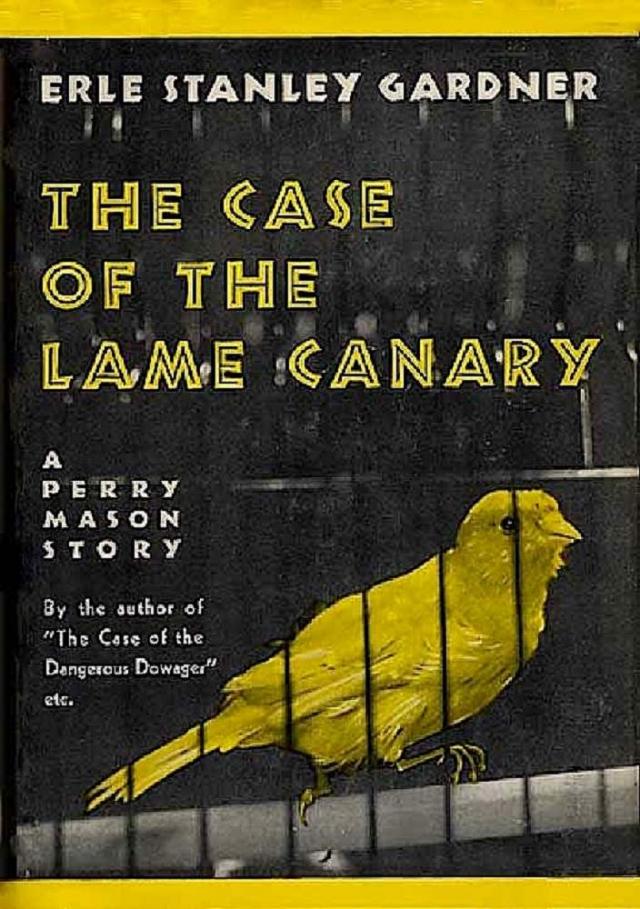
“It is a good canary,” Helmold said. “It is worth a good price. He has a fine voice.”
“He seems to have a sore foot,” the lawyer said.
“Ja. It is nothing. The claws on the right foot have been cut too short. Today he is lame. Tomorrow he is lame. The next day, nothing. And the day after that, you could never tell.”
“How about the left foot?” Mason asked.
“On the left foot the claws are cut nicely, all except one claw, and that claw, it is not cut at all. I do not understand.”
“The claws were cut today?” Mason asked.
"Ja, ja. There are little fine threads of blood on the perch which come from the sore toes of the right foot. It was done today, ja.”
“And the young woman wants to keep him here?”
“Ja."
“For how long?”
The fat proprietor of the pet store shrugged his shoulders and said, “I do not know. She does not tell me that.”
“For a day?” Mason asked.
The eyes grew wide with surprise. “You joke, nicht wahr? A day! What sort of a storage business is that?”
“No,” Mason said, “I want to know. Did she say anything about leaving him here for a day?”
“Ach, no. By the month I quoted her prices, and by the month she paid. Understand, Counselor, not even by the week; by the month.”
Mason slid from the counter. “Okay, Karl,” he said. “I just wanted to check up on it.”
“I thank you for sending her to me,” Helmold said. “Some day perhaps I can do something for you, nicht wahr?”
“Possibly,” Mason said. “What name did she give you?”
“Her name?”
“Yes.”
Helmold stepped into the office, thumbed over some records, came out with a card in his hand and said, “The name is Mildred Owens, and the address is General Delivery, Reno. She moves to Reno, and after a while she sends and gets the bird. But not for more than a month, anyway.”
A slow grin spread over the lawyer’s face.
“That is good news?” Helmold asked anxiously, looking over the top of his glasses.
“Very good news,” Mason said. “You know, Karl, I was commencing to think my hunches weren’t right. Now I feel a lot better. Take care of that canary, Karl.”
“Ja, ja. I take care of him. Would you like to look around and—”
“Not today, Karl. I’ll see you some other time. I’m busy right now.”
Helmold nodded genially, escorted Perry Mason to the door of the pet shop. “Any time I can do something for you, you tell me. It is a pleasure. This—” with a sweep of his hand—“talk of a lame canary, it is nothing. I wish to do something.”
Mason grinned, left the pet-shop proprietor bowing and smiling in the doorway, and sought a barber shop, where he was shaved, massaged and manicured.
Usually, hot towels on his face made him relax into a state where he was neither awake nor asleep, a peculiar, drowsy, half-dreaming condition in which, his imagination stimulated, he could see things with crystal clarity. But this time the hot towels steamed no thoughts into his mind. The canary was lame. One of the claws on the left foot had not been clipped at all. The remaining claws on that foot had been trimmed correctly. But the claws on the right foot had been trimmed too closely. And it was this which made the canary lame. Moreover, Rita Swaine, in taking the bird to the pet store, had been frank enough in referring to Mason as the person who had sent her there, but had given a fictitious name and address.
Why?
Out of the barber chair, Mason adjusted his tie, glanced at his wrist watch, and strolled leisurely back to his office. The street was filled with afternoon shadows and the advance guard of the late afternoon traffic jams.
Rounding the corner in the corridor from the elevator, he saw Della Street standing in the doorway of his private office, beckoning to him frantically, and, as he quickened his stride, she ran swiftly down the flagged floor of the building.
“Listen,” she said, “Paul Drake’s on the private line and he says he must talk with you right away.”
Mason’s long legs added another few inches to his quick stride. “How long ago did he call?”
“He’s on the line, just this minute. I recognized the sound of your steps in the corridor.”
“This his first call?”
“Yes.”
Mason said, “It may be important, Della. Don’t go home until we find out.” He pushed his way into his private office, picked up the receiver of his desk telephone and said in a low voice, “Okay, Paul, what is it?”
The slightly distorted sound of the detective’s voice showed the lawyer that Drake was holding his lips directly against the transmitter.
“Perry,” he said, “was this a run-around?”
“Was what a run-around?”
“About the divorce case.”
“No. What are you talking about?”
“I think,” Drake told him, “you’d better get out here right away.”
“Where’s ‘here’?”