The case of the lame can.., p.4
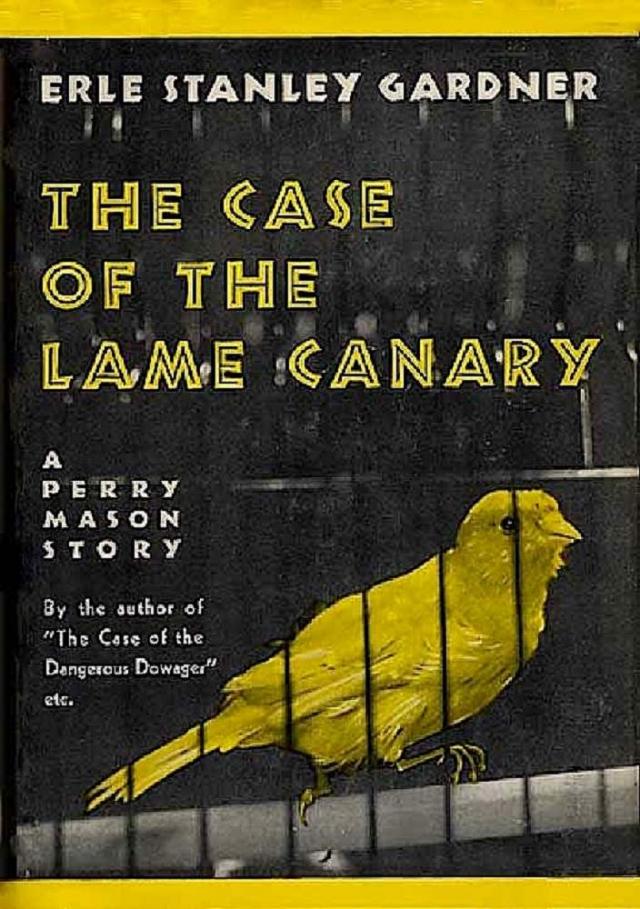
The Case of the Lame Canary (Perry Mason Series Book 11),
p.4


“I’m wondering,” Mason said, “whether you are good at remembering details.”
“I think my powers of observation are quite normal, young man.”
“Could you, for instance, tell me which foot she was clipping when she was so careful to get the light on her work?” Mason asked.
Mrs. Anderson pursed her lips, wrinkled her forehead into a frown, and then said positively, “The right one.”
“You’re certain?”
“Yes, I can see her right now in my mind’s eye, standing there at the window, the canary held in her left hand, his feet up in the air—yes, it was the right foot she was working on.”
“That was after the young man had left?”
“Oh, yes, that was after I’d come back from the Weymans’— Well, now, here’s someone else coming! I wonder what he wants. Land sakes, this has been a day!”
Mason got to his feet and stood by his chair while Mrs.Anderson, with quick, nervous strides, fluttered over toward the door. Sergeant Holcomb had hardly touched the bell button before she opened the door and said, “How do you do? What do you want?”
“You’re Stella Anderson?”
“Yes.”
“I’m Sergeant Holcomb, of the homicide squad. You reported having seen a young man over in the house next door hand a revolver to a woman who concealed it?”
“Why, yes,” she said, “but I don’t know how you found it out. I haven’t told a soul except Mrs. Weyman, and a man who’s calling on me—”
“What man?” Holcomb asked.
“A Mr. Mason.”
Mason heard the pound of Sergeant Holcomb’s feet, then the police sergeant stood scowling at him from the threshold. “So,” he said, “you’re here.”
Mason nodded and said casually, “How are you, Sergeant? Better ditch the cigar. She doesn’t want the curtains to smell of tobacco smoke.”
Sergeant Holcomb made little jabbing motions with the cigar he was holding between the first two fingers of his right hand. “Never mind that,” he said. “How do you fit in on this murder?”
“What murder?” Mason asked, raising his eyebrows.
Sergeant Holcomb said sarcastically, “Oh, sure, you wouldn’t know anything about it, would you?”
“Not a thing,” Mason told him.
“And I presume,” Holcomb said with a sneer, “you just dropped in for a social chat, to ask Mrs. Anderson to go to a movie.”
Mason said with dignity, “As a matter of fact, Sergeant, I called to investigate an automobile accident.”
Holcomb turned toward Stella Anderson and raised inquiring eyes.
Her glittering eyes were fastened in beady indignation on the cigar which Sergeant Holcomb returned to his lips.
“That right?” Sergeant Holcomb mumbled past the moist end of the soggy cigar.
“Yes,” she said, sniffing audibly.
“Okay,” Holcomb said to Perry Mason. “You’ve found out about the automobile accident, and that’s all you’re concerned with. Don’t let me detain you. I have business with Mrs. Anderson.”
Mason, moving toward the door, smiled at Stella Anderson and said, “Thank you so much, Mrs. Anderson. It’s a pleasure to meet a woman who sees and remembers things as clearly as you do. So many witnesses are putty in the hands of an officer who wants them to swear to facts which will support his theory of the case.”
Holcomb cleared his throat ominously, but Perry Mason, smiling at Stella Anderson, slipped out of the door and walked rapidly across to Paul Drake’s car.
The detective was seated behind the steering wheel.
“Find out anything at Weyman’s?” Mason asked, sliding into the seat beside him.
Drake grinned and said, “I got thrown out on my ear.”
“By the homicide squad?” Mason asked.
“No, by an irate husband. He’s crocked to the eyebrows. Some guy’s given him a beautiful licking. His face is patched, bandaged and bruised, and now he’s looking for someone he can lick. The woman is nice. I don’t think she knows very much about what happened, but this Anderson woman gave her an earful about seeing a girl named Swaine and some unidentified man hiding a gun. And Mrs. Weyman got to thinking it over and decided to call the cops.”
Mason stared through the windshield in frowning concentration and said, “I don’t like this thing, Paul. Why should a woman call up the cops just because she’s heard that a next door neighbor and a boy-friend were hiding a gun? And why should the cops come out and start searching the house on a tip like that? Usually, you could phone things like that to headquarters until you were black in the face and get nothing more than a stall out of the desk sergeant.”
Drake motioned toward the house and said, “Well,there’s your answer. Mrs. Weyman got more than a stall out of them.”
“Tell me some more about her,” Mason said.
“She’s in the late thirties, rather slender, and sounds nice. She talks in a quiet, refined way, but there’s a lot of determination about her. Her face shows unhappiness and character. Looking at her, you’d say she’s been through some great tragedy and it had made her—oh, you know, sort of sweet and gentle and patient.”
“Any idea what the tragedy was?” Mason asked.
Drake chuckled and said, “Take a look at her husband when you get a chance.”
“What’s he like, a big bully?”
“No. Medium sized. He’s about her age, but he’s an awful soak, probably all right when he’s sober, but he isn’t sober now. You know the kind I mean, Perry, four drinks and they’re wonderful fellows, five and they’re quarrelsome. And from then on they just get more quarrelsome. Well, I should judge he’s had about fifteen drinks.”
“What did he say to you?” Mason asked.
“He heard me talking, and came stumbling downstairs, busted into the room and made a scene. I could have hung one on his jaw and stuck around. But Mrs. Weyman was so embarrassed to think I’d seen him in that condition she wouldn’t have told me anything more anyway. I’d already got most of it.”
“Had the homicide squad been in there?”
“I don’t think so.”
“What did you tell her?”
“Told her I was investigating an automobile accident, and then asked her what was happening next door.”
“She admitted calling the police?”
“Yeah.”
“But she didn’t say why she’d called them?”
“She said that Mrs. Anderson had told her about seeing a Miss Swaine, and some fellow who was evidently making pretty violent love to her, hiding a gun. And she said they looked guilty. She said that after worrying about it for some time she’d called the police.”
“You didn’t find out any more than that?”
“No, I didn’t, Perry. I was just about that far in the interview when the trouble started, and I figured it was a good plan to get out.”
“Well,” Mason told him, “let’s drive to a phone, put in a call for the office and see what’s new. There’s nothing we can do here while the homicide squad are making nuisances of themselves.”
“Take both cars?” Drake asked.
Perry Mason nodded. “Let’s clear out of the neighborhood,” he said, reaching for the car door. “I’ll meet you in the drug store on the boulevard.”
By the time the lawyer arrived at the drug store, Drake was at the telephone. He scribbled something in his notebook and said, “Okay, hold the line a minute.”
“I have a report on that accident stuff. Do you want it?” he asked Mason.
“Go ahead. Shoot,” the lawyer told him.
“The Trader’s Transfer Company, which owns the van, is a one-man concern. Harry Trader’s the big shot. He was driving the van himself, delivering some stuff to Walter Prescott’s garage. Prescott had given him a key. Trader says he was coming down the Alsace Avenue and was just getting ready to turn into Fourteenth Street when this chap, Packard, driving a light coupe, tried to pass him on the right without sounding the horn. Trader says he had to swing fairly wide to get the big van around the comer, and when he made the turn, the coupe was between the van and the curb, and it was just too bad for the coupe. Packard was unconscious, and Trader delivered him to the Good Samaritan Hospital. He stuck around there until the doctor told him Packard was okay, and could leave under his own power. He had a sock on the side of his head which had put him out. He was punch-groggy for a while after he came to. Trader says it was all Packard’s fault, but he’s fully covered by insurance and isn’t going to worry about it very much. He said he was frightened at first because he thought the man was seriously injured, but that any damn fool who tries to pass a big moving van on the right, without using the horn and without watching the road, is a candidate for the boobyhatch. Trader says that after Packard recovered consciousness at the hospital, he admitted it was all his fault, said he wasn’t watching the street, but was staring at something he’d seen in a window. First thing he knew, he saw this big van on his left, and then he struck it, just as Trader was making a right turn.”
“Something he saw in a window?” Mason asked.
“That’s what Trader reports.”
“Didn’t say what window?”
“Apparently not.”
“Then it must have been either in Prescott’s house or Stella Anderson’s house. Let’s run out to the hospital and see if we can chase down the doctor who treated Packard. I’d like to find out just what Packard said when he admitted liability.”
Drake said, “Okay, Perry,” turned to the telephone and said, “That’s all, Mabel. Stay on the job and take down the dope as it comes in. The homicide squad’s doing things out at Prescott’s house. They’re not passing out any information, but you’ll probably hear details from one of the boys. As soon as you get anything definite, call me at the Good Samaritan Hospital. I’m going out there now. I’ll call you again when I leave. Okay Mabel. G’by.”
Drake hung up the receiver, turned to Mason and said, “Perry, I was just wondering. Do you suppose this Swaine girl would have any reason for wanting her sister out of the way?”
“Forget it,” Mason told him. “If you must pin a murder on someone, hang it on the guy who was in there making love to the sister. Don’t wish it off on one of my clients.”
“Is the Swaine girl your client?” Drake asked as they walked toward the door of the drug store.
Mason said slowly, “Come to think of it, Paul, she isn’t. She’s the one who employed me, but I’m employed to represent the married sister.”
“You mean Mrs. Prescott?”
“Yes.”
Drake said, “Well, I’ll bet you five to one your client’s dead, then, Perry.”
Mason said, “I think I’ll leave my car here, Paul, and ride out with you. That’ll give us a chance to talk. Just how do you figure it’s Mrs. Prescott who’s killed?”
“It’s a cinch,” Drake said. “According to Mrs. Anderson, the murder must have been right around noon, just before that automobile accident. Now, at that time of day, Walter Prescott, as a business man, would be at his office, but Mrs. Prescott would be playing housewife.”
“Prescott may have slept late,” Mason pointed out.
“No. Remember that he got Harry Trader to take some things up to his garage, and gave Trader a key to the garage. That shows that he was not only up this morning, but that he didn’t intend to be home when Trader made the delivery, and Trader was coming to make the delivery just about the time the Swaine girl and her boy-friend were hiding the gun.”
Mason nodded as Drake started the car. “Good reasoning, Drake,” he said.
“It’s a gift,” Drake grinned.
“Then,” Mason told him, “you might try this one: Rita Swaine and her boy-friend are at the back of the house, in the solarium, at the time of the accident. But Packard saw something in a window. He could only have seen the front of the house. Now, then, who else was in that house, and what or whom did Packard see in that window? And remember, Mister Wise-Guy, it must have been something interesting enough to send him crashing into a moving van.”
Drake said ruefully, “You would bring that up. Okay, Perry, your clients have an alibi—if Packard saw what you think he saw in the front of the house—only don’t forget it might not have been any crime at all, perhaps some woman who’d forgotten to pull down the shades—perhaps she’d got blood stains on her clothes when she killed someone, and was—”
Mason laughed. “There you go again! You have a criminal mind, Paul, and you’ll be imagining my clients into the gallows before you’re done. Step on it, and let’s see what that medico says.”
“Don’t try crawfishing,” Drake insisted. “I rather like that blood-stained clothes business myself.”
CHAPTER FIVE
DR. JAMES WALLACE was still on duty at the Good Samaritan Hospital when Mason and Drake arrived. He listened to Mason’s introduction with courteous attention.
“Indeed, yes,” he said, shaking hands, “I remember the patient perfectly. He was received at twelve-ten this afternoon. For the most part, his injuries were cranial and superficial, but there was a most interesting condition which is sometimes encountered in cases of this sort. The man was suffering from traumatic amnesia.”
“Translated into English,” Drake said, “what is traumatic amnesia?”
The doctor favored Drake with a condescending smile and said, “Pardon. I didn’t intend to use technical terminology. Amnesia is a loss of memory. Victims of amnesia know nothing of their past, cannot tell their names; of anything about themselves. And traumatic, of course, implies that the cause of the amnesia was superinduced by injury, that is, an external violence.”
“Let’s see if I understand you, Doctor,” Mason said. “When Packard regained consciousness he had an impaired memory—is that right?”
“That’s right,” Dr. Wallace said in his well modulated, suavely courteous voice. “There were no broken bones. In fact, from what I hear of the accident, I would say he had escaped remarkably well. There were a few ecchymoses, one or two superficial cuts about the face, the possibility of a strained ligament, and, of course, the effect of shock. My treatment of his physical injuries took only a very few minutes.
“According to the statement of the man who brought him here, the collision had been rather severe. The patient had been unconscious when lifted into the truck. He regained consciousness as he was being carried on the stretcher to the surgery, but he had a complete lapse of memory. He couldn’t tell us his name, his occupation, where he came from, whether he was married or single, or anything about himself. We searched his pockets and founds cards which showed that he was Carl Packard, of Altaville, California. I was very careful not to call his attention to these cards, or do anything which might refresh his recollection until after the effect of the shock had worn off somewhat, and I had satisfied myself there were no serious injuries. Then I gave him a brandy, talked with him for a few moments, and then quite casually asked him how things were in Altaville.”
There was a moment of dramatic silence, while Dr. Wallace stood smiling at them, waiting for the effect of his strategy to sink in.
“Had I attached undue importance to the question,” Dr. Wallace went on to explain, “the man would have sensed that I was placing too much emphasis on it, and unconsciously would have known why. Thereupon the temporary paralysis of the memory function would have been aggravated by a process of self-consciousness, just as we sometimes encounter in bad cases of stage-fright. We—”
“Never mind that,” Mason interrupted. “Did. he recover his memory?”
“Yes,” Dr. Wallace said, the tone of his monosyllabic answer a rebuke to the lawyer’s abruptness.
“Did he remember his name?”
“Yes.”
“Did you have to tell him his name or did he remember it of his own accord?”
“He remembered it of his own accord,” Dr. Wallace said with dignity. “If you will permit me to give you a complete report, I think you will get the picture a little more accurately.”
“Go ahead,” Mason said, pulling his cigarette case from his pocket. Drake looked around the room, sighed, dropped into a chair, propped his head back against the wall and closed his eyes.
“When I asked him how things were in Altaville,” Dr. Wallace said, “I took particular pains to make my question casual. His answer was equally casual. I asked him if he knew the President of the First National Bank in Altaville, and he said he did, said he knew him quite well. We chatted along for a moment, and I asked him just where he lived in Altaville. He gave me an address which coincided with that on his driving license. I asked him his name. He told me. By degrees I brought him up to the accident, and then he remembered it perfectly.”
“What did he say about it?”
“Said that he was the one who was at fault. The truck man, Mr. Trader, was very business-like. He said he was insured; that if he were to blame, the insurance company would pay, but he wasn’t at fault. Packard seemed rather sheepish about it. He said he’d seen something in the window of one of the houses on his right, that he’d craned his neck to get a better look and then sensed something closing in on his left. The crash came almost at once, and that’s all he remembers.”
“Did he say what he saw in the window?”
“No, but he seemed a bit—well, embarrassed. I think ‘sheepish’ describes it.”
“Was it a woman?” Drake asked, opening his eyes.
“He didn’t say,” Dr. Wallace remarked with dignity.
“Did Packard say what he planned to do in connection with moving the car?” Mason inquired.
“He said he was going out to take a look at it and see what could be salvaged.”
“Is Packard insured?”
“I gathered that he was not.”
“How long was he here?”
“Perhaps twenty minutes.”