

The case of the lame can.., p.3
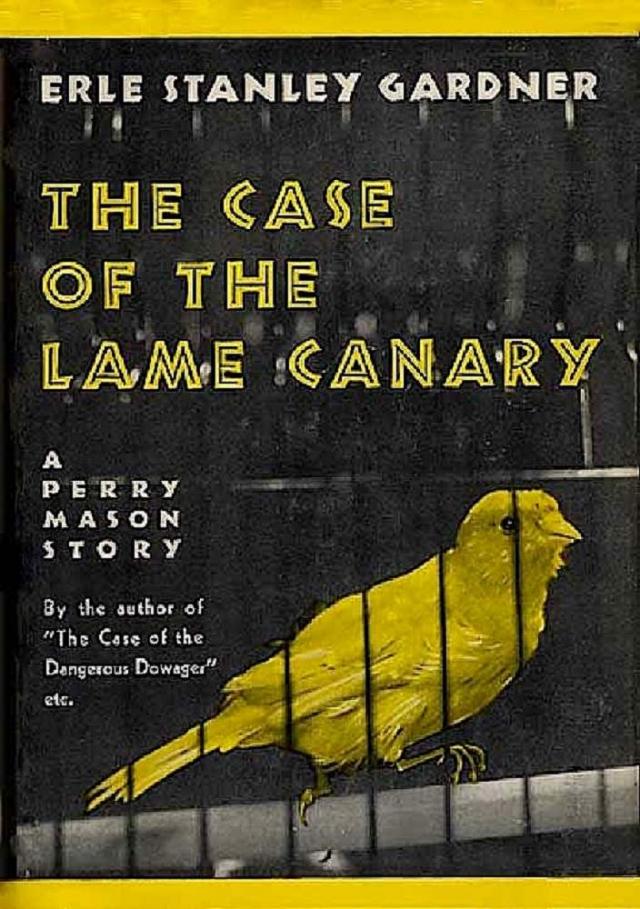
The Case of the Lame Canary (Perry Mason Series Book 11),
p.3


“Out in front of Mrs. Stella Anderson’s place on Alsace Avenue. I’m talking from a drug store a couple of blocks away, but I’ll meet you where my car’s parked.”
“What’s the trouble?” Mason asked, frowning.
Drake lowered his voice and said, “Listen. A couple of men in a prowl car drove up, stopped at the Prescott house, opened the back door with skeleton keys, and went in. About fifteen minutes later, Sergeant Holcomb of the homicide squad came out with lots of sirens and a couple of men, and a few minutes later the coroner showed.”
Mason gave a low whistle. “Did you pick up anything, Paul?”
“Not much, but I understand the tip-off came from a Mrs. Weyman, who lives just west of the Prescott house on Fourteenth Street.”
“How did she get the tip-off?” Mason asked.
“No one knows.”
“And you don’t know who’s the corpse.”
“No.”
“You,” Mason told him, “wait for me in front of Stella Anderson’s place. I’m coming out. And let me give you a tip, Paul—don’t ever underestimate a hunch on a lame canary.”
CHAPTER FOUR
DRAKE’S AUTOMOBILE was parked near a neat, but somewhat dingy-looking house, just to the north of a big two-storied residence in front of which half a dozen cars were clustered.
Mason slid his car to a stop in behind Drake’s machine. The detective joined him on the sidewalk. “They know you’re here, Paul?”
“Not yet. They haven’t spotted me.”
“Have they started asking questions of the neighbors?”
“Not yet. They’re fooling around inside the house.”
“Newspaper men?”
“Yes, a couple of those cars are Press. I got the lowdown on the Weyman tip-off from one of them.”
“Okay,” Mason said, “we haven’t much time. Let’s go. You make a stab at Mrs. Weyman, pretend you’re selling washing machines, life insurance, or investigating the auto accident. I’ll take Mrs. Snoops. Join me here. Make it snappy.”
Drake nodded, swung around the corner. Mason walked up a narrow cement walk, climbed the echoing steps of a wooden porch, and pressed his thumb against the bell button. He had rung the third time when the door was thrown open and an angular woman, whose long, bony nose fenced apart restless, glittering eyes, asked impatiently, “What do you want?”
“I’m investigating an automobile accident which took place out here—”
“Come in,” she said. “Come right in. Are you a detective?”
Mason shook his head.
For a moment there was a flicker of disappointment on her face, but she led the way into an old-fashioned living room where chairs with crocheted doilies for head and arm rests were arranged in a stiffly conventional design.
“Sit down,” she invited. “—Land sakes, I’m so excited I’m all of a tremble, what with that automobile accident this morning, and then what they’ve found over in the Prescott house. I just can’t seem to calm myself down.”
Mason seated himself, stretched his neck to peer out of the window. “What have they found in the Prescott house?” he asked.
“I don’t know,” she said, “but I think it’s a murder. And I don’t know whether I did right in not telling the officers what I saw. I suppose they’ll come over and question me, won’t they?”
Mason smiled and said, “What did you see, Mrs. Anderson?”
“Well,” she said, sitting very stiffly erect, “I saw plenty. I just said to myself, says I to myself, says I, ‘There’s something going on over in that house, and you, Stella Anderson, had better call the officers.’ ”
“But you didn’t do it?”
“Not about that. I called them about the automobile accident.”
“And you didn’t tell them about what you’d seen in the house?”
She shook her head, compressed her thin lips and said in a tone of righteous indignation, “They didn’t ask me. They didn’t even come near the house. I never had a chance to tell them, and it serves them right!”
“What!” Mason exclaimed. “They didn’t even come to talk with you after you’d put in the call for them?”
“That’s right. They came and looked over that coupe, and took down the license number and copied the registration certificate, then they talked with the young man who came out of Walter Prescott’s house, and then got in their car and drove away. They never once came near my place, not once!”
“And you’d seen something you could have told them about?” Mason asked.
“I’ll say I could.”
Mason, sizing her up with his steady, patient eyes, crossed one leg over the other, settled back in the chair and said casually, “Oh, well, if it had been important they’d have asked you about it.”
She teetered back and forth on the edge of her chair, her bony back rigid with indignation. “What’s that?” she snapped.
Mason said, “They probably had all the information about the automobile accident they needed.”
“Well,” she said, bristling, “it just happens this wasn’t about the automobile accident. Don’t you go jumping at conclusions, young man.”
Mason raised his eyebrows. “What was it?”
“No,” she said, “it doesn’t concern you. You’re investigating the automobile accident. What do you want to know about it?”
“Everything you know about it,” Mason said.
“Well,” she said, “I was here in my house at the time.”
“Did you actually see the accident?”
Her face showed disappointment. “I heard the sound of sliding tires and ran to the window just about the time of the crash. The cars were locked together and skidding. Then they struck the curb with an awful crash. The man who was driving the van jumped down and tried to get the door of the coupe open, but he couldn’t do it. Then he ran around to the other side of the coupe, and by that time the man had run out of the Prescott house. He helped—”
“What man?” Mason interrupted her.
“A man I’d seen over there earlier.”
Mason raised his eyes and said, “Oh, you had seen him, then.”
“Of course I’d seen him.”
“You didn’t say so.”
“Well, you didn’t give me a chance.”
“I thought,” Mason remarked, “that I’d asked you about what you saw in the house and you told me it was none of my business—Do you mind if I smoke?”
“I didn’t say it was none of your business,” she said, “and I’d very much prefer you didn’t smoke. The odor of tobacco gets in the curtains and stays there.”
Mason nodded. “Where were you when you first heard the sound of sliding tires?”
“I was in the dining room,” she said.
Mason nodded to an open archway and said, “That’s the room?”
“Yes.”
“Would you,” Mason asked, “mind showing me exactly where you were standing?”
She got to her feet with effortless agility and without bending her back. Without a word, she strode through the doorway into the dining room.
“Stand just as you were standing when you heard the sound of the tires,” Mason said.
She turned and stared out through the south window. Mason stepped over and stood at her side. “That’s the Prescott house over there?” he asked.
“Yes.”
“You’re rather close to it, aren’t you?”
“Yes.”
“What’s the room directly opposite?”
“That’s the solarium.”
“And you were standing here when you heard the sound of the tires?”
“Yes.”
“In just about this position?”
“Yes.”
“And what did you do?”
“I ran through that door, across the parlor, pulled back the curtains and looked out.”
“Just in time to see the van push the coupe into the curb?”
“Yes.”
“Do you,” Mason asked, “know who was to blame?”
“No. I didn’t see enough of it. And, even if I had, I might not be able to tell much. I never did learn to drive a car. Now, let’s go back in the other room. There’s something I’m interested in, and—”
“What did you do after the accident?”
“Well, I went to my telephone and notified the police there’d been an accident and a man was hurt. After a few minutes, a police car came around that corner. The young man who had helped load the driver of the coupe in the truck was just leaving the Prescott house. The men from the police car asked him questions and made him show them his driving license—”
She broke off as a car drove by on Alsace Avenue. She followed it with her eyes until it slowed and rounded the corner on Fourteenth Street.
“That’s seven cars,” she said, “that have come there in the last half hour. Now, who do you suppose that could be?”
“I’m sure I don’t know,” Mason told her.
“Well, one of the cars had ‘Homicide Squad’ painted on the side. You could hear the siren coming a mile away.”
Mason said, “Perhaps the man who was hurt in the automobile accident died.”
“Don’t be silly,” she snapped. “The man who was hurt went to a hospital. Traffic accidents aren’t homicides. This was the homicide squad.”
“Are you,” Mason asked, “absolutely certain that the young man ran out of the Prescott house?”
“Of course I’m certain.”
“Isn’t it possible he’d been sitting in a car parked around the corner? I see that the Prescott house is right on the corner of Fourteenth Street and—”
“Certainly not,” she interrupted. “That’s absurd! I guess I know when a man comes out of a house. What’s more, I saw him in the house before that accident.”
Mason raised inquiring eyebrows. “Whatever happened in the Prescott house couldn’t have any bearing on the automobile accident. I’m afraid you’ve exaggerated some trivial neighborhood happening—”
“Fiddlesticks!” she interrupted. “Now you look here, young man—What’s your name?”
“Mason.”
“All right, Mr. Mason, you look here. I know when something’s important and when it isn’t. Now you let me tell you just what I saw over there, and you’ll realize that it is important and what a mistake those radio officers made not coming over to talk with me in the first place.
“Now, I was standing in front of that window in my dining room, looking out. I wasn’t looking at anything in particular, but you can see how things are. A body can’t help but see things that go on in the solarium over in the Prescott house unless the shades are drawn. And Mrs. Prescott never draws the shades. Land sakes, the things I’ve seen—Well, this young man was in there with Mrs. Prescott’s sister. She was alone in that house with this young man.”
“He probably just dropped in to pass the time of day,” Mason said.
Her sniff was eloquent. “The time of day,” she exclaimed scornfully. “Well, he’d been there exactly forty-two minutes before the accident, and if you’d seen what I saw when Rita Swaine let go of that canary you’d change your tune a bit.”
“What,” Mason asked, striving to keep the interest from his voice, “caused her to let go of the canary?”
“She was standing there,” Mrs. Anderson said, “right in front of that window. The shades were up and she must have known I could see her from my dining room if I’d happened to be looking out of the window—not that I make a practice of looking into people’s houses, because I don’t. I haven’t any desire to go sticking my nose into other people’s business. But if a young woman leaves the shades up and engages in passionate lovemaking right in front of my eyes, she’s got no complaint if I look. Land sakes! I’m not going to keep my shades down just because the neighbors haven’t any modesty. These modern women don’t know the meaning of the word. When I was a girl—”
“So the young man was making love to her, was he?” Mason prompted.
“Well,” she said, drawing herself up primly, “in my time that wasn’t what we’d have called it. Love, huh! I never saw two people carry on so in my life.”
“But aren’t you mistaken about the canary?” Mason asked.
“Certainly I’m not mistaken about him. Rita Swaine was holding that canary in her hand. She’d just started to clip his claws when this young man grabbed her in his arms. And the shameless way in which she twined herself around him made me blush for her. I never did see such carryings-on. She certainly never learned embraces like that in any young woman’s finishing school. She just—”
“And what happened to the canary?”
“The canary was flying all around the place, frightened, and fluttering up against the windows.”
“And the man had been there for some time then?”
“Yes. And he let her go and she was all flustered and nervous. She tried to catch the canary, and couldn’t. The young man slipped out into the adjoining room. And then I heard the accident.”
“So then you left the dining room window and ran to the front window, is that right?”
“Yes.”
“And then what happened?”
She lowered her voice and said, “After this young man had gone back into the Prescott house, I went back to the dining room window. I couldn’t help wondering what he and Mrs. Prescott—”
“Oh, was Mrs. Prescott there?”
“No, she wasn’t,” Stella Anderson said. “That was my mistake. I’d thought for a minute it was Mrs. Prescott, though. You see, Rita Swaine was wearing one of Rosalind Prescott’s dresses. It’s a print house dress that I know just as well as I know my own clothes, because I’ve seen it so often. She and her sister aren’t twins, but they’re as alike as two peas from the same pod. And, at the time, seeing that dress and not being able to see her face clearly, I thought it was Mrs. Prescott. And thinking what a pretty kettle of fish it would make if this young man had been that way with a married woman—Well, I’m glad he wasn’t!”
“Perhaps it was Mrs. Prescott,” Mason said.
“No, it wasn’t. Afterwards I got a good look at her face.”
“And it wasn’t Mrs. Prescott?” Mason asked.
“No,” she said in a voice which showed her disappointment, “it wasn’t.”
“You’re certain?”
“Of course I’m certain. I’m just as certain as I am that I’m sitting here right this minute.”
“You’re talking now about something which took place after the accident?”
“You mean when I found out for certain it was the unmarried sister?”
“Yes.”
“Well, by that time this young man had gone back into the Prescott house. He seemed frightened about something, and that’s when he gave Rita Swaine the gun.”
“A gun?”
“Yes—Oh, I wasn’t going to tell you about that. Perhaps I shouldn’t. You—”
“What kind of gun?”
“It was a blued-steel revolver. He took it from his hip pocket and gave it to Rita and she pulled out a drawer in that big desk near the corner of the solarium, and pushed the gun in back of the drawer and then closed the drawer.”
“Then what happened?” Mason asked.
“Well,” she said, “I’d already telephoned to the officers that there’d been an accident and that a man was hurt. I figured I could tell them about the gun when they came over here to question me. And then they didn’t come.”
“Was the man still in the coupe when you telephoned?”
“No. He’d been taken to the hospital.”
“How long would you say it was after you telephoned that the officers came?”
“I don’t think it could have been over five minutes. It might have been seven or eight minutes, but I think it was around five.”
“And what did they do?”
“They looked the coupe over and took down the license numbers, and then this young man was just coming out of the house, and they took his name and address and looked at his driver’s license, and then dismissed him, and then they got in their car and drove away without once coming over here. I can’t understand it. I was the person that had called them. They didn’t ask me what I knew about it.”
“But, of course,” Mason said, “you didn’t see the accident.”
“Well,” she said, “I saw plenty of it. And, again, how did they know that? I might have seen the whole thing for all they knew. I might have been standing right there in the window.”
“Yes,” Mason said thoughtfully, “that’s so. Whom have you told about this?”
“No one,” she said, “except Mrs. Weyman.”
“Mrs. Weyman?”
She nodded and said, “Yes, that’s the next door neighbor over on Fourteenth Street. They’ve been there for six months now. Our back doors are just a few steps from each other. I told her about it right after the accident, within less than an hour. She’s a wonderfully fine woman. It’s certainly too bad about her husband.”
“What’s wrong with her husband?” the lawyer inquired.
“Drink!” she sniffed. “When he’s sober he’s all right, but when he’s drunk he starts looking for trouble. He’s always beating someone up or getting beat up. Land sakes, he came in while I was there telling about it. He was reeking of whiskey, staggering all over the place, and he’d been in an awful fight. Well, perhaps that’ll be a lesson to him. He got the worst of this one.”
“Did he admit it?” Mason asked, smiling.
“He didn’t have to admit it. He’d had a bloody nose and a cut cheek and a couple of black eyes. It was bad enough so he’d had to go to a doctor and have his face bandaged. A pretty how-d’y-do when a man can leave a sweet, refined little woman like Mrs. Weyman sitting home crying her eyes out, while he makes a sodden nuisance of himself.”
Mason nodded sympathetically.
“Getting back to what happened over in the Prescott house,” he glanced casually out of the window and observed the square-shouldered, short-necked individual who was plodding his purposeful way toward the Anderson residence, “you say you had a good look at Rita Swaine—that is, you saw her clearly enough so you couldn’t be mistaken?”
“Of course I did. Later on she caught the canary and came and stood right at the window. She seemed to want to get a lot of light on what she was doing. My Heavens, you’d think she’d been a surgeon doing a brain operation, the fuss she made over that bird’s claws!”















