The case of the lame can.., p.5
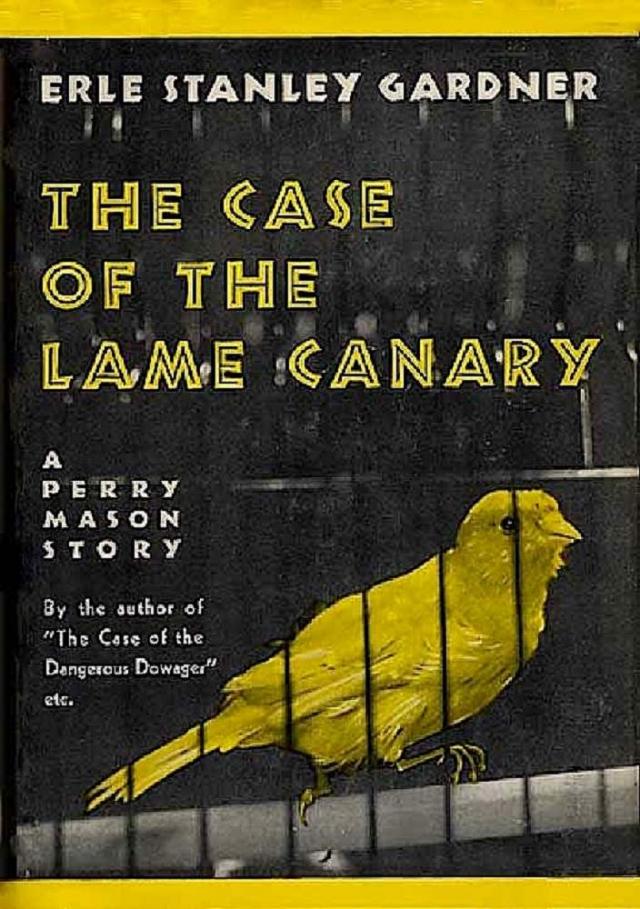
The Case of the Lame Canary (Perry Mason Series Book 11),
p.5


“When he left, he was all right, was he?”
“Oh, quite all right—that is, except for these superficial cuts and bruises.”
“Did you,” Mason asked, “get Packard’s address?”
“Oh, yes. Just a moment and I’ll get it.”
Dr. Wallace consulted his file of card records, selected one, and read off an address, “1836 Robinson Avenue, Altaville, California.”
“That’s evidently his permanent address,” Mason said. “Did you find where he was staying here in the city?”
“No, I didn’t. I gathered that he was just passing through.”
“Did you gather that impression from a direct statement made by him, or simply because of what you—”
“Certainly not,” Dr. Wallace said, with dignity. “In my profession one does not rely upon inference except when it is absolutely necessary. I asked him when he had arrived here, and he said he had reached here this morning. That he had expected to be in San Diego by night.”
“You didn’t ask him where he’d stayed last night?”
“No, I didn’t. I failed to see that that would assist me in any way in reaching a diagnosis, or prescribing a treatment. You must remember, gentlemen, that my interest in the matter is purely from a medical standpoint. Incidentally, I may say that it was a matter which called for rather delicate handling. To have impressed upon Packard that he was a victim of amnesia would have caused a sudden fright which would have been a cumulative shock, superimposed, as it would have been, upon the shock incident to the accident. You see, gentlemen, in a motor accident, there is not only the shock resulting from the injuries, but there is that momentary realization of impending disaster which comes a fraction of a second before the actual impact.”
Mason nodded and said, “I understand. You haven’t any more information which might be of value to me, have you?”
“None whatever,” Dr. Wallace said, “other than that I may repeat, the man’s injuries were not serious. Doubtless you are representing an insurance company which—”
“No,” Mason said, “I’m not representing the insurance company. I’m interested, that’s all. You have Harry Trader’s address?”
“Yes. The Trader’s Transfer Company, 1819 Center Street.”
Mason said, “Thank you, Doctor. Come on, Paul, let’s go.”
Dr. Wallace followed them into the corridor, his manner suave, dignified and professional. “Good afternoon, gentlemen,” he said.
As they left the hospital and crossed to the automobile, Drake said, in his slow drawl, “Where does that leave you, Perry?”
Mason said, “I don’t know. I can’t tell very much about it until after I find out what’s happened at the Prescott residence. Right now I’m working pretty much in the dark.”
Drake said, “Well, I’ll call the office and get another earful.”
“I’ll wait here in the car,” Mason said. “Tell your girl to run in to my office and tell Della to wait for me.”
For some five minutes Mason reclined against the cushions of Drake’s car, smoking thoughtfully, then he raised expectant eyes as Drake came running down the white stone steps of the big building. “Anything new?” he asked, as Drake opened the door of the car.
“I’ll say! Plenty of news. The homicide squad was playing around the Prescott house because Walter Prescott was found dead in an upstairs bedroom. He was fully clothed for the street, and somebody had plugged him right through the brisket with a .38 caliber revolver. Three shots were fired. All of them took effect. One of them went through the heart. The shots must have been fired at close range, because there were powder bums on the clothing and skin. The cops searched the drawer in the desk where Mrs. Anderson had seen the Swaine girl planting the gun. They didn’t find any gun in the drawer, but back of the drawer, where it had been shoved down into a little recess in the desk, they found a .38 caliber Smith & Wesson revolver, with three empty cartridges in the cylinder, and three loaded shells. The smell of the gun shows it had been recently fired.”
“How about the Swaine girl?” Mason asked. “What are they doing about her?”
“They’re looking for her. She left the house around two-thirty, carrying a suitcase and a caged canary. Police figure she intended to skip the country and didn’t want to leave the canary in the house to starve.”
“In that event,” Mason pointed out, “she must have felt certain her sister, Rosalind Prescott, wasn’t going to return.”
“The police are looking for the sister, too.”
“Any luck?”
“None so far.”
“They’ve identified the man who was at the house?”
“Yes. A chap by the name of Driscoll. They’re looking for him.”
“Find him?”
“I don’t think so. Not yet.”
“Put a couple of men on the job digging out all the information you can about Driscoll,” Mason ordered.
Drake’s carp-like mouth twisted into a slow grin. “I saved a nickel on that one,” he said.
“What do you mean?”
“I started a couple of operatives on him as soon as I had the name over the telephone, so I won’t have to call back.”
Mason nodded and said, “Get in, Paul. We’re going to hunt up Harry Trader. We’ll try his place of business first. He may be there.”
Harry Trader, a barrel-chested individual, with the odor of stale perspiration and tobacco clinging to him, was still in his office, making out some reports. He surveyed his two visitors with cold, gray eyes.
“Just where do you two guys fit into this picture?” he asked.
“We’re making an investigation,” Mason told him.
Trader slipped a plug of tobacco from the pocket of his stained overalls, cut off a slice and inserted it in his mouth. With calm deliberation, he replaced the tobacco, shut the knife, and shoved it down deep in his pocket. “Yeah,” he said. “When a guy starts asking questions, he’s making an investigation. That don’t mean anything. Are you representing Packard?”
“No, I’m not,” Mason said. “I’m investigating another angle of the case.”
“Which angle?”
Mason said, “An angle which is quite incidental.”
Trader rolled the piece of tobacco about in his mouth through tightly clenched lips, and said, “Uh huh. Thanks for tellin’ me.”
“Did you take Packard to the hospital?” Mason asked.
“Yes.”
“Did you take him out of the hospital?”
“No. I had a delivery to make. I turned him over to the doctor.”
“You don’t know when he left?”
“No.”
“You don’t know how seriously he was hurt?”
“Sure. He was just banged up a bit. I stuck around until I was sure there was nothing wrong with him.”
“Was he suffering from amnesia—loss of memory?”
“He was punch-groggy, if that’s what you mean.”
“How did the accident happen?” Mason asked.
Trader adjusted the piece of tobacco between his molars, chewed with a barely perceptible motion, his facial muscles bunching into little knots as his jaws clamped shut. His eyes were cold and uncordial. On the wall, a clock clacked off the seconds.
“You’re not going to answer that question?” Mason asked.
“You said it, buddy. I’ve made my report to my insurance company. Go talk with them if you want to.”
“Just who is your insurance company?” Mason asked.
“That’s something else again,” Trader told him,
“Look here,” Mason said, “for reasons which are none of your damned business, I’m trying to get this thing cleaned up in a way which will be satisfactory to all concerned. You haven’t anything to lose by co-operating with me.”
“You go see my insurance company,” Trader said.
“But we don’t know who your insurance company is,” Drake pointed out.
“That’s right, buddy,” Trader said, “you don’t.”
“You were making a delivery out near the scene of the accident?” Mason inquired.
“Yes.”
“To Prescott’s house?”
“I don’t see as it makes any difference,” Trader said.
“It makes a difference as to whether you were really making a turn down Fourteenth Street,” Mason pointed out.
“Yes,” Trader said, “it was to Prescott’s place. I had some stuff to put in his garage.”
“And as soon as the accident occurred, you and some other man lifted Packard from the car and put him in your truck. You took him directly to the hospital, is that right?”
“That’s right.”
“Who was this other man?”
“I don’t know. Some guy that came out of the house.”
“What house?”
“Prescott’s house.”
“Do you know Prescott?”
“Yes.”
“Know him well?”
“I’ve done some business for him.”
“Know who this man was?”
“I’ve never seen him before.”
“Would you know him if you saw him again?”
“Of course I would.”
“And, when you found out Packard wasn’t seriously injured, you left the hospital, returned to the scene of the accident and made your delivery to Prescott’s house—is that right?”
“That’s right.”
“Was anyone home in Prescott’s house?”
“I don’t know. My instructions were to put the stuff in the garage, and I put it in the garage.”
“Who gave you those instructions?”
“Prescott. He gave me a key to the garage.”
“When?”
“Ask Prescott.”
“What were the articles?”
“Ask Prescott.”
“When you made the delivery, the wrecked coupe was still in front of the house?”
“Yes.”
“Did Packard make any statement to you about where he was staying in town, what his business was, or what his plans were?”
Trader clamped his lips together again, and after a moment puckered up the corners enough to send out a thin stream of yellow liquid into the cuspidor which stood by his table.
“Not answering that question?” Mason asked.
Trader shook his head. “He admitted it was his fault,” he said at length. “That’s all I’m telling you guys about the talk I had with him.”
Mason said, “Look here, Trader, you’re not helping us very much. I’m not trying to drum up a damage suit. I’m trying to get information, and it isn’t going to hurt you any to give us that information.”
“I’ve done all the talking I’m going to,” Trader said.
Mason motioned to Paul Drake. “Come on, Paul,” he said, “let’s go.”
“Where to now?” the detective asked, as they crossed the curb to his car.
“Take me out to my car,” Mason said. “I’ll drive it back to the office. In the meantime, you start men finding this chap, Carl Packard.”
“How bad do you want him?” the detective asked.
“So bad it hurts, Paul. On all the other stuff we’re tagging along behind. On this one thing, we’re ahead of the police, or will be, if we can find Packard. What he saw in that window may save the life of an innocent man or woman.”
“Or,” Drake said dryly, switching on the headlights and starting the motor, “may hang a murder around the neck of your client. Have you thought of that, Perry?”
“No,” the lawyer said, his face grim, “and what’s more, I won’t let myself think of it.”
CHAPTER SIX
MASON fitted a latchkey to the exit door of his private office and entered, to find Della Street seated at her secretarial desk, telephoning. She said into the transmitter, “Okay, I’ll tell him. He’s coming in the door now,” hung up, smiled and said to Mason, “Well, your lame canary seems to have brought you a mystery after all.”
“I’ll say. Who was on the line?”
“Drake’s secretary. She said to tell you operatives hadn’t been able to contact Jimmy Driscoll, Rita Swaine, or Rosalind Prescott. And, of course, the police are looking for all three, so they must have skipped out.”
“All right,” Mason said, “what did she tell you about the murder?”
“Nothing new. Prescott was found in the upstairs bedroom, shot three times with a .38 caliber revolver. The revolver the police found, where Rita Swaine had hidden it, was also a .38. Drake’s men haven’t been able to find out whether the rifling marks on the bullets are identical. The probabilities are the police haven’t the information themselves yet. Tell me, Chief, if Rita had been mixed up in the killing, why didn’t she say so frankly when she came in here? She must have known it would all come out. Having you working in the dark didn’t help her any.”
Mason crossed the room, sat on the corner of his desk and lit a cigarette. “Do you know what Paul Drake’s men have discovered, Della?”
She nodded. “I was talking with Mabel Foss a few minutes ago. She gave me the latest.”
“Then you’ve probably noticed that the only evidence which connects Rita Swaine with the actual murder is the testimony of Stella Anderson.”
“Otherwise known as ‘Mrs. Snoops,’ ” Della Street commented. “What about her?”
“It isn’t about her,” Mason said slowly, “it’s about the evidence, Della. She says that Rita Swaine was clipping the canary’s claws, that there was a passionate love scene between her and .Jimmy Driscoll, that the canary escaped. And about that time there was this automobile accident. Jimmy ran out and helped load the victim into the van which took him to the hospital. Then Jimmy came back and gave Rita a gun which Rita hid. Then, as he was leaving the house, Jimmy ran right smack into the arms of the officers. Thereafter an interval elapsed during which the witness couldn’t see what was going on in the house. Later on she saw Rita return, catch the canary, and finish trimming its claws. Now then, notice that, on this occasion Rita apparently needed plenty of light to determine what she was doing. Before, she’d been able to clip the canary’s claws standing near the middle of the solarium, and without bothering to move the lace curtains. But when she finished the job, she found it necessary not only to come to the window, but to push aside the curtain and stand directly against the window, clipping the claws on the canary’s right foot.”
“But,” Della Street said, frowning, “isn’t that the foot that’s clipped too closely?”
Mason nodded.
“Well,” she said, “go ahead, Chief, tell me the rest of it.”
“At the time,” Mason went on, “Rita was wearing one of Rosalind’s dresses. Does that mean anything to you?”
Della Street shook her head, “Not a dam thing, Chief, except that I always felt I was short-changed by not having any sisters. Two sisters who are the same height and build can—Hey, wait a minute! You don’t mean—” Her voice trailed away into silence as she stared at the lawyer with wide-open, startled eyes.
“That’s exactly what I mean,” Mason said, “Mrs. Snoops was standing in her window, looking in the solarium. She saw the frenzied love scene, and she saw Jimmy Driscoll hand Rosalind Prescott the gun. At the time, Rosalind and Jimmy were too engrossed in what they were doing to pay very much attention to their surroundings. Later on, Rosalind saw Mrs. Snoops standing outlined against the window, and realized she’d seen everything.
“Now, let’s analyze that situation a bit: Rosalind was standing in the solarium in front of the desk, which is some eight or ten feet back from the windows. The windows are covered with thin lace curtains. It’s possible to see through those curtains and into the solarium, but not too distinctly. On the other hand, Rosalind, standing there near the center of the room, looking out through those curtains, and across to the Anderson house could very plainly see the angular form of Stella Anderson standing at the window, very apparently an interested observer of what had been taking place.”
“Then,” Della Street said positively, “it was Rosalind Prescott Jimmy made love to and not Rita Swaine.”
Mason said cautiously, “It looks like it.”
“And was Rita in the house at the time?”
“Probably not,” Mason said. “Remember that later on, when Rita appeared at the window with the canary, she was wearing one of Rosalind’s dresses. It was a print dress with a distinctive flower design, striking enough in pattern and vivid enough in color so Stella Anderson could easily recognize it. She was more certain of the identity of the dress than of the person wearing it when she’d seen it earlier.
“Now then, let’s suppose that sometime around noon Rita Swaine was summoned to the telephone, and heard the frantic voice of her sister saying, ‘Listen, Rita, I’m in an awful jam. Jimmy Driscoll was over here and we just couldn’t keep apart. He took me in his arms and I forgot everything and clung to him. Then I looked up, and who should we see watching us but old Mrs. Snoops. Now, you know what that means. Walter’s going to sue me for divorce, and drag Jimmy into it if he can. We just can’t let Mrs. Snoops testify that Jimmy was in the house, making love to me, while Walter was at the office.’
“Then it’s possible Rita said, ‘Well, lie out of it. Pretend that Jimmy’s your brother. After all, she doesn’t know who Jimmy is,’ and Rosalind said, ‘We can’t do that because there was an automobile accident, and when Jimmy went to leave the house, the officers took his name and address from his driving license, so we’re up against it. Now listen, Rita, I was clipping the canary’s claws at the time. The canary got away and is still flying around the solarium. .Jimmy has left, and I’m going to Reno. Now suppose you come over and put on that print dress of mine, which is the one I was wearing, catch the canary, go back over and stand in front of the window, as though you’d come back to finish clipping his claws. Make certain Mrs. Snoops sees you. When you see her looking, pull the curtain aside so she can get a good look. Then she’ll see that it’s you instead of me. That’ll make her think it was you all along. Then you can announce to some of your intimate friends that Jimmy’s madly in love with you, but you don’t want me to know it right at present. Do it in such a way it gets back to Mrs. Snoops.’ ”